Category Archives: Uncategorized

Bayeux Tapestry – Panel 43

Time and Space – 1066 AD, England

Normans vs. Anglo-Saxons

Casus belli: Duke William has been betrayed by King Harold, and must now seize his “rightful” throne

The Normans Arriving at Pevensey Bay — The Bayeux Tapestry. approx: 1070-1080. The Bayeux, Normandy. “The Bayeux Tapestry scene39.jpeg” Wikimedia Commons. Accessed 11/25/2018.

This scene from the Bayeux Tapestry shows William’s men sailing across the English channel and arriving on the shores of Pevensey Bay. The arrival took place on September 28. Normally, local watchmen would be keeping watch over the seas, detecting invaders, if any. Fortunately for the Normans, however, was that members of the “fyrd,” (farmers by trade, though part of Harold’s militia) had abandoned their posts to tend to their harvests, as it was September. Thus, William and his men were able to land relatively easily. Though not spotted by watchmen, the men did not arrive entirely undetected: local landowners witnessed the arrival and their reports reached Harold three days later (Rud 67-68).

The ships on the left of the image are shown traveling across the channel. Evident by the straining sails in the artwork, the wind was at the backs of the Normans. Though perhaps not as glorious as the tapestry depicts, there was almost certainly strong wind on the waters. The English channel is notoriously unpredictable between states of strong wind and silent calm. These same winds also chased away King Harold’s navy from the location. Where the Normans should have met resistance from the navy, they found empty waters, as Harold’s ships were being repaired of damages sustained in tumultuous waters (Rud 66-67).

The ships on the right of the image are used to depict the actual landing of the Normans. The main boat is in the process of being received on the shore: men are lowering the masts and the onboard horses are leaping into the shallow water. The boats furthest right have been emptied and lay decommissioned on the shore (Rud 67). In the entry for the year 1066 in the Anglo-Saxon Chronicle, it reads:

Then came William duke of Normandy into Pevensey… This was then made known to King Harold, and he then gathered a great force, and came to meet him at the estuary of Appledore; and William came against him unawares before his people were assembled. But the king nevertheless strenuously fought against him with those men who would follow him; and there was great slaughter made on either hand. There was slain King Harold and Leofwine the earl… and the Frenchman had possession of the place of carnage, all as God granted them for the people’s sins. (Anglo-Saxon Chronicle D – Worcester)

While this entry describes scenes not included in my panel, it confirms that Duke William was able to land in England with some element of surprise. Had the previously mentioned fyrds been attentive to their posts, perhaps William’s arrival would have been met with resistance and therefore changed the course of the invasion.

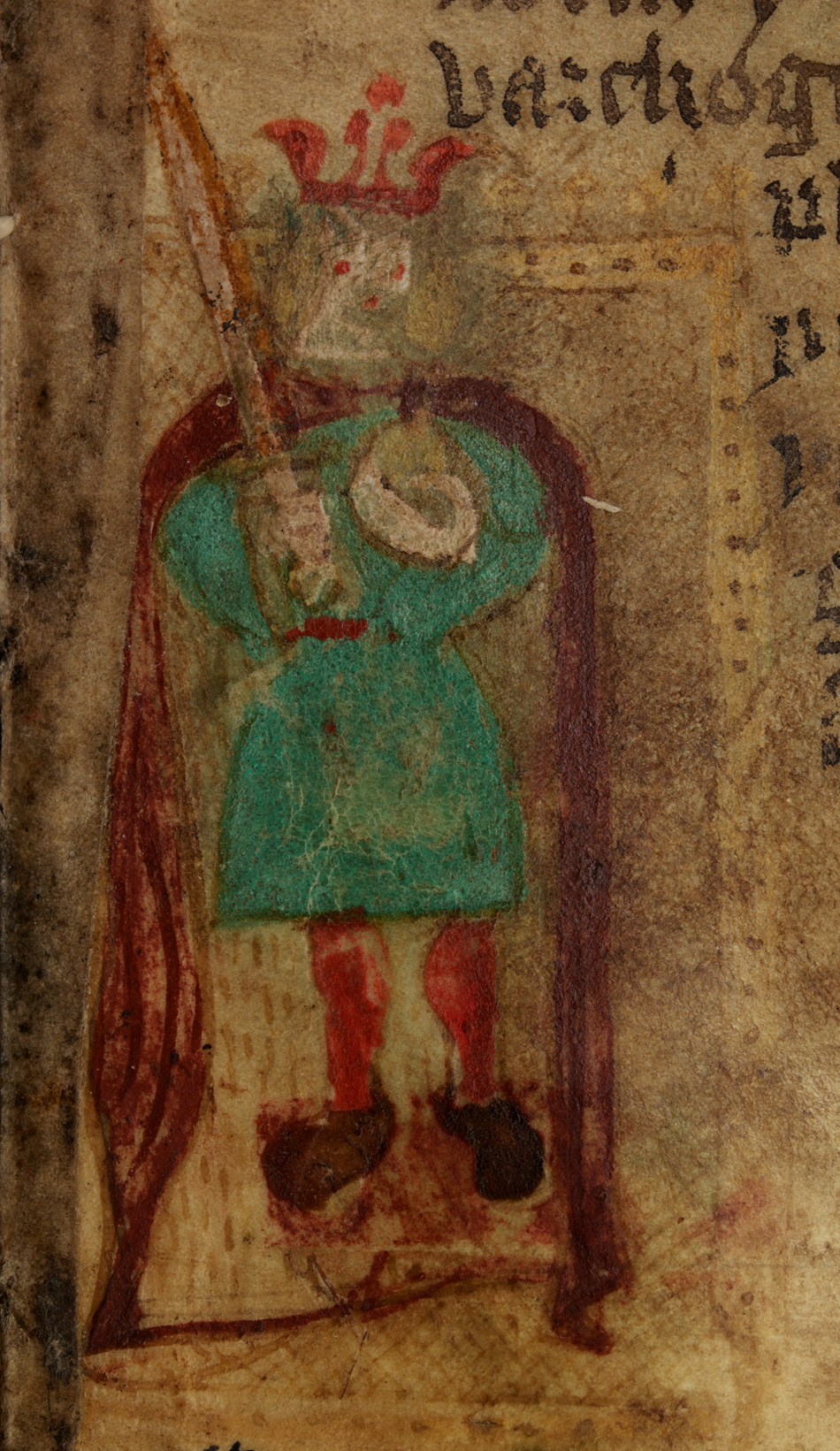
Page from the Worcester Chronicle (Anglo-Saxon Chronicles D) —- The Introduction To The Annals, In The Worcester Anglo-Saxon Chronicle. British Library, http://www.bl.uk/onlinegallery/onlineex/illmanus/cottmanucoll/t/largeimage75452.html. Accessed 11/25/18.

When using this artwork as a historic source, it is important to take into account the perspective of the creators. Even without knowing who embroidered the linen, one could tell that it tells a story of William gloriously conquering his rightful throne and removing the dishonorable Harold. That alone would reveal bias for William’s actions. The nature of the embroidery itself invites multiple interpretations of the scenes depicted. In fact, the Latin text here and there on the artwork are the only forms of narrative offered (Milbrandt, Bonds 26).

Sources

“Battle of Hastings.” Wikipedia. Wikimedia Foundation, 23 Sept. 2017. Web. 25 Nov. 2018.

Milbrandt, Melody K., and Katrina Bonds. “Instructional Resources: Violence in Art: Raising Authenic Issues for Discussion.” Art Education, vol. 53, no. 1, 2000, pp. 25–32. JSTOR, JSTOR, http://www.jstor.org/stable/3193859.

Rud, Mogens. The Bayeux Tapestry and the Battle of Hastings 1066. Christian Ejlers, 2002.

Translated by James Ingram. The Anglo-Saxon Chronicle. Champaign, Ill. : Boulder, Colo. :Project Gutenberg ; NetLibrary, 19901999. Print.

Wilson, David M. The Bayeux Tapestry: The Complete Tapestry in Color. New York: A.A. Knopf, 1985. Print.

Leave a comment

Filed under Uncategorized

The Bayeux Tapestry (Panel 65)

The Tapestry

The Bayeux Tapestry is an embroidered work what follows William the Conqueror’s conquest of England in 1066 AD. William used the Norman army to invade England in order to regain the English throne from Harold. Harold had taken the throne after the former king of England, Edward the Confessor, had died without an heir.

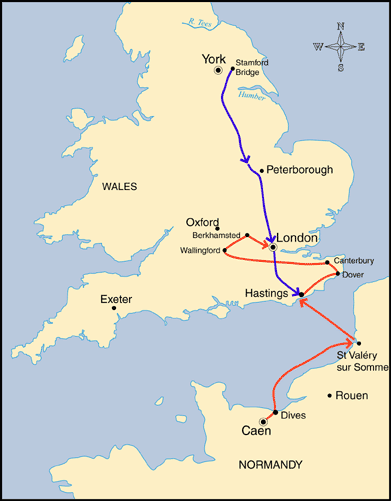
map

Movement of the English (blue) and Norman (red) armies during the conquest.  https://mondes-normands.caen.fr/angleterre/histoires/4/zooms/map4-5-william.htm

The piece is nearly 70 meters long and consists of nine conjoined strips of linen that have been embroidered with only 10 colors of thread. It may have been longer, but it is speculated that the final scenes have been lost. It was likely commissioned by Bishop Odo, William’s half-brother. The tapestry has a more Anglo-Saxon style of stitching than French, and was probably not made in Bayeux at all. This is supported by Old English characters in the writing on the tapestry (Lewis). The validity of the tapestry as a source for the events of William’s conquest is questionable. Embroidery is not the clearest art form and can be easily misconstrued, the text that appears on the tapestry is limited and often abbreviated. The tapestry also focuses mainly on events in England, leaving out many details of events that took place elsewhere (Lewis).

Bayeux Tapestry Scene 65, Wilson

Panel 65 depicts an intense battle where men were lost from both sides

Panel 65

This panel depicts a violent battle including many dead and broken weapons. It was uncommon to depict the dead in a piece like this. The latin text over this scene reads, “Regis: hic ceciderunt simul Angli et Franci in prelio”, which translates to “Here fell the English and French simultaneously in battle”. This battle scene likely represents what is known as the Malfosse incident (Wilson). The Malfosse incident was a disastrous charge by the Normans through English lines into a trap where many soldiers and horses were killed.  The English were positioned on a hill and faked retreat, tricking the Norman cavalry into charging their horses into concealed spikes (Wilson).

There is debate as to whether the animals depicted in the borders of the tapestry are directly related to the scenes that occur above or below them. Figures in the top border of panel 65 include lions and griffins, these may just be there to take up space or they could represent something symbolic about the scene. The bird that appears in the top border of section 65 is a dove carrying an olive branch, this is often used as an expression of peace (Owen-Crocker), this seems to be quite unrelated to the bloody battle that occurs below it.


Resources:

Lewis, Michael J. “Questioning the Archaeological Authority of the Bayeux Tapestry.” Cultural and Social History, vol. 7, no. 4, 2010, pp. 467–484.

Owen-Crocker, Gale R. “Squawk Talk: Commentary by Birds in the Bayeux Tapestry?” Anglo-Saxon England, vol. 34, no. -1, 2005, p. 237.

Wilson, David M. The Bayeux Tapestry. Christian Ejlers Publishers, 2003.

Leave a comment

Filed under Uncategorized

Bayeux Tapestry – Scene 57

As an Object:

The Bayeux Tapestry is said to be made up of degreased wool and nine pieces of linen that were treated by alum to ensure the dyes would stay before it was spun (Bloch 494). The other colored parts of the tapestry were dyed thread in addition to the dyed wool. Upon examining the Bayeux Tapestry, some parts of the colored areas wasn’t as faded as the others. This means that some parts of the Bayeux Tapestry weren’t exposed to sunlight as much as the others. It was also discovered with Carbon-14 dating that tapestry borders and central panels were embroidered after the tapestry was hung between the fifteenth and seventeenth century (Bloch 494).

Considering the timeline, it was believed that the tapestry was made between and after the conquest, resistance, or revolt (Bloch 493). Some professors find the Bayeux Tapestry an interesting topic and due to the timeline not having an exact timeline, they created assignments for students to research if the tapestry was made between or after the conquest, resistance, or the revolt (Carter 31).

As Content:

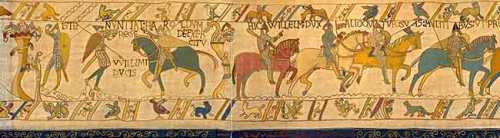
bayeux25

“William Rides To War – Scene 3.” The History of Britain’s Bayeux Tapestry, Britain’s Bayeux Tapestry, 2014, http://www.bayeuxtapestry.org.uk/Bayeux25.htm.

“William, mace in hand, gives a speech to encourage his soldiers (William Rides).”

With the description provided, William, Duke of Normandy, would be on the red horse and the mace in hand. This picture is suspected to be William the Great’s army heading into the Battle of Hastings of October 14th, 1066 (Carter, Historians 24). With the new battle in the horizon, William’s army of calvary was terrified of King Harold’s army, not confident in their formation, and recollecting that no Norman’s ever being a King of England (Tanton). Seeing this as a huge weakness, William raised his mace and rallied his men. With the battle cry and in the scene provided, it seems to have helped his men recollect their spirits and rush into war (Tanton).

King Harold’s army was composed of infantry and filled with archers. With the mobility of riding a horse and disciplined training, William the Great’s army overpowered King Harold’s and he became the first Norman King of England.

On the tapestry, there is a crow on the top right corner pointing to King Harold’s army. I believe this signifies his ill fortune and death. Without William’s speech to his troops, I believed they wouldn’t have won due to having a poor mentality.

e23ebe2457f1793ca9a67e77626759569679938a

https://ka-perseus-images.s3.amazonaws.com/e23ebe2457f1793ca9a67e77626759569679938a.jp(g)

Primary Sources

Wilson, David M. The Bayeux Tapestry: The Complete Tapestry in Color. New York: A.A. Knopf, 1985. Print.

“William Rides To War – Scene 3.” The History of Britain’s Bayeux Tapestry, Britain’s Bayeux Tapestry, 2014, http://www.bayeuxtapestry.org.uk/Bayeux25.htm.


Secondary Sources

Bloch, R. Howard. “Speculum.” Speculum, vol. 81, no. 2, 2006, pp. 493–494. JSTOR, JSTOR, www.jstor.org/stable/20463736.

Carter, John Marshall. “Doing What Historians Do: Using the Bayeux Tapestry to Discover the Past.” The Clearing House, vol. 70, no. 1, 1996, pp. 24–25. JSTOR, JSTOR, http://www.jstor.org/stable/30189228.

Carter, John Marshall. “Writing Games in the Bayeux Tapestry.” The English Journal, vol. 74, no. 7, 1985, pp. 31–34. JSTOR, JSTOR, www.jstor.org/stable/817592.

Leave a comment

Filed under Uncategorized

Bayeux Tapestry Panel 62

Bayeux Tapestry Panel

The Bayeux Tapestry. approx: 1070-1080. The Bayeux, Normandy. “The Bayeux Tapestry scene62.jpeg” Wikimedia Commons. Accessed 11/20/2018. 

The full sentence at the top of this section of the tapestry reads “Hic Ceciderunt Lewine et Gyrd Fratres Haroldi Regis,” or “Here fell Leofwine and Gyrth, brothers of King Harold.” The name Gyrth is spelled with a Nordic D on the tapestry and is therefore thought to have been written by an Anglo-Saxon.

This section depicts the start of a second phase in the battle, where the English infantry led an attack along the entire Norman front. The soldiers in the tapestry can be seen carrying javelins and spears, as well as sticks, stones, and axes. Leofwine, brother of King Harold who died later in the battle, is believed to be depicted near the center of the panel, wielding an axe with his head turned. To the right of Leofwine, an English soldier is stabbed in the face by a Norman cavalryman’s spear. This is believed to be Gyrth. We know that both men were killed on October 14, 1066.

Both Leofwine and Gyrth were earls back in England, Leofwine over Buckinghamshire and Surrey to Essex, and Gyrth over East Anglia and Oxfordshire. Together the brothers controlled almost all of east England, which would have made them fairly important figures at the time, but very little is known about them besides what we can deduce from the tapestry. One of the only sources to mention them by name, William of Malmesbury, says that Gyrth tried to persuade King Harold not to lead the English army against William of Normandy, and offered to do so himself so that his brother could remain in London to lead their people. Harold refused, and he was subsequently killed in the battle along with Gyrth and Leofwine.

When using the Bayeux Tapestry to learn about history, specifically as an account of the Battle of Hastings, one must keep in mind that it was likely made to celebrate the victory of William of Normandy. Accounts of war are told and remembered from the victor’s point of view, and the lack of detailed English records at the time make the Bayeux Tapestry one of the only, and by far the most detailed, source of knowledge about the Battle of Hastings.

Works Cited:

Wilson, David M. The Bayeux Tapestry: The Complete Tapestry in Color. New York: A.A. Knopf, 1985. Print.

“Battle of Hastings.” Wikipedia. Wikimedia Foundation, 23 Sept. 2017. Web. 20 Nov. 2018.

“Gyrth Godwinson.” Wikipedia. Wikimedia Foundation, 7 May. 2018. Web. 20 Nov. 2018.

Gameson, Richard. “The Authority and Interpretation of the Bayeux Tapestry.” The Study of the Bayeux Tapestry. Rochester, NY: Boydell, 1997. 89. Print.

Leave a comment

Filed under Uncategorized

The Bayeux Tapestry: Scene 71

The Bayeux Tapestry is thought to have been made in England for William’s half-brother, Odo. Odo happened to be the bishop of the Bayeux -hence the name of the tapestry- and Earl of Kent. Speculators believe that the tapestry was made in Canterbury in a workshop that was associated with St. Augustine’s Abbey (Laynesmith).

The Bayeux Tapestry portrays William the Conqueror and how he took hold of England back in the 1060’s. In my specific piece, it is supposed to portray the death of King Harold Godwinson at the Battle of Hastings. However, there is a lot of debatable matters when it

688px-Bayeux_Tapestry_scene57_Harold_death

The Bayeux Tapestry. approx: 1070-1080. The Bayeux, Normandy. “The Bayeux Tapestry scene57 Harold death.jpeg” Wikimedia Commons. Accessed 11/15/2018. https://commons.wikimedia.org/wiki/File:Bayeux_Tapestry_scene57_Harold_death.jpg

comes to this scene in the Bayeux Tapestry. Before diving in though, let me explain the difference in the soldiers. Historically, King Harold’s army was almost entirely infantry with the exception of a few archers. The Normans, on the other hand, were about half infantry, a quarter cavalry, and another quarter of archers (Battle of Hastings). Because of this, we can figure out that any of the horses in the tapestry (There is only one, in my case) are part of the Norman cavalry.

Looking at the tapestry, it is hard to determine which figure is King Harold. we can rule out that the person on the horse is not King Harold, because only he Normans had cavalry. So it is really left to two figures in the image; the one directly behind the horse, and the one being trampled by the horse. Because we don’t know in this context, we can look at how King Harold died. According to World Monarchies and Dynasties, Harold had been shot in the eye with an arrow, then mistakenly wandered into enemy lines half blind where he was killed (Middleton 376). Unfortunately, that does not solve any issues, because both figures could describe certain parts of King Harold’s death. In the 1st figure, it looks to be that there is an arrow in the eye of the figure. that perfectly matches up with the story given. However, because this photo is a photo of the replicated tapestry, we should see what other forms of the tapestry have. Bayeux-tapestry.org.uk goes into this, and points out that different replications of the tapestry show different things. For example, the Le Thieuller 1824 copy shows that the figure is holding a dotted line. In the Montaucon 1730 engraving, it just shows that the figure is holding something. It is not indicative of an arrow or a spear, but we don’t know what else it could be. Another thing to point out is that the first written mention of Harold dying by being shot in the eye with an arrow appears 14 years later; written by Baudri in a poem. Some speculators say that there is really no way to know how Harold died, because of the lack of detail in the primary sources. It really comes down to the interpretation of two sources; Carmen, then the Bayeux Tapestry itself (Bradbury 206)

The second figure also seems to match up with the story given by John Middleton. After being shot in the eye, he wandered into enemy lines and was slaughtered. The tapestry is indicative of that, except for the fact that the arrow is missing from the figure’s eye. However, if you look closely at the second figure’s head, you will see that there seems to be missing stitches leading to the second figure’s head. Why were the stitches put there, and why were they removed? These are both critical questions that unfortunately can’t be solved, and further deepen the mystery into figuring out which figure is the real King Harold.

An attempt to try and analyze the location of the title a certain figure also fails, because the title, “Harold Rex Interfectus Est,” stretches above both figures,  “Harold” being closer to the first figure, and “Interfectus est” being closer to the second figure.

In my own speculation, I think that it is very possible that both of the figures could be King Harold. It is somewhat apparent that the -most likely Anglo-Saxon- artist(s) did not know how to divide the different scenes, therefore making it look like the Normans were attacking themselves in some part of the tapestry. I think that this is another one of those situations. If my speculation is true, it shows that Harold was shot in the eye, and then immediately after was killed by the Norman cavalry. This opinion is supported by David Bernstein, who was the first to point out the missing stitch marks leading to the second figure’s head (Bradbury 207).

Despite the pitfalls in using the Bayeux Tapestry as a 100% accurate source for the Battle of Hastings, it does give us some insightful cues on what the Battle of Hastings was like, even if it is not completely accurate. An example would be the bottom part of the tapestry in the scene, “Harold Rex Interfectus Est.”

Bottom piece of tapestry

The Bayeux Tapestry. approx: 1070-1080. The Bayeux, Normandy. “The Bayeux Tapestry scene57 Harold death.jpeg” Wikimedia Commons. Accessed 11/15/2018. https://commons.wikimedia.org/wiki/File:Bayeux_Tapestry_scene57_Harold_death.jpg

Here we can see people stripping the valuables off of the dead soldiers and peddling their newfound loot for money. While there seems to be no other source that mentions this happening after the battle of Hastings, it seems likely that it did happen.

There are some problems when it comes to using the Bayeux Tapestry as a source though. There was an absolute bias of the art itself. The embroidery was made with the idea of showing the victory of William the Conqueror and his army, and was probably made for Bishop Odo, who was William’s half brother. Also, because of the lack of worded description on what the artist was trying to convey, it is mostly up to the artist to interpret what actually happened during the Norman conquest. That is disadvantageous because of people’s variance of views and opinions.

As mentioned before, the embroidery doesn’t offer us 100% accuracy of exactly what happened, or at least we can not assume that. However, it does bring a resourceful and interesting perspective of what did happen. We may never know which figure was supposed to be King Harold.


Sources:

Middleton, John. World Monarchies and Dynasties. Routledge. 2015. pp. 375-376. EBSCOhost. Accessed 11/15/2018. https://web.b.ebscohost.com/ehost/detail/detail?nobk=y&vid=2&sid=87f8a57e-8a79-45a4-a864-feb5286a

“the Death of Harold.” Accessed 11/15/2018. http://www.bayeux-tapestry.org.uk/deathofharold.htm

Bradbury, Jim. The Battle of Hastings. Sutton Publishing. 1998. pp. 206-207.

Lawson, M.K. “Observations upon a Scene in the Bayeux Tapestry, the Battle of Hastings and the Military System of the Late Anglo-Saxon State.” James Campbell. 2000. DRM_PETER. “Observations upon a Scene in the Bayeux Tapestry, the Battle of Hastings and the Military System of the Late Anglo-Saxon State.” De Re Militari. 10/02/2017. Accessed 11/16/2018. https://deremilitari.org/2017/10/observations-upon-a-scene-in-the-bayeux-tapestry-the-battle-of-hastings-and-the-military-system-of-the-late-anglo-saxon-state/

“Bayeux Tapestry.” Wikipedia. Accessed 11/22/2018. https://en.wikipedia.org/wiki/Bayeux_Tapestry

Laynesmith, J. L. “A Canterbury Tale.” History Today, vol. 62, no. 10, Oct. 2012, pp. 42–48. EBSCOhost, hal.weber.edu/login?url=https://search-ebscohost-com.hal.weber.edu/login.aspx?direct=true&db=aph&AN=82392810&site=ehost-live.


Leave a comment

Filed under Uncategorized

Early Sources For Arthur (Sean)

  • Much folklore has been developed around the title of King Arthur; indeed, he is a chief character in much medieval and modern literature (some of my personal favorite modern nods to him include “The Buried Giant,” by Kazuo Ishiguro, the character Saber, a.k.a. Arturia Pendragon, in the Fate anime series, and a single obscure episode in the third season of Babylon 5, in which nothing remotely significant to the plot ever occurs). However, the bulk of this work tends to be very fanciful, growing more so the further the source is displaced from the approximate period of Arthur’s life. It is natural to wonder what the earliest sources say about Arthur, as these should (logically) carry the most accurate and reliable information. Below, we investigate some of the early records and events popularly associated with Arthur, in an effort to determine the likelihood of his existence.
  • “De Excidio et Conquestu Britanniae” — Gildas
    • Providing the most relevant context to the time when Arthur’s actions would have been current events, as Gildas was most likely a Briton, this text will get most of our attention.
    • There are limitations to how seriously and literally we can take this work, in spite of it being the earliest work following the lifetime of King Arthur, if he existed. As one notable article states, “This preface is the only surviving narrative history of fifth century Britain, but it was not written as history. Though Gildas was a native of Britain and deals with the period at some length, he was extremely ill-informed about the Roman period. . . [H]e may be regarded as the authority for the period before 547-9 (the year of death of Maelgwn Gwynedd in the Annales Cambriae), but in general he gives very little definite information.” (Vortigern Studies)
    • Additionally, this work is highly politicized, near impossible to date, and gives no direct reference to King Arthur, limiting the use we can make of it. The connection with King Arthur is found through the account of the Battle of Badon Hill, a battle generally connected to Arthur for reasons discussed below.
    • As mentioned, Gildas doesn’t mention Arthur in his commentary on the Battle of Badon. 12th century hagiography claims that “Gildas had praised Arthur extensively but then excised him completely after Arthur killed the saint’s brother, Hueil mab Caw.” (Wikipedia). In Concepts of Arthur, Thomas Green theorizes that the events of that battle were so well known that describing them in greater detail would have seemed a triviality (Green, 2007). However, it is somewhat difficult to believe that Gildas would have failed to comment on a monarch he disapproved of, considering the nature of the rest of his writings.
  • The Battle of Badon Hill
    • As this name keeps coming up, it is worth commenting on this battle. Out of the information available from the time of Arthur’s potential, the reality of this battle is one of the strongest points advocating for Arthur’s existence, as it is an event commonly associated with Arthur that almost certainly occurred. It is mentioned in a variety of sources, both with and without reference to Arthur. Here is the simple version:

The Battle of Badon has significance because the encroachment of the Anglo-Saxons on the Celtic Britons was halted as a result of it. This decisive victory was accomplished by a united force of Britons, which implies that they had some sort of leadership, at least militaristically; their military leadership was purported by later sources to be Arthur, though he was clearly not “King” Arthur at this time, as Gildas refers to Ambrosius Aurelianus (see right) as the organizer of this force. (Korrel).

    • Later sources name Ambrosius Aurelianus as Arthur’s uncle, the brother of his father.
    • Unfortunately for Arthur, the sources that actually connect him with the battle come much later, and their accounts are so fanciful that one cannot reasonably take them at face value. Historia Brittonum, for example, indicates that Arthur personally slew 960 men in a single charge (though other sources scale this number back to a more modest figure in the mid to upper 400’s). (Mommsen).
  • Other Sources:
    • Simply put, other notable historical documents of that time, including the Gallic Chronicles and Bede’s Ecclesiastical History of the English People, do not mention Arthur, though they both comment on the Saxon invasion of Britain and Bede specifically makes reference to the “siege of Mount Badon, when they made no small slaughter of those invaders” (Bede).
  • Conclusion:
    • It seems doubtful that there was a historical King Arthur. The contemporary sources simply don’t reference him, while the later sources represent him in a way that is clearly more folklore than fact. If there was a historical Arthur, it seems very likely that Badon Hill would be the key event to tie him to, being an actual event that would be a pivotal moment in the events Arthur is described as being central to (the halt of Saxon encroachment and the unifying of Britain). However, as this battle is impossible to accurately place in time and space and as details of the battle from contemporary sources are effectively nonexistent, at least with the records we currently have, this pursuit is futile. And it is quite certain that if there ever was a King Arthur the accomplishments attributed to him are largely fictitious.


Works Cited:

  • Vermaat, Robert. “Gildas (early sixth century AD).” Vortigern Studies. http://www.vortigernstudies.org.uk/artsou/gildas.htm (accessed November 3, 2018).
  • “Battle of Badon.” Wikipedia. https://en.wikipedia.org/wiki/Battle_of_Badon (accessed November 3, 2018).
  • Korrel, Peter. “Arthur, Modred, and Guinevere in the historical records and in the legendary Arthurian material in the early Welsh tradition”, An Arthurian Triangle: A Study of the Origin, Development, and Characterization of Arthur, Guinevere, and Modred. Brill Archive, 1984.
  • Mommsen, Theodore (ed.) Historia Brittonum. Accessed 7 Feb 2013.
  • Bede. “The Ecclesiastical History of the English People.”


Arthurian Artifacts (Abe)

The earliest mention of King Arthur can be found in the 594 poem “Y Gododdin” by Aneirin. Still, this is only a reference and certainly provides no concrete evidence for a real King Arthur. The stanza in which Arthur is referenced reads:

He fed black ravens on the rampart of a fortress

Though he was no Arthur

Among the powerful ones in battle

In the front rank, Gwawrddur was a palisade (Wikipedia)

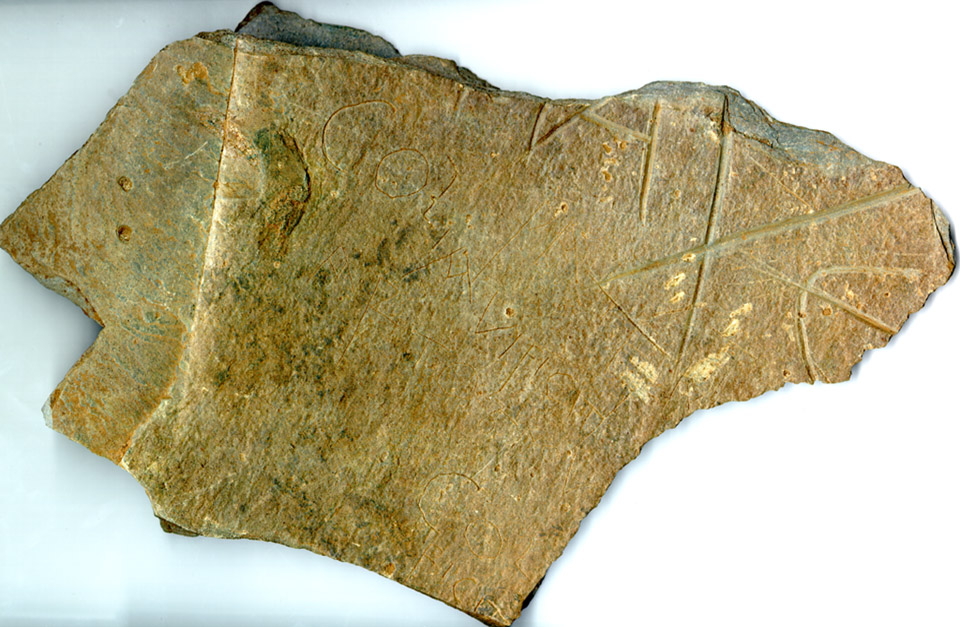
One remarkable, though quickly refuted, artifact is the Artognou stone, discovered in 1998 at Cornwall, United Kingdom. The inscriptions on the stone read, as translated by the Celtic Inscribed Stones Project,  “Artognou descendant of Patern[us] Colus made (this). Colus made (this).” (Wikipedia). Because “Artognou” bears semblance to “Arthur,” many parties, including the media, mistakenly referred to the artifact as the “Arthur stone.” Additionally, the stone was dated back to the approximate time period in which Arthur is reputed to have lived, if he did. Despite these commonalities, scholars have rejected the notion that the stone is related to the historic King Arthur in any way. Perhaps one of the contributing factors to this rejection is the fact that the stone does not appear to be an official inscription, rather a work of graffiti, as the carvings are shallow and untidy.

The Artognou Stone


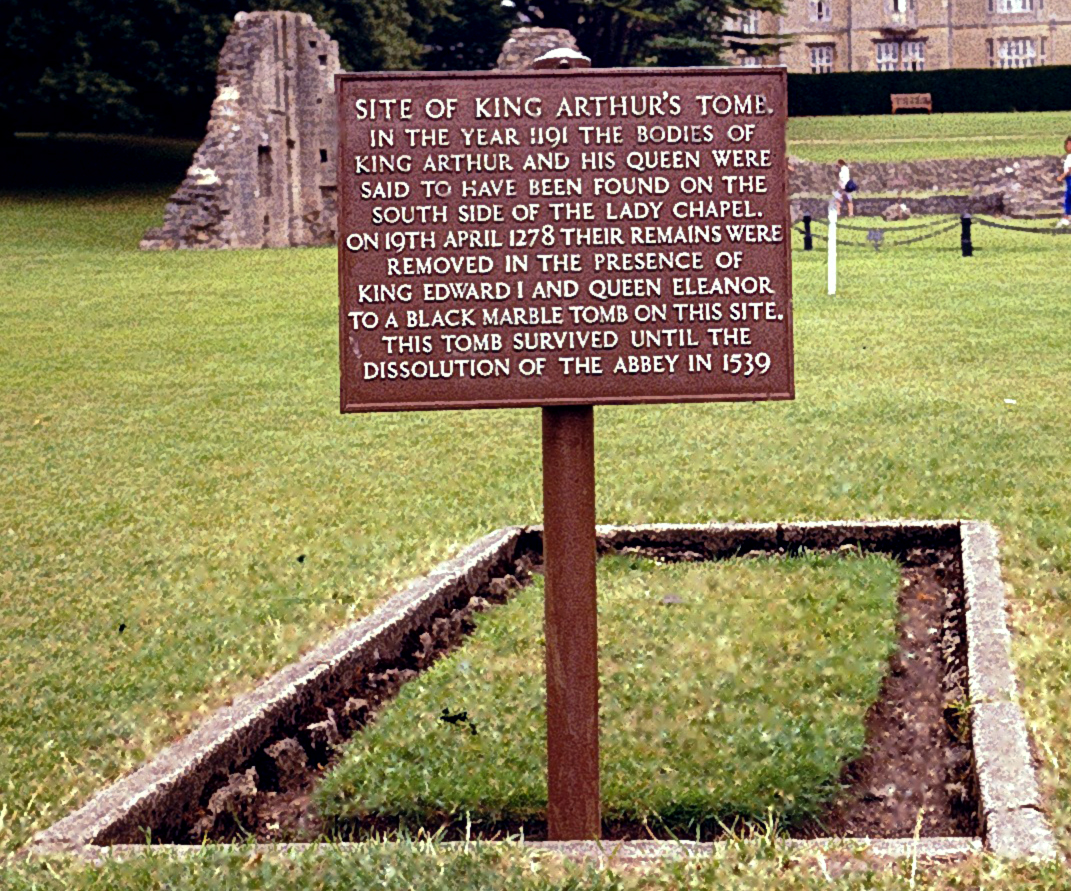
Another artifact, also refuted, is the Glastonbury cross. In 1184, at Glastonbury Abbey,  fire destroyed the monasteries. While reconstruction was underway, visits to the abbey declined, that is until the burial place of King Arthur and Queen Guinevere was reportedly discovered, alongside a leaden cross that read: Hic jacet sepultus inclitus rex Arthurus in insula Avalonia (“Here lies interred the famous King Arthur on the Isle of Avalon“). (Wikipedia). In retrospect, this incidence has been dismissed by scholars and historians as nothing more than a publicity stunt by the abbey to attract visitors (Britannia History).

The Alleged Burial Place at Glastonbury Abbey


Most recently, a castle was discovered on the Tintagel peninsula in Cornwall. This structure evidently housed noblemen of the area, based on the additional findings of fancy, imported food utensils, such as plates from North Africa and glass cups from France (Daley). Most relevant to the legend of King Arthur, however, is the fact that this structure lines up with the writings of Geoffrey of Monmouth, who wrote History of the Kings of Britain in 1138. Geoffrey claims that King Arthur was either conceived or born in the same area that this high-profile structure has been discovered (Huber). In discoveries such as this, it is important for researchers to objectively analyze what they have found, rather than seek to connect their findings to King Arthur. Prematurely claiming Arthurian ties without backing evidence only encourages the spread of misinformation among both media and scholarly works. Such has been the case with the Tintagel excavation: the slightest inkling of possible ties to King Arthur are ran with, and facts becomes muddled (Proctor).

Based on these artifacts, evidence for the historical King Arthur is rather shaky. The castle-like structure carries the most weight, as Geoffrey of Monmouth described a similar location for the origin of Arthur. Altogether, however, physical evidence for King Arthur is about as convincing as the written and spoken testaments of his existence. The evidence, or lack thereof, points towards King Arthur existing only in legend.


Works Cited:

“Artognou Stone.” Wikipedia. Last modified August 18, 2018. https://en.wikipedia.org/wiki/Artognou_stone. (accessed November 4, 2018)

Daley, Jason. “A Palace Was Unearthed Where Legend Places King Arthur’s Birthplace.” Smithsonian.com. Last modified August 5, 2016. https://www.smithsonianmag.com/smart-news/palace-unearthed-king-arthurs-birthplace-180960035/. (accessed November 4, 2018)

Huber, Emily Rebekah. “Geoffrey of Monmouth: Introduction.” Robbins Library Digital Projects. Last modified 2007. http://d.lib.rochester.edu/camelot/text/geoffrey. (accessed November 4, 2018)

“King Arthur.” Wikipedia. Last modified October 19, 2018. https://en.wikipedia.org/wiki/King_Arthur. (accessed November 4, 2018)

“King Arthur’s Burial Cross.” Britannia History. Accessed November 4, 2018. http://www.britannia.com/history/arthur/cross.html. (accessed November 4, 2018)

Proctor, Elizabeth Gaj. “The Legendary King: How the Figure of King Arthur Shaped a National Identity and the Field of Archaeology in Britain.” DigitalCommons. Last modified May 2017. https://digitalcommons.library.umaine.edu/cgi/viewcontent.cgi?article=1267&context=honors. (accessed November 4, 2018)

“Y Gododdin.” Wikipedia. Last modified July 30, 2018. https://en.wikipedia.org/wiki/Y_Gododdin. (accessed November 4, 2018)

Pictures:


Ambrosius Aurelianus: Possible King Arthur? (Amanda)


Ambrosius Aurelianus was a 5th century Roman leader in Britain. From the writings of Gildas it can be determined that he was noble or descended from nobles, and most likely a Christian as Gildas said that he won his battles “with the help of God.” Had he not been a Christian, the author would likely have neglected to mention him at all, or at least not by name.

Based on a record of Saxon conflicts by Bede, it is generally accepted that his parents and many of his people were killed in an early invasion. According to Gildas, Ambrosius organized the survivors and defeated the Saxons, though this is disputed by other historical records which claim multiple battles were fought, with both sides claiming victories.

In Historia Brittonum, written by Nenius, Ambrosius morphed into a semi-mythical character who warns the hero Vortigern about dragons. Some believe Geoffery of Monmouth took some of this character’s superhuman attributes and changed his name to Merlin in his work History of the Kings of Britain. In Latin, Merlin’s name is given as Ambrosius Merlinus.

Based on Geoffery’s writings however, Ambrosius would have been too old to have fought in Arthur’s battles. He would have been around 70 years old when Arthur should have fought at Camalan. Based on this information, some people have concluded that Ambrosius is not Arthur, but his name and some of his deeds may have become mixed up in the Arthurian legends.

Ambrosius was known to the Welsh as Emrys Wledig (The Imperator). Some sources name him as the brother of Uther Pendragon, father of Arthur, while others write him as the great warrior king that Uther may have been based on. Since Ambrosius was likely too old to have been Arthur, it is more likely that his victories against the Saxons led to him being written into myths as the famous king’s father, who was also known for his prowess in battle

Some have speculated that there were two men named Ambrosius, possibly an older and younger brother, one who fought against Vortigern in battles often attributed to Uther, and another who fought against the Saxons in the 5th century. This is unlikely however, as historical sources have only ever alluded to one Ambrosius.

Works Cited:

Hunter-Mann, Kurt. “The Last of the Romans: The Life and Times of Ambrosius Aurelianus.” The Heroic Age, no. 4 (2001). Accessed November 5, 2018. https://www.heroicage.org/issues/4/Hunter-Mann.html.

“Ambrosius Aurelianus.” Britannia. Accessed November 5, 2018. http://www.britannia.com/history/biographies/ambros.html.

“Ambrosius Aurelianus.” New World Encyclopedia. Accessed November 5, 2018. http://www.newworldencyclopedia.org/entry/Ambrosius_Aurelianus.

Lydwien, Charlotte. “Who Was King Arthur?” 2010. Accessed November 5, 2018. http://www.lydwien.nl/kingarthur/ambrosius.htm.


Arthur and Christianity (Andrew)

Was King Arthur based on Jesus? I personally do not believe this is true, but it’s important to consider. The Annales Cambriae mentions Arthur carrying a cross for 3 days and 3 nights in year 516. This could potentially be a retelling of Jesus carrying his cross and being resurrected on the third day. Mordred is a man who betrayed Arthur. In year 537 they mention Arthur and Mordred dying. Mordred could be based on Judas who betrayed Jesus before he was crucified. The knights of the round table could be Christ’s apostles.

There are many reasons why I don’t believe Arthur was based on Christ. Thus said Arthur, noblest of kings: ‘See ye, my Britons, here beside us, our full foes,–Christ destroy them!’ In this legend Arthur is mentioning Christ. It’s strange that legends would refer to him mentioning the person he’s based on. Most of the rest of Arthur’s stories don’t relate much to Jesus himself.

It’s more likely he’s based on other religious figures such as saint Armel. Saint Armel was a prince who established some churches, retired as a monk, and even had rumors of slaying a dragon. While not talking about Arthur himself, there’s a quote that says, “to have such apostles for leaders was to have Christ Himself fighting in the camp.” The people may have thought similarly of Arthur and it’s possible that while not being based directly off Jesus, Arthur was a religiously impactful leader.

Sources

“Annales Cambriae” The Annals of Wales, 447-954 AD. http://www.vortigernstudies.org.uk/artsou/annales.htm

Robert Vermaat “The text of the Vita sancti Germani.” http://www.vortigernstudies.org.uk/artsou/constex.htm

Saint Armel, Wikipedia. https://en.wikipedia.org/wiki/Saint_Armel

Wace, “Arthurian Chronicles: Roman de Brut” https://ia800300.us.archive.org/20/items/arthurianchronic10472gut/10472-8.txt


Arthur was Based on Many Leaders (iamcamalot)

Based on the widespread popularity of the Arthurian Legends across many cultures, it is my belief that the historicity of Arthur was created from many different historical, mythical, and religious figures.  Due to the larger than life nature of Arthur’s feats, it seems unlikely that they were all completed by one man, let alone in one very short medieval lifetime.  There are also evidences of the mixing of religious and mythological themes along with the historically accepted battles, guesstimated timelines and locations.  The story of Arthur is popular in not only the Celtic traditions, but is claimed by the Romans and Scottish as well.


Given that there is a long list of potential claimants for the historical role of King Arthur, it stands to reason that there is likely the influence of one or many of those individuals in the lore.  The most commonly accepted theory is Ambrosius, mentioned above, but due to discrepancies between the timeline and other details, it is not likely that he was the one and only Arthurian archetype.  Other potential candidates for Arthur include a wide timeline and potential locales.  (Ashe)


Another reason that Arthur’s story is not likely to be based on one historical figure is that there are echoes of cultural influences of mythology, folklore, and religion in each culture that has adopted the Arthurian legends.  Christianity is one example. (Crawford) Irish and Celtic folklore is another. (Loomis) Lastly, there is a heavy link to Sarmation culture in many of the artifacts associated with Arthur. (Littleton) (Wadge)


One thing is for certain, the idea of a brave and just king was popular.  Add to that, the heroic journeys, epic battles, and magical elements to his story, there is little to rival such a romantic telling of history.  Let’s face it, the middle ages were no picnic to have lived through.  If the story of the legendary King Arthur was made up of only facts, it likely would not have endured through the ages.  There is something about the ethereal mythical properties of the tale that linger in the imaginations of men and women throughout the ages.  It is no wonder that the legend itself has gained a form of immortality, much like Arthur does in some versions of the story.


Sources Cited:

ASHE, GEOFFREY. “The Origins of the Arthurian Legend.” Arthuriana 5, no. 3 (1995): 1-24. http://www.jstor.org/stable/27869122.

Crawford, Deborah. “St. Joseph in Britain: Reconsidering the Legends, Part I.” Folklore 104, no. 1/2 (1993): 86-98. http://www.jstor.org/stable/1260798.

Littleton, C. Scott. “The Holy Grail, the Cauldron of Annwn, and the Nartyamonga: A Further Note on the Sarmatian Connection.” The Journal of American Folklore 92, no. 365 (1979): 326-33. doi:10.2307/539418.

Leave a comment

by | November 13, 2018 · 12:21 am

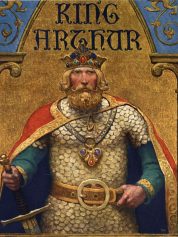
Who Is King Arthur?

king-arthur-e1500901664935


The Arthur Myth:

Isaac, Son of Abrahm

Legends typically form through either a kernel of truth or just a made up story. It is very possible that King Arthur may have been based on a true person, but as time passed and as oral traditions of the story became deformed, the true historical person was credited with feats and quests that he simply did not do, which would make the main character of the story an entirely different person. In this case, a made up one.

Legends start like this. We have an event that is worth retelling. As we retell it, we forget the things that didn’t mean much to us, but glorify the story where the character did something amazing. Running a story through such a filter like this over and over again via oral tradition is bound to get yourself a legend. One that seems to be unrealistic.

This explanation seems likely as this sort of pattern is found to be true among human nature; Remember the fun stuff, forget the boring stuff.

It is also very possible that the story is a political or religious anecdote. Some have made similarities between the story of King Arthur and the Bible, claiming that King Arthur was similar to Joshua. Another claim suggests that the legendary 12 battles that King Arthur fought in was not so much historical, but had more of a biblical and symbolic meaning pointing to the 12 tribes of Israel. As for the political standpoint, there have been sources that cite that English Rulers like Henry VIII and Queen Victoria used the story of King Arthur for political purposes, suggesting that the story was skewed for the purpose for whatever the ruler so pleased. For example, although he didn’t skew the story, Edward III of England tried to make his own Knights of the Round Table, called the Order of the Garter. On the flip side, the legend of King Arthur could have been used as a template for how English Rulers were supposed to behave (maybe leading the rulers to skew the story to lower the standards.)


While the accuracy of this information is up for debate, some suggest that the legend may have been a scare tactic and to portray the Britons as a more war efficient society than they really were. Not to mention the sense of pride that it brought to the Britons. King Arthur served as a mascot just as much as the Utes are to the University of Utah or the Lancers to Layton High School.
It’s interesting to note that all of the more known legends come after the fall of a civilization. For example, the Iliad after the fall of Troy, the Legend of Romulus and Remus, after the fall of Greece, and of course, the legend of King Arthur after the descent of Rome. It could be speculated that legends are made by merely a consolidation of a time where things were better.


mediocrelegionnaire:

The Pendragons

  • Arthur or Uther were not on the list of Pendragons detailed by Laurence Gardner, so that means if Arthur was a Pendragon, he had a different name.

Brychan (430-500):

  • We don’t know very much about him, but it seems very unlikely he was Arthur
  • According to a legend, he had 35 children, and when one of his daughters, Gwladys, was abducted, he persued the culprit in a fit of rage. Arthur, Cei, and Bedwyr were needed to stop the bloodshed.
    • Arthur was added later to this legend, which proves that there isn’t a legend where Bychand and Arthur are the same person.
  • Bychan did have a son named Arthen (460-530) (he was the first “Arthnamed” child of a Pendragon) but he entered the church.


Dyfnwal Hen (455-525):

  • He was a great and powerful warrior from the North
  • He had a pattern of battles that was similar to those on Nennius’s List
    • If true, would place the Badon near Linlighgow
      • The site does not indicate it’s old enough to be Badon
      • There were so many conflicts along the area it’s too hard to tell
  • Not in all the genealogies, but when he is referenced it’s always as “the son of Mar, grandson of Ceneu and great-grandson of Coel” which is why we date him around the 480s.
  • His name sometimes appeared as “Athrwys”
    • The root Athro means “master” or “teacher”


Riothamus:

  • Most of the stories he’s in were written 80 years after he died in by a Byzantine historian called Jordanes
  • Some historians argue that he is the same person as Ambrosius Aurelianus
  • King of Briton and/or Armorica (we’re not sure!)
  • Riothamus fits some of the Arthur criteria
    • Crossed into Gaul twice (helped a Roman emperor and subdued a civil war)
    • His actions in Gaul casually resemble Arthur’s campaign
    • Betrayed by advisor/ ally
    • Carried off/ fled to Avalon (or maybe passed through a place that was called Avallon)
  • The name means something along the lines of “High King”, “Freest”, “Most Kingly”, or “Kingliest” depending on which scholars you want to go with
  • What we know for sure:
    • Was “King of the Britons”
      • Could mean Briton Briton or Armorica (nearby colony)
    • Alive in the ballpark of 470
    • Fought against the Goths and was alligned with the Romans and was defeated
    • Received a letter from Sidonius Apollinaris, who was asking for his help and judgement
      • The letter survived
  • However the timeline doesn’t really match up to Arthur


Hopology Enthusiast:

Ambrosius Aurelianus

  • Ambrosius is one of the only people that is identified by name him the sermon De Excidio et Conquestu Britanniae and the only person named from the 5th century
    • This document is the oldest extant British document about the Arthurian period,
  • Ambrosius was supposedly of noble birth and was also a most likely a Christian as the document says that he won all of his battles with God’s help
    • The document specifically states that he wore the purple which could mean a couple different things not just royalty
      • Purple can denote the purple worn by roman emperors and other aristocrats
      • Purple can also be in reference to the purple worn by Roman Military Tribunes
      • The purple may also represent blood referring to martyrdom
  • He is said to have fought of an invasion of saxons around the time that Arthur would have
  • This character’s life seems to match up with aspects of arthur’s supposed life
    • He was suppodley of noble birth
    • He was supposedly on a quest to reclaim his rightful place as king
    • He was born in troubled times and gathered a force to fight off a force of saxons invaders
  • Although a few of his life details successfully match with Arthur’s he his specifically mentioned as Arthur’s uncle and the father of Uther Pendragon
    • While this could be a drifting of names, this could also explain the similarities that he had to Arthur
      • As Arthur’s uncle he would be of royal blood
      • He could have helped fight of the saxons
      • He could have helped the real Arthur reclaim his place as king.

Owain Danwyn

  • Prince of Rhos in Gwynedd, Wales, in the 5th century.
  • Very little is known about his actual life
  • Graham Phillips and Martin Keatman proposed a theory that he was the basis for Arthur
    • This theory was based on how they interpreted the British power structure of the 5th century
      • The name Arthur is in reference to Owain’s honorific title and means bear
  • This is a very unpopular theory and has been disputed by many scholars


codexromana99:

Æthelstan

  • Born in the late 800s, so if he is “Arthur” than elements of AEthelstan’s life were added in later. Arthur supposedly lived around the 400 or 500s.
  • He succeeded his brother as the King of Wessex, centralized government and maintained control over productions.
  • His victory over the last Viking kingdom of York made him the first Anglo-Saxon King of England, later was known as King of all of Britain
  • He wanted to be seen as supreme ruler of all of Britain but not everyone liked him
  • He collected lots of relics and there are many manuscripts about him, more than any other king of this time. If there were no historical records he would likely be as famous as King Arthur. He married some of his sisters off to other european leaders to support his throne and was not selfish. He respected others if they respected him, and was always ready to support his many nieces and nephews.
  • Sources say he was “king arthur material” but he never married or had any kids. He did have a great influence over England and was considered the “English Charlemagne”, though he remains widely unheard of today.


Sources:

Fanning, Steven. “Speculum.” Speculum, vol. 79, no. 2, 2004, pp. 502–504. JSTOR, JSTOR, www.jstor.org/stable/20462924.

https://www.history.com/news/was-king-arthur-a-real-person

Bonnet, James. “How the Great Myths and Legends Were Created.” Writers Store. https://www.writersstore.com/how-the-great-myths-and-legends-were-created/

https://en.wikipedia.org/wiki/Edward_III_of_England

“Æthelstan, The First King of England (c.893-939)” Roots of Excalibur https://wjartuso.wordpress.com/2014/01/10/aethelstan-the-first-king-of-england-c-893-939/

Bilyeau, Nancy. “The Secrets of a Saxon King”. English Historical Fiction Authors. https://englishhistoryauthors.blogspot.com/2011/12/secrets-of-dark-ages-king.html

Phillips, Graham. “The Lost Tomb of King Arthur.” The Lost Tomb of King Arthur 4, www.grahamphillips.net/arthur_tomb/arthur_tomb4.html.

“Owain Danwyn.” Wikipedia, Wikimedia Foundation, 27 Mar. 2018, en.wikipedia.org/wiki/Owain_Danwyn.

“History.” King Arthur – The Legend, www.caerleon.net/history/arthur/page2.htm.

Russell, J. C. “Arthur and the Romano-Celtic Frontier.” Modern Philology, vol. 48, no. 3, 1951, pp. 145–153. JSTOR, JSTOR, www.jstor.org/stable/435384.

Hopkins, Annette B. “Ritson’s Life of King Arthur.” PMLA, vol. 43, no. 1, 1928, pp. 251–287. JSTOR, JSTOR, http://www.jstor.org/stable/457699.

Ashley, Mike. A Brief History of King Arthur. Little, Brown Book Group, 2013. Digital File.

Wikipedia contributors. “Riothamus.” Wikipedia, The Free Encyclopedia. Wikipedia, The Free Encyclopedia, 14 Oct. 2018. Web. 5 Nov. 2018.

Wikipedia contributors. “Historicity of King Arthur.” Wikipedia, The Free Encyclopedia. Wikipedia, The Free Encyclopedia, 12 Oct. 2018. Web. 5 Nov. 2018.

Lydwien Charlotte. “Riothamus”. 2010. http://www.lydwien.nl/kingarthur/riothamus.htm


Leave a comment

Filed under Uncategorized

Likely People who were King Arthur

Who was King Arthur? – Caci Kynaston/ Cassandra57

If we wish to know who the historical King Arthur is, we need to look at the historical records of the time. Some qualities that all the “historical texts” indicate:

  • Arthur was a great warrior king
  • He died c. 540
  • “Killed” by Mordred (Annales Cambriae and Historia Brittonum)
  • His final battle was at Camlan (Geoffrey of Monmouth)

Location may the most important thing to look at when deciding upon a historical King Arthur. This is because the legend of Arthur was mainly used as a political move by the Normans to instill divine right when they conquered England. They used Arthur as the true King of England, who they were descended from, to defend the conquest of why they should be the rightful rulers. Camlan is a real mountain pass in Wales, which happens to be near the 4th largest stronghold/city in Roman Britain — Virconium. It is also near Monmouth, where the author, who popularized the Arthur legend, Geoffrey is from.  

Presentation1

Maps taken from lecture by David Hartwig 2018.

The ruler of this city was Owain Ddantgwyn c. 500, the King of Powys. Owain was known as “The Bear King” (Bonsing and Jones) which connects him to the name Arthur, which has two root-words for bear: “Arth” which is the Celtic root and “Ur” which is the Latin root. Having that Celtic root further implies that a historical Arthur would be from Wales.

Another reason Owain is a good candidate for being the historical Arthur is his family. The legend goes that Arthur was fatally wounded by his nephew (or illegitimate son) Mordred. This is historically correct for Owain, who was killed by his nephew Maglocunus (Bonsing and Jones). Another interesting point is Owain’s father. Owain was the son of Enniaun Yrth, king of Gwynedd. The kings of Gwynedd were known as “Dragons.” Therefore, Owain’s father could be known as Yrthyr-pen-Dragon, which bears a striking resemblance to Arthur’s father’s name, Uther Pendragon (Bonsing and Jones). Owain may have also married a woman named Guinevere, but that fact has not been historically verified.

Owain Ddantgwyn is the best possible candidate for the historical Arthur because he fits all of the characteristics that the primary historical sources agree upon. His timeline fits with the estimate of when Arthur would have lived. He helped to fight off the Saxon invaders and was known as a great warrior. He was killed by his nephew. Yet most importantly, he is the most logical candidate geographically speaking, which is the most important factor because of why the Arthur legend even started.


Artuir ap Pedr (550 – 620) – scaleydragon – Patrick Luo

There are many King Arthur candidates. I chose Artuir ap Pedr who was the king of Welsh and name is pronounced the same a Arthur. It was suspected that the geographical location of Welsh is the same as the one read in King Arthur’s stories (King 120). Another reason why Artuir ap Pedr is most likely King Arthur from the sources is due to his sister, Niniane being equated and named Lady of the Lake (Ashley 16). Merlin was also the lover of Niniane from Artuir ap Pedr’s history (Ashley 16). With King Arthur’s treasures, Artuir ap Pedr’s treasures and exploits were said to be the same, if not, extremely similar to the story (Ashley 16). He is also cited from multiple sources that his battles and physical features are the same as King Arthur (Parry 572, Pacal).

AEASTMANIG_10313040931

Julia Margaret Cameron (English, 1815-1879). King Arthur. 1874. Artstor, library.artstor.org/asset/AEASTMANIG_10313040931

The reason why Artuir ap Pedr may not be a likely candidate for King Arthur is due to him being born in 550 while King Arthur was said to be born in 500(+/- 10 years) (King 119). Aside from his birth, Artuir ap Pedr was known to not be the best of fighters. This would be hard to imagine that Artuir ap Pedr actually fought and won against the Saxons in King Arthur’s tales (Ashley 16). Since Artuir ap Pedr was born decades after King Arthur, it may be possible that he was named after him (Matthews). It may also be possible that parts of their stories could be coming from entirely different events, one particular example is the Gwent episode (Ashley 16).

In conclusion, with Artuir ap Pedr’s birth being so late after King Arthur’s, it is very likely to say he isn’t the famous King Arthur we know dearly. With his feats being so similar to the other King Arthur, it is possible that it was in fact him living up to his given name. With the geographical location, Welsh it is in the same area of Wales (East Britian). So the most likely candidate still leads to Owain Ddantgwyn.

Pros

  • The historical King Arthur was thought to be from Welch and Artuir ap Pedr was from Welsh (Parry 572, Pacal).
  • Artuir ap Pedr’s sister (Niniane) was called and equated to be the Lady of the Lake (Ashley 16).
  • Artuir ap Pedr’s exploits during his time as King of Dyfed is said to be similar or the same as King Arthur’s reported treasures (Ashley 16).
  • The geographical location of Artuir ap Pedr’s era lines up with King Arthur’s historical sites (Ashley 16, King 120).

Cons

  • Artuir ap Pedr was born in 550 while King Arthur was said to be born in 500(+/- 10 years) (King 119).
  • It’s hard to imagine Artuir ap Pedr fighting the Saxons as told in King Arthur’s tales (Ashley 16).
  • It’s possible that Artuir ap Pedr was named after King Arthur’s tales since he was born decades after King Arthur’s tale (Matthews).
  • “The Gwent episode may relate to an entirely different historical event (Ashley 16).”


Ambrosius Aurelianus (430 – 500)-somebodycallixii- Kimberlee Whitmore

Ambrosius Aurelianus is another likely candidate for King Arthur. He was  a Romano-British leader who lived near the time of Arthur. His name could have easily been construed over the years to become Artorius and eventually Arthur.

Gildas writes that he was a war leader who won an important battle against the Anglo-Saxons sometime in the 5th century. This combat could have been the Battle of Badon Hill. This a battle claimed to have been the culminating fight of the contentions Arthur lead. If it was not the Battle of Badon that Ambrosius fought in it likely followed combat he lead. It is difficult to pinpoint because the names of the combatants are never mentioned directly by Gildas. Although we don’t know which battles Ambrosius fought we can say that he was certainly a great military leader. In the Historia Bittonum Ambrosius is said to be a ‘King among kings of the British nation.’ by Nennius. This is the first mention of Ambrosius as a king of any kind.

The trouble with naming Ambrosius Aurelianus as King Arthur is that the timing does not line up. The texts that mention him place this age around the rise of Vortigern. This event is placed around 425 CE by Nennius, but much later at about 460 CE by Geoffrey of Monmouth.  Since the year 425 CE is from older texts, it is likely more accurate and is used more often to place his birth. This is an age difference of about 30 years and is of great importance when considering whether Ambrosius could be the historical King Arthur. This date would make him quite old when participating in the most famous battles of King Arthur, which are often placed in the early 6th century. He would not have lived to see the Battle of Camlann in 537 CE if this date is used, and he would have been quite old if his birth year was 460 CE.

Ambrosius Aurelianus is unlikely to be the sole historical figure the legendary King Arthur is based on. If King Arthur is a culmination of people, the heroics of Ambrosius probably contributed to the tales.


Aedan Mac Gabran (526-608 CE) Fifth King of the Irish- Scots:  Beholdaman

Aedan Mac Gabran was the fifth  King of the Scottish in Dal Riata, and often noted with the surname Pendragon, a name given by his cousin, Saint Columba of Iona, upon his coronation (pedigree resource file). He was married to a Domelch o Gwynedd verch Maelgwyn, a Welsh princess whose name translates to: Domelch of Gwynedd, of the Maelgwyn line (Áedán Mac Gabráin, Rí Na Dál Riata.). Her lineage could lend to the name Gwendolyn. It should be noted that Aedan and Demelch supposedly had a son named Arthur, who is often considered a candidate for the title of THE king Arthur, however, he never became King as he died well before his father in the battle of Maeatae, in approximately 590 CE(Áedán Mac Gabráin, Rí Na Dál Riata.). The existence of this son is often called into question and widely considered to be a product of revisionist history.

He is considered to have been the most powerful king at the time and King Aedan had many battles against the saxons as well as being one of the first Christian Kings of Scotland, which fits with the arthurian quest for the holy grail (Cowing). He is also well known for having ventured to many islands in “the west sea” while campaigning(Cowing). In legend, King Arthur traveled to an island in the west sea called Avalon, where he was sent to be healed.

300px-Dalriada

After being defeated by Æthelfrith, King of Bernicia, Aedan abdicated the throne in 574 CE and spent his days in a monastery, where he died in 608 (Nash). It is possible that Aedan could have sought refuge in the monastery founded by Saint Columba, his cousin, on the island of Iona. Many medieval kings are known to be buried on Iona, though records and markers have been destroyed over the years, leaving only 48 known royal tombs.

There are a few reasons why Aedan may not be the legendary King Arthur. First and foremost is the matter of his name. The only connection he has to the name Arthur is a son that may not have even existed. He has no known nicknames similar to Arthur. The second issue is how well documented his life was. Though much of his life is still shrouded in mystery, enough about it is known thanks to Saint Columba. The third problem is that there are already many recorded myths and legends surrounding King Aedan Mac Gabrain. How can two seperate legends spring from the same man?

It is likely that King Arthur is a legend based on an actual person. Aedan Mac Gabrain is as good a candidate as any proposed thus far.


Works Cited

scaleydragon

Ashley, Michael. A Brief History of King Arthur. Robinson, 2010.

“King Arthur.” The R. I. Schoolmaster, vol. 5, no. 4, 1859, pp. 119–120. JSTOR, JSTOR, www.jstor.org/stable/44788453.

Julia Margaret Cameron (English, 1815-1879). King Arthur. 1874. Artstor, library.artstor.org/asset/AEASTMANIG_10313040931

Matthews, John, and Caitlin Matthews. The Complete King Arthur: Many Faces, One Hero. Inner Traditions, 2017.

Pacal. “Dowsing for King Arthur.” Skeptical Humanities, Word Press, 31 Mar. 2011, skepticalhumanities.com/2011/03/31/dowsing-for-king-arthur/.

Parry, John J. “Modern Welsh Versions of the Arthurian Stories.” The Journal of English and Germanic Philology, vol. 21, no. 4, 1922, pp. 572–600. JSTOR, JSTOR, www.jstor.org/stable/27702670.

Cassandra57

Annales Cambriae. Vorigernstudies.org.uk, http://www.vortigernstudies.org.uk/artsou/annales.htm. Accessed on 4 Nov. 2018.

Bonsing, John and S. Rhys Jones. “Historical Arthur.” athurproject.caeraustralis.com, 21 June 2007, http://arthurproject.caeraustralis.com.au/historical.php. Accessed on 4 Nov. 2018.

Geoffrey of Monmouth. Historia Regum Britanniae. Vorigernstudies.org.uk, http://www.vortigernstudies.org.uk/arthist/vortigernquotesgom.htm. Accessed on 4 Nov. 2018.

Nenius. Historia Brittonum. Vorigernstudies.org.uk,http://www.vortigernstudies.org.uk/artsou/gildas.htm. Accessed on 4 Nov. 2018.

Beholdaman – somebodycallixii

“Pedigree Resource File,” database, FamilySearch (https://familysearch.org/ark:/61903/2:2:3QC2-8BK : accessed 4 November 2018), entry for KING Scotland Aedan /MacGABHRAN/, cites sources; “Sanders Jones Wilkins Snyder” file (2:2:2:MMD8-L9C), submitted 8 June 2014 by bob sanders_4 [identity withheld for privacy].

Cowing, Emma. “Fabled King Arthur ‘Was a Scottish Warlord’.” Lifestyle, 17 Nov. 2013, www.scotsman.com/lifestyle/fabled-king-arthur-was-a-scottish-warlord-1-3191742.

Nash, David. “HISTORICAL CHRONOLOGY of the EARLY KINGDOMS of SCOTLAND PART 1: AD 498-597 .” EBK: Historical Chronology of the Early Kingdoms of Scotland AD 498-597, Nash Ford Publishing, 2001, http://www.earlybritishkingdoms.com/adversaries/kingdoms/scot498.html.

“Áedán Mac Gabráin, Rí Na Dál Riata.” geni_family_tree, 3 Nov. 2018, http://www.geni.com/people/Áedán-mac-Gabráin-Rí-na-Dál-Riata/6000000003318435827.

Leave a comment

Filed under Uncategorized

Gladiators

Jacob- People and training of gladiators

Gladiator Schools:

While there were many gladiator schools, by far the biggest and most important ones were the ones located right there in Rome. The first, Ludus Magnus, was the biggest; holding about 2,000 gladiators. Then there is Ludus Dacicus, east of the colosseum, used to train Dacian prisoners of the Dacian wars. Third is the Ludus Gallicus; the smallest of the gladiator school and more dedicated to training more heavily armoured classes. Lastly, the Ludus Matutinus; this school was more for beast hunters and not so much for gladiators fighting each other. The word matutinus means “of the morning” where these sorts of shows would be performed.  The schools had their training ground in the middle, with their barracks and other supporting structures -such as a mess hall and a kitchen- surrounding the periphery of the training ground.

Where the Gladiators came from:

While there are many sources that suggest many different things about where the gladiators came from, there is a trend within the sources. The majority of the gladiators were criminals or slaves, but there were a few exceptions. There are accounts of volunteers who became gladiators professionally.

Employment of the gladiator schools:

The owners: Just like most corporate businesses today, the owners don’t do much except for accumulate money.

The Lanistae: The Lanistae can be assimilated to the managers of the ludus. What is interesting about the Lanistae, is that there seemed to have been a stigma with the lanistae and they were looked down upon; they were on the same ground as pimps and even the gladiators of that time.  (Talbert, Slootjes, Brice. 133 )

Medici: The medici were the doctors of the Ludus. They insured that the gladiators’ health was kept up to par. They may have been slaves or prisoners, but the gladiators competing was a source of income for the owner of the ludus. Included with the medical care that the gladiators received, they also had access to decent food to keep their energy up. One account mentions that the gladiators ate barley water mixed with beans.. (Talbert, Slootjes, Brice. 126 )

Magistri: The magistri were the gladiators’ trainers. Most of the magistri was composed from retired gladiators, mostly because after retirement from gladiating, they did not have good prospects, so they trained newer gladiators. While the magistri were the official trainers, many of the gladiators helped each other out. The more experienced ones were in charge of training the newer gladiators, despite the fact that they may have to fight each other in the ring.

Training of the Gladiators:

The gladiators were separated in different ways. The first way they were separated was by social standing. The volunteers, or the professionals, were separated from the slaves and criminals and ended up getting better treatment. The slaves and criminals though, even though it wasn’t as bad as regular prison -they had to be healthy for fighting- it wasn’t up to par to the professionals. They were also separated based off of their fighting style, and each fighting style had their own trainer. It wasn’t unusual for the gladiators to befriend their fellow adversaries, because the friends usually were the ones that made their gravestone.(Coleman)  Another point of segregation, usually the professionals went by their own name; while the slaves tended to have stage names that they used. One example is “Secundus” or “Lucky” (Talbert, Slootjes, Brice. 129)

In the arena:

Despite popular belief, there were actual rules when it came to gladiating; and it even included umpires. It wasn’t just kill your enemy, because you didn’t always have to. The gladiators were trained to fight with skill and accuracy; not necessarily to kill the enemy, but to disarm him or somehow disable him. (Talbert, Slootjes, Brice. 139)Remember, this is a show, even if it does seem like a battlefield. From there, it was decided by the crowd whether the defeated would die or be spared.

Among many things, one of the things that was harsh about the gladiating world is that you could have trained with someone, and even befriended him/her, only to be pitted against them in the arena.  (Talbert, Slootjes, Brice. 137)

Special gladiator schools were created in Rome. Capua was one of them. Agents scoured the empire looking for gladiators to recruit, as their turnover time was very short.


History of the Games – Garrett

The games have roots in both religious funeral rites and practices created by the people located in modern day Italy. The Etruscans of Northern Italy held gladiator battles and chariot races as sacrifices to the gods. The Romans picked up the practice later and continued to hold the games about 10-12 times a year (Pierre). It was believed in Rome that when people died their souls would travel in human blood to the afterlife. Because this was a popular belief, they would kill slaves or prisoners of war at important funerals. At Julius Brutus’s funeral in 264 BC his family had 3 pairs of slaves fight each other to the death (ushitory.org). Other wealthy families followed this example and began having these fights as well to prove their wealth. People passing by would come watch these fights as well and someone eventually had the idea to put out chairs and charge people to come watch the fight. The funeral of P. Licinius Crassus 120 gladiators fought and his funeral took place over 3 days and ended with a massive banquet in his honor (Thomassen). This practice eventually changed from its religious routes to more of a political event to win the favor of the mob.

The games were originally created and funded to show one’s wealth at a funeral and ensure safe passage into the afterlife. This quickly changed once they realised that they could win the hearts of the poor and desolate masses by putting on these massive spectacles for free. Once the aristocrats realized that the games would slowly increase in size to become massive, almost unbelievable spectacles of bloodsport.

As with most entertainment industries the most important thing is to be bigger and better than your competition so each times gladiator games were put on they had to be better than the last. The first advancement in scope came when aristocrats began constructing wooden arenas filled with sand. Previously they had fought either out in the open or in a roped off area. With the sand there to absorb the blood that was spilled the games could be held more often and for longer periods of time. This increase in frequency and duration then allowed gladiators to become a big business. Gambling on the outcome of gladiatorial games became a massive industry with gladiators creating troupes or familia, with managers that would decide where and when they would fight. Schools that recruited slaves, criminals, and prisoners of war in order to teach them combat techniques. Some elite romans even owned their own troupes of gladiators. formed. This growth, backed by the most elite in Rome, lead to the games becoming massive spectacles lasting months at a time at the creation of dedicated arenas rather than improvised grounds.

But private citizens owning sometimes hundreds of well trained warriors was something that could not be ignored by the state. When the Roman Republic fell the Roman empire and the Senate assumed complete control over all gladiators. They also gave Roman courts the ability to sentence criminals to participate in the games. With the ever increase in popularity, amphitheatres made of stone were built to house the games. The first of these arenas was called the Amphitheater of Statilius Taurus and was built in 29 BC with the most famous of these, the Roman Colosseum being built in 80AD (Thomassen).

The history of using animals in the arena also have roots in funerals as well, with wealthy people would stock up native creatures to parade around in honor of the dead. They would teach these animals tricks as well as kill them in staged hunts called venationes. Wild animals first came into the games when elephants captured during the first punic war were taken the games in 252 B.C (ushitory.org). This really expanded however with the wealth figures of Pompey, Crassus, and Julius Caesar bringing in animals from Africa such as crocodiles, hippopotami, tigers, lions ,leopards, and more. Trajan’s games is famous for being the largest show ever put on. It lasted form 79-81 A.D and was held to celebrate his victory over the Dacians (ushitory.org). The games lasted 120-123 days and consisted of over 9,000 gladiators and about 11,000 animals (ushitory.org).These animal hunts were so popular that many Roman Emperors actually fought in these gladiatorial animal hunts in order to earn the honor that was afforded to to the coliseums greatest champions. Emperor Commodus is the biggest example of this as he is said to have participated in over 700 gladiatorial fights (Pierre).

Eventually the attitude towards the games shifted dramatically. The rise of Christianity lead to a feeling of the games being wrong. Eventually the Emperor Honorius ended the Gladiatorial games after an Egyptian monk named Telemachus was killed after he plead to end the games. Honorius decreed the end of the games officially in 399 AD ushitory.org). Although the gladiator games were abolished at this time the last known gladiator fight in the city of Rome took place on January 1 404 AD ushitory.org). A bloodsport spectacle that once once brought emperors and nobles the people’s favor was now doing the opposite, and so it disappeared into history.


Emma- Colosseum 

Originally called the Flavian Amphitheater, the Colosseum could hold between 50,000 and 80,000 people, probably averaging to about 65,000 spectators per event. It was used for about 500 years, and it is estimated that over 400,000 people died there. Construction began in 70 AD and it was finished in 10 years, followed by a 100 day streak of daily events to celebrate the emperor, the city, and the arena. Unlike other amphitheatres carved out of hillsides, the Colosseum is a freestanding concrete and stone structure. The land it was built on was originally a lake, so drains were built to clear the area, and the arena itself would have needed to have extensive architecture planning done before construction. Since its days of fame, the Colosseum has been used for several things, including a Christian shrine, a quarry, and a source for building materials. It was also partially destroyed by an earthquake in the 1300s. There were over 250 arenas built in this time, but this was the largest of them.

There were 76 entrance gates labeled with roman numerals, much how modern stadiums are set up. Spectators were packed in like sardines, and though some scholars guess that the people were sat according to their rank, more than likely everyone just packed in as tight as they could. The Colosseum was renovated a few times, and underground tunnels, sun and rain shades, and other amenities were installed. Some evidence of latrines and even water fountains has been found. Eventually canvas shades mounted on masts that extended from top of the arena were installed, which could be rolled out to protect spectators from the hot sun and sometimes rain. The floor of the arena was covered in sand to help absorb the spilt blood of combatants. The arena was used for the famous gladiator battles but also for chariot racing, naval battles, public executions, and even plays. There is no physical evidence that the naval battles happened, but there are a few ancient records that report the Colosseum being flooded and used to recreate famous battles at sea. Underground, there were tunnels, cages for animals, holding areas for upcoming gladiators, and machinery like trap doors. This underground area was probably not present during the supposed naval recreations.

Overall, the Colosseum was a hugely successful and impressive work of art that displays Rome’s power and position at the time. It was planned out carefully, and funds were controlled to ensure the best and fastest construction. Even over a thousand years past its last use, the Colosseum is still a huge attraction today, even if you now have to pay for tickets, and has been named one of the 7 Wonders of the World.


“Munera” The Games– Alaina

Before the games could begin, advertising had to be done to inform spectators of date, venue, editor, fighters, scheduled executions, and added perks for those in attendance; which may include information on food, drink, shade awnings, and on some occasions, “door prizes”. More detailed programs could be obtained the day of, and provided additional information about the matchups and fighting styles of the gladiators. The night before the event a banquet would be held as a sort of “last meal”. It was a chance for the gladiators to sort out their affairs as well as bring more publicity to the event.

The munera would begin with something similar to an “opening ceremonies”. A pompa, or procession, would enter the arena and led by lictors (who represented the power of the magistrate editor over life and death), and were then followed by trumpet fanfare, images of the gods (who were brought to “watch” the spectacle), a scribe, and men carrying in the palm branches to be awarded to winners. The magistrate editor would then enter with the weapons and armour to be used, and the gladiators entered last.

The exact order of the munera would differ among individual events, but would generally open with sham fights, which were fought with wooden or dummy weapons as a sort of warm-up. The munus could also be opened with animal spectacles, such as the ones Seneca praised involving trainers and handlers putting their heads in lions’ mouths or getting elephants to perform tricks like kneeling and walking on ropes. He also recalled wild animals fighting each other and people; with events in single combat being fought by bestiarii (beast-fighters), and groups of hunters demonstrating their skill in venationes, or “beast hunts”.

The next stage was called the ludi meridiani, which featured a wide range of possible content. It often featured the execution of noxii (condemned prisoners), which was sometimes done through fatal re-enactments of Greek or Roman myths. The audience, as well as the gladiators were not as enthralled with these events as they denied the noxii the dignity associated with a fair fight. Comedy fights, which had the potential to be lethal, would be performed in this stage of the munus as well.

By far the most popular event were the scheduled fights between gladiators. These were also the most expensive events, owing to the need for highly trained fighters who possessed both the skill in combat and showmanship needed to create a successful show. There were four main classes of gladiators: the Samnite (named for the warriors the Romans had defeated early on in the Republic) were the most heavily armored. They carried a sword or lance, a large shield, and wore armour on his sword arm and opposing leg. The second class were the Thracian gladiators, who carried a short curved sword called a sica and a small shield for deflecting blows.The Myrmillo gladiator (sometimes called “the fisherman”) was armed in a Gallic style and was easily idenfied by the crest in the shape of a fish on his helmet. The last class, the Retiarius, wore only a padded shoulder piece for armour and carried a heavy net and a trident.

In terms of the actual combat, retired gladiators often served as “referees”, and music was played during the match to enhance the experience. The match was over when a gladiator defeated his opponent, which was done when his opponent surrendered by raising a finger or was killed. The victor was awarded a palm branch, but a laurel crown and additional money from the audience could be awarded for an outstanding performance, and emancipation granted to those who fought an especially spectacular performance.

If a gladiator surrendered, it was up to the editor to determine whether he lived or not; a decision that was usually made based on the audience’s collective decision, and was marked by the infamous thumbs up or down gesture. In the later years of the munera, the audience favored missio (not killing the gladiator) for various reasons, some being the shortage of gladiators or the rise of Christianity and decrease in bloodthirst.

In the unfortunate event a gladiator was denied missio, he was killed by his opponent, usually by a well-placed blow to the neck, but that was only if he had already earned the right to a quick death, that is. If he died honorably (without begging for mercy or crying out), he would be removed to the morgue in a dignified manner, stripped of his armour, and his throat would be cut to ensure he was in fact dead. However, if he did not die with honor, his corpse would be subjected to a more humilating fate, which involved area officials dressed as Dis Pater, the god of the underworld, and Mercury who would beat the body with a mallet and “test” for signs of life with some sort of “heated wand”, respectively. The body would then be dragged out of the area and would be denied proper funeral rites and memorial; effectively condemning his manes (shade) to wander as a restless lemur forever.


Sources:

Cagniart, Pierre. “The Philosopher and the Gladiator.” The Classical World, vol. 93, no. 6, 2000, pp. 607–618. JSTOR, JSTOR, www.jstor.org/stable/4352467.

Cartwright, Mark. “Roman Gladiator”. Ancient History Encyclopedia. Ancient History Encyclopedia, 3 May 2018. https://www.ancient.eu/gladiator/. Web. Accessed 22 October 2018.

The Editors of Encyclopaedia Britannica. “Gladiator”. Encyclopædia Britannica. Encyclopædia Britannica, inc., 16 March 2018. https://www.britannica.com/sports/gladiator. Web. Accessed 22 October 2018.

Wikipedia contributors. “Gladiator.” Wikipedia, The Free Encyclopedia. Wikipedia, The Free Encyclopedia, 2 Oct. 2018. Web. 22 Oct. 2018.

Cartwright, Mark. “Roman Gladiator.” Ancient History Encyclopedia. 2018. https://www.ancient.eu/gladiator/

“Capua.” Livius.org. 2018. www.livius.org/articles/place/capua/

Talbert, Richard. Slootjes, Danielle. Brice, Lee. “Aspects of Ancient Institutions and Geography: Studies in HOnor of Richard J.A. Talbert” Impact of Empire: Roman Empire, C. 200 B.C.-A.D. 476. Volume 19. EBSCOhost. 2015. https://web-b-ebscohost-com.hal.weber.edu/ehost/detail/detail?vid=0&sid=27e32f3d-1548-4eea-85f8-3907f258fc29%40sessionmgr101&bdata=JnNpdGU9ZWhvc3QtbGl2ZQ%3d%3d#db=e025xna&AN=919102

The Ludus Originating

“About Rome.” BB Roma. 2012. http://www.bb-roma.com/en/blog/about-rome/ludus-magnus-the-gym-of-the-roman-gladiators.html

Coleman, Kathleen. “Gladiators: Heroes of the Roman Amphitheatre.” BBC- Ancient History in Depth: Gladiators. 2012. https://courseweb.hopkinsschools.org/pluginfile.php/130911/mod_resource/content/0/World_Studies/Gladiators.pdf

“Ludus Dacicus.” Wikipedia.

https://en.wikipedia.org/wiki/Ludus_Dacicus

“Rome, Ludus Magnus.” Livius. http://www.livius.org/articles/place/rome/rome-photos/rome-ludus-magnus/?

“Gladiator Schools in Rome” http://www.tribunesandtriumphs.org/gladiators/gladiator-schools-in-rome.htm

ushistory.org. Ancient Civilizations Online Textbook. Gladiators, Chariots, and the Roman Games. Web. 21 10 2018 Accessed.

Thomassen, Lasse. “‘Gladiator,” Violence, and the Founding of a Republic.” PS: Political Science and Politics, vol. 42, no. 1, 2009, pp. 145–148. JSTOR, JSTOR, www.jstor.org/stable/20452389.

Pierre Cagniart. “The Philosopher and the Gladiator.” The Classical World, vol. 93, no. 6, 2000, pp. 607–618. JSTOR, JSTOR, www.jstor.org/stable/4352467.

Jackson, Ralph. “The Chester Gladiator Rediscovered.” Britannia, vol. 14, 1983, pp. 87–95. JSTOR, JSTOR, www.jstor.org/stable/526342.

BOWER, BRUCE. “Roman Gladiator School Digitally Rebuilt.” Science News, vol. 185, no. 8, 2014, pp. 14–14. JSTOR, JSTOR, www.jstor.org/stable/24366006.

History.com Editors. “Colosseum .” History.com, A&E Television Networks, 2009, www.history.com/topics/ancient-history/colosseum.

“Top Attractions.” Rome by CIVITATIS, www.rome.net/colosseum.

Hopkins, Keith. “History – The Colosseum: Emblem of Rome.” BBC, BBC, 22 Mar. 2011, www.bbc.co.uk/history/ancient/romans/colosseum_01.shtml.

Nikola Simonovski. “Ancient Romans Flooded the Colosseum to Re-Create Famous Naval Battles for Thousands to See.” The Vintage News, 13 Mar. 2018, www.thevintagenews.com/2018/03/13/colosseum-naval-battles-2/.


1 Comment

Filed under Uncategorized

Hadrian

Hadrian: Buildings, Public Works, and Administration


Hadrian’s rule of Rome is best characterized by his numerous buildings and similar establishments. It is important to recognize the effects Hadrian’s works had on Rome’s legacy and reputation as well as the effects on his citizens’ lives.

IMG_0410

Hadrian

Looking retrospectively upon his actions, Hadrian was deeply invested in improving the living quality of Rome for its citizens. Two minor but effective ways of accomplishing this were by sanctioning and reducing wheeled traffic in the city and by serving harsher punishments to those caught burying dead bodies within city limits (Boatwright 26). These steps would contribute to a cleaner and more appreciated city. A more direct service to his citizens was Hadrian’s increase of Rome’s borders to include land that was previously uninhabitable due to flooding. Through the creation of a dike, the land was made safe and habitable, and became a significant area for housing (Boatwright 24). Another benefit to Roman citizens was the creation of jobs for tens of thousands. Large numbers of workers were needed for Hadrian’s projects; skilled and unskilled workers alike were needed (Boatwright 20). Examples of these projects are the development of shrines, temples, baths, and theatres (Boatwright 7).

IMG_0409

Map of Rome

Each of these things contributed to a greater Roman identity for citizens. Between the swell of new buildings and public works as well as the active presence and power of the Roman senate and other princeps, citizens of Rome saw their city as a beacon of strength and unstoppable improvement (Boatwright 7). A greater Roman identity would have benefited the republic in that citizens would be more supportive of their officials and proud of their community. Hadrian was well aware of these effects. In fact, many of Hadrian’s buildings arguably serve two purposes: their literal purpose and their perceived statement of status or power. For example, the purpose of the Pantheon has been debated, but it can be agreed that aside from just being a structure of religious importance, it is a uniquely Roman accomplishment. It was an emblem of Roman identity and potential (Joost-Gaugier 21).

Another point of interest is Hadrian’s buildings themselves. Hadrian, famously enamored with the culture, drew much of his inspiration from the Greeks. This can be seen in his classically Greek yet Roman reinventions of architecture (Somers). The majority of the most well known ancient Roman buildings were built under Hadrian’s reign, such as the Pantheon, the Temple of Venus and Roma, and the Mausoleum (Boatwright 5). Unlike the buildings commissioned by Trajan before him, Hadrian’s buildings lacked lavish decorations and detailing. Rather, these buildings compensated with their sheer size and scale (Boatwright 21). A contributing factor to this feat was the development of efficient and reliable concrete, which opened the doors to buildings previously impossible (Wikipedia).


IMG_0408

The Roman Pantheon

These buildings also serve as important cooperations between the senate and the emperor. As the senate was chiefly responsible for religious matters, the creation of religious buildings required agreement between the two powers. In fact, most of the identified buildings from Hadrian’s time are religious, which paints the relationships between Hadrian and Rome’s senate in a positive light (Boatwright 29).


Works Cited

Boatwright, Mary Taliaferro. Hadrian and the City of Rome. Princeton, NJ: Princeton University Press, 1987.

“Concrete.” Wikipedia. Last modified October 16, 2018.https://en.m.wikipedia.org/wiki/Concrete.

“Hadrian.” Wikipedia. Last modified October 17, 2018. https://en.m.wikipedia.org/wiki/Hadrian. Joost-Gaugier, Christiane L.

“The Iconography of Sacred Space: A Suggested Reading of the Meaning of the Roman Pantheon.” Artibus Et Historiae, Last modified January 1, 1998. https://www.jstor.org/stable/1483585?Search=yes&resultItemClick=true&searchText=legacy&searchUri=/action/doBasicSearch?prq=hadrian&Query=legacy&wc=on&fc=off&swp=on&so=rel&acc=on&hp=25&refreqid=search:ada5f9323d46fb65d5a9b5bf47913833&seq=1#metadata_info_tab_contents.

Mark, Joshua J. “Hadrian.” Ancient History Encyclopedia. Last modified October 21, 2018. https://www.ancient.eu/hadrian/.

Granger. “Roman Empire: Map Of Rome by Granger.” Fine Art America. Accessed October 21, 2018. https://fineartamerica.com/featured/roman-empire-map-of-rome-granger.html.

Somers. “Hadrian’s Villa A Roman Masterpiece.” Washington.edu, Last modified October 4, 2004. https://depts.washington.edu/hrome/Authors/somers/Nososureyets/pub_zbarticle_view_printable.html.

“The Roman Pantheon.” The Roman Pantheon – Crystalinks. Accessed October 21, 2018. http://www.crystalinks.com/romepantheon.html.


aganippe


Hadrian’s Public Works

Hadrian had an interest in architecture even before he became emperor. Unlike Trajan before him, Hadrian was unable to create a military legacy, and left an impact on Roman history through public works instead. Hadrian used his public improvement projects in Rome and throughout the empire to unite his people, giving them a sense of common identity.

The Pantheon is Hadrian’s most well-known architectural achievement. It is considered by many to be the pinnacle of Roman construction ability, largely due to the use of concrete in its design. The Pantheon’s 43.3-meter-wide dome remains the largest unreinforced concrete dome in the world even today. The original Pantheon was built by Marcus Agrippa after 27 BC but was burned down around AD 80. Hadrian completely rebuilt it into the building we know today. Cultural impacts of the Pantheon and its revolutionary architecture can be seen across the world, from the Hagia Sophia in Constantinople to the Basilica of St. Peter in 15th century Rome, which was partly designed by Michelangelo after close study of the Pantheon.

Through his extensive building and public works projects, Hadrian was able to secure his legacy as emperor, as well as strengthening the empire for his successors. In order to ensure a smooth transition of power after his death, Hadrian built himself a tomb in the center of Rome modeled after that of Augustus’s mausoleum nearby. This action was seen as a bold political statement, highlighting Hadrian’s desire to establish a dynasty.


Works Cited

“Hadrian–Life and Legacy.” British Museum. 2017. Accessed October 20, 2018. http://www.britishmuseum.org/explore/themes/leaders_and_rulers/hadrian/life_and_legacy.aspx.

“The Pantheon.” Honors Program in Rome. September 8, 2004. Accessed October 20, 2018. https://depts.washington.edu/hrome/Authors/asc1/ThePantheon/pub_zbarticle_view_printable.html.

Gill, N. S. “The Roman Emperor Hadrian.” ThoughtCo. August 14, 2018. Accessed October 20, 2018. https://www.thoughtco.com/hadrian-roman-emperor-118894.

artemisia189


Religion in the time of Hadrian

The emperor Hadrian seems to have had a rather eclectic view of spirituality.  He favored the traditions of Hellenism, with a flair for Egyptian mythology, and a sprinkling of other religions of the day.  He constructed temples to the Greek and Roman gods, deified Antinous by comparing him to Osiris, and curbed anti-Christian sentiments by instructing governors to investigate claims against Christians and punish those who made false accusations.

Hadrian himself is difficult to classify into just one religion.  (Walton, 165) He had at least a passing knowledge of most of the sects and cults of his time, and it would stand to reason that he had a particular fascination for eastern religions, given his time spent in that region.

Hadrian desired to rebuild many cities that had been destroyed in previous conflicts, including Jerusalem.  This, however, enraged the Jewish populace — who believed that it was an insult for anyone other than their people to rebuild their holy city and temple, and ended in the Bar Kokhba revolt. (Rénan, 501)  This bloody conflict put down further Jewish uprisings.  (Goodman, 182)

The Hellenistic religions during Hadrian flourished.  New temples to the gods were erected, and nothing controversial happened between people of those beliefs. (Religious Activities, Wiki)

Christians, who practiced their religion quietly so as not to provoke enemy persecution, benefitted from Hadrian’s policies.  Hadrian allowed their religious practices so long as Christians did not object to paying homage to the many Roman gods.  Only if they broke other laws were Christians punished. (Religious Activities, Wiki)  Hadrian had knowledge of the teachings of Jesus, and would have built a temple to him if not for the admonishment of the oracle at the time, who warned that if he built that temple, the other temples would fall into disuse and it would be the end of those other religions. (Rénan, 508)

The death of his boy-lover Antinous began a new cult that was spread by Hadrian far beyond the Nile, where Antinous likely drowned.  Hadrian deified the young man, and he became known as Osiris-Antinous.  A city was established near the place of this death, called Antinopolis, which also served as a place that connected the Egyptian culture with Greco-Roman culture.  (Antinous, Wiki)

These religions would have translated from the population as a whole into the military ranks.  Though, for many soldiers, the Hellenistic cults would have been the most popular, given their high favor by emperor Hadrian.  There would have likely been a small group of Christians and other religions among the soldiers as well.

In conclusion, Hadrian’s rule was largely peaceful, with many benefits to the various religious groups — with the notable exception of the Jews, whose uprising was perhaps the most violent event in Hadrian’s reign.


Sources Cited:

Goodman, Martin. “Trajan and the Origins of Roman Hostility to the Jews.” Past & Present, no. 182 (2004): 3-29. http://www.jstor.org/stable/3600803.

Rénan, Ernest. “The Emperor Hadrian and Christianity.” The North American Review 127, no. 265 (1878): 492-508. http://www.jstor.org/stable/25100698.

Walton, Francis R. “Religious Thought in the Age of Hadrian.” Numen 4, no. 3 (1957): 165-70. doi:10.2307/3269342.

“Antinous.” https://en.wikipedia.org/wiki/Antinous

“Hadrian: Religious Activities.” https://en.wikipedia.org/wiki/Hadrian#Religious_activities

iamcamalot


The Law Under Hadrian

When Hadrian became emperor, he sought to organize the government more efficiently. During his reign he sought to codify roman law. In other words, he wanted the law written down and set in stone with little room for personal interpretation. He made his legal advisors into a permanent office. The central government became very strong and often helped the upper classes more than the lower. Punishments for higher classed citizens were much more forgiving than those for the lower class. He encouraged political figures to behave well and dress nicely.

While emperor he implemented the Praetor’s Edict or Perpetual Edict. A praetor “was the magistrate charged with the administration of justice” (Touri). They made sure the law was being upheld and made sure proper legal action was taking place. At the beginning of each year, praetors would publish their edict and all legal procedures listed within. As the year continued, changes and additions may happen. When legal action needed to take place, they could refer to the edict to determine what the outcome should be. If they were ever presented a case they hadn’t dealt with in the past, they could work the case out and add to the edict.

The Perpetual Edict would be very beneficial in many ways. It prevented the law from being left to interpretation. Rather than every single legal issue needing to be brought before the emperor or praetor, smaller issues could be dealt with by referring to the edict. If anybody attempted to find a way around the law, the edict could adapt to cover their offenses.

With most praetors, their edict would rarely change from year to year (Johnston). The idea of the perpetual edict was not new to Hadrian’s time, though he was the first emperor to make it official. There are also very few sources that reference the perpetual edict and it is difficult to find exact dates for when they were published. When referring to Hadrian’s perpetual edict, there is uncertainty and vagueness associated. It is possible that modern ideas have influenced what has been said about the government of ancient Rome and it is even possible the edict didn’t exist until after Hadrian’s time.


Sources:

Watson, Alan. “The Development of the Praetor’s Edict.” The Journal of Roman Studies, vol. 60, 1970, pp. 105–119. JSTOR, JSTOR, www.jstor.org/stable/299417.

Dr Kaius Tuori (2006) Hadrian’s Perpetual Edict: Ancient Sources and Modern Ideals in the Making of a Historical Tradition, The Journal of Legal History, 27:3, 219-237, DOI: 10.1080/01440360601041076

Johnston, David. Roman Law in Context. Cambridge University Press, 1999. EBSCOhost, hal.weber.edu/login?url=https://search-ebscohost-com.hal.weber.edu/login.aspx?direct=true&db=e025xna&AN=54486&site=ehost-live.


wingedhussar420


The Military under Hadrian

What made the legions (and auxilia and such) so appealing compared to other professions?


Significant Non-Military Occupations:

  • Construction
  • Mining
  • Farming
  • Trade
  • Government Positions


Benefits of the Legions (and Auxilia and such):

  • Legion:
    • A well established and secure pension at the end of service (worth about 14 years of income).
      • A lesser pension is given if you are misso causaria (this depends on your length of service.
    • Opportunities to travel, meet new people, and receive training in some professional skills (and lots of training in construction and ditch digging).
    • Potential for loot if you are actually involved in and survive a successful campaign.
    • More if you’re a centurion or higher officer, including potential advancement, though your fancier garb will put you in greater danger in the event of an actual battle.
  • Auxilia and such:
    • Potential to become a Roman citizen after service.
    • A pension, though a lesser one when compared to that of a Legionnaire.
    • In the navy, a slave can serve and potentially be freed
    • Again, travel and receive professional experience


Pros and Cons of Other Occupations:

  • Construction: much of the work you might like to do is already done by the legions. A traveling army needs roads, so if no such convenience exists it must be built. However, in the empire proper this is a valid occupation, if you can do the work for less than a slave.
  • Mining, Quarrying, etc.: Genuinely a valid career path, though like construction it’s hard to be more affordable than slave labor. As Hadrian downsized the empire and largely ceased conquesting however, competition with slave labor went down as slaves became less plentiful and more expensive.
  • Farming: To put it simply, land is expensive. Also, there are many parts of the world that are more agriculturally productive than Rome (much of southern Asia, for example). As a result, foreign imports tend to be less expensive for many products than their domestically produced equivalents.
  • Trade: This is, again, a decent alternative. Assuming you live somewhere along a major trade route or on the coastline, you will likely be able to make a decent living. However, like modern entrepreneurship, getting into the business and getting established is as hard as ever.
  • Government/Public Service Positions: There are obviously a lot of these in the world’s greatest empire. However, there are a few major hurdles to overcome. Among other things, you need some sort of patron to obtain a good position. Also…public service really isn’t an alternative to military service, as most civil offices are reached only after service as an officer in the Roman Army (a position which one also requires a patron to obtain).
  • In general, all of these alternatives have the advantage of significantly lower chances of being cut to pieces, shot, trampled, or otherwise brutally killed. And, with the exception of construction, you will also spend less time digging trenches than the average legionary by a significant amount.


Works Cited:

Rodgers, Nigel (2006). Roman Empire. Dodge, Hazel. London: Lorenz Books.


“Ancient Rome.” Wikipedia. https://en.wikipedia.org/wiki/Ancient_Rome#Economy (21 October, 2018).

Matyszak, Philip. Legionary: The Roman Soldier’s (Unofficial) Manual. London: Thames & Hudson Ltd, 2009.

caltrop101

Leave a comment

Filed under Uncategorized