Monthly Archives: April 2014

Final Project Blog #5: The Roman Siege of Veii

The Siege of Veii was one of the most important sieges in Roman history. The Siege itself took place c.a. 404-396 BCE, lasting for an approximate eight years! (Tucker, 2011) These dates are, however, disputed due to the fact that Livy documents the siege as lasting ten years, which clearly is contradictory. Nevertheless, as with all battles, it is vital that we first learn why the event took place so we can better understand the significance of the event. In the case of this particular siege, most of the information that we have is based on documentation by Livy, who lived c.a. 64 BCE – c.a. 17 A.D., several hundred years after the event being considered took place. This is somewhat problematic, because this leaves some uncertainty in the accuracy of his telling of the events. Regardless, we should be led to wonder, why did this conflict occur and what were the outcomes?

As far as we can tell, one of the main issues between the Etruscans and Roman’s was that Rome was unable to expand northward because the Etruscan city-state of Veii was established right in their way (approximately 16 km away). This would not normally be too big of a problem, however the city-state of Veii was quite large (about 562 km²) and was clearly capable of withstanding Rome (Lendering, 2014). This fact alone makes this siege far more significant and concerning for the Roman’s than most other invasions from the time period. Livy begins his documentation of the events between Rome and Veii by saying, “Whilst peace prevailed elsewhere, Rome and Veii were confronting each other in arms, animated by such fury and hatred that utter ruin clearly awaited the vanquished.” (Livy, The History of Rome, 5.1). It is clear that there was building tension, even hatred between the two parties and thus war between the two was imminent. Immediately the Roman’s begin to establish a solid blockade about the Etruscans. One of the longest sieges in history had just begun.
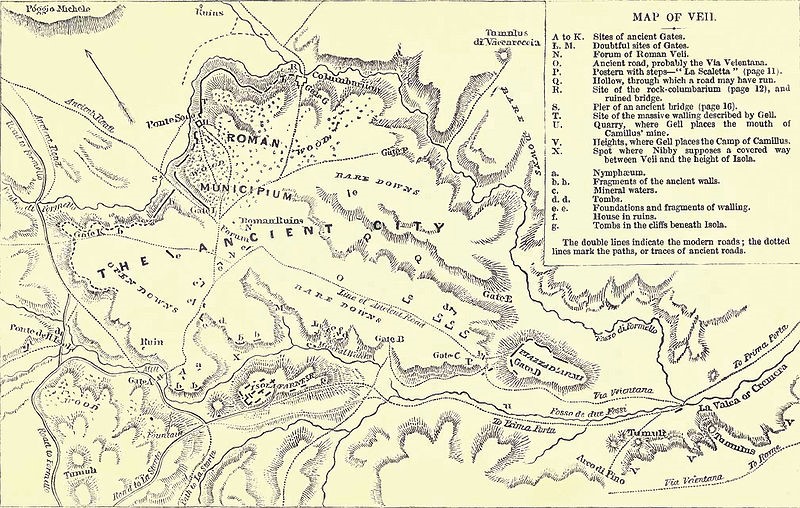
Veii

Map of the ancient Etruscan City-State of Veii (Dennis, Wikipedia.org)

While Rome was busy overtaking Fidenae, the Veientines began to build up walls for defense against the inevitable incoming invasion from Rome. These massive walls proved to be a very difficult obstacle for the Roman army to overcome. The situation did not become any better with the Capenates and the Faliscans joining theVeientines under the assumption that if Rome took Veii they would surely be next. In this particular siege, the Roman’s stood by their defenses year-round, for a documented 10 years according to Livy. “… (Veii) since after being besieged for ten summers and winters and inflicting more loss than it sustained, it succumbed at last to destiny” (Livy, The History of Rome, 5.22). This incredible display of persistence and determination shows the will power and diligence that the Roman army possessed towards their cause. The resources, time, and effort spent in this siege did have lasting negative effects on the people involved during the grueling time of the invasion.

In the end, the solution that yielded the sweet taste of victory was a simple undermining strategy. The men were split into six work forces that would trade off (as one of Rome’s primary advantages was manpower) digging into a mine that was to lead straight into the enemy citadel for invasion. It has been suggested that perhaps the Roman’s ended up using an Etruscan sewer system as a passage, due to the fact that the Etruscans were known for their complex engineering (Lendering, 2014). Once the mine was complete, the Roman army used their established passageway to disoriented the besieged by breaching directly into the besieged land as well as invade from all directions round about the wall, which the Roman’s had ultimate control over. The Veientines were surrounded, and had inevitably lost to the Romans.

The way that Livy documents the news of victory is fascinating as it uncovers the true emotions of victory within the Roman lifestyle. Livy says, “when the capture of Veii was announced in Rome, after so many years of undecided warfare and numerous defeats, the rejoicing was as great as if there had been no hope of success” (Livy, The History of Rome, 5.23). It is also states that the people continued on in a public Thanksgiving for four days. After overtaking the seemingly most probable enemy to the Roman people, the general attitude quickly became one of ease and joy. The Romans had put lots of time and resources into the siege and now finally had the opportunity to reap the benefits, including an “enormous wealth” that was taken from the Etruscans (Livy, The History of Rome, 5.21).

This battle is significant not only to our political and social understanding of Rome, but specifically to the tactical/technological aspects of Rome. The use of undermining and other siege engines clearly demonstrates the progression of siege warfare even early in Rome’s history. The applications of such tactics and technology will only grow in complexity, and ultimately provide greater victories for the Roman’s in the future.


Bibliography

Contributors, Wikipedia. “Battle of Veii.” 30 November 2013. Wikipedia.org. Web. 17 April 2014. <http://en.wikipedia.org/wiki/Battle_of_Veii>.

Dennis, George. “Map of Veii.” 5 November 1848. Map. 17 April 2014. <http://en.wikipedia.org/wiki/File:Map_of_Veii.jpg>.

Lendering, Jona. “Veii.” 23 March 2014. Livius.org. Web. 17 April 2014. <http://www.livius.org/person/marcus-furius-camillus-1/marcus-furius-camillus-2/>.

Livius, Titus. Livy’s History of Rome: Book 5. Ed. Ernest Rhys. Trans. Rev. Canon Roberts. 1905. Web. 17 April 2014. <http://mcadams.posc.mu.edu/txt/ah/livy/livy05.html>.

Nossov, Konstantin. Ancient and Medieval Siege Weapons. Guiolford: The Lyons Press, 2005. Book. 28 March 2014.

Rickard, J (6 October 2009), Siege of Veii, 405-396 B.C. , http://www.historyofwar.org/articles/siege_veii.html

Tucker, Spencer. Battles That Changed History: An Encyclopedia of World Conflict. Santa Barbara, 2011. Web. 17 April 2014. <http://books.google.com/books?hl=en&lr=&id=SWBkx0UlgMAC&oi=fnd&pg=PA25&dq=siege+of+veii&ots=m55OqprHOe&sig=5KbWdDbFwAS1o_1GU1epNXMB1uU#v=onepage&q=veii&f=false>.

Ward-Perkins, J.B. “Veii: The Historical Topography of the Ancient City.” Papers of the British School at Rome 29 (1961). Web. 17 April 2014. <http://www.jstor.org.hal.weber.edu:2200/stable/40310633>.

 

Leave a comment

Filed under Uncategorized

Final Project Blog #6: Medieval Castle Siege: The Siege of Château Gaillard

In the middle Ages, warfare often involved the surrounding and besieging of an enemy castle within their city walls. As I mentioned in previous blog posts, this type of siege-works was completely different from that experienced by the Roman’s in surrounding and starving an entire city, although they did share some commonalities. While Roman sieges were often very long and devastating, they usually did not involve the intense tactical and technological considerations required in breaching castle walls. This change, in part, may be attributed to the reduction of army sizes from Roman to Medieval times, which made sheer brute force against an enemy insufficient and no longer plausible. This is not to say that siege armies had few men, camps of cavalry and other infantry were always part of proper siege works (Morris, 1914), although they were not organized in the same manner that the Roman’s were.  This is to say that when dealing with a compact and concentrated defense structure such as a castle, the attacker was often faced with many tactical problems that required their utmost concentration like never before. In any case, in order to understand castle siege better, it is vital to first consider the basic design and purpose of medieval castles.

Although each castle was unique, they all shared one thing in common… they were nearly impossible to get inside of while under siege. A perfect example of such a structure is that of Château Gaillard, a famous medieval castle. This amazing fortification was build c.a. 1196 under the reign of Richard the Lionhearted of England, and was purposefully placed in a naturally defensible spot as to provide additional protection when confronted with a siege situation. These locational defense precautions taken by castle builders of the time period were appropriate especially as many castles were used as protection for a location of importance. For example, Château Gaillard overlooked the Seine River which was an important transport route at the time (Rigord, 1204). In accordance with these considerations, castle’s designs emphasized heavy fortification and defense as evident by the large walls and towers. Château Gaillard consisted of an outer and inner bailey (or outer and inner wall), along with several defense towers and ditches as mediums of defense (Hamill, 2012). In addition to all of that, Château Gaillard was also built on limestone as to further its sturdiness and protect it against potential undermining. The advanced design of this castle (and many other castles like it) clearly demonstrate that these structures were prepared for the worst, and that is exactly what they faced.

Plan.Chateau.Gaillard

Plan of Château Gaillard showing the outer and inner baileys (Viollet-le-Duc, Wikipedia.org)

In c.a. 1204, the famous besieging of the castle Château Gaillard took place between the kingdoms of France and England, closely following the death of King Richard. King Philip of France was in pursuit of control of Normandy, and Château Gaillard was a central part in his campaign in so doing. In preparation for this six month siege, Philip besieged and overtook several, lesser, castles around the area. When the time became appropriate, the French army finally began to move into position to besiege the English castle. Rigord, a medieval monk, documented the siege’s beginnings saying, “When he had recovered his strength and that of his army he laid siege to Castle Gaillard, in the month of September following. This was a strong fortress which King Richard had had constructed upon a high rock which dominated the Seine near the island of Andelys” (Rigord, 1204). Phillip quickly identified his options and began to contemplate what his next move would be. He concluded that he could either find a way to sneak through his enemy’s defenses by means of breaching, or to open the main gate. The latter of the two seemed less desirable if not impossible, so he and his men immediately began to plot a method of breaching. Soon, the French were executing common medieval siege tactics including the scaling of castle walls and undermining. With the use of siege towers and other Siege Engines, the French were soon pounding through the outer Bailey. These actions did not come without any adversity from the English. By the time the first bailey was decimated, the French had experienced great losses. Although the defender always has a clear advantage in these situations, all good siege artist know that quitting never is an option.

As the French made it through the first Bailey, they quickly re-established themselves and began to work on the second, inner bailey. As I mentioned above, castles were designed to keep the enemy out, which kept the besieged in. This may seem irreverent, but all castle logistics carry some weight of importance to the invasion as a whole. This inability to allow people to leave castle quarters quickly became a major issue in this particular siege, as several local civilians ran to the fortified castle to survive from their burning villages (W. Contributors, 2014). How was this an issue? Well, before long these additional civilians began to greatly increase the consumption rate of the already limited supplies, making the situation within the castle walls even worse. While the defenders within castle tried to do everything possible to make any type of enemy breach impossible, persistence has a way of overcoming if it given enough time. Thus Phillip, now having lost many of his men, came up with a new idea that really encompasses the devotion nested in medieval castle siege tactics. He proposed that they climb up the garderobe, commonly known as a toilet chute. This may sound strange, and perhaps it is, but when an army is trying to breach enemy defenses nothing is too crazy or daring to do if it works… at least that is how they felt. This exploitation of the enemy’s architectural weakness ended up being significant enough that it cost the English the siege and King John was forced give into an inevitable surrender, as was the case for most defending parties of the time period.


Bibliography

Alchin. “Attacking a Castle in the Middle Ages.” n.d. Lordsandladies.org. Web. 17 April 2014. <http://www.lordsandladies.org/attacking-a-castle-in-the-middle-ages.htm>.

Contributors, Wikipedia. “Château Gaillard.” 7 April 2014. Wikipedia.org. Web. 17 April 2014. <http://en.wikipedia.org/wiki/Ch%C3%A2teau_Gaillard>.

Hamill, John. “Chateau Gaillard.” 2012. Johnsmilitaryhistory.com. Web. 17 April 2014. <http://www.johnsmilitaryhistory.com/Gaillard.html>.

“Medieval Warfare: How to Capture a Castle with Siegecraft.” June 12 2006. Historynet.com. Web. 17 April 2014. <http://www.historynet.com/medieval-warfare-how-to-capture-a-castle-with-siegecraft.htm>.

Morris, J. E. “Mounted Infantry In Medieval Warfare.” Transactions of the Royal Historical Society (1914). Web. 17 April 2014. <http://www.jstor.org/discover/10.2307/3678449?uid=2&uid=4&sid=21103915858217>.

Rigord. Deeds of Phillip Augustus. 1204. Web. 17 April 2014. <http://deremilitari.org/2014/03/warfare-in-normandy-1201-1204-according-to-rigords-deeds-of-phillip-augustus/>.

Viollet-le-Duc, Eugene. “A plan of Château-Gaillard.” 1856. Web. 17 April 2014. <http://en.wikipedia.org/wiki/File:Plan.Chateau.Gaillard.png>.

Leave a comment

Filed under Uncategorized

Final Blog Post VI- Alaric’s Sack of Rome

In 410 C.E., led by King Alaric, the Visigoths successfully sacked the city of Rome. This catastrophic event was the culmination of a few years’ attempts, and left the symbolic heart of the Roman Empire in a state of chaos.

Under the emperor Theodosius I, Alaric was actually a strong ally of Rome, as Theodosius realized the benefit of having a great barbarian hoard under his control. Alaric also saw how he could gain power through the arrangement, but when Theodosius died, and his conniving adviser Stilicho, a part-Vandal himself, became “ruler of the West” for the young Emperor Honorius, things began to fall apart for the Visigoth king (Bunson, 2002, p. 12).

At first Stilicho tried to use Alaric and the Goths to his advantage politically and as a pool for recruits. Soon after though, Alaric saw that his people were doing all the dirty work, and became angry at the situation. Stilicho saw the shift of the Goth’s mood, so he attacked Alaric and drove the Goths to the East in 402 C.E. (Bunson, 2002, p. 12). Alaric’s “aggressive intentions” toward Rome at this time can be strongly attributed to the fact that he wasn’t compensated for offering military support when called upon to defend the borders of the empire (Constable, 2003, p. 166). With Stilicho vying for power and the tension growing between the Eastern and Western Empires, Alaric saw that his “position in the East was no longer secure,” which may have also contributed to his invasion of Italy and subsequent sacking of Rome (Bayless, 1976, p. 67).

In retaliation for being crossed, Alaric had actually tried to take Rome in 408 C.E., but was given a large sum to leave in peace. He returned the following year, but was repulsed and “kept outside the Aurelian Wall” (Constable, 2003, p. 167). As part of the deals made to appease Alaric’s lust for power, he was appointed the “magister militum per Illyricum” (Master of the Soldiers in Illyria) (Bayless, 1976, p. 66). However, none of these deals and payments were able to dissuade Alaric, as he set out once again in 410 to try show his dominance in the region and bring Rome to its knees.

Alaric had put all his time and effort “in the siege, and had not been able either by force or by any other device to capture the place,” so he devised a great plan (Procopius, 1916 Trans., p. 13). Alaric chose 300 “youths in the army whose beards had not yet grown,” but “possessed…valor beyond their years,” and offered them as slaves to the Roman nobles (Procopius, 1916 Trans., p. 13). These young men were to “display much gentleness and moderation and serve…eagerly” until a set date when they would slip away and kill the guards at the Salarian gate (Procopius, 1916 Trans., p. 15). Meanwhile Alaric would pull some of his men back and make it appear that the siege was lifted. The foolish Romans fell for the Trojan Horse-like trick and suffered dearly for it.

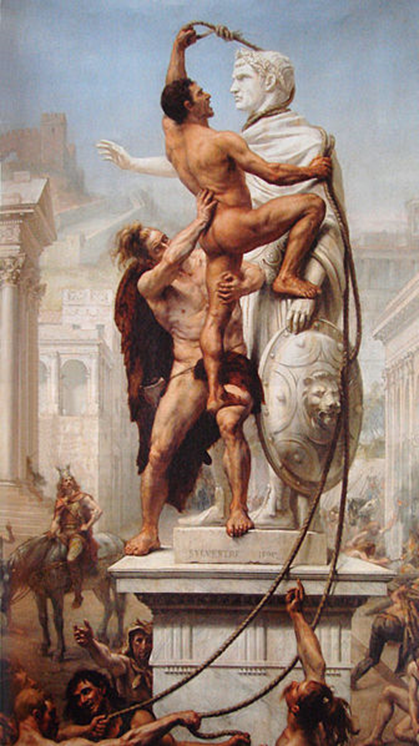
On the appointed day, the young men rushed the guards at the gate and opened it for Alaric’s waiting army. The Visigoths entered Rome, burned down some buildings, then continued to “[plunder] the whole city and [destroy] the most of the Romans” (Procopius, 1916 Trans., p. 17). Alaric’s looting and burning of the city lasted three days, but it was a “relatively restrained affair” compared to the sacking of the Vandals a few decades later (Constable, 2003, p. 167). In the image below, the Goths are shown wreaking havoc on the city, as well as pulling down a Roman monument (Sylvestre (Wikipedia), 1890). It must have been horrifying to awake to the sounds of Goths slaughtering your people and demolishing everything you treasure.

Painting of Visigoths pulling down a monument after entering Rome. Retrieved from http://en.wikipedia.org/wiki/File:Sack_of_Rome_by_the_Visigoths_on_24_August_410_by_JN_Sylvestre_1890.jpg

Painting of Visigoths pulling down a monument after entering Rome. Retrieved from http://en.wikipedia.org/wiki/File:Sack_of_Rome_by_the_Visigoths_on_24_August_410_by_JN_Sylvestre_1890.jpg

Alaric’s sack of Rome was a crippling loss for the Roman Empire. While power had already shifted to other cities like Ravenna and Constantinople, the invasion into the symbol of greatness was the pinnacle event in the fall of the Western Empire. In my opinion, this was also one of their most humiliating defeats, all thanks to the arrogance and stupidity of the Roman elite.

Works Cited

Bayless, W. (1976). The Visigothic Invasion of Italy in 401. The Classical Journal, 72, 65-67. Retrieved from http://www.jstor.org/stable/3296883

Bunson, M. (2002). Alaric. In Encyclopedia of the Roman Empire (p. 12). New York, NY: Facts on File, Inc.

Constable, N. (2003). Historical Atlas of Ancient Rome. New York, NY: Checkmark Books.

Procopius. (1916). History of the Wars: Books III-IV (H. B. Dewing, Trans.). Cambridge, MA: Harvard University Press.

Sylvestre, JN. (Artist). (1890). Sack of Rome by the Visigoths on 24 August 410 by JN Sylvestre 1890 [Web Photo]. Retrieved from http://en.wikipedia.org/wiki/File:Sack_of_Rome_by_the_Visigoths_on_24_August_410_by_JN_Sylvestre_1890.jpg

Leave a comment

Filed under Uncategorized

Final Blog Post V- The Battle of Adrianople

In 376 C.E., the Visigoths’ lands around the Danube River were being invaded by the Huns, so they pleaded for the help of the Eastern emperor, Valens. The Ostrogoths also sought refuge, and Valens saw the situation as a great opportunity to strengthen his position. By allowing the Goths to settle across the Danube, he could get “hardy troops as well as revenues,” giving him a great advantage over his enemies (Burns, 1973, p. 336). So Valens “allowed the Visigoths to cross the frontier and settle in Thrace,” under the condition that they “surrender their arms and submit all male children as hostages” (Scarre, 2000, p. 228; Bunson, 2002, p. 5).

Not long after Valens let the Goths settle within the Empire’s borders, a “general rebellion threatened the entire Danube front,” all thanks to the “avarice and extortion” of the local Roman officials (Bunson, 2002, p. 5; Scarre, 2000, p. 228). The administrators failed to meet the food demands of the many Germanic peoples, which led to a lot of tension among them. As a sign of good faith, a Roman commander called Lupicinus led a large group of Goths to Marcianopolis, a city where he said they would be fed. Instead there was a plot to eliminate the German leadership. Luckily for the Goths, it failed, and one of the leaders that managed to escape Marcianopolis, the Visigoth chief Fritigern, led them in retaliation. After a victorious battle against Lupicinus, Fritigern and his men “armed themselves with Roman arms” and prepared to meet more of their so-called protectors in battle (Burns, 1973, p. 338). It seems the Goths often armed themselves with the fallen Romans’ superior equipment, which must have added to their humiliation when they lost against their own weapons!

While the Western emperor Gratian was working to deal with the angry Goths, Valens realized that he had another opportunity to better his standing- not only to put the barbarian uprisings to rest, but to receive recognition for the great achievement. So in 378 C.E., Valens marched his army of around 60,000 men against the Gothic force of over 100,000 (Bunson, 2002, p. 5). Overestimating his chances, and refusing to wait for Gratian’s legions to arrive, he came upon the Gothic laager (wagon camp), and both armies formed up to fight (Burns, 1973, p. 342).

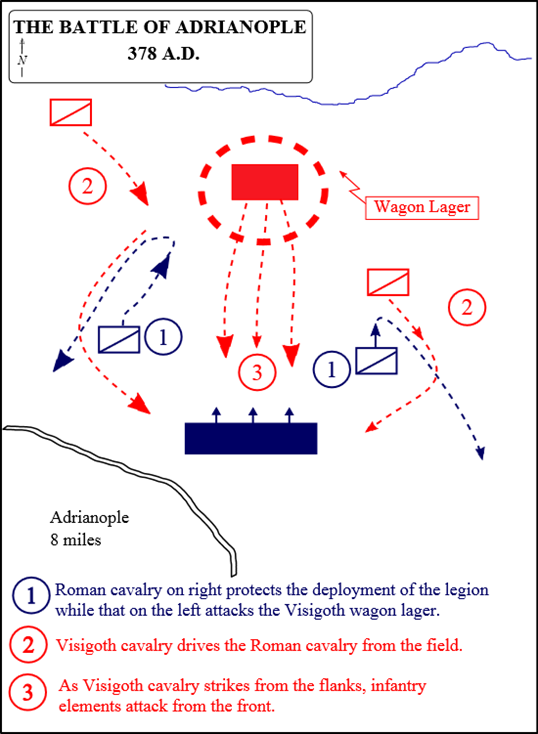
The two armies “dashed together like beaked ships” and alternated in intensity “like waves at sea” (Ammianus Marcellinus, 1939 Trans., p. 473). The Visigoths were pushed back into their wagon camp, but like cornered animals, they refused to give in. Once the Goths managed to overwhelm the left wing of the Roman army, though, the tide of battle quickly turned. As the image below illustrates, the Gothic cavalry (mostly Ostrogothic) was also able to flank the Roman line and surprise them, dealing heavy casualties (Elias84 (Wikipedia), 2010). Amid the chaos, the Roman line fell apart, and they all “scattered in flight over unknown paths,” abandoning Valens’ dream of glory (Ammianus Marcellinus, 1939 Trans., p. 477). Even some of Valens’ great generals made a hasty retreat to get away from the onslaught of the frenzied Germans. Because of the lack of good leadership and the might of the German army, the Roman forces became helpless, but in spite of realizing all hope was lost, they still fought on. Some say that the Ostrogoth charge “revitalize[d] military tactics for the next thousand years,” showing the effectiveness of shock and awe battle tactics (Bunson, 2002, p. 5). Emperor Valens, along with 40,000 Roman soldiers, was slain in battle, although his body was never found (Ammianus Marcellinus, 1939 Trans., p. 479).

Illustration showing how the Romans were beaten at Adrianople. Retrieved from http://en.wikipedia.org/wiki/File:Battle_of_Adrianople_378_en.svg

Illustration showing how the Romans were beaten at Adrianople. Retrieved from http://en.wikipedia.org/wiki/File:Battle_of_Adrianople_378_en.svg

The battle at Adrianople was a major sign of the Roman Empire’s decline. The loss of an emperor was irreparable, and on top of this the Romans were never able to “defeat and disperse this vast group of barbarian tribesmen,” instead offering them land and allowing them to serve as foederati (non-Roman nations that would provide military assistance) (Burns, 1973, p. 336). Perhaps if Valens hadn’t gone off to be a hero, he and Gratian could have mustered up a large enough army to crush the Gothic rebellion, but it seems his pride, like so many other Roman generals before, was his downfall. As a result of the great upset at Adrianople, the barbarians knew they could press the boundaries, that the ideals of Rome were far from invincible, and that it was only a matter of time before Rome itself would fall.

Works Cited

Ammianus Marcellinus. (1939). Ammianus Marcellinus Volume III (J. Rolfe, Trans.). Cambridge, MA: Harvard University Press.

Bunson, M. (2002). Adrianople. In Encyclopedia of the Roman Empire (p. 4-5). New York, NY: Facts on File, Inc.

Burns, T. (1973). The Battle of Adrianople: A Reconsideration. Historia: Zeitschrift für Alte Geschichte. Bd. 22, H. 2, 336-345. Retrieved from http://www.jstor.org/stable/4435342

Elias84. (Artist). (2010). Battle of Adrianople 378. Retrieved from http://en.wikipedia.org/wiki/File:Battle_of_Adrianople_378_en.svg

Scarre, C. (2000). Chronicle of the Roman Emperors: The Reign-by-Reign Record of the Rulers of Imperial Rome. New York, NY: Thames & Hudson.

Leave a comment

Filed under Uncategorized

Final Blog Post IV- The Battle of Teutoberg Forest

One of the most well-known Roman defeats occurred in Teutoberg Forest in 9 C.E. It was in those Germanian woods that the Roman ‘general’ Quintilius Varus and his forces were annihilated by the Cheruscans under the leadership of Arminius. After other successful ventures in Germania, Emperor Augustus had started to “push for full provincial development of the wild German interior” (Bunson, 2002, p. 529). To aid in the Romanization of the Germans, the great administrator Varus was made governor of the region, but while he may have been a great diplomat, Varus was far from what one would call a military leader.

Soon after Varus arrived, revolts began, being led by the Cheruscan prince Arminius, who was actually a former auxiliary of the Roman army (Bunson, 2002, p. 40). Interestingly, another Germanic tribe leader, Segestes, was loyal to Rome and tried to get Varus to see Arminius’ treachery. He even suggested that Varus put all the Germanic leaders, including himself, “in bonds,” because without leaders the people wouldn’t revolt anymore, and in this situation Varus would be more able to determine who his true allies were (Tacitus, 2004 Trans., p. 29). But the inexperienced Varus would not heed his advice, instead “[falling] to fate and Arminius’ violence” (Tacitus, 2004 Trans., p. 29).

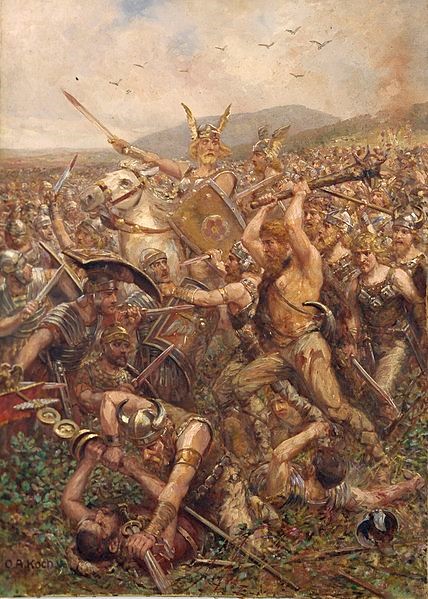
Varus, tricked by his German advisers, left camp with the three legions under his command, and marched them through the rugged and nigh impenetrable terrain of Teutoberg Forest. Slowed down by their baggage train and unable to move forward, nearly 20,000 Romans were slaughtered in a Cherusci ambush (Bunson, 2002, p. 529). The Germans at this time, as the image below shows, weren’t exactly heavily armored (Koch (Wikipedia), 1909). The Romans clearly had the advantage in equipment and discipline, but because the German army vastly outnumbered them, was “powerfully helped by the terrain,” and the Romans were being led by the militarily incompetent Quintilius Varus, they were doomed to destruction (Thompson, 1958, p. 12).

Painting depicting the intense fighting during the Battle of Teutoberg Forest. Retrieved from http://en.wikipedia.org/wiki/File:Otto_Albert_Koch_Varusschlacht_1909.jpg

Painting depicting the intense fighting during the Battle of Teutoberg Forest. Retrieved from http://en.wikipedia.org/wiki/File:Otto_Albert_Koch_Varusschlacht_1909.jpg

As the Germans started cutting the Romans down, Varus was wounded. However, Varus “met his death by a blow from his own luckless right hand,” that is, he killed himself because of his great fear, and while the remaining officers and soldiers fought on bravely, they were eventually defeated (Tacitus, 2004 Trans., p. 32). The few that did survive the onslaught were burned alive in wicker cages. This brutal response to Roman expansion sent a strong message to Rome- that the Germanic tribes would not remain subject to oppressive outside forces.

As a result of the defeat, Varus and his entire force were disgraced. The loss of the legions was a huge blow to the development efforts of Augustus, hindering the flow of Roman influence in this region, and he was deeply affected by the event. While his stepson Tiberius “moved swiftly to the Rhine frontier to prevent any German invasion of Gaul,” he began a period of mourning (Scarre, 2000, p. 24). He stopped cutting his hair and his beard, and was also said to have cried “Quintilius Varus, give me back my legions!” (Scarre, 2000, p. 24). The remains of Varus and his men remained unburied until six years later when the Roman general Germanicus brought his own forces in to avenge Rome’s loss at Teutoberg Forest and suppress the Germanic tribes, but the crushing loss couldn’t have been forgotten.

Works Cited

Bunson, M. (2002). Arminius; Teutoberg Forest. In Encyclopedia of the Roman Empire (p. 40; p. 529). New York, NY: Facts on File, Inc.

Koch, O. (Artist). (1909). Otto Albert Koch Varusschlacht 1909 [Web Photo]. Retrieved from http://en.wikipedia.org/wiki/File:Otto_Albert_Koch_Varusschlacht_1909.jpg

Scarre, C. (2000). Chronicle of the Roman Emperors: The Reign-by-Reign Record of the Rulers of Imperial Rome. New York, NY: Thames & Hudson.

Tacitus. (2004). The Annals (A. J. Woodman, Trans.). Indianapolis, IN: Hackett Publishing Company, Inc.

Thompson, E. A. (1958). Early Germanic Warfare. Past & Present, 14, 2-29. Retrieved from http://www.jstor.org/stable/650090

Leave a comment

Filed under Uncategorized

Final Blog Post III- The Battle of Carrhae

In 53 B.C.E., the Roman Triumvir Marcus Licinius Crassus led his army against that of the Parthians in the arid land of Carrhae in Mesopotamia. Crassus’ intentions were all but noble, as he was most likely invading Parthia with the either the “desire to rival the military exploits of Caesar and Pompey,” or “add to his already legendary fortune” (Mattern-Parkes, 2003, p. 387). Parthia had been going through a lot of internal conflict over succession after King Phraates IV died, so Crassus was under that impression that he could easily conquer the Parthians amid the chaos. Without the consent of the Senate, Crassus led his army of around 36,000 men across the Euphrates River and began his campaign (Bunson, 2002, p. 97). Among his officers were his son, Publius Crassus, and Cassius, who would later be involved in the assassination of Julius Caesar (Bunson, 2002, p. 97).

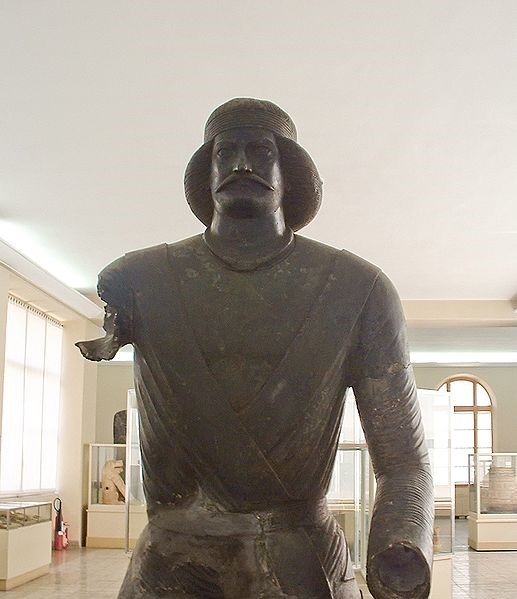
Shown below are the generals of this great battle- the bust of Crassus and a bronze statue that is most likely of the Parthian general Surena (cjh1452000 (Wikipedia), 2009; Julia W (Wikipedia), 2010).

Bust of Marcus Licinius Crassus. Retrieved from http://en.wikipedia.org/wiki/File:Marcus_Licinius_Crassus_Louvre.jpg

Bust of Marcus Licinius Crassus. Retrieved from http://en.wikipedia.org/wiki/File:Marcus_Licinius_Crassus_Louvre.jpg

Bronze statue believed to be Surena. Retrieved from http://en.wikipedia.org/wiki/File:Arm_less_man_edit_3.jpg

Bronze statue believed to be Surena. Retrieved from http://en.wikipedia.org/wiki/File:Arm_less_man_edit_3.jpg

The Parthian successor Orodes was not oblivious to Crassus’ moves, and gave command of all the Parthian forces to a general named Surena, who, despite having a much smaller army than Crassus, had a number of advantages for the battle. For one thing, the Parthians’ mostly cavalry force was made up of “heavy-armed cataphracts and mounted archers” that were “legendarily accurate bowmen,” giving them the edge on the flat plains of Carrhae (Mattern-Parkes, 2003, p. 388; Bunson, 2002, p. 97). A huge mistake Crassus made that benefited the Parthians was that he left the Euphrates River, his only supply line, to meet General Surena’s army (Mattern-Parkes, 2003, p. 388). Without those supplies, the Roman soldiers, who were unaccustomed to the region, would feel the horrible effects of hunger and thirst in the deserts of Carrhae.

If the circumstances weren’t bad enough, Crassus’ army was encircled and ambushed by Surena, causing his soldiers to panic. Crassus hastily ordered the formation of a defensive square, but his son Publius charged the Parthians to buy the Romans more time to form up. Publius’ bravery was short-lived, though, as he was separated from the main line of Roman forces, and his whole detachment was slaughtered, his own head being cut off and put on a spear (Bunson, 2002, p. 97). His death was demoralizing to the rest of the troops, and Crassus was unable to console them.

The disheartened Romans were doomed from the start, due to the superior Parthian tactics, “[f]or if they decided to lock shields” to block the incoming arrows, “the pikemen were upon them in a rush,” but “if they extended their ranks to avoid this, they would be struck with the arrows” (Dio Cassius, 1914 Trans., p. 437). The Parthian army “fought at long range” and on horseback, so the legions were unable to engage their more “mobile opponents” (Matyszak, 2003, p. 179). Crassus tried to keep his men in order, but with the Parthians raining down arrows on them, they broke down and retreated, “abandoning 4,000 wounded to certain death” (Bunson, 2002, p. 97). Crassus “was in the very extremity of fear, and was distraught by the terror of the calamity” (Dio Cassius, 1914 Trans., p. 445). His troubles were far from over, though, as he was pursued by the unrelenting Parthians and the scorching Mesopotamian sun.

With great reluctance, Crassus agreed to hold a negotiation meeting with Surena, but he was killed in the encounter. There is speculation whether Crassus was killed by a Parthian or “one of his own men to prevent his capture alive,” but whatever the case, his forces were subsequently wiped out, with many others being captured, and their eagles, the standards symbolizing legionary power, were taken by the victorious Parthians (Dio Cassius, 1914 Trans., p. 447). As for Crassus, the Parthians “poured molten gold into his mouth in mockery” of his excessive wealth and greed, and held a mock triumph to further insult the Romans (Dio Cassius, 1914 Trans., p. 447).

Crassus’ military campaign could be labeled an “unjust war,” as it was fought on the grounds of personal gain and glory, not retaliation for a past Parthian offense (Mattern-Parkes, 2003, p. 392). With the death of Crassus came the fall of Roman Republic and the emergence of the Empire, as the two surviving triumvirs, Pompey and Julius Caesar, would fight for sole dominance over Rome. Unfortunately for Crassus’ surviving forces, retaliation was out of the question because Rome would become involved in a heated civil war, so the disastrous events that unfolded at Carrhae were never truly reconciled. Carrhae was a horrible loss for the Romans, and a sign that Rome’s greed would only result in tragedy and death.

Works Cited

Bunson, M. (2002). Carrhae. In Encyclopedia of the Roman Empire (pp. 96-97). New York, NY: Facts on File, Inc.

cjh1452000. (Photographer). (2009). Marcus Licinius Crassus Louvre [Web Photo]. Retrieved from http://en.wikipedia.org/wiki/File:Marcus_Licinius_Crassus_Louvre.jpg

Dio Cassius. (1914). Dio’s Roman History Volume III (E. Cary, Trans.). Cambridge, MA: Harvard University Press.

Julia W. (Photographer). (2010). Arm less man edit 3 [Web Photo]. Retrieved from http://en.wikipedia.org/wiki/File:Arm_less_man_edit_3.jpg

Mattern-Parkes, S. (2003). The Defeat of Crassus and the Just War. The Classical World, 96, 387-396. Retrieved from http://www.jstor.org/stable/4352789

Matyszak, P. (2003). Chronicle of the Roman Republic: The Rulers of Ancient Rome from Romulus to Augustus. New York, NY: Thames & Hudson.

Leave a comment

Filed under Uncategorized

Final Blog Post II- The Battle of Arausio

In 105 B.C.E., the Romans felt the backlash of the Germans at the great battle of Arausio, which is now known as Orange, France.  As the Roman Republic began expanding its territory, they had to deal with “unrest and hostility” all across their lands, and as such, became involved in a number of conflicts (Cornell and Matthews, 1982, p. 60).  In the various wars being fought at the time, “[t]he Romans incurred…some heavy defeats, notably at Arausio” (Crawford, 1969, p. 80).  Arausio was part of an “unprecedented series of military reverses,” as the Roman army clearly had the better equipment and discipline (Cornell and Matthews, 1982, p. 60).  Their forces were spread far too thin, and with a large army marching through their territory, it seems they should have tried to avoid engaging the enemy at all costs.

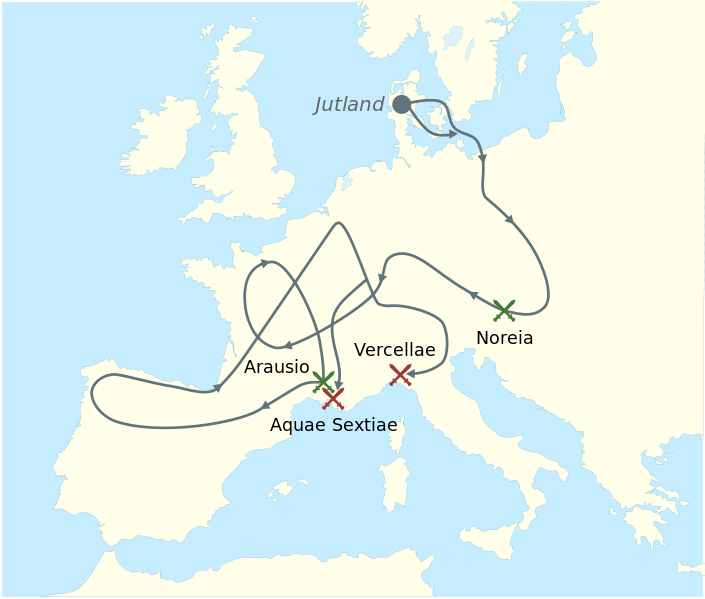
Map showing the warpath of the massive Germanic army. Retrieved from http://en.wikipedia.org/wiki/File:Cimbrians_and_Teutons_invasions.svg

Map showing the warpath of the massive Germanic army. Retrieved from http://en.wikipedia.org/wiki/File:Cimbrians_and_Teutons_invasions.svg

The image above shows the victories (green swords) and defeats (red swords) of the massive Cimbri and Teuton force that swept through Europe and Roman territory (Pethrus (Wikipedia), 2010).  This Germanic army, estimated at around 300,000 men, was marching from the north, crushing all opposition, and while they did suffer some losses, as the map shows, these were only minor setbacks to their cause (Matyszak, 2003, p. 152).  Unfortunately for the Romans, the battle at Arausio was no different.

The Roman army of around 80,000 men came out to meet them, being led by the consul Mallius Maximus and proconsul Quintus Servilius Caepio (Matyszak, 2003, p. 152; Hornblower, et al, p. 1354).  Arausio turned out to be more of a massacre that “left Italy at the mercy of the Germans” (Cornell and Matthews, 1982, p. 60).  “According to Valerius Antias, 80,000 soldiers and 40,000 servants and camp followers of the Romans were slain at Arausio” (Lendering: Livy, Book 67).  “Caepio, who had caused the defeat by his rashness, was convicted” (Lendering: Livy, Book 67).  Apparently, Caepio had disregarded the authority of Mallius Maximus, “[refusing] to co-operate” with him, which “led to the disaster at Arausio” (Hornblower, et al, p. 1354).  As part of his punishment for attacking the Germanic army rather than trying to negotiate, as Mallius intended, Caepio’s wealth was seized, he lost all his power in the senate, and he was forced into exile.

The humiliating defeat at Arausio was an early example of unrest among the Germanic tribes, even before the empire had begun.  It was a clear sign that peace times in the empire would be few and far between, and that the oppressed peoples under Roman rule would be anything but submissive.  Luckily for the Romans, though, the barbarian hordes’ conquest took them west to Spain instead of east into Italy, where no Roman army would have been available to hold them back (Pethrus (Wikipedia), 2010).  This gave the new Roman consul Gaius Marius the chance to make reforms to the military, as he is well-known for (Matyszak, 2003, p. 152).  He altered the training, such as by having the soldiers practice fighting gladiator style, and adjusted “the Roman battle array to resist the barbarian assault” (Matyszak, 2003, p. 152).  While these military revamp measures benefited the Roman army for years to come, the horrible defeat at Arausio couldn’t have been forgotten, because “at that moment Rome was faced with complete extinction” (Cornell and Matthews, 1982, p. 60).


Works Cited

Cornell, T., & Matthews, J. (1982). Atlas of the Roman World. New York, NY: Facts on File, Inc.

Crawford, M. (1969). Coin Hoards and the Pattern of Violence in the Late Republic. Papers of the British School at Rome, 37, 76-81. Retrieved from http://www.jstor.org/stable/40310672

Hornblower, S., Spawforth, A., & Eidinow, E. (Eds.) (2012). Caepio, Quintus Servilius. In The Oxford Classical Dictionary (Fourth Edition) (p. 1354). Oxford, UK: Oxford University Press.

Lendering, J. (March 23, 2014). Livy: Periochae 66-70. Livius.org. Retrieved March 23, 2014, from http://www.livius.org/li-ln/livy/periochae/periochae066.html#66

Matyszak, P. (2003). Chronicle of the Roman Republic: The Rulers of Ancient Rome from Romulus to Augustus. New York, NY: Thames & Hudson.

Pethrus. (Designer). (2010). Cimbrians and Teutons invasions [Web Photo]. Retrieved from http://en.wikipedia.org/wiki/File:Cimbrians_and_Teutons_invasions.svg

Leave a comment

Filed under Uncategorized

Final Blog Post I- The Battle of Cannae

At Cannae in 216 B.C.E., the Roman army faced off against the Carthaginians led by Hannibal. Here, “Hannibal won his greatest victory” and caused “one of Rome’s worst military disasters” (Cornell and Matthews, 1982, p. 46). As part of a “renewed effort from Rome” during the Second Punic War, two large consular armies were sent out to crush Hannibal (Matyszak, 2003, p. 95). Tension and conflict were high at this time, with both Rome and Carthage executing bold strategies in attempts to devastate the other, but in the decisive battle at Cannae, Hannibal was the victor.

The two elected consuls of Rome- Lucius Aemilius Paullus and Gaius Terentius Varro- were put in charge of the legions for this battle, but it was ultimately the folly of Varro that caused the loss. Aemilius had “argued against a battle, since the surrounding area was flat and treeless, and the enemy had cavalry superiority,” but the inexperienced Varro superseded his advice and marched on the Carthaginian camp (Polybius, 2010 Trans., p. 215). Hannibal launched a surprise attack with his cavalry and light infantry that “caused considerable disruption in the Roman column,” but the Romans were able to recover from the blow (Polybius, 2010 Trans., p. 215). They set up a defensive screen, and it appeared that they “had the advantage all over the field,” especially because Hannibal “had no reserves to speak of” (Polybius, 2010 Trans., p. 216).

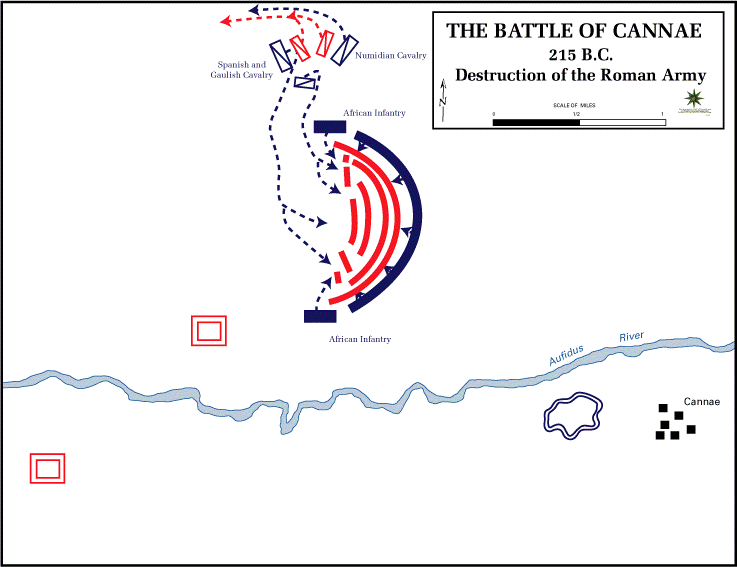
After the skirmish ended, the two forces separated and made preparations for the battle that would ensue. The Romans set up two palisaded camps on either side of the river Aufidus, with the Carthaginians setting up only one. With tensions rising and a major conflict inevitable, Varro had all the Roman soldiers form up, with nearly 80,000 infantry and 6,000 cavalry (Polybius, 2010 Trans., p. 218). Hannibal moved his own troops (40,000 infantry and 10,000 cavalry) into a “single, straight line,” but then had them create a “crescent-shaped bulge,” a brilliant tactical move that would come into play later in the battle (Polybius, 2010 Trans., p. 218).

The heavy infantry of the Romans were able to fight back the Iberians and Celts in the center of Hannibal’s army, destroying the crescent bulge. With their lines too thin, Hannibal drew them back and proved his strategic genius. The Romans had unknowingly rushed after the retreating Celts, only to become trapped by the Libyan portions of the Carthaginian army. They were flanked on both sides and completely helpless. As the image below shows, Hannibal defeated the Romans with a “classic envelopment maneuver,” surrounding their forces by collapsing the middle of his own line (GhePeU (Wikipedia), 2006; Matyszak, 2003, p. 95). The Numidian cavalry, which “were most effective and dangerous once they had the enemy on the run,” followed the fleeing Romans and cut them down (Polybius, 2010 Trans., p. 220).

Around 70,000 Romans died in the battle, along with their great leader Aemilius and other generals. Most of those that survived were captured, but a few managed to escape, including the one “largely responsible” for the loss, Varro, who was from then on labeled “a man of no redeeming qualities” (Matyszak, 2003, p. 98; Polybius, 2010 Trans., p. 221). While the Carthaginians sustained thousands of casualties, the Romans suffered far greater.

Image showing the layout of the battle of Cannae.  Retrieved from http://en.wikipedia.org/wiki/File:Battle_cannae_destruction.gif

Image showing the layout of the battle of Cannae. Retrieved from http://en.wikipedia.org/wiki/File:Battle_cannae_destruction.gif

The impacts of this defeat were severe for the Romans, as their loss was a sign of weakness to their allies. Strong alliances during this time would have been crucial, as Rome and Carthage were involved in the Second Punic War. After Cannae, there were “some defections…among the allies, and large areas of the south [in Italy], went over to Hannibal” (Cornell and Matthews, 1982, p. 46). “[T]he defection of Roman allies in the aftermath of Cannae” allowed Hannibal to continue to fight, although he was “forced to forego his march on Rome” due to “[t]he lack of a permanent base of supply” (Shean, 1996, p. 168; p. 174). In fact, many historians believe that “Hannibal’s best opportunity for a decisive victory was immediately following” the battle fought at Cannae (Shean, 1996, p. 159).

There is no doubt that Cannae was a military catastrophe for the Romans, and it could have meant Rome’s doom, but despite the shift of power in the region, “[t]he Romans’ blind refusal to admit defeat” made them tough to extinguish (Cornell and Matthews, 1982, p. 46). If things had gone the way Hannibal planned, it is likely that Rome itself would have fallen, but the “constitution and…sound deliberation” of the Romans “enabled them to regain dominion over Italy,” enact their revenge on Hannibal and Carthage, and make themselves “masters of the entire known world” (Polybius, 2010 trans., p. 222).

Works Cited

Cornell, T., & Matthews, J. (1982). Atlas of the Roman World. New York, NY: Facts on File, Inc.

GhePeU. (Artist). (2006). Battle cannae destruction [Web Photo]. Retrieved from http://en.wikipedia.org/wiki/File:Battle_cannae_destruction.gif

Matyszak, P. (2003). Chronicle of the Roman Republic: The Rulers of Ancient Rome from Romulus to Augustus. New York, NY: Thames & Hudson.

Polybius. (2010). The Histories (R. Waterfield, Trans.). New York, NY: Oxford University Press.

Shean, J. (1996). Hannibal’s Mules: The Logistical Limitations of Hannibal’s Army and the Battle of Cannae, 216 B.C. Historia: Zeitschrift für Alte Geschichte, Bd. 45, H. 2, 159-187. Retrieved from http://www.jstor.org/stable/4436417

Leave a comment

Filed under Uncategorized

The History of the Trojan War

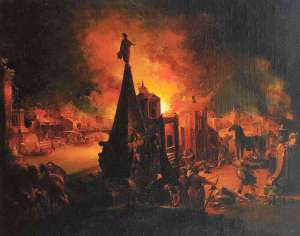
Figure 1: A depiction of the Siege of Troy

Figure 1: A depiction of the Siege of Troy (Trautmann)

The Trojan War, which occurred sometime between 1260 and 1240 BC, was fought between the Greeks and the Trojans in the city of Troy. According to Greek mythology, the war was initiated when the goddesses Hera, Aphrodite, and Athena began to quarrel when Eris gave them the Apple of Discord, which was marked for the fairest. Paris judged that Aphrodite was the fairest and she received the apple. In return, Aphrodite made the wife of Menelaus, Helen, fall in love with Paris. This angered Menelaus, which caused him to have troops, led by his brother Agamemnon, to siege the city for over ten years.

Many historians disagree as to whether the Trojan War actually occurred. Many pieces of evidence of the war come from various pieces of Greek art. “A great proportion of Greek and Roman art can be connected with legends that stem from the Trojan War” (Sparkes, 54). “The most important literary sources are the two epic poems traditionally credited to Homer, The Iliad and The Odyssey, composed sometime between the 9th and 6th centuries BC” (Wikipedia Contributors). In The Odyssey, Homer writes of Odysseus who has not returned home from the war. He mentions the Trojan War in the first sentence of this poem. “Tell me, O muse, of that ingenious hero who travelled far and wide after he had sacked the famous town of Troy” (Homer, 1).

In Homer’s epic poem The Iliad, he “never overtly refers to the ruse of the wooden horse” (Franko, 121), but he does allude to the horse three times near the end of the poem. Greek legend states that the war was ended when the Greeks constructed a large hollow wooden horse. He filled the horse with soldiers and delivered the horse to the Trojans’ camp. The Trojans accepted the horse, which was a sacred animal to them, and the soldiers emerged from within and sacked Troy.

Bibliography

Franko, George Fredric. “The Trojan Horse at the Close of the Iliad.” Classic Journal. 101.2 (2005/2006): 121. Web. 20 Apr. 2014. <http://www.jstor.org/discover/10.2307/30038644?uid=3739256&uid=2&uid=4&sid=21104040000563&gt;.

Homer. The Odyssey. 800 BC. 1. Print.

Sparkes, B.A. The Trojan Horse in Classical Art. 18. Cambridge University Press, 1971. 54. Web. <http://www.jstor.org/discover/10.2307/642388?uid=3739256&uid=2&uid=4&sid=21104040000563&gt;.

Trautmann, Johann Georg. Blik Auf Das Brennende Troja. 1759. Painting. Wikipedia: The Free EncyclopediaWeb. 20 Apr 2014. <http://en.wikipedia.org/wiki/File:J_G_Trautmann_Das_brennende_Troja.jpg&gt;.

Wikipedia Contributors. “Trojan War.” Wikipedia: The Free Encyclopedia. 05 Apr 2014. Web. 20 Apr 2014. <http://en.wikipedia.org/wiki/Trojan_war&gt;.

Leave a comment

Filed under Uncategorized

DUE DATE CLARIFICATION

Logon to Canvas  for more information about due dates.

Reports are due tomorrow.  Final due date for all six blogs and the  one blog for people doing projects is next Thursday, April 24.

Leave a comment

Filed under Class Stuff