The Column of Trajan Assignment

The goal of this assignment is to get you to look at the benefits and perils of using non-text primary sources,  in this case art.  Specifically, I’ve asked you to look at different scenes from the Column of Trajan.

1.  Look at scenes about your topic and see what it tells you about the subject.  Can you figure out weapons?  What they’re wearing?  What they’re doing?  How do the various scenes support (or not) the information you’ve read in your textbook (Matyszak. Legionary) and elsewhere?

2.  Once you’ve done that,  it’s time for the harder part.  Art is not created, nor does it exist, in a vacuum.   When it’s created, why it’s created, how it’s created, what it’s made from, all affect the finished product.  As you look at your scenes, think about why Trajan had the column created, why the particular scenes that are shown might have been chosen (for example:  look at the Dacians.  How are they portrayed? ), how the choice of a column affected the design, etc.

3.  Once you’re ready to post, be sure to give proper credit for the scene and the cartoon, if you use one.  Mr. Peter Rockwell  has kindly given us permission to use his pictures in our blog.  Directly under each image, you need to use the caption feature to give credit.  For help using the caption feature see: http://en.support.wordpress.com/images/#insert-an-image-from-the-web  – the easiest way is to click on the highest resolution image available then copy the URL.

4.  The caption should give the following information:  Scene number if available,  subject of image.  Used with permission.  Copyright Peter Rockwell.  Via http://URL of the image you used.

5.  You also need to credit the image at the end of your post using the correct APA or MLA style.

For example:

Scene from the Column of Trajan

Scene 110. Legionaries foraging. Used with permission. Copyright Peter Rockwell. Via http://www.stoa.org/trajan/images/hi/2.27.h.jpg

Leave a comment

Filed under Class Stuff

Hannibal’s Roman prisoners

http://www.history.com/flash/VideoPlayer.swf?vid=82261632401

I couldn’t get this video to embed correctly. This is a video created by the History Channel on the Battle of Cannae. There were also some enjoyable YouTube videos of Cannae as well; however, I could not figure out how to give due dilligence.

August 2 of 215 BC, on the field of Cannae 50,000 Romans lay dead. Eight-thousand prisoners have been captured and the victorious Hannibal following the customs of war had made preparations to capitalize on the situation. Modern scholars and historians Livy and Polybius alike speculate Hannibal was in need of provisions in particular financial support for his campaign and fresh troops. As such, Hannibal may not have wanted take Rome, rather it is possible he only wanted to decrease its power and therefore sent an embassy of roman prisoners to settle the negotiations of defeat.

Note: Roman prisoners of war lost their citizenship and patriarchal rights afforded to them. In effect they became the property of the enemy to be exploited or killed as the victor saw fit. However, a roman prisoner of war could gain his freedom by paying his ransom, being recaptured (treated), or possibly petition for freedom if he escaped (Brill’s New Pauly, 878).

Unfortunately for Hannibal, at some point at the during the close of the First Punic War, the customs of prisoner exchange had changed in Rome. The governing body in Rome felt no obligation to uphold the customs of the world which they helped establish (Hopkins, 17-18). This change was an ethical change in society which now held strong belief of honor and what it meant to be a soldier of Rome. Romans were not apt to negotiate terms upon their defeat. Hannibal may have underestimated the pride and society of the Roman state (Lazenby, 42).

Perhaps this Roman notion of honor is best understood from the senator T. Manlius Torquatur, who was under the persuasion to disallow the liberation of the prisoners of war despite the public opinion. He argued two points. First, the prisoners were idle cowards who made no attempt to save themselves. And second, they didn’t truly defend the camp, and in actuality gave up, reserved to their fate as prisoners of war (Livy, 22.60).Further Livy records the senators held other reservations against the ransoming of the captive Romans, the most noteworthy being monetary (22.61). O’Connell coincides that the refusal for the ransoming of the slaves was strictly a monetary one. As he makes claim that the families of the captive soldiers were denied that ability to pay the ransom (168).

Nonetheless, upon these points the senate voted against the ransoming of the prisoners. The decision from the senate was to Hannibal’s dismay, the prisoners we sold into slavery and some slaughtered (O’Connell, 168). Hannibal was ineffective in convincing Roman allies to defect. Thus, Hannibal’s plan was then thwarted as his ability acquire necessary provisions for his army and his ability to create battle with the learning Romans.

Works cited:

“Hannibal Leads Carthaginians.” 2012. The History Channel website. Feb 22 2012, 9:29 http://www.history.com/videos/hannibal-leads-carthaginians-over-romans.

Hopkins, Tighe. Prisoners of War. London : Simpkin, Marshall, Hamilton and Kent Co 1914.

Livy, Titus. “Livy’s History of Rome: Book 22 The Disaster of Cannae.” The History of Rome, Vol. III  http://etext.lib.virginia.edu/etcbin/toccer-new2?id=Liv3His.sgm&images=images/modeng&data=/texts/english/modeng/parsed&tag=public&part=2&division=div1  18 Feb. 2012. Online.

Lazenby, John. Was Maharbal Right?. Bulletin of the Institute of Classical Studies, 41: (1996) 39–48. Print. doi: 10.1111/j.2041-5370.1996.tb01912.x

Messer, Rick Jay. The influence of Hannibal of Carthage on the art of war and how his legacy has been interpreted. MA thesis. Kansas State University Manhattan, Kansas 2009. Print.

O’Connell, Robert L. The ghosts of Cannae : Hannibal and the darkest hour of the Roman republic. New York : Random House, 2010. Print.

“Romans as Prisoners of War.” Brill’s New Pauly: Encyclopedia of the Ancient World. Antiquity Vol. 11 English Ed. 2007.

2 Comments

Filed under Uncategorized

Politics and War: Scipio Africanus and the Battle of Zama

Meeting of Hannibal and Scipio at Zama. Adapted from Young Folks' History of Rome by Charlotte Mary Yonge. “Battle of Zama.” Wikipedia.com. Wikipedia. Web. 16 Feb. 2012.

The first Punic War (264-241 B.C.) began as a small conflict in Sicily which quickly escalated into an all out war between Carthage and Rome (“Punic Wars”). The Romans won many of the battles, and the war eventually ended with a peace treaty that gave the Romans control of Sicily. Twenty-two years later (219 B.C.) Hannibal “attacked Saguntum in Hispania, a city allied to Rome, starting the second Punic War” (“Punic Wars”). After suffering a major defeat at Cannae, the Roman armies under the direction of Publius Cornelius Scipio (Scipio Africanus) traveled to Africa and prepared for the Battle of Zama.

From the accounts given of him, Scipio Africanus appears to have been not only a strong general, but also a capable politician in the time surrounding the battle of Zama. There was significant initial resistance to Scipio’s plan to attack the Carthaginians in their own territory by the Roman Senate. They were “persuaded by Fabius Maximus that the enterprise was far too hazardous” (“Battle of Zama”). However, Scipio, who had been elected a consul because of his recent victories against the Carthaginians, apparently had enough political savvy and support to convince the Senate to let him go, but not enough to convince them to supply him with an army of anything more than volunteers (“Battle of Zama”). Eventually he did receive the support of formal troops.

Scipio’s language during the battle of Zama also indicates political savvy. Polybius recounted that Scipio’s reply to a speech made by Hannibal at the beginning of the battle was “That neither in the Sicilian nor Iberian war were the Romans the aggressors, but the Carthaginians” and that “the gods themselves had confirmed this by giving the victory…to those who acted only in self-defense” (Polybius 15.8). This is, of course, frankly false. The first Punic War was started because of offenses on both sides, but Scipio’s statement, if recorded accurately, would have served to validate the actions of his troops and intimidate his enemies. Though it is possible that Polybius may have distorted Scipio’s language in order to strengthen the “righteous” image of the Roman army in the second Punic War, and though it is possible that Scipio himself may have believed that they Romans were completely innocent, it is not outside the realm of possibility that Scipio might have used such a tactic purposefully to his advantage.

One of the strongest indications of Scipio’s political prowess, however, came at the end of the battle. As part of the treaty to end the war after the Carthaginians had been defeated, Scipio requested various things including “a hundred hostages of their good faith, —such hostages to be selected from the young men of the country by the Roman general, and to be not younger than fourteen or older than thirty years” (Polybius 15.18). According to M. James Moscovish, “the Senate had authority to amend treaty clauses issued by its generals in the field, but in the case of Scipio’s terms with the Cartheginians…the Senate ratified them without change” (418). Though the Senate might have changed any number of terms in the treaty, they remained satisfied with Scipio’s decisions. This seems to indicate that Scipio had either enough insight into the Senate to create a treaty that supported their interests, or enough influence because of the significance of his victory that the Senate wanted to pacify him. Either way, Scipio’s political and military abilities during the battle of Zama significantly impacted the empire.

Works Cited

“Battle of Zama.” Wikipedia.com. Wikipedia. Web. 16 Feb. 2012.

Polybius. Histories. Perseus Digital Library. Ed. Gregory R. Crane. Tufts University. Web. 16 Feb. 2012.

“Punic Wars.” Wikipedia.com. Wikipedia. Web. 16 Feb. 2012.

Muscovich, M. James. “Hostage Regulations in the Treaty of Zama.” Histora: Zeitschrift fur Alte Geschichte. 23.4 (4th Qtr., 1974): 417-427. JSTOR. Web. 16 Feb. 2012

Leave a comment

Filed under Uncategorized

The Diverse Weaponry of Hannibal’s Carthaginian Army

Hannibal employed many soldiers from many different places. His army consisted of soldiers from Africa, Spain, Italy and he even had Celtic soldiers. Each group of soldiers brought their own culturally used armour and weapons to battle with the Romans.

The African soldiers wore very colorful uniforms that came in different varieties. The heavy infantry wore chain mail over their clothes and carried heavy shields. They mostly fought with an assortment of exotic weapons which they were well trained with and proved to be useful and deadly when they wielded them. They also used spears and long and short swords.

The Iberian or Spanish soldiers carried wooded shields and used sling and javelins as well as swords and spears. The heavy infantry also wore chain mail and used the typical heavy roman sword.  They also used the falcata which is a sickle shaped sword made of iron or steel. The falcata is made from 3 lamina or sheet of steel.

an Iberian Falcata

The Celts or Gauls were armed simple iron long swords. The swords weren’t of very good quality and were used more effectively when hacking rather than stabbing (Polybius).  Both Plutarch and Polybius describe the Celts as often ceasing fighting so as to straighten their swords. Polybius and Livy also assert that the Celts didn’t wear any armour and often fought naked.

Sources

Wikipedia contributors. “Carthiganian Army.” Wikipedia, The Free Encyclopedia. Wikipedia, The Free Encyclopedia, Web. [Cited 17 Feb. 2012.] http://en.wikipedia.org/wiki/Carthaginian_Army

Wikipedia contributors. “Hannibal.” Wikipedia, The Free Encyclopedia. Wikipedia, The Free Encyclopedia, Web. [Cited 17 Feb. 2012.]

Knox, E.L. Skip. The Punic Wars: Battle of Cannae. Boise State University History of Western Civilization. [Cited 17 Feb 2012.] http://www.boisestate.edu/courses/westciv/punicwar/09.shtml

Shean, John F. Hannibal’s Mules: The Logistical Limitations of Hannibal’s Army and the Battle of Cannae, 216 B.C.. Franz Steiner Verlag, 1996. [Cited 16 Feb 2012.] http://www.jstor.org/stable/4436417

Pleiner, Radomir. ”The Celtic Sword.” Oxford: Clarendon Press (1993). Print. [Cited 16 Feb 2012]

http://www.unrv.com/empire/invasion-of-italy.php [Cited 16 Feb 2012 Web]

Polybius. Shuckburgh, Evelyn S. (trans.) “Histories”. London, New York. Macmillan. 1889. Reprint Bloomington 1962. Perseus.tufts.edu. [Cited 16 Feb 2012] Web http://www.perseus.tufts.edu/hopper/text?doc=Perseus:text:1999.01.0234:book=15:chapter=9

Livius, Titus. “The History of Rome”. Electronic Text Center, University of Virginia Library. Web  [Cited 16 Feb 2012] http://etext.lib.virginia.edu/etcbin/toccer-new2?id=Liv4His.sgm&images=images/modeng&data=/texts/english/modeng/parsed&tag=public&part=5&division=div1

Polybius. “The Battle of Cannae.” Fordham University.  [Cited 16 Feb 2012] Web http://www.fordham.edu/halsall/ancient/polybius-cannae.asp

Leave a comment

Filed under Uncategorized

Ancient Military Medicine in the Battle of Cannae

The Battle of Cannae was fought between the Romans Republic and the Carthaginian Republic.  The Carthaginian commander was Hannibal and the Roman commanders were Gaius Terentius Varro and Lucius Aemilius Paullus.  The war took place near Cannae a town in southeast Italy. Hannibal’s army defeated the Roman army even though the Roman army was greater in number.  The victory is credited to the fact that Hannibal’s army used superior tactics and they were united in their efforts (The Battle of Cannae).

The health of the soldiers before the war and the treatment of the wounded during and after the war was an important part of maintaining the effectiveness of an army. The conditions that the soldiers had to endure and the number of people in an area created complications for the sick and the wounded.  During that time in history medical facilities where important and many times would be based in temporary camps.  The Greeks and the Romans both had made many discoveries for medical treatments by this time in history, so it was not uncommon to have a doctor (medicus) who was highly skilled as well as assistants who would oversee the operation of the medical facility (Goldsworthy).

Ancient Medical Tools

http://en.wikipedia.org/wiki/Medicine_in_ancient_Rome#Surgical_Tools_used_in_ancient_Rome.5B3.5D


Works Cited

Goldsworthy, Adrian. The Complete Roman Army. London: Thames & Hudson Ltd., 2003.

The Battle of Cannae. 8 Feb 2012. 16 Feb 2012. <http://en.wikipedia.org/wiki/Battle_of_Cannae&gt;.

Leave a comment

Filed under Uncategorized

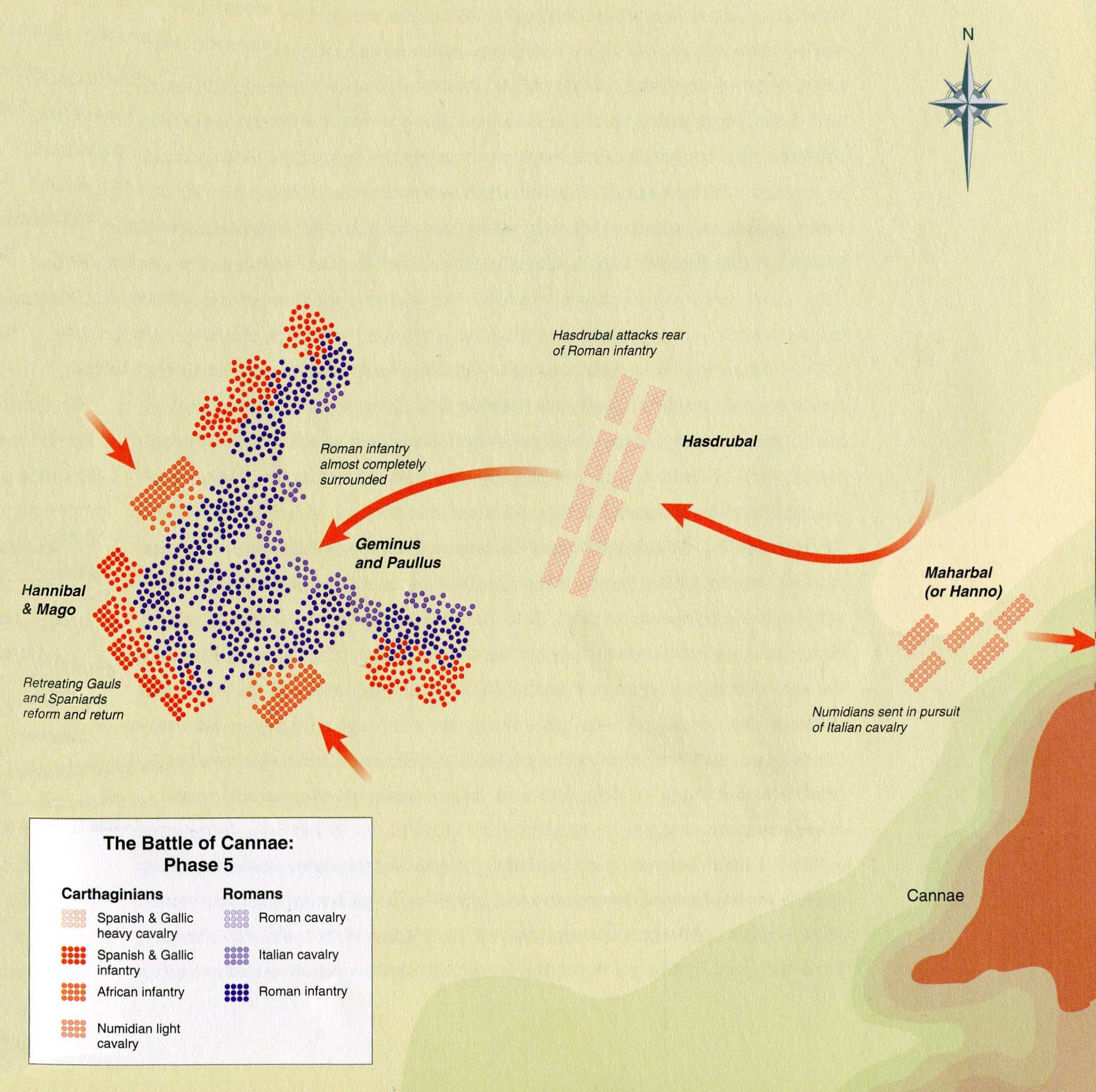
Strategic Formations of the Battle of Cannae

August, 216 B.C: near the small township of Cannae, a mere two hundred fifty miles from Rome, Hannibal of Carthage and his army prepared for battle. They were faced off against the legions of Aemilius Paullus and Caius Terrentius Varro, the Consuls of Rome. Under normal circumstances, one consul and a couple of legions was enough to stir optimism in a Roman victory. “On the occasion in question, however, they were so alarmed and terrified that they decided to send not just four, but eight Roman legions into battle at once” (Polybius 213) as well as both of their consuls. These were also extended legions, each consisting of 5000 infantry and 300 cavalry instead of 4000 and 200 respectively (Lancel 104). Legionary command alternated every other day for Paullus and Varro, who disagreed on nearly everything. On August 2, 216 B.C., it was Varro’s turn to command the army. Just after sunrise, he led his troops out onto the battlefield, forming a continuous line facing south. Aemilius commanded the right wing of 2,400 Roman cavalry posted near the river Aufidus. Center force of 55,000 heavy infantry  and forward center position of 15,000 light infantry(McKnight 7) was commanded by the previous year’s consuls, Atilius and Servilius (Polybius219). Varro headed the Allied cavalry of 3,600 on the left wing. In total, the Roman army was a force of approximately 86,000 men.

Hannibal’s army of 50,000 was much smaller than that of the Romans. However, he also had cavalry superiority, which was perfect for the flat and treeless battlefield they would be fighting on. Hasdrubal was in charge of the Spanish and Gallic cavalry of 6,500 on the left wing near the river. Hannibal and his brother, Mago, commanded the center of 10,000 Libyans, 6000 Spaniards, and 1,250 Gauls/Celts as well as the 11,500 light infantry that took up the forward position. Right wing made of  3,500 Numidian cavalry was commanded by Hanno (McKnight). The fighting had begun: it was Hasdrubal’s Spanish/Gallic cavalry versus Paullus’ Roman cavalry near the river, the main bodies of infantry in the center, and Hanno’s Numidian cavalry versus Varro’s Roman Allied cavalry on the opposite side.

Varro’s plan was to smash through the Carthaginian center using sheer weight of numbers. To further this ideal, he reduced the gaps between the maniples in each line and made each maniple very deep (Goldsworthy 97) increasing its power but sacrificing its order and flexibility. Hannibal took his straight line of infantry and moved the center forward, making a crescent shaped line that protruded out toward the enemy (Polybius 218).

Outcome and movements of the Roman and Carthaginian armies

 Near the river Afidus, Hasdrubal’s cavalry engaged Paullus’ Roman cavalry. Varro hoped that the cramped space between the river and the flank of the river army would cancel out any advantage Hasdrubal may have had in making a mobile attack. However, the Gauls and Spaniards were used to fighting in close quarters (McKnight 11). Their ferocity decimated the Roman cavalry, whose survivors were chased along the riverbank and slaughtered. Paullus escaped and rejoined the main conflict in the center.

 The Roman line of infantry had become much thicker in the center, since Hannibal’s formation provoked the Romans to attack there first.  The thin crescent line of Gauls and Spaniards began to fall back under the pressure of the densely packed maniples. As they gave way and swiftly retreated, the Romans chased after them. Exploiting their supposed success, maniples from behind as well as large numbers from the sides were drawn into the struggle. The Roman infantry was now more like a frenzied crowd than an organized body of soldiers. (Goldsworthy147)

 Meanwhile, the Numidian Cavalry on Hannibal’s right wing attacked the Roman Allied Cavalry facing them. The Numidians harassed them from all sides, taking turns at throwing javelins and then running away. They did not inflict or sustain any major damage but at the same time distracted the Roman allies from aiding the infantry in the main conflict.

 Hasdrubal’s cavalry had regrouped and came over to assist the Numidians. The outnumbered Roman Allies panicked and fled. The remaining Allied horsemen were picked off by the pursuing Numidians, whose peculiar tactics became more dangerous once they had the enemy on the run (Polybius 220).

During this time, the Roman legions rushed right into Hannibal’s trap. In pursuit of the fleeing Gauls and Spaniards, the Romans had continued so far forward that they exposed both flanks to the heavy Libyan infantry. Having not yet fought, these eight to ten thousand troops were fresh and in good order (Goldsworthy 148). Startled by the energetic attack from the Libyans on either side, the Romans stopped dead in their tracks and turned to face their attackers. The Gauls and Spaniards returned, walling them in from three sides.  

With the Allied cavalry being taken care of by the Numidians, Hasdrubal’s horsemen joined the main conflict. Closing in and attacking from the back served to boost morale for Hannibal’s troops as well as demoralize and terrify the Romans. They were now surrounded on all sides, unable to escape because of their packed formations. Inner maniples may not have realized the danger until the men in front of them were cut down; the victorious Carthaginians annihilated the remaining Roman army rank by rank from the outside in.
Works Cited

Polybius. The Histories. Trans. Robin Waterfield. New York: Oxford University Press, 2010. Print

Goldsworthy, Adrian. Cannae. London: Cassell & Co. 1988. Print.

McKnight, Sean. Holmes, Richard., ed The Hutchinson Atlas of Battle Plans. Chicago: Fitzroy Dearborn Publishers, 1998. Print.

Holmes, Terence M. “Classical Blitzkrieg: The Untimely Modernity of Schlieffen’s Cannae Programme.” The Journal of Military History 67.3 (2003) 745-771. Web. 15 Feb. 2012

Lancel, Serge. Hannibal. Malden, Massachusetts: Blackwell Publishers Inc.

Leave a comment

Filed under Cohort II

The Battle of Zama: Aftermath

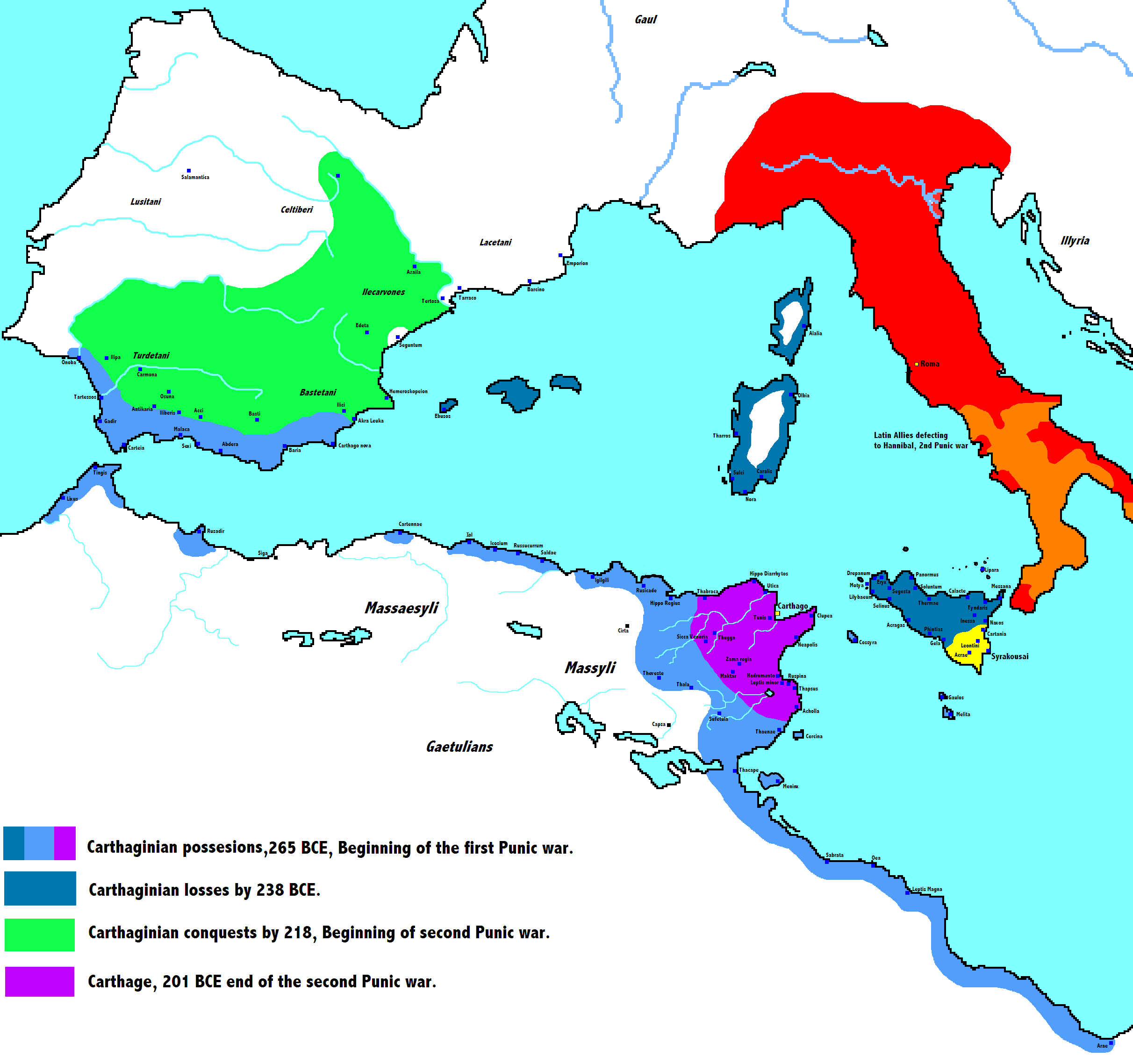
Carthage was reduced to a fraction of its empire at the end of the Second Punic War. (Picture in public domain.)

The Battle of Zama took place at Zama, near Carthage, in October of 202 BC. Publius Cornelius Scipio led the Roman army and extra Numidian cavalry against Hannibal and his Carthaginian troops. The Romans soundly defeated the Carthaginians, which brought an end to the Second Punic War (Wikipedia contributors).

According to Polybius, Scipio set the terms for a treaty and told the Carthaginian ambassadors. The ambassadors returned to Carthage to tell their senate, and Hannibal persuaded them to accept the “lenient terms” (Polybius). The terms of the treaty included parts beneficial to both sides, though naturally favoring the Romans. Carthage was to be a client state of Rome, but would be able to retain all territory owned prior to the war, as well as all property. Carthage would still rule itself, and no Roman garrison would be set in the city. In return, Carthage needed to return all prisoners of war and deserters to Rome, pay a tribute of 10,000 talents (200 a year for 50 years), and provide corn and pay the Roman army while they waited until Rome replied to the treaty. Also, Carthage had to give up 100 hostages (males between the age of 14 and 30), and give up their war elephants and all warships except 10 triremes. If crippling any potential land or sea force wasn’t enough, Rome forbade Carthage from making war on any nation outside of Africa, and required permission to war within Africa. F.E. Adcock suggested the Romans crippled the Carthaginian navy because they had a policy of making their states keep weak ones, so Rome wouldn’t have to build up a strong navy (118).

Masinissa, of the Numidians that had helped the Romans, was crowned as the King of greater Numidia. Scipio was given the name “Africanus”, and was proclaimed a war hero (“Results of the Second Punic War”).


Works Cited

“Results of the Second Punic War.” United Nations of Roma Victrix. UNRV.com, 2003-2011. Web. 16 Feb. 2012.

Wikipedia contributors. “Battle of Zama.” Wikipedia, The Free Encyclopedia. Wikipedia, The Free Encyclopedia, 9 Dec. 2011. Web. 16 Feb. 2012.

Adcock, F.E. “‘Delenda Est Carthago.’” Cambridge Historical Journal 8.3 (1946): 117-128. Print. 6 Feb. 2012.

Polybius. Histories: IV. Trans. W.R. Paton. Ed. Jeffrey Henderson. Cambridge: Harvard University Press, 2000. Print.

Leave a comment

Filed under Class Stuff, Cohort VII Scutum Decoris

Battle of Zama (strategy & tactics)

The Battle of Zama took place between the Romans, accompanied by the Numidian cavalry, and the Carthaginians with Scipio as the commander of the Roman forces and Hannibal as the leader of the Carthaginian troops. This confrontation between the Romans and Carthaginians marked the end of the Second Punic War, which had been occurring for many years. It took place on the plains of Zama Regia in the fall of 202 BC.

Romans marching and making camp- Use by permission. Copyright Peter Rockwell

Previous to the battle, the Romans utilized diverse mental tactics to psych out their opponents and prove dominance. As they won each battle, the Romans intentionally mangled the bodies of their fallen foes to demonstrate their ruthlessness and display an example of what the next enemy could expect to occur (75 Zhmodikov). They also made a camp each night, not only out of necessity, but to show their superiority as a force. The Romans had enough sophistication to build an entire village in one night and have it taken down by morning in order to be ready to march.

Both the Romans and the Carthaginians used similar battle layouts, but each tweaked their tactics with personal techniques. Hannibal utilized a traditional phalanx line of troops consisting of three rows with a cavalry on the wings, but also had war elephants as a unique weapon of war. Scipio, on the other hand, used a maniple formation of troops consisting of three lines with a large cavalry on the wings. The first two lines consisted of lighter infantry men known as the Hastati and the Principes (67 Zhmodikov). The last row consisted of heavy infantry men called Triarii; they were only used as back-up so they rarely saw much fighting. Although the Romans had fewer infantry troops, they made up for it in number and skill of cavalry troops. This became an important factor in the outcome of the battle; the terrain highly favored cavalry troops.

As the battle commenced, Hannibal unleashed his elephants on the Roman lines, which Scipio had anticipated. Scipio then used the maniple formation in order to allow his troops to move apart and permit the elephants to run right past them; it worked. In addition, the Romans blew loud horns as the elephants approached in an attempt to scatter them from their charge (Scullard 1930). As the lines clashed, they met in deadlock and each side repeatedly gained and lost ground with their opponent. It wasn’t until the superior Roman cavalry joined the battle, victorious over the Carthaginian cavalry, that the Romans were able to surround the Carthaginians and slaughter them. Roughly 20,000 Carthaginians were killed and another 20,000 were taken prisoner, while only 5,000 Romans were slain during the battle of Zama.

Works Cited

Rockwell, P. (1999). Romans marching and making camp- trajan’s column. Retrieved from

http://www.stoa.org/trajan/buildtrajanpage.cgi?261

Sabin, P. (2000). The face of roman battle. The Journal of Roman Studies, 90, 1-17.

Scullard, Howard Hayes (1930), Scipio Africanus in the second Punic war, CUP Publisher Archive .

Zhmodikov, A. (2000). Roman republican heavy infantrymen in battle. Historia: Zeitschrift für Alte Geschichte, 49(1), 67-78.

1 Comment

Filed under Cohort VII Scutum Decoris

The Battle of Zama

The Battle of Zama was fought in October of 202 BC between “a Roman army led by Publius Cornelius Scipio Africanus” and “a Carthaginian force led by the legendary commander Hannibal.” (Battle of Zama)

Scipio set himself apart from other historical leaders by using scouts and spies from both his own, and the Carthaginian army to benefit his cause. When Hannibal came to Zama, “he sent spies to ascertain the place, nature, and strength of the Roman general’s encampment.” The Roman soldiers caught them, and brought them before Scipio to decide their fate, but rather than punishing them, he “appointed a tribune to show them everything in the camp thoroughly and without reserve,” and then “gave them provisions and an escort, and dispatched them with injunctions to be careful to tell Hannibal everything they had seen.” This reaction was so far from the norm that it seemed to charm Hannibal into “a lively desire for a personal interview with” Scipio, at which meeting he proposed a treaty which, although not successful, seemed to hint at some intimidation by Scipio’s tactics. (Polybius)

Hannibal’s terms for a new treaty (Now that they had broken the previous one) were unnacceptable to Scipio, and eventually told Hannibal the Carthaginians “must submit [them]selves and [their] country to us (The Romans) unconditionally, or conquer us in the field.” Hannibal chose to attempt the latter.

Scipio had also been studying Hannibal’s techniques for years. “Having been at Cannae,” He knew most of Hannibal’s tricks, and was able to “trump [him] with a few minor adjustments.” Having seen the use of war elephants before, he knew how to counter them in a battle. After they were taken care of, he used Hannibal’s own “battle strategy from Trebbia and Cannae” (Billau) to defeat him. One might say that he had been gathering intelligence for fourteen years, and it served him well.

Charlotte Mary Yonge, 1880, Hannibal and Scipio meet to discuss terms.


“Battle of Zama.” Wikipedia, The Free Encyclopedia. Wikipedia, The Free Encyclopedia, 09 Dec  2011. Web. 16 Feb 2012. <http://en.wikipedia.org/wiki/Battle_of_Zama&gt;.

Billau, Daneta, and Donald Graczyk. “Hannibal: The Father of Strategy Reconsidered.” Comparative Strategy. 22.4 (2003): 335. Web. 16 Feb. 2012. http://web.ebscohost.com.hal.weber.edu:2200/ehost/detail?vid=14&hid=127&sid=5417bfe7-001f-472d-bf63-d993f5832806@sessionmgr114&bdata=JnNpdGU9ZWhvc3QtbGl2ZQ==

Polybius. Evelyn S. Shuckburgh. Translator. Histories. London: Bloomington, 1962. Web. <http://citationmachine.net/index2.php?reqstyleid=1&mode=form&reqsrcid=MLABook&srcCode=1&more=yes&nameCnt=1&gt;.

Leave a comment

by | February 16, 2012 · 11:27 pm

To Rome!! Or not…

After a victory of epic proportions at the Battle of Cannae, the assumed logical step for Hannibal and the Carthaginian army would be to march on Rome and overtake the capital. With 20/20 hindsight, it is in fact quite obvious that Hannibal’s failure to capture Rome “cost him his one good chance of final victory” and eventually led to his downfall (Matyszac). Livy has recorded that while congratulating him on an incredible victory, Hannibal’s general Maharbal stated:

“That you may know, what has been gained by this battle I prophesy that in five days you will be feasting as victor in the Capitol. Follow me; I will go in advance with the cavalry; they will know that you are come before they know that you are coming” (22.51). Livy records that Hannibal “told Maharbal that he commended his zeal, but he needed time to think out his plans” (22.51). To this Maharbal replied: “The gods have not given all their gifts to one man. You know how to win victory Hannibal, you do not how to use it” (22.51).

One can only speculate his true motivation behind the decision not to march on Rome, but clues exist that help to illustrate a clearer picture of Hannibal’s judgment.

Hannibal (Wikipedia Contributors)

One of the most fundamental, yet easily overlooked reasons behind Hannibal’s decision is his supply of food. Prior to Cannae, Hannibal lacked the sustenance necessary to support an army. At this time he was not receiving any support from Carthage and his troops spent much of their time foraging across the Italian countryside (Shean, 185). Hannibal’s strategy once in Italy focused largely on relying upon Rome’s resources (Lazenby, 43). Shean states that “logistical problems had dogged him throughout his early campaigns in Italy [and] the victory at Cannae brought no immediate relief to these problems” (185). It is not difficult to imagine why Hannibal chose not to drag an already battered, poorly provisioned and underfed army on a 250 mile march to attack a walled and fortified city. Even after a catastrophic defeat, the Romans still had an advantage of an “inexhaustible suppl[y] of provisions and of men” (Lazenby, 43). According to Shean, “Hannibal’s failure to move on Rome stemmed from the least glamorous and most mundane reason of all: no food” (185).

Maharbal’s eager exclamation of Hannibal dining as a victor in Rome within five days is indeed a pretty sentiment, but would be logistically next to impossible. The distance Hannibal’s forces would be required to cover the between Cannae and Rome within five days would equate to a pace of fifty miles per day, as opposed to the usual pace of Hannibal’s army which hovered around nine (Lazenby, 41).  After such a sprint across the Italian countryside, it is highly unlikely that his troops would be able to accomplish anything significant once they reached Rome—a city that was by no means left unfortified or lacking in able-bodied civilians (Lazenby, 41). Hannibal would not only face many who would have already seen military service, but many armed slaves, and all who would rise to defend their country, honor, wives and children (Lazenby, 41; Polybius, par. 109).

It is impossible to pinpoint a single motivation for Hannibal’s decision not to attack the capitol. Food, logistics and manpower may have all contributed to the objections against taking the city. Hannibal may have recognized his disadvantage in the particular type of “trench warfare” that would have been required to take Rome (Lazenby, 41). It is also a possibility that the victory at Cannae left Hannibal with the impression that the “war was already won” (Matyszac, 38). Whatever the reason behind the decision, “that day’s delay is believed to have saved the City and the empire [of Rome]” (Livy, 22.51).

Sources:

Knox, E.L. Skip. The Punic Wars: Battle of Cannae. Boise State University History of Western Civilization. 15 Feb 2012. http://www.boisestate.edu/courses/westciv/punicwar/09.shtml

Lazenby, John. Was Maharbal Right?. Bulletin of the Institute of Classical Studies. 22 Feb 2011. Web. 16 Feb 2012. http://onlinelibrary.wiley.com/doi/10.1111/j.2041-5370.1996.tb01912.x/abstract

Livy. Livy’s History of Rome: The Disaster of Cannae. Book 22. University of Virginia Electronic Text Center. Web. 15 Feb 2012.

Matyszac, Philip. The Enemies of Rome From Hannibal to Attila the Hun. London: Thames and Hudson, 2004. Print.

Polybius. The Battle of Cannae, 216 BCE. Book III. Fordham University Ancient History Sourcebook. Web. 15 Feb 2012.

Shean, John F. Hannibal’s Mules: The Logistical Limitations of Hannibal’s Army and the Battle of Cannae, 216 B.C.. Franz Steiner Verlag, 1996. 16 Feb 2012. http://www.jstor.org/stable/4436417

Wikipedia contributors. “Hannibal.” Wikipedia, The Free Encyclopedia. Wikipedia, The Free Encyclopedia, 14 Feb. 2012. Web. 17 Feb. 2012.

Leave a comment

Filed under Class Stuff, Cohort II, Uncategorized