Mini replica of a Thirteenth Century Hinged-counterweight Trebuchet

Timeline and Brief History of “Sling-base Throwing Machines”

This is a photograph of a work of art from the 12th century which shows a traction trebuchet. You can see the men pulling down on ropes to give flight to the projectile (Peter of Eboli).

China introduced us to the first sling based throwing machines in the 4th and  5th centuries (Chevedden, Eigenbrod, Foley, and Soedel, l). They were powered by men pulling on ropes that were connected to the end of a swinging arm. Later in the 7th century these man powered machines, manganikon, were developed in the Byzantine Empire. The Arabic empires then adapted the machines calling them manjaniq and were the most accurate and reliable. The Frankish Empire also used these first sling based throwing machines, finding a balance between reliability, accuracy, and cost (Nossov, 163-164).

This is an image of a traction trebuchet contained in a manuscript depicting a Byzantine siege of a citadel. The image is from the 11th century and the author is unknown. It is interesting to note the archer who would attempt to defend the pullers ("Unknown").


In the 8th century, a hybrid counterweight-man powered stone thrower was born, offering more power and accuracy. It easily hurled a 50 kilogram projectile through the air. Innovation of the stone thrower throughout four centuries produced a new throwing machine that used the force of gravity rather than pulling on ropes and by late 12th century the European trebuchet was developed (Nossov 171).

The Concept and Design of Hinged Counterweight Trebuchets.

The development of a trebuchet was an evolutionary process consisting of many engineering innovations throughout centuries of observation and design. Constructing a trebuchet consisted of a “supporting framework with vertical posts joined by an axle.” A beam is un-proportionately positioned through an axle. At the longer end of the beam a sling made of leather or netting was fixed with rope to the beam and then doubled-backed and attached to a metal pin or hook. On the shorter end ropes in the case of a traction trebuchet or an immense counterweight was attached to deliver the necessary conversion from force to mechanical energy (Nossov, 171).

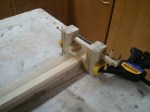
One of two vertical supports that will be attached to a base and joined together by and axle.
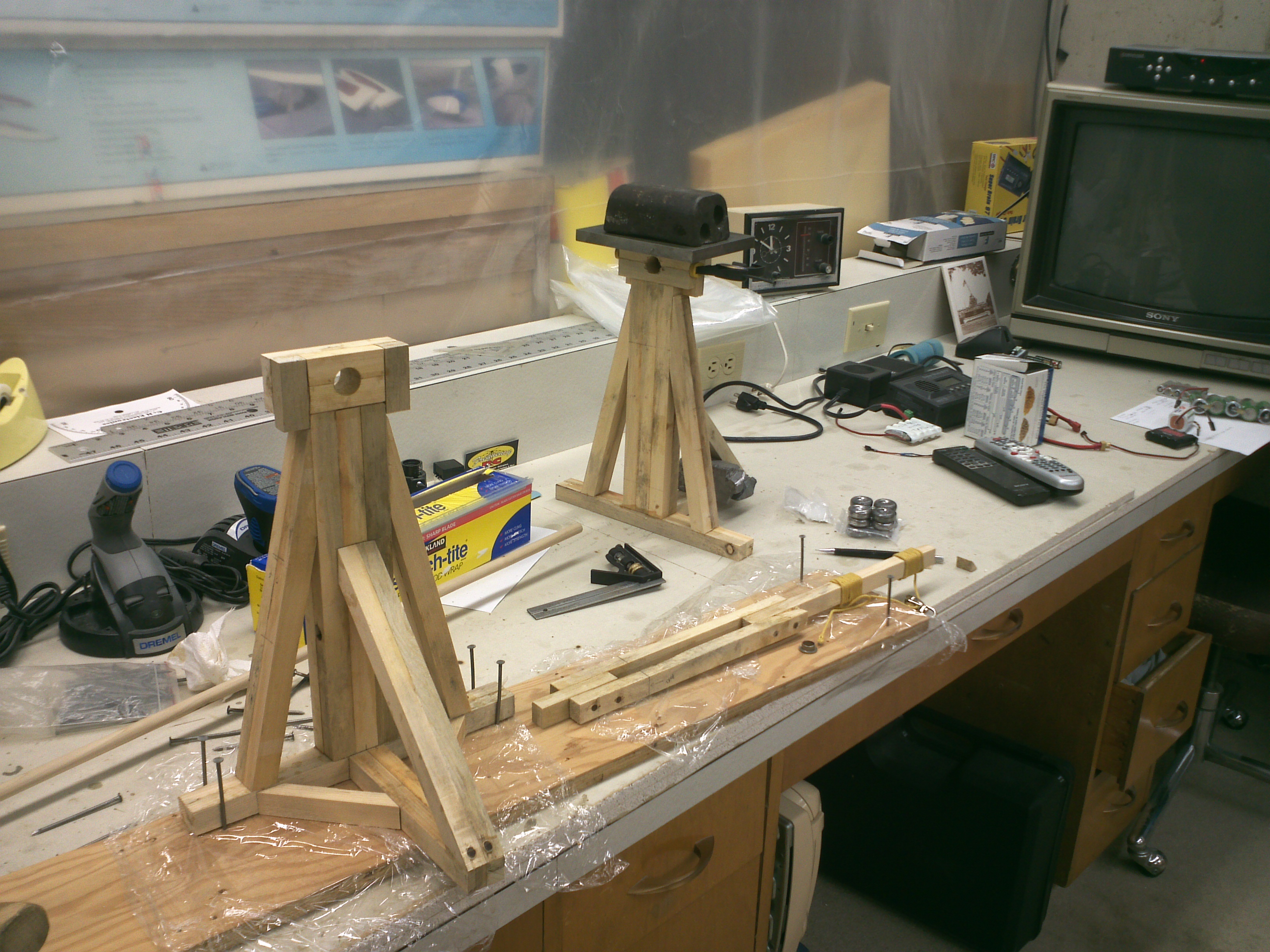
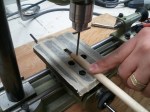
The two vertical supports (framework) of the trebuchet. The beam is also shown here which will have the axle go through it.
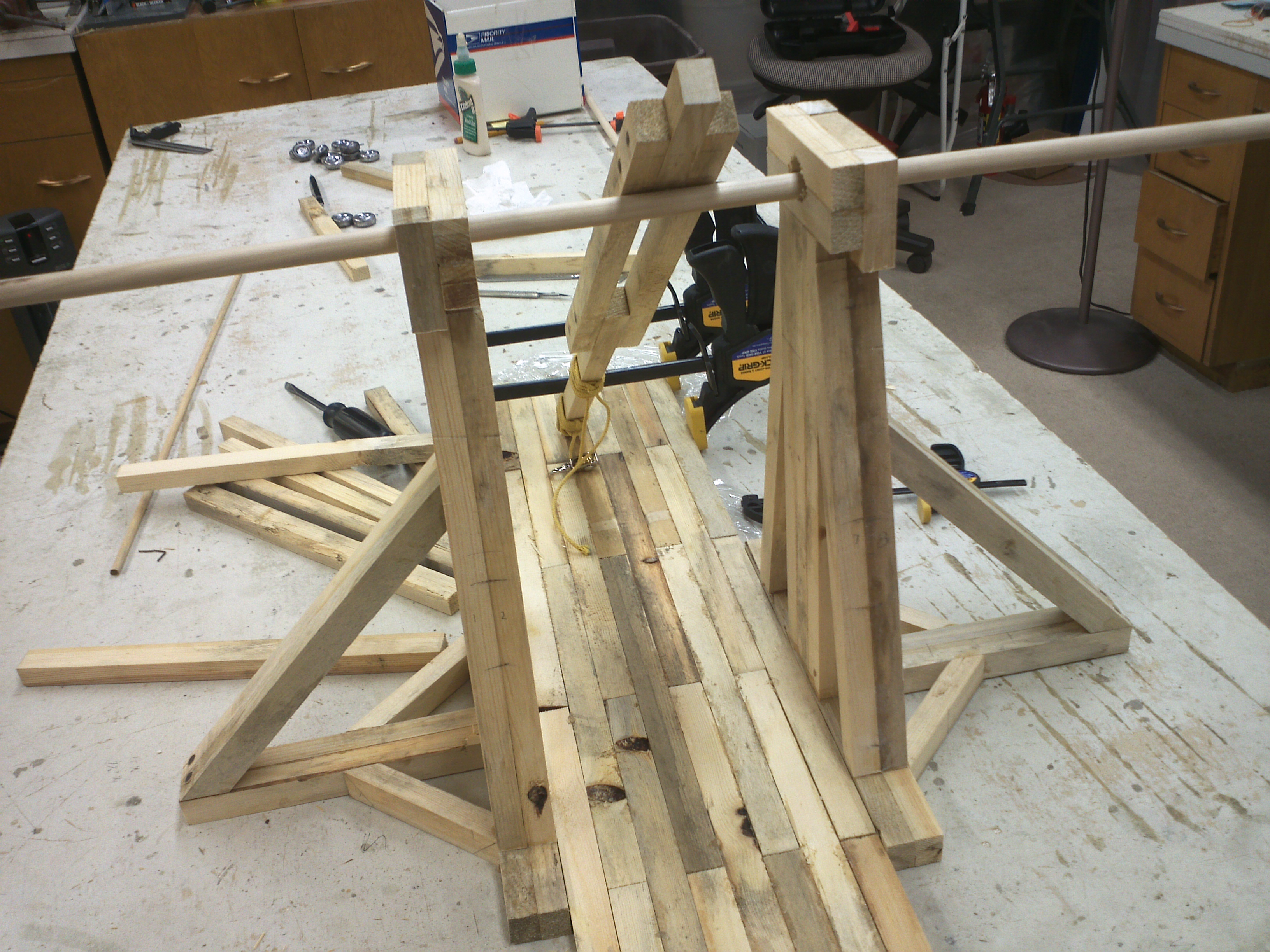
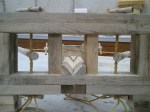
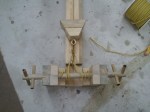
The two vertical post are connected to a base to complete the framework for the trebuchet. The hole for the axle has been drilled in the posts but not in the beam. The counterweight box, sling and channel still need to be completed.

Medieval engineers in the 13th century found that counterweights that were hinged could throw projectiles farther as, they were able to harness more energy than their other counterweight counterparts (Nossov, 174). Additionally the hinge proved to be a great braking system for the trebuchet allowing it to nearly completely stop as the beam rotates to an upright vertical position. The breaking system induced by the hinged counterweight decreased the amount of strain inflicted on the structural framework and cushioned the violent reaction that would cause the trebuchet to go off target upon the next firing (Chevedden, Eigenbrod, Foley, and Soedel, 3). As a result “The much gentler release of the trebuchet meant that engineers did not have to reposition the frame between shots and so could shoot more rapidly and accurately” (Chevedden, Eigenbrod, Foley, and Soedel , 3). Other advantages were that hinged or moveable counterweight trebuchets were easier to “transfer and assemble” (Nossov, 174).
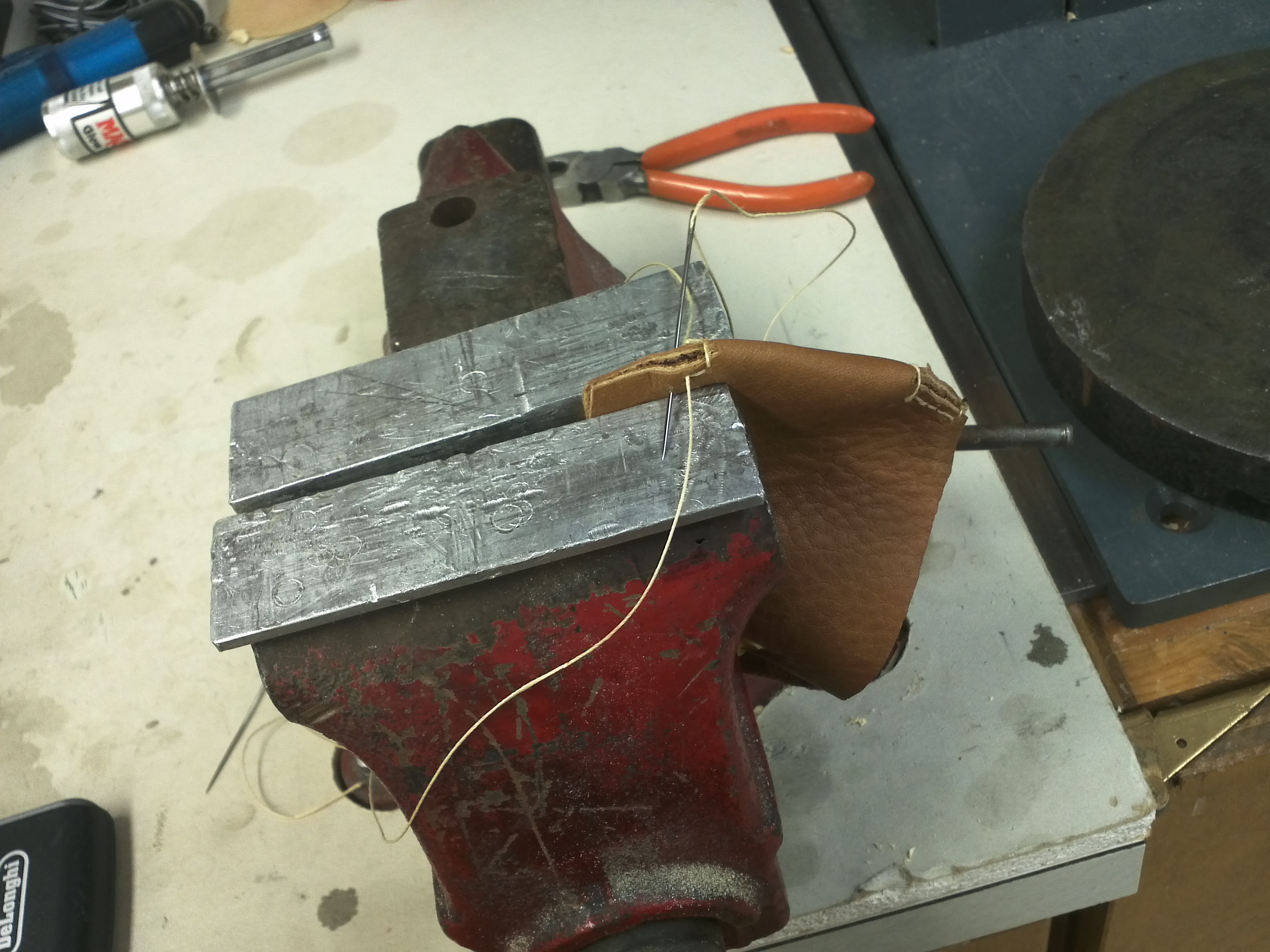
Sling pouch made of leather cut into a diamond like shape. Two triangle pieces of the leather were cut out and stitched together to create a pocket rather than a flap. Grommets were attached to each end of the leather and tied to the rope to complete the sling.
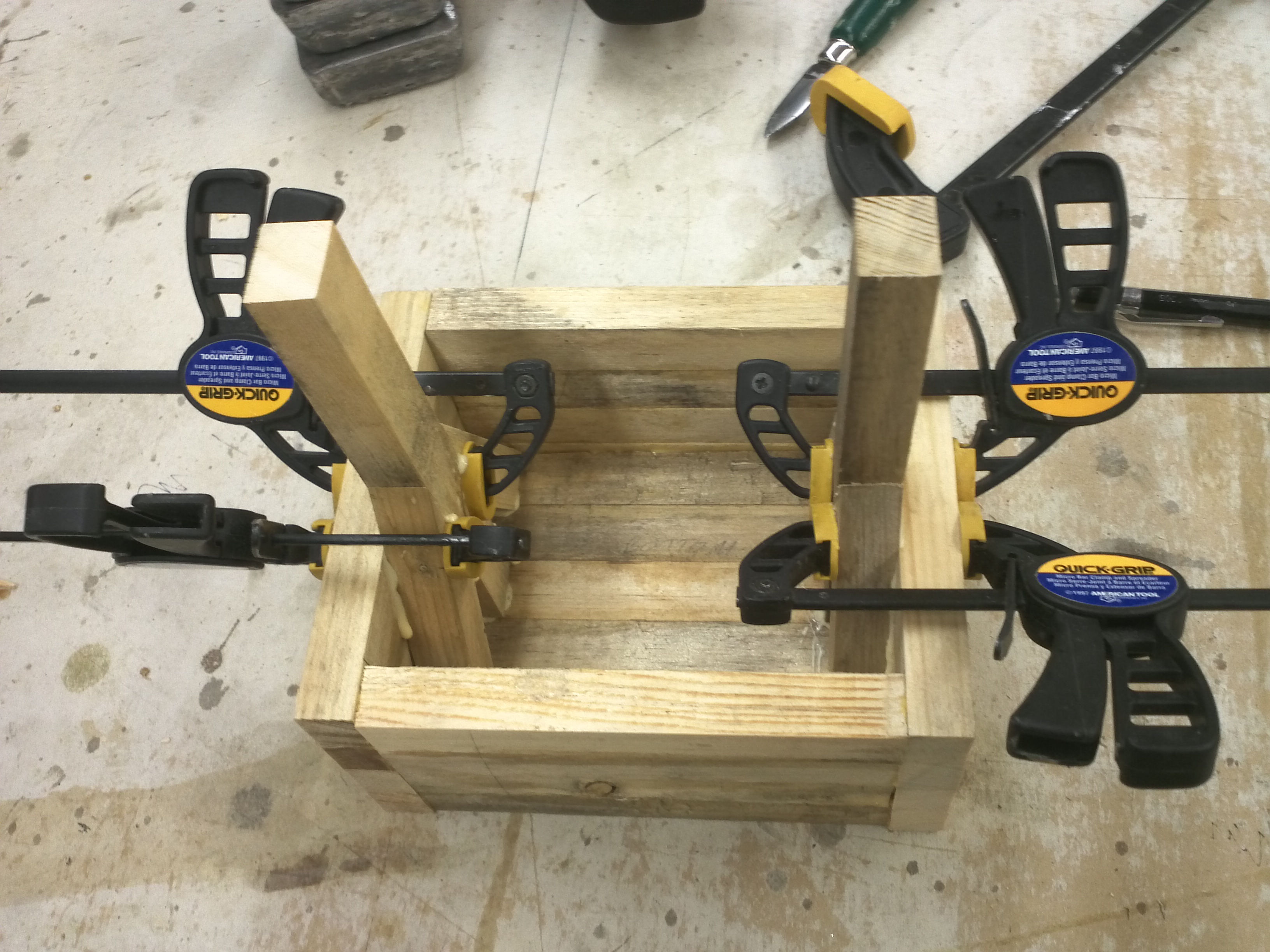
Don't make and glue pieces for the wrong side! Just completed the hinge supports for the counterweight box. Opps...they were for the wrong side. Luckily the glue hadn't dried.

Completed the counterweight box and hinge. The axle will be put through the short end of the beam. This will allow for more energy to be transferred to the sling and ultimately the projectile.

In order to load the trebuchet the long end of the beam was pulled down to the ground by a series of ropes, windlass, and or squirrel’s wheels. A large trebuchet was cocked by 10 to 12 men who could lift a 10-ton counterweight in approximately 6 minutes. When the long end of the beam was lowered into position the trigger was fixed and the sling was prepared (Nossov, 177). The sling entered a special channel which directed the sling and various projectiles: stone or lead balls, pots of flammable substances, cobble-stone grenades, burning sand/tar, darts, diseased corpses, or beehives were loaded inside the sling (“Trebuchets”).

 A shot was fired in the following way…the operator released the trigger mechanism and the counterweight sped downwards, propelled by the force of gravity. The longer end of the beam soared upwards respectively. The sling would tear itself off the chute in which it lay, outstripping the lifting of the beam, and would lash around the end of the beam, adding acceleration to the projectile. Depending on the construction of the sling, its end either slid off the cog on the beam or was pulled by a tie; the sling would unfold and release the projectile (Nossov, 174).

Trigger construction and application was diverse. Triggers found in ancient drawings of trebuchets do not always reflect the method of firing a trebuchet. Due to the proximity of the trigger in conjunction with the beam, it has been suggested that the soldier who’s duty to pull the trigger may have been just as dangerous as the soldier on the frontline. A common trigger was a rope-over beam method. The rope then needed to be expelled by a mallet, pin or snap (“Trebuchet Triggers”).
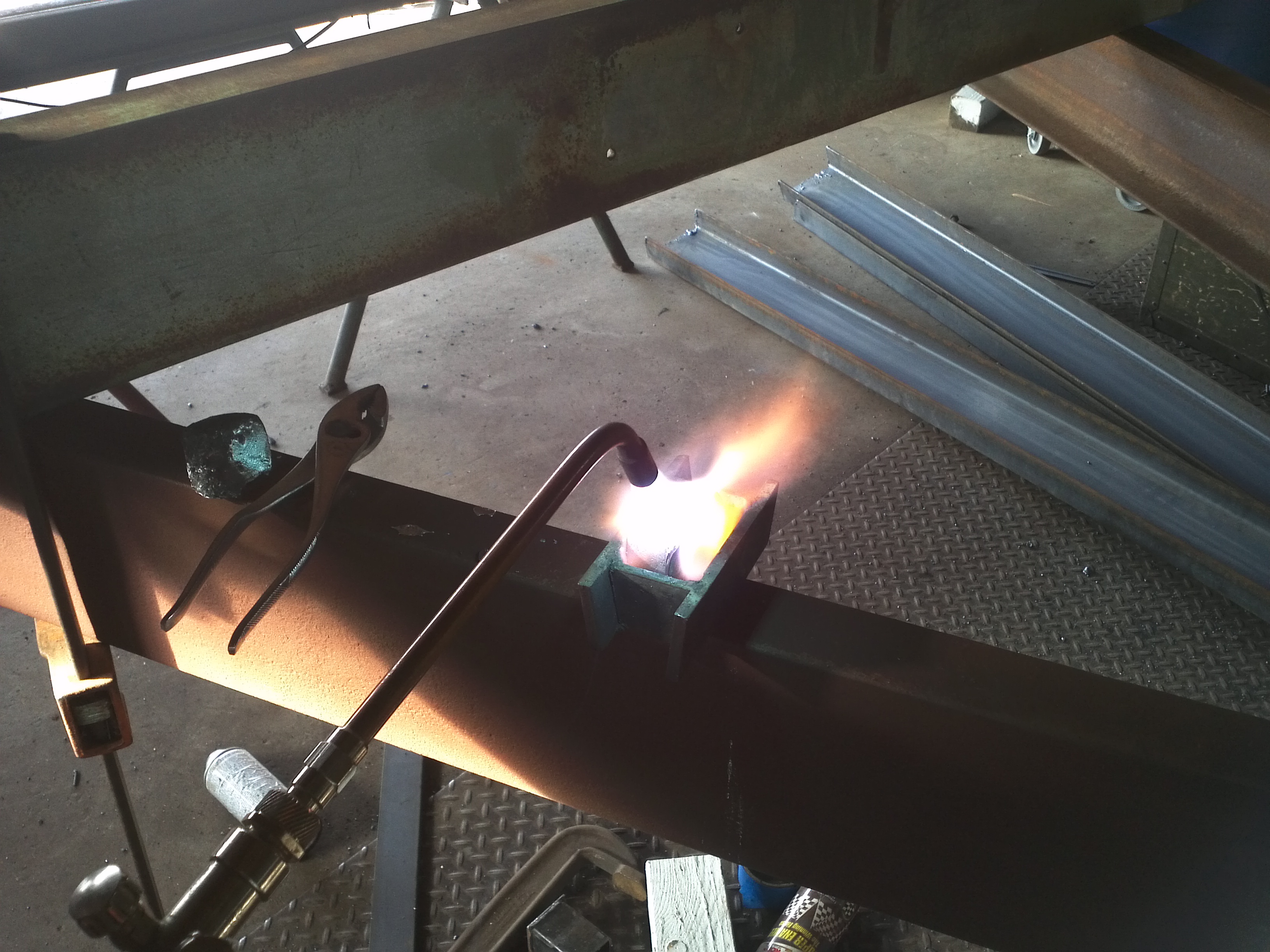
Melted lead into six bricks that weight approx. 1.5 pounds each.

Completed lead bricks to act as counterweight for the trebuchet. Don't touch they are still hot!
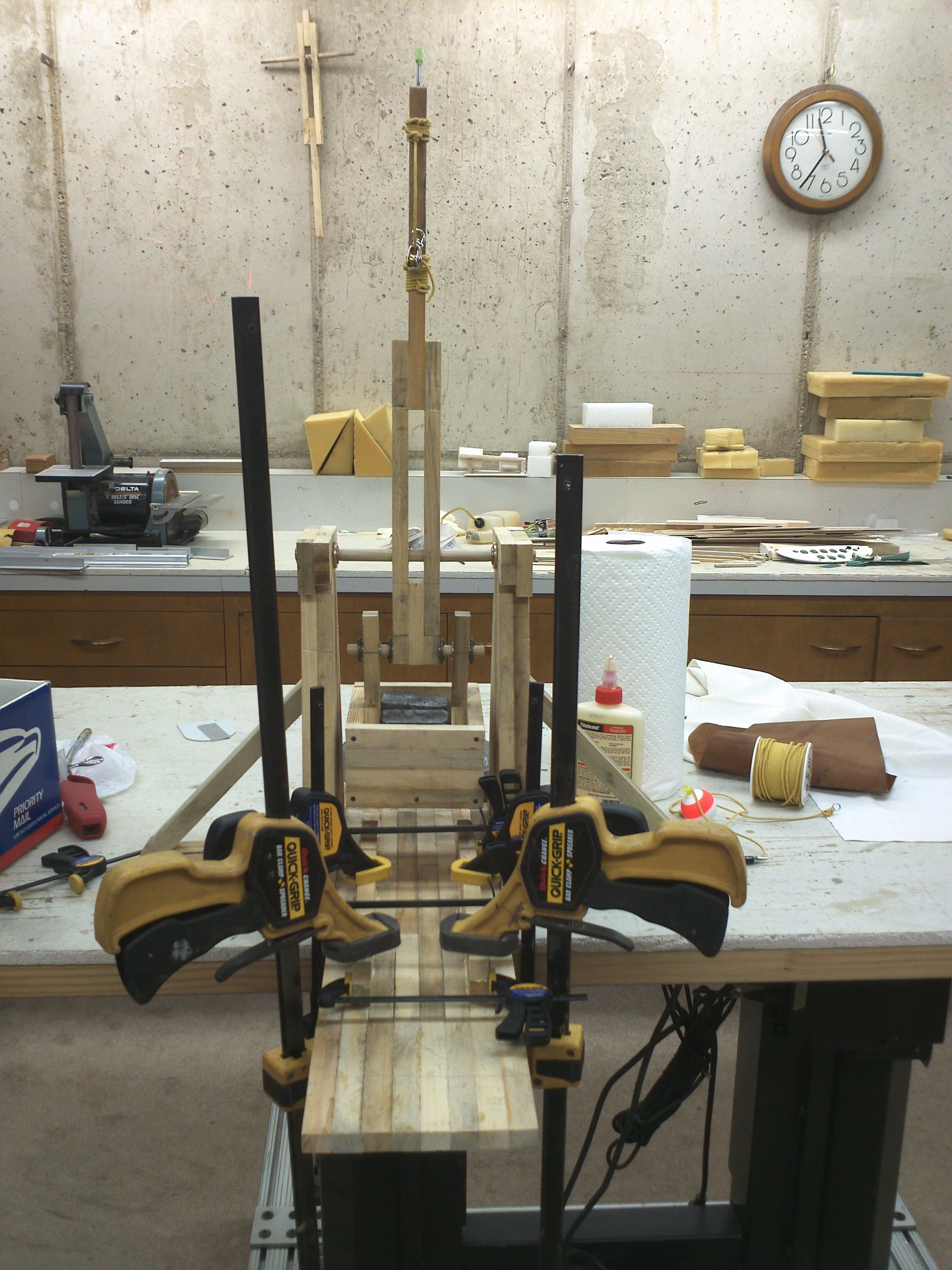
Attaching the channel which will guide the sling and keep the projectile on target. Also, in the background you can see my first attempt at the beam. The holes for the axle were not drilled straight.

When laying siege to a wall or castle stone or lead balls of the same caliber (weight and size) were used. This allowed consistent and accurate shots. The complete trebuchet mechanical system is truly a dynamic one. The velocity, distance, and trajectory are not only dependant on the ratio of projectile weight to counterweight but also the sling length, cog length and angles, and beam length and angles and counterweight motion.  Firing a projectile in a short sling versus a long sling resulted in a steeper or grazing trajectory respectively. However these trajectories were also determined by the size and weight of the projectiles and counterweight (Nossov, 177).
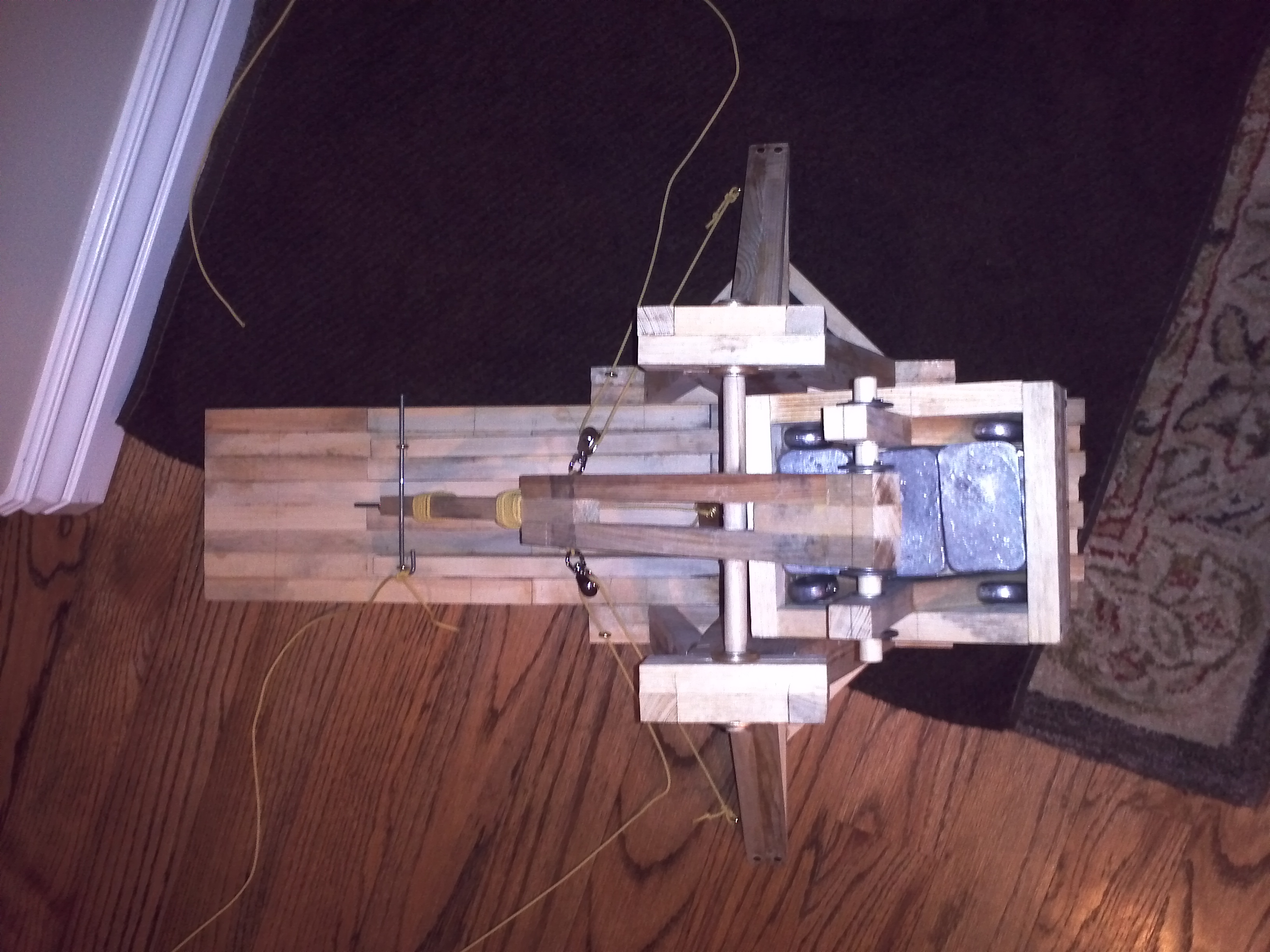
Locked and loaded. Bird-eye view of the completed trebuchet. The trigger is a metal rod connected to a pullrope. The box is loaded to the brim with lead bricks. The ropes and pulleys are connected to the framework and beam to lower the beam after it has been fired. The only thing which wasn't done on this trebuchet was the construction of a windlass.

Impacts of the Trebuchet….

The trebuchet expanded and impacted Islamic, Mongol and European conquest. It was a weapon which held both offensive and defensive operations and was an instrument which helped propelled the “Black Death” epidemic across ancient Europe – as diseased corpses were hurled into cities (Chevedden, Eigenbrod, Foley, and Soedel, 2).Further it seems to have had an impact on theories of motion and the development of clocks and pendelums.

“During their heyday, trebuchets received much attention from engineers indeed; the very word ‘engineering’ is intimately related to them. In Latin and the European venaculars, a common term for trebuchet was ‘engine’ (from ingenium, ‘an ingenious contrivance’), and those who designed, made and used them were called ingeniators” (Chevedden, Eigenbrod, Foley, and Soedel, 3).

The trebuchet was a multifaceted feat that furthered science, engineering, technology, as well as politics and war. It impacted four civilizations of which “its fullest development [was achieved] in Western Europe” (Chevedden, 71-72).  Today it’s role helps students understand not only historical achievements but also physical principles that were discovered centuries ago. It has been well enjoyed by historians, layman, hobbyists and enthusiasts. As for myself, I have enjoyed learning what made the trebuchet a “Great Idea of the West.”
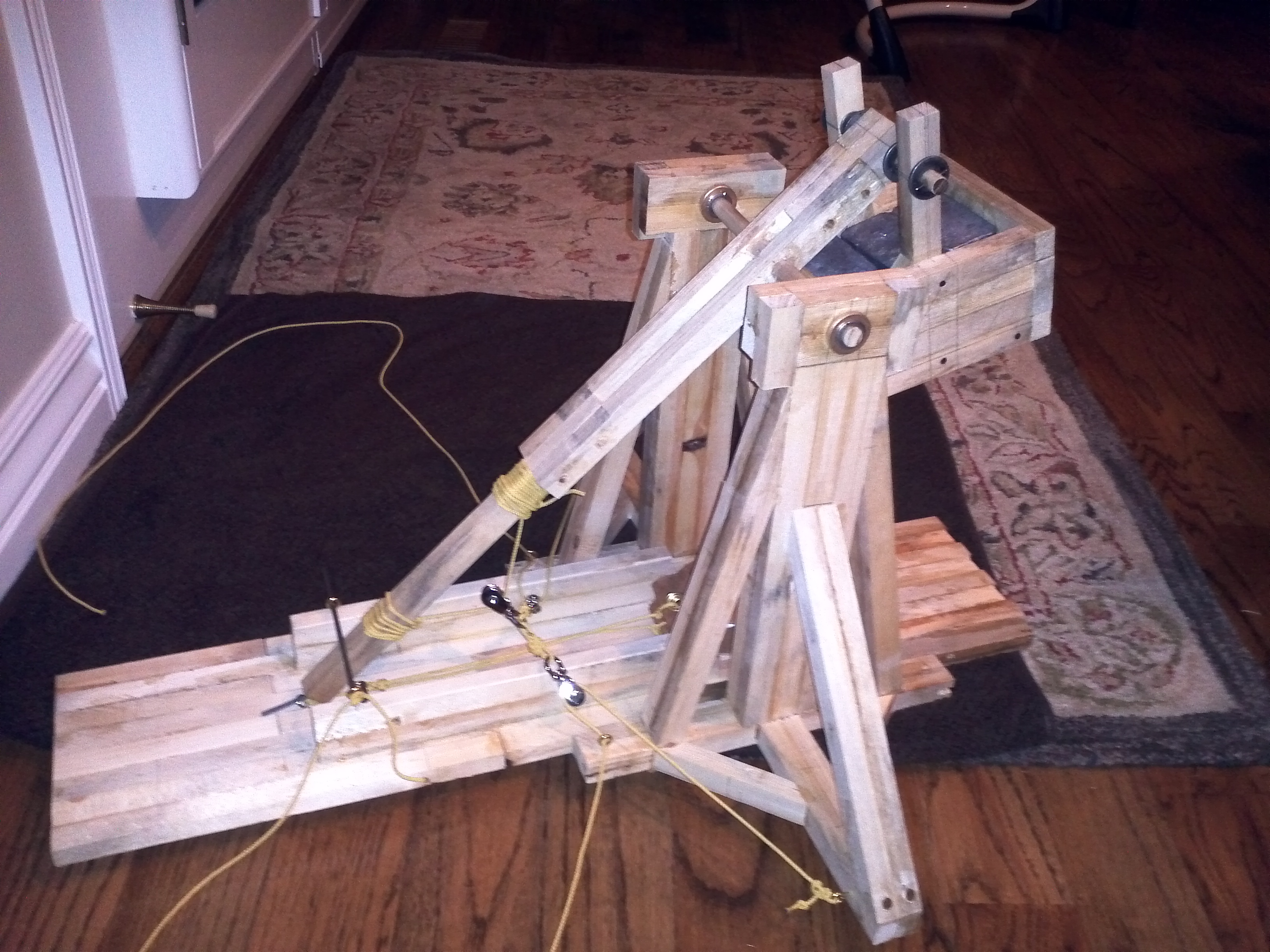
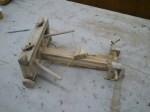
Side view of the completed trebuchet. Not bad considering It started with just a pile of sticks and some random hardware.

 Works Cited

Chevedden, Paul E. “The Invention of the Counterweight Trebuchet: A Study in Cultural Diffusion.” Dumbarton Oaks Papers, Vol. 54 (2000): pp. 71-116. JSTOR. Web. Apr 1. 2011. <http://www.jstor.org/stable/1291833&gt;.

Chevedden, Paul E. Eigenbrod, Les. Foley, Vernard. And Soedel, Werner. “The Trebuchet.” Scientific American Spec. Online Issue. Scientific American, Inc. Feb. 2002. Web. 1. Apr. 2012.

Peter of Eboli. Cesky: Obránci hradu. 12th century. <http://www.compagniasantuberto.it/images/frombola/liber2.jpg>. Web. 18 Apr. 2012

Nossov, Konstantin. Ancient and Medieval Siege Weapons: A Fully Illustrated Guide to Siege Weapons and Tactics.Guilford: TheLyons Press-The Globe Pequot press, 2005.

“Trebuchet.” The Middle Ages Website. Sep. 20, 2006. n.p. Web. 1 Apr. 2012. < http://www.middle-ages.org.uk/trebuchet.htm>.

“Trebuchet Triggers.” Greg Company Trebuchet. Russell Miners, Nov. 2000. Web. 1 Apr. 2012. <http://members.iinet.net.au/~rmine/triggers.html>.

“Unknown”, Image from an illuminated manuscript depicting a Byzantine siege of a citadel.  11th century. <http://en.wikipedia.org/wiki/File:Byzantine_Trebuchet_Skylintzes.jpg>. Web. 18 Apr. 2012.

1 Comment

Filed under Final Projects -- Cohort II

Proffessional driver on a closed course. Do not use in actual war against Dacians.

I thought making a replica of legionary outerwear and armor would be a fun project. I just had no idea how fun.

The standard tunic was the easiest part, and probably the most accurate portion of my replica. A real Roman tunic would be made of wool, but in this case, muslin was much more easily available and cost-effective, not to mention an appropriate color to represent un-dyed wool. The neck was made by cutting a slit, and ‘sleeves’ were simply gaps in the stitching. “Many tunics were made with much longer neckslits” in a real legionary’s tunic, “so that for heavy work the right arm could be slipped out.” (Amt) However, I couldn’t foresee any ‘heavy work’ being done during the presentation, and I wanted the tunic to stay on securely, so the neck of my tunic was more fitted.

I was able to make the armor fairly accurate as well, and it was by far the most enjoyable part of the project. Strips of poster-board lined on both sides with duct-tape simulated 1st century “lorica segmentata:” plate armor clearly depicted on Trajan’s column. Ancient armor would have been steel bands “fastened to internal leather straps” which “surrounded the torso in two halves, being fastened at the front and back by means of brass hooks, which were joined by leather laces.” (Wikipedia contributors) But for ease of transportation and presentation, I chose to make my armor in one piece, rather than have to construct and deconstruct it and waste class time.

I was concerned that the armor might not fit perfectly, but I realized that not many soldiers could have afforded custom-made armor. “Some pieces of armor” that have been found and salvaged bore inscriptions of “The names of two, three, or even four men, generally successive owners.” A new recruit may have bought armor from a veteran, inherited it from his father or grandfather, or had it issued to him by the “custos armorum,” (MacMullen) so it makes sense that it wouldn’t be a perfect fit.

The sandals and helmet were the least accurate parts of my presentation, and the only parts I bought rather than constructing myself. Images from Trajan’s column don’t shed much light on Roman military footwear, only showing the occasional ankle strap or visible sole of a shoe. Fashion wasn’t really the column’s focus, and it didn’t help that many Romans seemed to go barefoot at times. Sources varied on whether legionaries wore sandals, or more boot-like leather shoes. All agreed that often “hobnails were hammered into the sole for added strength. Similar to the modern cleat.” (Wikipedia contributors)

Soldiers from the time of the Dacian wars depicted on Trajan’s column generally wore ‘Montefortino’ helmets, “named after the region of Montefortino in Italy,” where one such helmet was uncovered. Rather than the plumed crest of the costume piece I purchased, the average soldier’s helmet would have had “a raised central knob, and a protruding neck guard” Instead of the thin half-guard of the costume helmet. A Montefortino helmet also had “cheek plates to protect the sides of the head,” Not the stylized face-guard of the helmet I presented. (Wikipedia contributors)

All in all, each piece gave me a good jumping-off point to describe a Roman soldier’s typical outerwear, regardless of its relative authenticity. And while duct-tape armor may not hold up against a sword – or even a particularly heavy rain – I learned quite a bit, and had a lot of fun making it.

Used with permission, Copyright Peter Rockwell


Amt, Matthew R. “Tunic.” LEGIO XX ONLINE HANDBOOK. larp.com, 18 mar 2011. Web. 12 Apr 2012. <http://www.larp.com/legioxx/tunic.html&gt;.

MacMullen, Ramsay. “Inscriptions on Armor and the Supply of Arms in the Roman Empire.” American Journal of Archaeology. 64.1 (1960): 23-40. Web. 17 Apr. 2012.

Wikipedia contributors. “Montefortino Helmet.” Wikipedia, The Free Encyclopedia. Wikipedia, The Free Encyclopedia, 01 Feb 2012. Web. 12 Apr 2012. <http://en.wikipedia.org/wiki/Montefortino_helmet&gt;.

Wikipedia contributors. “Roman military personal equipment.” Wikipedia, The Free Encyclopedia. Wikipedia, The Free Encyclopedia, 08 Apr 2012 . Web. 12 Apr 2012. <http://en.wikipedia.org/wiki/Roman_military_personal_equipment

((Primary source is image from Trajan’s column))

Leave a comment

Filed under Uncategorized

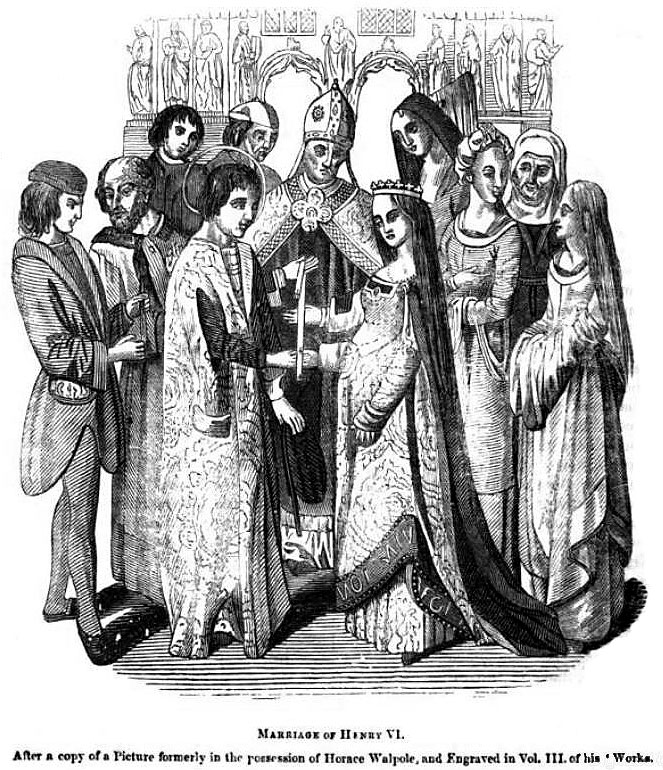
Medieval Marriage: Noblewomen vs. Peasants

Marriage of Henry VI to Margaret of Anjou
http://www.luminarium.org/encyclopedia/margaretanjou.htm

Noble Women:

Noble children were often betrothed in infancy. A Princeton professor, Lawrence Stone, stated these betrothals were contracts “by which children were bartered like cattle” (Searle). These marriage contracts were usually orchestrated to the political or monetary advantage of the father, whose feelings toward his own children would be emotional detachment at best (Searle). Wealth and status were the deciding factor in complicated transactions of betrothal and marriage, and age was largely irrelevant (Peakman). An example of these ‘transactions’ is seen in the marriage of Richard Neville and Anne Beauchamp (daughter of the Earl of Warwick). The future Earl was married when he was only six years old (Peakman). Not only did a woman have no choice of whom she married, but once married she came under her husband’s control and she was not allowed to divorce him (Medieval Women). It was taught that it was a woman’s religious duty and the will of God to defer to her husband: “Wives, submit yourselves unto your own husbands, as it is fit in the Lord” (Peakman, Colossians 3:18).

Peasant Women:

While the life of a peasant was undeniably more difficult, those that were lower on the social ladder had much more freedom to love and court whomever they chose (Peakman). Poor peasant women generally did not marry until much later than those of the upper class; as young children they began working to help provide for their families, and marriage would deprive poor peasants of a much needed worker (Medieval Women). Love was a much more public affair in the lower classes. When a peasant woman did reach an appropriate age for courtship, she would most likely court a young man from the same village and would do so publicly (Medieval Women). The couple would usually meet at markets and festivals, and according to recorded ballads the woman would be wooed with gifts of food, money and clothes (Peakman). Marriage was simple and life was hard, but it seemed that the poor really could marry for love.

Works Cited:

Holy Bible: King James Version. United States: 1979, p. 1496. Print.

Peakman, Julie. “Poise and Passion in the Middle Ages.”   History Today 61.8 (2011): p 36-41. Academic Search Premier. Web. 14 Apr 2012.

Searle, Eleanor. “Women and Marriage in Medieval Society.” California Institute of Technology (1981): 16-19. Web. 14 Apr 2012. http://calteches.library.caltech.edu/583/2/Searle.pdf

“Marriage of Henry VI to Margaret of Anjou.” Luminarium Encyclopedia Project: Wars of the Roses. Web. 16 Apr 2012. http://www.luminarium.org/encyclopedia/henry6marriage.jpg

“Medieval Women.” History Learning Site. Web. 14 Apr 2012. http://www.historylearningsite.co.uk/medieval_women.htm

Leave a comment

Filed under Final Projects -- Cohort II

Final Project- Ballista

Before the appearance of the ballista and other similar machines, the power of a weapon was limited to the frame of itself. Around 350 BC, the technology of a torsion powered machine was born (Nossov 136) Torsion machines uses ropes or animal cords tightly wound with a wooden arm in the middle to fire projectiles. By twisting the rope, these people were able to achieve greater power from their weapons and it was less likely to break their machines, just the ropes.

Although the original appearance of ballistae was around 350 BC, it wasn’t until roughly 334 BC that they started being widely used. Alexander was the first to start using these machines, which fired large arrows usually to take out soldiers, not structures (Nossov 136). As time progressed, they were adapted to throw stones. This meant the ballista was equipped with a larger frame and also metal parts began to be integrated into the construction to support the strain (Wikipedia 2012). With the capability of throwing stones, they were now able to take out structures rather than mainly soldiers. There is a wide variety of the calibers of stones used, each having its own purpose. The stones which were thrown ranged from 10 pounds up to 85 pounds; with the lighter stones being used primarily for defense and the heavier stones being used for offense (Nossov 138).

The ballista was a fairly simple weapon for the average soldier to operate; it worked similarly to a crossbow. Soldiers pulled levers at the rear of the machine to retract the pusher through a series of ratchets. All the energy was stored in the ropes, which carried a much higher potential energy than could have possibly been stored in

the wooden throwing arms. Due to this ratcheting system, it could be ready to fire in a moments notice. This weapon was highly accurate and there have been multiple accounts of skilled ballista shooters being able to take out enemy soldiers from a few hundred yards (Wikipedia 2012). Although they were highly accurate, they

Scene 40, Carroballistae. Used with permission, Copyright Peter Rockwell. http://www.stoa.org/trajan/buildtrajanpage.cgi?21

weren’t able to shoot very large projectiles and this eventually became the job of newly developed catapults (Nossov 150).

In this early version of a ballista, it can still be seen how they were used to fire arrows. These machines were relatively small, but that made it much easier to carry from place to place. As these weapons grew with new engineering techniques, they became more complex and had to be built more durably. As a result, metal was added to these machines, but this also made transportation more difficult. This required that they needed to be disassembled and reassembled at the site of war.

Works Cited

E. Schramm: Die antiken Geschütze der Saalburg. (Berlin 1918), S. 41 Abb. 14, 42 Abb. 15

Gurstelle, W. (2001). Backyard ballistics. (pp. 91-101). Chicago: Chicago Review Press.

Gurstelle, W. (2004). The art of the catapult. (pp. 60-69). Chicago: Chicago Review Press.

Nossov, K. (2005). Ancient and medieval siege weapons. (p. 136, 138, 150). Guilford: The Lyons Press.

Rockwell, P. (Photographer). (1999). Carroballistae. [Print Photo]. Retrieved from http://www.stoa.org/trajan/buildtrajanpage.cgi?21

Wikipedia. (2012, April 08). Ballista. Retrieved from http://en.wikipedia.org/wiki/Ballista

Demo:

Leave a comment

Filed under Class Stuff, Cohort VII Scutum Decoris, Final Projects - Cohort VII, Uncategorized

Extra Credit info

Want to do extra credit, but don’t remember what you’re supposed to be doing?

April is  Holocaust/Genocide Commemoration/Awareness Month.   All extra credit relates to that.

Option 1:  Attend the film, Witnessing Darfur: Genocide Emergency,  which was shown on Friday April 6  in the Center for Diversity and Unity, attend the discussion and blog about it.

Option 2:  Watch one of the movies listed below and blog about it (requirements follow).

All movies are on reserve in the library.   All are documentaries except Blood Diamond.

  •  The Reckoning: the Battle for the International Criminal Court 
  • The Devil Came on Horseback 
  • God Grew Tired of Us
  • Facing Sudan
  • Blood Diamond

(Most are about Africa because I got them for an African History course.  I’ll be adding others for next year.)

The blog post:  15 pts
Due date:  Thursday, April 19, midnight MDT

  • 200-250 words
  • Includes:
    • Name of movie you saw
    • What it had to say about genocide
    • I didn’t have this originally, but you should also consider the perspective of the film – whose point of view – an outsider, perpetrator, survivor, victim, etc. and how that affects content
  • Causes
  • Effects
  • Solutions

No sources or image required

Leave a comment

Filed under Class Stuff

Blood Diamond

I watched the movie Blood Diamond over the weekend. I had heard of it in the past and pretty much ignored it because I just wasn’t interested at all in the movie. I decided to give it a shot for the extra credit and found myself wondering how in the hell humans can be so vastly different, yet the same.

The genocide in Africa seems to be such a constant event that it becomes so normal that it is just ignored, I have even thought in the past that it is odd when they aren’t killing each other, an attitude that is very disconnected from the problem.

In this movie the genocide is not what we normally think of with one culture wiping out another. This movie it is rebels within the country of Sierra Leone killing other tribes folk in the country and forcing them into slavery or soldiering. This movie shows how the diamonds are gotten through slave labor and then sold in order to obtain weapons to fight the “gubmint” as they are called in the movie.

This was allowed to perpetuate because people in more “civilized” countries simply wanted the diamonds for their own purposes and not caring about the people who are hurt in the process. This allowed the rebels to overthrow the government and run amok in the country.

The solution from this movie was awareness and desire of the rest of the world to stomp out the “blood diamond” trade. Stop purchasing these diamonds and stop putting money into the hands of rebels or others who would exploit and murder for their own greed.

Leave a comment

Filed under Genocide Awareness

Final Project: Scutum and Pilum

To make the legionary shield, it took a lot of planning and designing in my head what I wanted it to be like before I even looked for the materials. I first looked up legionary shields on Google, and I also looked at the design that was on Trajan’s column. The legionary shield, or the scutum, was used to as a defense mechanism against the Persians and enemies of the Roman Empire. It started at the beginning of 100 BC till about 300 AD. The scutum was made from pieces of wood that were glued together piece by piece. There was a frame that was usually made out of bronze and protected by a metal band. Then the surface was covered in leather with different color schemes according to each cohort’s own color. If not in battle, the shields were strapped on the back of the legionary.

I first found a piece of wood that was warped a little that was just plywood. I cut it a little bit just to straighten out the edges but it looked to be about the right size for a man. I sanded down the board around the edges and sharp corners, but could not fit it to curve to a body because it took a very long time. It would not have been hard to curve a shield to a legionary because they went around the frame and they glued the pieces of wood together, giving it a curved shape. I drew the design that legionaries had on a piece of parchment paper and painted the shield red. Then painted the design over the shield in yellow. The final part was that I had to outline everything in black and make the frame on the outside.

The pilum is the roman javelin that the used to attack enemies while marching or the first attacks. The pilum was used to disarm and wound the enemy before they actually got to attack them. The top three feet of the pilum has a spear metal top to attack enemies and detaches from the other four feet of wood. I used a dowel that I had with a fence post that fight and put them together. However, since I could not attach metal to wood, I could not have the pilum completely attached. Legionaries were able to melt down metal and make a spear and fit a piece of wood to the metal.

This project was so much fun, and I loved it.

Works Citied:

http://www.unrv.com/military/legionary-weapons-equipment.php

http://en.wikipedia.org/wiki/Roman_legion

http://egarland.com/_wsn/page2.html

http://medievalcostumesandgifts.com/roman-legionary-scutum-infantry-shield-67.html

Rockwell, P.  Bridge. Retrieved April 5, 2012 from http://www.stoa.org/trajan/buildtrajanpage.cgi?260

Leave a comment

Filed under Class Stuff, Final Projects - Cohort VII

John Hawkwood the Condottiero

There were many kinds of knights in medieval Europe. Perhaps some of the most interesting were the condottieri, or mercenary knights. During approximately 1268 to 1513, political divisions caused by the “struggle between popes and emperors had promoted the growth of independent communes or city-states, particularly in northern Italy” (“Despots and Condottieri”). These factions struggled against each other, and often the cities hired condottieri “under contract to fight their wars” (“Despots and Condottieri”). The condottieri are controversial figures because of their pecuniary interest in armed conflict. It is important however, as a modern reader, to remember that “the lure of instant knighthood (the case of John Hawkwood) and wealth through pillaging attracted many to the recruiting campaigns, but no military man ventured to war in the fourteenth century without being paid wages” (Pratt 20).One of the most famous of these mercenary knights was John Hawkwood.

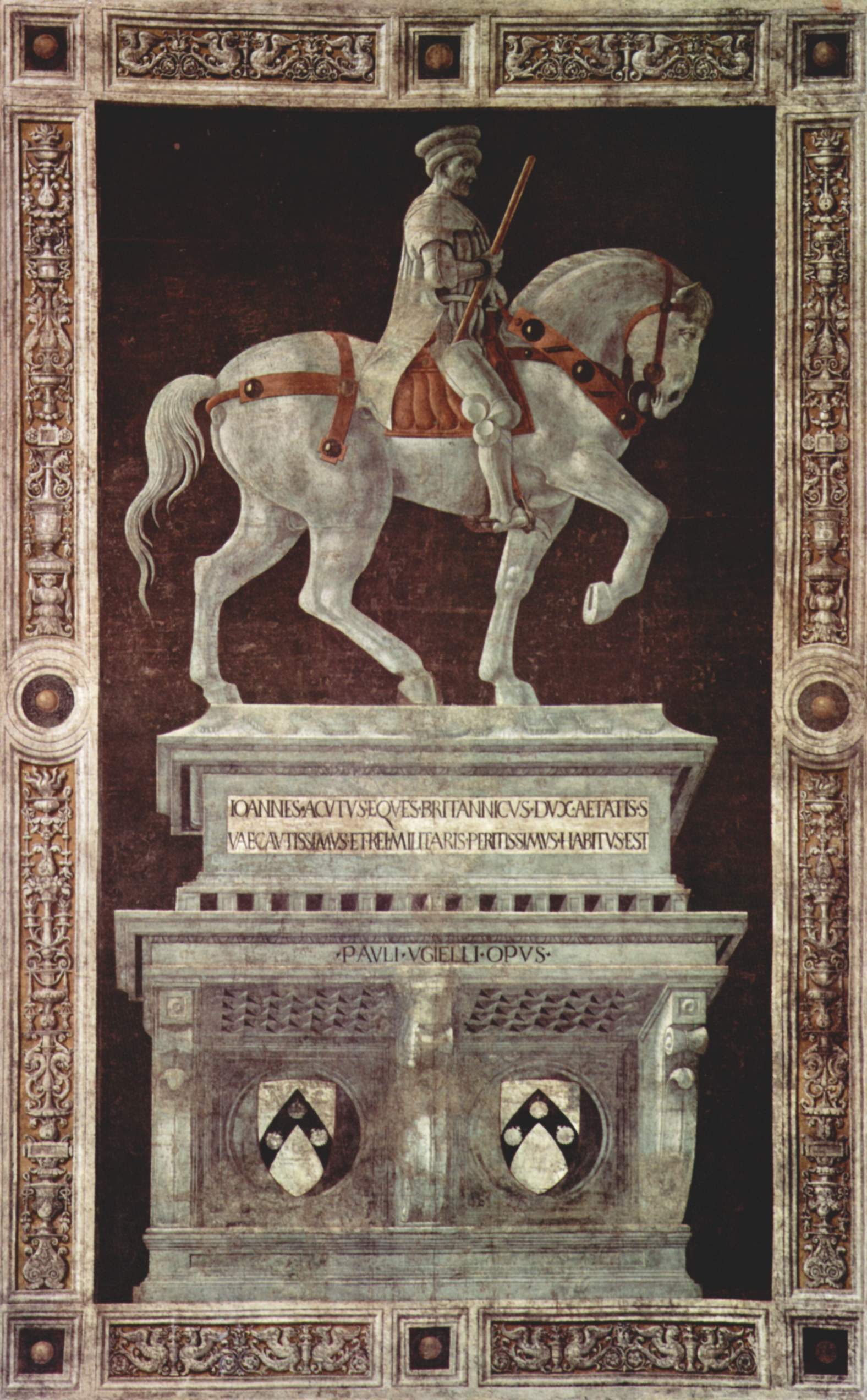
Figure 1. “Funerary Monument to Sir John Hawkwood.” Wikipedia, The Free Encyclopedia. Wikipedia, The Free Encyclopedia, 4 Apr. 2012. Web. 9 Apr. 2012.

John Hawkwood was born in England, but made a name for himself during his campaigns in Italy. He was a “soldier of immense ability….[a] tactician, strategist and inspiring leader” and additionally had  “the diplomatic skill to succeed in the complex world of Italian city rivalries” (Prestwich 11). His value as a soldier is emphasized by his employment record. Hawkwood worked for “Pisa, Milan, Padua, the Papacy, and above all Florence” (Prestwich 11). He was so successful in the Florentine campaigns that the city created a fresco in his honor (see Figure 1).

As a mercenary knight, Hawkwood’s character is surrounded by a great deal of propaganda. The fresco created in Hawkwood’s honor is clearly congratulatory. The horse has one foot raised in motion and is erect and dignified. Hawkwood also sits erect and is dressed in an Italian style hat that evokes a sense of loyalty to the Italian people. The inscription on the monument further honors Hawkwood. It reads, “‘Ioannes Actus eques brittanicus dux aetatis suae cautissimus et rei militaris pertissimus habitus est’ (John Hawkwood, British knight, most prudent leader of his age and most expert in the art of war)” (Wikipedia Contributors). All of this seems to indicate that Hawkwood was a beloved leader. It is important to note, however, that “the fresco was initially commissioned, decades after Hawkwood’s death, in 1433 by the Albizzi government, just months before the regime’s collapse” (Wikipedia contributors). These factors certainly influence the sentimental Hawkwood depicted in the piece. Though Hawkwood does seem to have been a very skilled man-at-arms, he also plundered (Prestwich 101) and appears not to have been entirely loyal to Italy as he intended to return to England at the end of his life (Wikipedia Contributors).


Works Cited

“Despots and Condottieri in Italy, 1268-1513: the Rise of the Nation.” Bigsiteofhistory.com. Big Site of History. Web. 10 Apr. 2012.

Pratt, John H. “Was Chaucer’s Knight Really a Mercenary?” The Chaucer Review 22.1 (1987): 8-27. JSTOR. Web. 10 Apr. 2012.

Prestwich, Michael. Knight: The Medieval Warrior’s Unofficial Manual. London: Thames & Hudson Ltd., 2010. Print.

Wikipedia contributors. “Funerary Monument to Sir John Hawkwood.” Wikipedia, The Free Encyclopedia. Wikipedia, The Free Encyclopedia, 4 Apr. 2012. Web. 9 Apr. 2012.

Leave a comment

Filed under Uncategorized

Courtly Love

Eleanor of Aquitaine
The Medieval and Renaissance History Portrait Gallery

The aggressive warrior queen, Eleanor of Acquitaine, is not the most likely candidate for advancing civility in a ruthless era. Yet one of her strongest influences on medieval culture is attributed to her attempt to promote the songs of troubadours, chivalry and courtly love (Weider History Network). Although the idea and practices of courtly love certainly existed before Eleanor’s time, between the years of 1168 and 1173 she served as a catalyst to help bring about a new movement toward courtly love (Weider History Network).

During Medieval times a woman ” is elevated to the position of an ideal, a feminine ‘essence,’ if you will, who serves’ as man’s cause” (Ragland, 5). The idea of courtly love is not based on rational courtship practices, nor does there appear to be any real correlation between marriage and love. According to Jacques Alain Miller, love is the demand for nothing (as quoted by Ragland, 9). While it has been stated that courtly love was a heroic effort to “circumvent a necessary impasse between the sexes” (Ragland, 3), courtly love came to be defined as “a question to which the answers were not apparent” (15) and was driven largely by the fulfilling of “unconscious [and mostly sexual] desires” (16).

In a way, courtly love is a ‘feminist’ practice. According to Ragland, this issue of feminism hedges on “each woman’s grappling with the problem of finding a signifier to valorize her existence as Woman” (Ragland, 9).  In contrast Lacan states in the Ethics of Psychoanalysis that rather than being feminist, courtly love is narcissitic with the “feminine object being voided of any real substance, her real virtues of prudence, wisdom, etc., not being extolled (Lacan 150-151, as quoted by Ragland, 16).

Today it is generally assumed that rules do not exist when it comes to love. While these may not be considered ‘rules’ of  love, here is a list of general guidelines or explanations of courtly love as written by 12th century Frenchman Andreas Capellanus (“Courtly Love”):

  • Marriage is no real excuse for not loving
  • He who is not jealous, cannot love
  • No one can be bound by a double love
  • It is well known that love is always increasing or decreasing
  • That which a lover takes against the will of his beloved has no relish
  • Boys do not love until they arrive at the age of maturity
  • When one lover dies, a widowhood of two years is required of the survivor
  • No one should be deprived of love without the very best of reasons
  • No one can love unless he is impelled by the persuasion of love
  • Love is always a stranger in the home of avarice
  • It is not proper to love any woman whom one would be ashamed to seek to marry
  • A true lover does not desire to embrace in love anyone except his beloved
  • When made public love rarely endures
  • The easy attainment of love makes it of little value; difficulty of attainment makes it prized
  • Every lover regularly turns pale in the presence of his beloved
  • When a lover suddenly catches sight of his beloved, his heart palpitates
  • A new love puts to flight an old one
  • Good character alone makes any man worthy of love
  • If love diminishes, it quickly fails and rarely revives
  • A man in love is always apprehensive
  • Real jealousy always increases the feeling of love
  • Jealousy, and therefore love, are increased when one suspects his beloved
  • He whom the thought of love vexes eats and sleeps very little
  • Every act of a lover ends in the thought of his beloved
  • A true lover considers nothing good except what he thinks will please his beloved
  • Love can deny nothing to love
  • A lover can never have enough of the s  <3olaces of his beloved
  • A slight presumption causes a lover to suspect his beloved
  • A man who is vexed by too much passion usually does not love
  • A true lover is constantly and without intermission possessed by the thought of his beloved
  • Nothing forbids one woman being loved by two men or one man by two women

(Beard)

Works Cited:

Beard, Frank. Bible Symbols or The Bible in Pictures (London: Hertel, Jenkins & Co., 1904) 81. Web. 9 April 2012. http://fithfath.com/images/?p=311

Ragland, Ellie. “Psychoanalysis and Courtly Love.” Aurthuriana, Vol. 5, No.1. Scriptorium Press: 1995. pp. 1-20. 9 April 2012. http://www.jstor.org/stable/27869092 .

Weider History Network “Biography: Eleanor of Aquitaine.”HistoryNet. 9 April 2012. Web. http://www.historynet.com/eleanor-of-aquitaine.htm

“Courtly Love” The Middle Ages Website. 9 April 2012. http://www.middle-ages.org.uk/courtly-love.htm

“Eleanor of Aquitaine.” Queens of England, 1894. The Medieval and Renaissance History Portrait Gallery. Web. 9 April 2012. http://historymedren.about.com/od/whoswho/ig/Portrait-Gallery/Eleanor-of-Aquitaine.htm

Leave a comment

Filed under Final Projects -- Cohort II

The Knight’s Charger

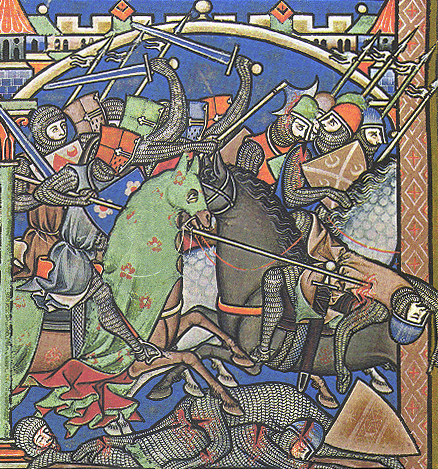
The quintessential knight is rarely a solo character; indeed, he is generally depicted riding his great steed.

“David defeats the Philistines.” Used with permission. Via http://www.medievaltymes.com/courtyard/images/maciejowski/leaf30/otm30vb.gif

Horses in the Middle Ages were not like the genetic breeds we have today, instead they were characterized by their physical attributes or what they were used for (“Horses in the Middle Ages”). The main types of horses used by knights in war were the destrier, courser, and rouncy. Destriers, large and strong horses, and the lighter coursers, were favored for use in battle (Prestwich, Knight, 45). Poorer knights, squires, and men-at-arms would use the rouncey, an all-purpose horse used for riding, battle, or as pack horses (“Horses in the Middle Ages”).

The horse was likely the most expensive piece of equipment in the knight’s inventory (Prestwich, “Miles”, 212). Prices of horses ranged considerably; Prestwich suggests that the value of a horse may have been determined by more than quality, the social rank and wealth of the owner may have also contributed to the value (“Miles”, 211). Generally, destriers tended to be more expensive than other horses – one estimate is seven times that of a normal horse (“Horses in the Middle Ages”).

Knights were skilled at fighting on the ground as well as on their mounts, and their tactics varied depending on time and the situation. Sidnell suggests that knights would dismount to boost the morale of the infantrymen, as well as when the terrain made riding ineffective (321). When mounted, the horses would sometimes fight each other, and destriers might have been trained to bite and kick their enemies. This may be due to the fact that stallions were most commonly used as war horses in Europe (“Horses in the Middle Ages”).

The armor worn by horses was called barding, and it consisted of many pieces. Depending on the time and cost of material, the various pieces of barding would be made of plates, chainmail, or leather worn over a layer of padding. Often, the armor would be covered with stretches of cloth called caparisons (“Barding”), pattered with the insignia of the knight to distinguish them in battle (Prestwich, Knight, 46).

In battle, horses needed to be obedient and maneuverable, so training was very important (“History of Dressage”). Tournaments were used for training the horses to get used to the noise and frenzy of battle (“Horses in the Middle Ages”).


Works Cited

“David defeats the Philistines.” Maciejowski Bible. The Morgan Library & Museum, New York. Medieval Tymes. Web. 5 Apr. 2012.

“History of Dressage.” United States Dressage Federation. n.p, n.d. Web. 5 Apr. 2012.

Prestwich, Michael. Knight: The Medieval Warrior’s Unofficial Manual. London: Thames & Hudson, 2010. Print

Prestwich, Michael. “Miles in Armis Strenuus: The Knight at War.” Transactions of the Royal Historical Society 5 (1995): 201-220. Print.

Sidnell, Philip. Warhorse: Cavalry in Ancient Warfare. London: Hambledon Continuum, 2006. Print.

Wikipedia contributors. “Barding.” Wikipedia, The Free Encyclopedia. Wikipedia, The Free Encyclopedia, 30 Mar. 2012. Web. 5 Apr. 2012.

Wikipedia contributors. “Horses in the Middle Ages.” Wikipedia, The Free Encyclopedia. Wikipedia, The Free Encyclopedia, 5 Apr. 2012. Web. 5 Apr. 2012.

Leave a comment

Filed under Cohort VII Scutum Decoris