Persian Archery and Tactics.

Persian armies had many traits that made them some of the most feared and most successful armies of all time.  The Special Forces of the Persian armies were a huge reason why they were so successful; some of the most important special force soldiers were the archers. Archery was a huge part of the Persian Army, it often times was the deciding factor in wars that were fought. I am going to focus on the tactics that the archers used.  Persian archery was often about quantity over quality. In the Landmarks Herodotus it said, “They used volleys of arrows that darken the sun.” (7.218.3)   Persian archers would shoot thousands of arrows at the same time into the sky.  Archers’ job wasn’t to hit specific targets, but to weaken the line opposing them.  You didn’t necessarily have to have a good shot to be an archer for the Persian army.  In the Landmarks Herodotus it says, “ Persians launch arrows tipped with burning hemp at walls of Athenian Acropolis.”(9.49.1)  So fire arrows were developed to weaken and distract the opposing forces.  These were brilliant tactics to use in war, because oftentimes whoever’s front line broke first would lose the fight. I imagine it would be quite difficult to keep in perfect formation while flaming arrows are setting a blaze to your surrounding and hitting and burning you.

An Achaemenid Archer with a composite bow.

An Achaemenid Archer with a composite bow.

Archers couldn’t just be exposed to enemy fire, so a tactic that the Persians used was  setting up wicker shield walls which sheltered archers as they shot volleys of arrows at their enemies. A Persian archer would not have been very effective on their own. That is why there were lines of archers that all stood in formation and shot at the same time to take down enemies. The arrows they used were often times made out of light wood or reed, so archers actually didn’t have as much range as we think of archers having today.  Also since the arrows were so light, more than one was usually required to kill an opposing Greek.  Tactics were very important for Persian archers. They had to work with each other in order to be effective.

Works Cited

“An Introduction to the Achaemenid Military Equipments.” CAIS, The Circle of Ancient Iranian Studies, (Image) web

http://www.caissoas.com/CAIS/History/hakhamaneshian/AchaemenidMilitaryEquip.htm

“Herodotus.” The Landmark Herodotus: the histories. New York: Pantheon Books,   2007. Text   (Primary Source)

“Iranian Archer Solders Profile.” Military History Monthly .  Nov. 10 2010. Web

                     http://www.military-history.org/articles/profile-iranian-archer.htm

“Persian Warriors.” Legends and Chronicles. Edited 2007-2014 Web.

                    http://www.legendsandchronicles.com/ancient-warriors/persian-warriors/


Leave a comment

Filed under Uncategorized

The Persian Archer

My blog is going to primarily focus on the Persian archer himself. For example, the qualities he needs to have, the characteristics and attributes that would benefit him, and the type of armor he would wear when going into battle. This information was found in an article that was based off of a Persian archery manuscript called Resāleye Kamāndāri, which was discovered in 1968. It goes through many different aspects of archery, including the qualities that it was thought that the archer should have. It summarizes those qualities in ten points which are further grouped into moral, temperamental and physical characteristics. The moral requirements are to be pure of heart and grateful to one’s master, to not be greedy and to lead a pure life, and to keep promises and to do good deeds. Temperamentally, the archer needs to be in a good mood and stand tall, and be able to cope with suffering and be chivalrous. The physical features are having an open chest, wide shoulders, and long arms. The archer also needed to have the knowledge and skills of how to properly use the bow. It was not a weapon you could just take and use immediately, it required thought and preparation along with calmness and self-control (Dwyer et al 2).

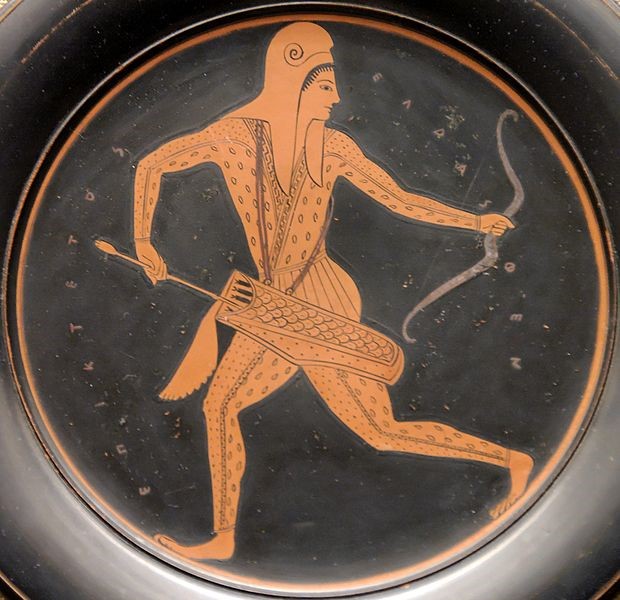
This is a red vase and based on my research this is an accurate depiction of how the archers in this time period looked, artist Epiktetos (signed), time frame between circa 520 and circa 500 BC

This is a red vase and based on my research this is an accurate depiction of how the archers in this time period looked, artist Epiktetos (signed), time frame between circa 520 and circa 500 BC

The archer’s attire was made up of a tunic and trousers, which were loose fitting and usually had an elaborate woven decoration to them. There was also a cap that they wore along with a combined quiver and bow-case (Iranian Archer- Soldier Profile). Many times, the foot soldier carried a short sword (acinaces), a spear with wooden shaft and metal head and butt, a quiver full of arrows of reed with bronze or iron heads, and a bow about one meter long with ends formed in animals’ heads, and a case which combined the bow-case and quiver-holder (Shahbazi).

An Achaemenid Archer with a composite bow. This is another idea of what the Persian archer would have looked like.

An Achaemenid Archer with a composite bow. This is another idea of what the Persian archer would have looked like.

References:

An Achaemenid Archer with a Long Bow. The Circle of Ancient Iranian Studies. Web. http://www.cais-soas.com/CAIS/Images2/Achaemenid/Military/Achaemenid_Archer.gif

DWYER, Bede, and Manouchehr MOSHTAGH KHORASANI. “An Analysis of A Persian Archery Manuscript Written By Kapur Čand.” Revista De Artes Marciales Asiaticas 8.1 (2013): 1-12. Academic Search Premier. Web. 28 Jan. 2014.

Iranian Archer- Soldier Profile. 10 November 2010. Web. 9 Feburary 2014.

Shahbazi, Sh., A. Achaemenid Army. n.d. Web. 9 Feburary 2014.

Wikipedia contributors. “Trousers.” Wikipedia, The Free Encyclopedia. Wikipedia, The Free Encyclopedia, 22 Jan. 2014. Web. 28 Jan. 2014.

2 Comments

Filed under Class Stuff

Battle of Salamis: Greek Organization/Tactics

Honors 2110B

Rainey, William. Death of the Persian admiral at Salamis. The Stapleton Collection / The Bridgeman Art Library. Plutarch's Lives for Boys and Girls',. n.d. Colour Lithograph.

Rainey, William. Death of the Persian admiral at Salamis. The Stapleton Collection / The Bridgeman Art Library. Plutarch’s Lives for Boys and Girls’,. n.d. Colour Lithograph.

January 28, 2014

Battle of Salamis

     In the roaring waters between the mainland of Salamis and the island in the Saronic Gulf near Athens, a naval battle was fought between the Greek city-states and the Achaemenid Empire of Persia in September 480 BC.  As numerous ships trailed through the waters, the marking of the soon to be war was upon them as they lined up in preparation to see who would be victorious.

As each side prepared for battle, different tactics and strategies engulfed the minds of each side. The Persians, expecting an easy victory, were at a significant tactical advantage, outnumbering their allies, and having better ships, one being the Phoenician, which was the fastest ship. Most of their marines carried a bow, which the Persians relied greatly on in their battles, which would most likely fail if their ship was boarded, as the bow would be negated due to the standoff range. Persians had swifter ships with triremes being equipped with a ram at the bows, which would be used for ramming, which required skill sailing, Persians were more likely to employ this technique, but the Greeks developed special tactics and a unique set-up specifically to counter this.

Led by Themistocles, the Greeks sailed there estimated 300 plus ships in a single file line towards the Persians who had their boats aligned in a different form.  As the Greek ships approached closer to the Persians, the Greeks began to roe out of there single file line into a circular formation as they rowed into the clumsy line set-up of the Persians. Once in position, the Greeks turned their ram-equipped bows toward the Persians, using a common tactic “diekplous”, which is described as a tactic of sailing into gaps between enemy ships and then ramming them into the sides. As the Greeks rammed the Persians, they began to lure the Persians further into the channels. As the Persians fell for the trick, the Greeks struck again hitting the weakest point of the ships on the sides and the stern quarter. As the process was repeated, the objective was to puncture a hole in the enemy vessel or break a number of the enemy’s oars to disable the ship or get the ship to sink.

As the Persian ships sank, the Greeks were at an advantage because of their ability to swim. Many Persians drowned because they could not make it to shore. Persian command and control soon broke down, and in fear of that the Greeks might attack the bridges across the Hellespont, the few remaining ships headed back, as the Greeks scored a decisive victory.

Works Cited

Elayi, Josette. The Role of the Phoenician Kings at the Battle of Salamis (480 B.C.E.). Vol. 126. Paris: Journal of the American Oriental Society, 2006. Scholarly Journal.

Gabriel, Richard A. Battle of Salamis. Vol. 26. Military History, 2009. 28 January 2014. <http://web.a.ebscohost.com.hal.weber.edu/&gt;.

Rainey, William. Death of the Persian admiral at Salamis. The Stapleton Collection / The Bridgeman Art Library. Plutarch’s Lives for Boys and Girls’,. n.d. Colour Lithograph.PICTURE.

Rawlinson, George. Herodotus: The History. Vol. 4. New York Appleman & Company, 1885. Print.

Waterfield, Robin. Herodotus:The Histories. 2008. Book.

Wood, Adrian K. Warships of the World. 2012. Book.

Leave a comment

Filed under Uncategorized

Test

Hope this works!

Leave a comment

Filed under Uncategorized

Testing!

This is Hypatiathemartyr, and this is my first blog post! 

Leave a comment

Filed under Uncategorized

Hi there

This is vulpesvulpes95 and this is my first blog post ever!

Leave a comment

Filed under Uncategorized

Hello

Hey everyone! Just saying hello on the blog.

Leave a comment

Filed under Uncategorized

¡Hola!

Hello world! My name is rosina1313. Wishing you all a wonderful day!

Leave a comment

Filed under Uncategorized

Hey!

hey guys! I’m AnneOfKiev.  Let’s get to going on this class!

Leave a comment

Filed under Uncategorized

Blog works

I was able to access the blog

Leave a comment

Filed under Uncategorized