Category Archives: Uncategorized

Alexander’s Intelligence System

Over the millennia warfare has changed exponentially.  Weapons have been innovated innumerable times.  Tactics have evolved to fit the needs of the modern army just as weapons have.  One thing that has not changed though is the need for military intelligence.  Although methods for gathering information have changed, the need to understand one’s ones strategical position is still essentially the same.  Alexander the III of Macedon, commonly known as Alexander the Great, understood this need.  During his conquest of the Persians, from 336-323 BC, he employed numerous tactics in order to gather information about the foreign lands and enemies around him.  Two of the most important positions in his army were scouts and guides.

Mounted scouts utilized by Alexander were most often called Prodromoi.  This is an apt name for them because the translation of this word, from ancient Greek, literally means “runners ahead” (“Prodromoi).  Their job exactly was to go ahead of the main body of the army to scout and perform reconnaissance.  These men would study the terrain in order to find the best places for the army to camp and march over.  The scouts also would interrogate the local population about weather, supplies, and enemy movements (Payne 283).  These tasks were vital to the survival of the army and were a major piece of the logistical puzzle of the Macedonian army.

Another aspect that could have spelled life or death for the Macedonian army was the work of guides.   Guides had to know the land most intimately so that they could guide the army over the path of least resistance. Alexander and his army needed to be led to traversable terrain and to places with fresh water and a source of food.  The escorts had to keep the troops out of geographical peril.  For these reasons, guides were most often people from the lands that Alexander had either conquered or had been surrendered.  Sometimes the native people willingly helped the Macedonians on their trek.  Other times these people would be angry about being subdued and would purposely lead soldiers astray.  Because of this, Alexander often held the family members of his guides hostage until they had gotten him to where he needed to go (Engles 331-332).  Regardless of the circumstance, Alexander always knew how to utilize his resources.

A time when Alexander most needed a source of information and intelligence was during his march through the Gedrosian Desert.  On his way back from India, through present day Pakistan and Afghanistan, he was forced to go through one of the deadliest deserts in the world (shown in the picture below).  The leader of the Macedonians knew that many other commanders had brought armies into the area before and had perished in the heat.  He knew that no man had ever been successful in bringing an army through the wasteland (Arrian 333).  Knowing this, he entrusted his scouts and guides to lead him through the desert.
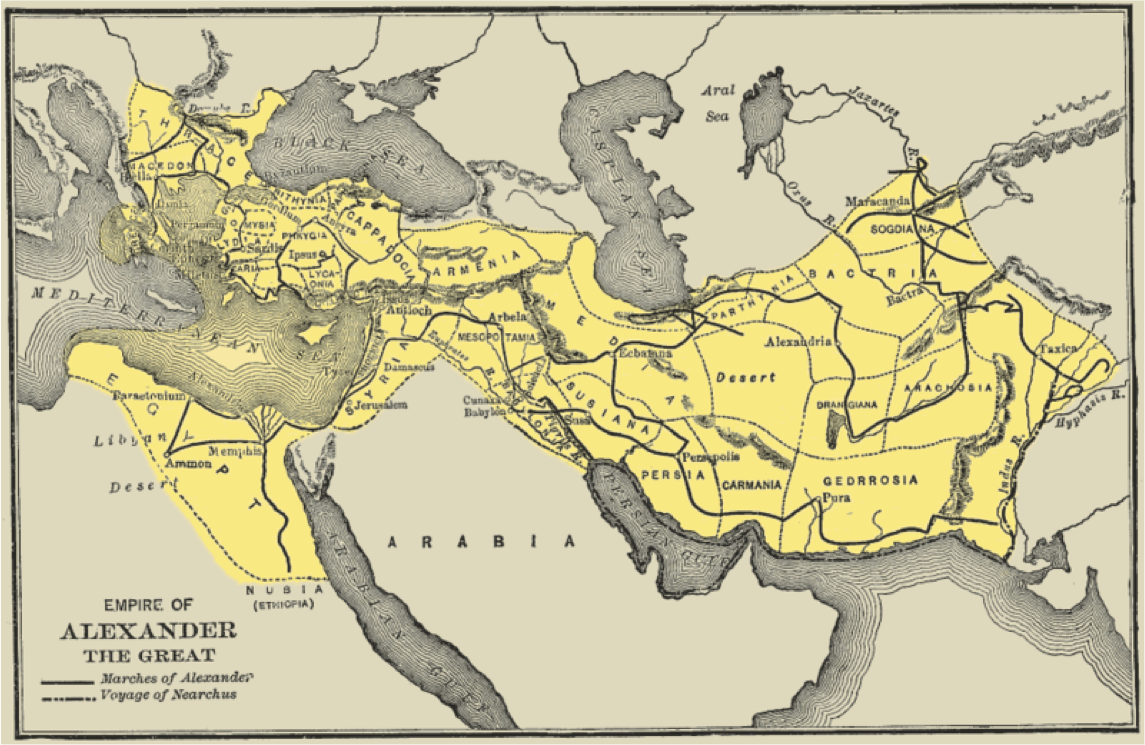
map

(Botsford. “Map of empire of Alexander the Great shortly after acquiring the Persian Empire.” The Gedrosian Desert is located in the bottom right hand corner- Southeast corner- of the page.  Alexander was traveling from the border of the yellow to the capital city Gedrosia in Pura.)

In the beginning, Alexander tried to follow the coast to stay supplied by his fleet.  When nothing could be seen of the ships, he sent some of his Prodromoi ahead, on a reconnaissance mission.  This mission yielded no sighting of the ships or fresh water sources (Arrian 334). Having this important information from his scouts allowed Alexander to save his troops from thirst, for a time.

When the coastal route failed, the King of Macedon turned his army inland.  This turned out to be a bad decision.  The scorching heat and the less than abundant source of water led to the death of many of his men (Arrian 335).  Despite their hardship, his guides continued to lead the way.  After a time though, even they lost their way.  They were unable to find specific landmarks because the marks had been scrubbed away by sand (Arrian 335).  It seemed that all hope was lost, but the tide soon turned.

Once again Alexander’s intelligence gathering system saved the day.  A group of Prodromoi, led by the king himself, found a route back to the sea.  The discovery of fresh water, on the beach, by the scouting party literally saved the bodies and the morale of his men.  Soon after, the guides found their way back to the proper trail (Arrian 339).  Eventually Alexander the Great and his army made it out of the desert and into the less treacherous interior of Persia.

Although many of his men had perished, his force was the largest that had ever made it through the Gedrosian.  While part of this feat can be attributed to Alexander’s true grit, he would have never made it through without his intelligence gatherers.  His scouts and native guides were the true pathfinders through the desert as well as for all of his campaigns.  The combination of these two made the Macedonian information gathering system and army as a whole the most powerful military force of Alexander’s time.

Works Cited

Arrian. The Campaigns of Alexander. Trans. Aubrey De Selincourt. London: Penguin, 1958. Print

Engles, Donald. “Alexander’s Intelligence System.” The Classical Quarterly XXX.1 (1980): 327-340. Print.

Payne, Kathryn. “Information collection and transmission in Classical Greece.” Libri 43.4. (1993): 271-288. Print.

“Prodromoi.” Wikipedia. Wikipedia, n.d. Web. 3 March 2014.

Botsford, George Willis. “Map of empire of Alexander the Great shortly after acquiring the Persian Empire.” Photograph.                Wikipedia. Wikipedia, n.d. Web 3 March 2014.

Leave a comment

Filed under Uncategorized

The Battle of Issus

The battle of Issus was a major conflict between Alexander the Great, king of Macedonia, and Darius III Codomannus, the king of Persia. Macedonia had been preparing to invade Persia for several years prior to the battle, but these plans had been hampered by the death of then-king Philip. The ascension of his son Alexander to the throne allowed the invasion to continue, though the delay allowed Persia to overcome its own problems and better prepare to face the Macedonian forces (Lendering, Issus, 2014).

The battle itself took place in the year 333 BCE. During his invasion of Cilicia, Alexander passed through Issus once without incident. At the time, his army was split with Alexander in control of one section and his right hand man Parmenion in control of the other. Though he believed the Persian’s to be to the east, Alexander understood that his split army was vulnerable at the time. To amend that, he marched south around the coast to meet with Parmenion’s section. To speed the march, he left the sick and wounded behind in Issus. The plan was sound, though Alexander discovered too late that his information was flawed. While he was joining with Parmenion, the Persians had marched north and used a mountain pass to descend on Issus sooner than had been anticipated. They attacked the wounded Macedonians and killed most of them. Their methods were quite messy, and included such lovely methods as “slicing off hands and burning the stumps” (Curtius, 1998). The few survivors fled south to join with Alexander, who started moving back north after news of the massacre reached him. He moved slowly, as the terrain forced his army to reorganize frequently.

With the ocean to the west and mountains to the east, Alexander only had a narrow area to march through. The Persians, however, occupied a much more open plane, which offered their cavalry a distinct advantage. Though cavalry charges couldn’t be repeated for hours and hours, they were brutally effective (Sidnell, 2006). Heavily armored horses tired regrettably quickly, so most cavalry in use was lightly armored (Worley, 1994). In an attempt to mitigate this advantage, Alexander kept his hoplites in two lines, hoping that it would allow his troops time to advance to a more open area. He also kept his companions to the right, planning to use them to destabilize the Persian left wing.

 Blog 2 image

(Lendering, Map of the Battle of Issus, 2014)

The battle itself was bloody. Alexander’s hoplites were the main targets of the Persians. The Macedonian right wing was also in danger, though Alexander managed to turn the tide of the battle with a single, brilliant maneuver. During the initial charge, the Macedonian forces were fired upon by Persian archers, who then retreated as the attacking phalanx grew closer. However, in order for them to do so, the Persian lines had to open for a brief moment. It was then that Alexander and his companions struck in a devastating cavalry charge. By destroying the right flank of the Persian army, Alexander was able to flank the center and support his phalanx. At that moment, the Battle of Issus turned into the Massacre of Issus. The Persians in the front were pushed forward by their forces in the rear, and were quickly crushed by the combined force of the cavalry and the phalanx.

This battle cemented Alexander’s fame. None could mistake that he had led the charge that won the battle, which solidified his reputation for bravery. It also destroyed the bulk of the Persian forces and led to Alexander gaining Phoenicia and Egypt from the Persians.

Bibliography

Curtius, Q. (1998). History of Alexander. London: Harvard University Press.

Lendering, J. (2014, February 1). Issus. Retrieved from Livius.org: http://www.livius.org/battle/issus/

Lendering, J. (2014, January 23). Map of the Battle of Issus. Retrieved from Livius.org: http://www.livius.org/pictures/a/maps/map-of-the-battle-of-issus/

Sidnell, P. (2006). Warhorse. New York: Continuum.

Worley, L. (1994). Hippeis. Boulder: Westview Press.


Leave a comment

Filed under Uncategorized

Alexander’s Navy and the Siege of Tyre:


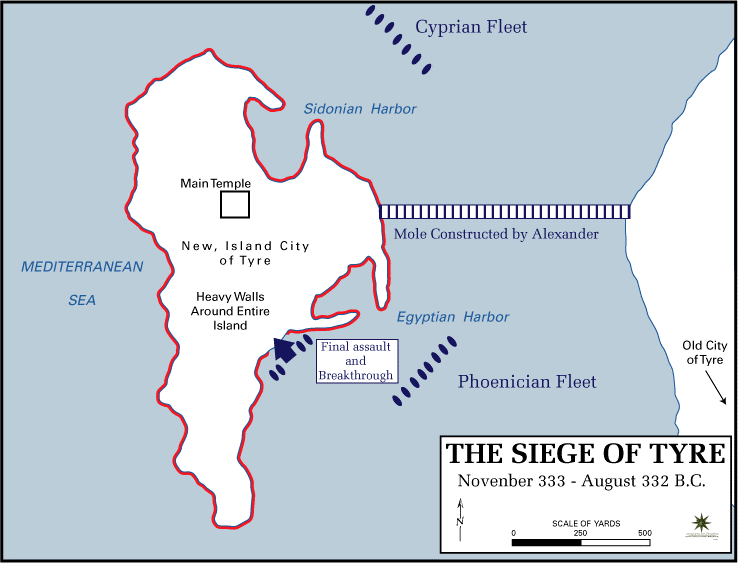
The Siege of Tyre was headed by Alexander the Great of Macedon in 332 BCE during his campaign against the Persians. This 7 month siege proved unique as Tyre was located on an island off of Phoenicia with no way to effectively invade it by land. Alexander began preparing to attack after having a dream of an invasion on Tyre that included a great struggle, but an ultimate victory in his favor. With his enthusiasm and appreciation of good behavior, Alexander managed to arouse support of his men even though the invasion seemed tactically improbable. They immediately began building a mole or causeway, essentially a bridge, from the mainland into the island using brick and wood in order to effectively invade the Tyrians (this passage would later bridge the island to the mainland through silt). This development immediately introduced new problems.

As a means of defense, The Tyrians had surrounded the city with thick fortified walls that they used to shoot the incoming Macedonians from as the mole approached the island. This forced Alexander to counter attack by constructing two defense towers to hold back the incoming fire. At this point, naval attacks seemed to be the only way to alleviate the building pressure between the two. The mole was at a standstill.

In response to the towers, The Tyrians “Fill(ed) a cavalry transport ship with dry vine twigs and other kindling… the greatest possible quantity of debris and firewood, and on top of that they put pitch, sulfur, and every other substance that stokes up a blaze…” (Arrian, II, 19), and successfully destroyed the defense structures. Alexander’s success now depended on a strong navy to further the development of the mole. Realizing this, he immediately began exploring new directions.

While seeking greater fortification to advance the mole, Alexander was informed of a large naval fleet that he could use with cooperation of Cyprus. The resulting naval assistance from Cyprus of 120 ships was given to Alexander with granted diplomatic Amnesty for their help. Alexander was also given additional naval assistance from Byblus, Aradus, Rhodes, Lycia, Cilicia and Macedon. Now with his fleet of approximately 220 ships consisting of quinquiremes, quadriremes, and triremes (polyremes), Alexander began to blockade Tyre. Alexander’s influence in the area had proven beneficial in assembling a navy. Obviously, these developements did not come without any adversity from the Tyrians.

Tyre

Map of the Siege of Tyre

The Tyrians continued to launch small naval attacks against the Macedonians with minimal success as they were outnumbered. However, by submerging boulders about the border of the wall, The Tyrians managed to slow down the incoming naval fleet by making the crews anchor and extract stone. This gave them the ability to shoot at the Macedonians as their stalled warships approached. While the ships were anchored, the Tyrians also sent out divers to cut anchor cords.  Again, Alexander’s tactical mind countered this by replacing the cord with chain.

As the surrounding Navy grew in numbers and efficiency, the mole progressed forward; the end of the siege was inevitable. Other Naval groups under Alexander’s command also overtook major Tyrian harbors. This growth of control around the perimeter allowed Alexander to focus on and eventually breach the wall. He, himself, helped lead men into Tyre with a successful overtaking. “Nearly eight thousand Tyrians Perished…. About four hundred Macedonians died.”(Arrian, II, 24)

The success of this invasion for Alexander relied completely on tactical innovation and numbers, especially regarding the navy. Evaluating the geography, it is clear that the Tyrians had a major advantage, being surrounded by water and heavy fortification. However, by effectively recalling and implementing a navy gathered through Alexander’s overarching power at the time, it is apparent that such an overtaking was possible. The Tyrians did not have the numbers necessary to hold back such an invasion as the one they were faced with. Although they did demonstrate effective defensive tactics, such as bouldering and other tactics to prolong the process. In the end, the tactical blockading, engineering, and constructing along Tyre’s perimeter, along with sufficient resources being available, resulted in the inevitable victory for Alexander.

Bibliography:

33°16′15″N 35°11′46″E. “Ancient Tyre” via Google Earth.

Arrian. The Landmark Arrian: The Campaigns of Alexander. Trans. James Romm. Anchor, 2012. Book. 28 February 2014.

C. Snell, D. 2012. Tyre. The Encyclopedia of Ancient History.

Chad M. Schaffer. (2011). Military Field Engineering in the Ancient World. Retrieved from https://www.landconference.org/journals/2011-scholars/schaffer.pdf

Gabrielsen, V. 2012. Navies, Greek. The Encyclopedia of Ancient History.

Grant. “Alexander’s Siege of Tyre, 332 BC.” 2011 August 2011. Ancient.eu. Web. 28 February 2014. <http://www.ancient.eu.com/article/107/&gt;.

Lendering, Jona. “Alexander Takes Tyre.” n.d. http://www.livius.org. 5 February 2014.

The Department of History, United States Military Academy. Siege of Tyre. N.d. Map. Wikipedia.org. Web. 28 Feb 2014. <http://en.wikipedia.org/wiki/File:Siege_tryre.gif&gt;.

Wikipedia Contributors. “Alexander the Great.” 2014 March 1. Wikipedia.org. Web. 28 Gebruary 2014. <http://en.wikipedia.org/wiki/Alexander_the_Great&gt;.

Wikipedia Contributors. “Siege of Tyre (332 BC).” 15 February 2014. Wikipedia.org. Web. 28 February 2014. <http://en.wikipedia.org/wiki/Siege_of_Tyre_(332_BC)&gt;.

Leave a comment

Filed under Uncategorized

The Battle of Gaugamela

The Battle of Gaugamela was a prime example of how the terrain was important in battle. This battle took place in 331 BC between Alexander the Great, from Macedon, and Darius III, leader of the Persians. Alexander led his army to victory. The battle was fought in the plains of Macedonia in Gaugamela, which is a small village near modern-day Iraq because Darius wanted to stop Alexander from encroaching even more on the Persian empire  (Britannica).

Darius specifically picked out this place to have the battle. It was an “empty plain suitable for cavalry; not even shrubs and short bushes hide the ground, and an unobstructed view is allowed even to objects which are far away” (Curtius 247). Also, “if there was any eminence in the plains, [Darius] gave orders that it should be levelled and the whole rising made flat” (Curtius 247). Darius wanted to ensure a level playing field for the battle (no pun intended).

Alexander had a strong cavalry called the Campanian, or Companion, Cavalry. Since they were heavy cavalry, they wore armor, usually consisting of a metal helmet and breastplate (Worley 156). Their weapon was called a sarissa, “a light, cornel-wood spear” which was about nine feet long. The length, weight, and shape provided easy throwing, smooth riding, and multiple attacking maneuvers (Worley 156).

Darius decided to make his cavalry his strong point, especially since Alexander led such a fine cavalry. It was also advantageous that the land was flat and convenient for cavalry. Darius’ formation included a very strong left wing, with approximately twenty thousand cavalry, which would compete with Alexander’s seven thousand (Sidnell 108-109). Alexander was able to view Darius’ formation from some hills. He noted that “even if he massed all his cavalry on that wing they would be outnumbered three to one, and of course his other flank would be left unprotected” (Sidnell 109).


Darius flees during the Battle of Gaugamela (Anonymous).

Darius flees during the Battle of Gaugamela (Anonymous).

Works Cited

Anonymous. The Battle of Gaugamela. National Archeological Museum of Spain.

“Battle of Gaugamela.” Britannica, Encyclopaedia. Encyclopaedia Britannica Online. n.d. 28 February 2014.

Curtius, Quintus. History of Alexander: Books I-V. Trans. John C. Rolfe. Cambridge: Harvard University Press, 1946.

Sidnell, Philip. Warhorse. New York: Hambledon Continuum, 2006.

Worley, Leslie J. Hippeis: The Cavalry of Ancient Greece. Boulder: Westview Press, 1994.

Leave a comment

Filed under Uncategorized

Alexander the Great and the Battle of Granicus River

Alexander the Great was the ruler of Macedonia in the year 336, following the assassination of his father, King Philip II. Before then, he was put in command over the left wing of the Macedonian army at the battle of Chaeronea two years before his father died. He was a great military leader, and his father saw him a trustworthy heir to the throne because of his loyalty and skill (Oxford).

When Alexander did finally become ruler of Macedonia, he began to conquer the East, and continued to do so until his death. His empire stretched over 3,000 miles from the Adriatic Sea to the Indus River (Sacks).To conquer the other lands, Alexander led major campaigns across the continent. These campaigns were very successful. In this post, I would like to focus on one such battle, called the Battle of Granicus River.

Alexander the Great began to conquer the Persian Empire, and his first battle against the, was at the River Granicus. In summary, Alexander was up against a slightly smaller Persian army commanded by local Persian govenors. The majority of the battle was fought on horse with cavalry and on foot with soldiers, and took course over a few attempts by Alexander to cross the river, which led to his eventual victory. To delve further into this battle, I will first discuss the terrain of the river and its surrounding areas and how the two armies were set up.

Battle of Granicus River

Alexander the Great during the Battle of the Granicus River

First of all, the Persian armies were already posted on one side of the river, having their cavalry take the front line and line up along the whole side of the river. Being on higher elevation, the Persians had an advantage over anyone who would try to cross the river due to a high bank. The Persians were in number some 20,000 cavalrymen, along with a force of foreign mercenary infantry (Hammond).

Alexander’s forces were more numerous in size than the Persian army, but were at a disadvantage due to the river and elevation difference. Alexander was in command of the cavalry in the right wing of the army, Parmenion was in charge of the cavalry in the left wing, and the phalanx was in the center in the center, which consisted of two rows.

Alexander was urged by some of his close advisors not to charge across the river when they arrived, and was encouraged to wait at the foot of it until the next day and charge the enemy before they could get into formation. Alexander disregarded the instruction and said that is would be unworthy of the Macedonians if they did not do battle that day(Romm and Strassler).

Alexander led the first charge against the Persians with his unit of cavalry. They attempted to cross the river, but were unsuccessful. The other wing of the Macedonian army also began to cross the river, but also met resistance. Meanwhile, the main units of the Macedonian phalanx began to successfully cross the river with ease, and eventually gained the upper hand.

The Persians began to retreat, but no severe chase was given. Instead, Alexander turned his attention towards the foreign mercenaries that were still in formation. He ordered the phalanx to attack the front while he circled around back with his cavalry. They killed most of the mercenaries, but took around 2,000 alive as prisoners (Romm and Strassler).

And thus the Battle of the Granicus River was won. Although Alexander faced a disadvantage due to the landscape, he still was able to gain the upper hand and win a very decisive first victory against the Persian Empire.


Works Cited

Hammond, N. G. L. “The Battle of the Granicus River.” Society for the Promotion of Hellenic Studies 100.Centennary Issue (1980): 73-88. Document.

Le Brun, Charles. Battle of the Granicus. Paris. Oil on canvas.

Oxford. The Oxford Encyclopedia of Ancient Greece and Rome. Ed. Micheal Gagarin. Vol. I. Oxford: Oxford University Press, 2010. Print.

Romm, James and Robert B. Strassler. The Landmark Arrian: The Campaigns of Alexander. New York: Pantheon Books, 2010. Print.

Sacks, David. Encyclopedia of the Ancient Greek World: Revised Edition. New York: Facts On File, 2005. Print.


Leave a comment

Filed under Uncategorized

Blog post two: The Siege of Tyre

File:A naval action during the siege of Tyre by Andre Castaigne (1898-1899).jpg

(source: Wikimedia common) Andre Castaigne’s depiction of Alexander the Great’s siege of Tyre in 332 BC.

Siege engines have been used since antiquity to break down walls and gain access to walled or fortified cities.

Both Alexander the Great and his father, Philip II, used siege warfare as part of their military strategies.  In particular, Alexander the Great laid siege to the ancient island city of Tyre, Phoenicia, present day Lebanon, in 332 BC.

After Alexander’s success at the battle of Issus, he wanted to sacrifice to Heracles at Tyre.  Seeing this as a ploy to occupy the city, take the last Persian harbor, and increase his navy,  the Tyrians refused Alexander’s request, suggesting that he could still sacrifice to Heracles at old Tyre on the main land, but not at new Tyre.

Still intent on visiting and worshiping at the new temple of Melqart, a Phoenician God that would have been roughly equivalent to Heracles, Alexander sent representatives to try to negotiate with Tyre. However, the representatives were killed and their bodies were thrown over the walls of the city into the Mediterranean Sea. Alexander saw this as an act of defiance and declared war upon Tyre.

Women and children were evacuated from Tyre to Carthage.  As well as providing refuge to the Tyrians, they also promised aid in the form of ships to the Tyrians.

Tyre presented more than one tactical problem to Alexander due to the terrain; new Tyre was built on an island about a half mile out from shore.  Alexander did not have much of a navy at the time, nor did he have much of a way to be able to access the walled, island city. To address this, Alexander began the process of building a causeway out to Tyre so he could transport siege engines and begin breaking down the walls of the city.

Building the causeway was not terribly difficult for a while, the sea was shallow and Alexander’s men were able to fend off artillery attacks from Tyre.  However, the closer Alexander and his men got Tyre, the more intense the artillery fire became. The sea floor also took a dramatic, cliff-like drop about half way between the shore and Tyre. The siege weapons had to be covered in wet rawhide so they would not catch fire from the flaming arrows that Tyre shot at them.  Despite Alexander’s best efforts to keep his men safe, about 400 were killed in the process of building the causeway, breaking down the city walls and entering the city of Tyre.

After seven long months of fighting and blockades, Tyre fell to Alexander’s forces.  Of the original population of Tyre, 30,000 were sold into slavery, 2,000 were crucified on the beach and 6,000 were killed during the attack.  Alexander did worship Heracles at the temple of Melqart before moving on to subdue Gaza and Egypt.

Works Cited:

“A naval action during the siege of Tyre.” by Andre Castaigne. 1898-1899.  http://en.wikipedia.org/wiki/File:A_naval_action_during_the_siege_of_Tyre_by_Andre_Castaigne_(1898-1899).jpg 

“Alexander’s Siege of Tyre, 332 BC” Ancient History Encyclopedia. Web. 4 March 2014. http://www.ancient.eu.com/article/107/

“Alexander the Great.” Wikipedia. Web. 4 March 2014 http://en.wikipedia.org/wiki/Alexander_the_Great

Bose, Partha. “Alexander The Great’s Art of Strategy.” India: Penguin Books, 1 May 2004. Web.

The Landmark Arrian: the campaigns of Alexander. New York: Pantheon Books, 2010. Print.

“The Siege of Tyre.” Wikipedia. Web. 4 March 2014. http://en.wikipedia.org/wiki/Siege_of_Tyre_(332_BC)

Leave a comment

Filed under Uncategorized

The Use of Scouts during Alexander the Great’s Time

This blog is going to focus on Alexander the Great’s use of scouts and the different types. I am going to be looking at two different types of scouts used, the ones to gather intelligence, and the ones who were used in battle. One incident of Alexander’s use of scouts to gather intelligence that I came across the most was for preparing for the battle of Issus. Alexander had scouts go and gather information about the size, status, and location of the fleeing Persians. He also obtained intelligence concerning the terrain of the region so that he could plan and be prepared and have the advantage when the battle actually occurred (Engles 334).

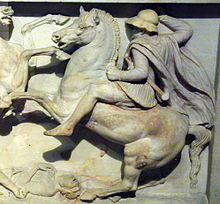
Alexander also used scouts in battle. They typically were on horses and were armed. Their job was to be sent ahead of the main army when contact with advance units of a hostile army was expected. The prodromoi were scouts that were equipped with only light armor and a sword. They are defined as skirmisher light cavalry who were equipped for scouting and outpost duties (“Ancient Macedonian Army”). They would jump early into battle and sort of harass the enemy and slash whoever they could. The sarissophoroi were scout raiders who were fast and capable of charging. They had throwing spears but were only lightly armored. The kontos were the scout lancers who were the most heavily armored and were used to break enemy defense lines (“Warfare”).

This is a a piece of sculpture that forms part of the Alexander Sarcophagus. It gives repesentation of what a scout in the calvary may have looked like. He is more heavily armed and has a sword.

This is a piece of sculpture that forms part of the Alexander Sarcophagus. It represents what a scout in the cavalry may have looked like. He is more heavily armed and has a sword.


Alexander benefitted from the use of scouts because it gave him the upper hand in knowing what was going to take place, what the enemy’s plans were, and how to best take his opponent down. This is proven by the battle of Issus, where Alexander was able to develop tactics and strategically place his men to overcome his opponent by using scouts. However, it is written that Alexander’s scouts are not mentioned after the pursuit of Darius, his opponent in the battle of Issus, the theories behind this are that maybe Alexander reorganized the scouts, or that maybe he trained some of the as a unit of javelin-men (Worthington 298). A little while after the battle of Issus, Alexander was planning on marching after Darius a third time, but scouts found out that Darius had been slain before Alexander could get to him, thus the scouts saved him a trip (Rufus 16). A lot of Alexander’s victories can be credited to the use of scouts and intelligence. Without using them, he wouldn’t have gotten the advantage of knowing what the enemies plans were and may not have won so many battles that he did.

References:

Engles, Donald. “Alexander’s Intelligence System.” The Classical Quarterly XXX.1 (1980): 327-340. Print

http://en.wikipedia.org/wiki/Alexander_Sarcophagus. Image.

Rufus, Quintus Curtius and Johann Freinsheim. Quintus Curtius: His History of the Wars of Alexander. 1747. Print.

Warfare in Ancient Greece- Cavarly. 28 November 2008. Web. 3 March 2014.

Wikipedia contributors. “Ancient Macedonian army.” Wikipedia, The Free Encyclopedia. Wikipedia, The Free Encyclopedia, 4 Mar. 2014. Web. 5 Mar. 2014.

Worthington, Ian. Alexander the Great: A Reader. Routledge, 2012. Print.

Leave a comment

Filed under Uncategorized

The Battle at the Hydaspes

When Alexander the Great reached the Hydaspes River in 326 B.C.E., his conquest of India came to a halt.  There he was met by an Indian king named Porus, whose forces kept guard along the opposite riverbank to prevent Alexander from crossing.  “The water was high at that time of year…and the current…swift and turbulent” (Arrian, 1958 Trans., p. 268), but Alexander was determined to continue, so he ordered the “continual movement of his own troops to keep Porus guessing” (Arrian, 1958 Trans., p. 267) as to where he would attempt to cross.  To add to the confusion, he had his men march around making a lot of noise, which Porus would obviously respond to.  But because no crossing ever accompanied the noise and marching, Porus grew complacent and stopped reacting to these movements.

Sir Aurel Stein, a British archaeologist, explored the area around the Hydaspes (Jhelum) River in the early 20th century, and did extensive research to try to determine the exact battle site, and how the terrain would have affected it.  As it was fought during the “season of rains” (Stein, 1932, p. 37), he concluded that “the waters of the river, swollen by the rains and the melting snows of the mountains, rendered fording impossible” (Stein, 1932, p. 33).  The flooded river was a major hindrance to Alexander’s plans, affecting where he could make a crossing, not to mention Porus’ troops were always watching the other side.  Despite this, Alexander had a stroke of good fortune when his scouts came upon a crossable location.  There was a “projecting spit of land, thickly wooded with different sorts of timber” and not far beyond was “an uninhabited island, also well wooded,” that would provide great cover for his army (Arrian, 1958 Trans., p. 269).  Under the cover of a thunderstorm, Alexander finally had the opportunity to sneak across (Arrian, 1958 Trans., p. 271).

The terrain of the area had a big impact on where the actual fighting could take place.   Due to the heavy rains the night before, “[m]uch of the ground was deep in soft mud, so [Porus] continued his advance till he found a spot where the sandy soil offered a surface sufficiently firm and level for cavalry manoeuvre” (Arrian, 1958 Trans., p. 276).  “On reaching a sandy and level position [Porus] halted and drew up his troops in line of battle to await Alexander” (Hamilton, 1956, p. 27).  Many historians believe that the battle that ensued, “fought in monsoon rains at the River Hydaspes…was Alexander’s military masterpiece” (Sacks, 1995, p. 17).  While the initial battle actions relied heavily on cavalry, the infantry were very much needed.  Luckily the battle took place on solid ground rather than mud, otherwise the horses and possibly the elephants would have been rendered useless.

Something that set the Macedonian infantry apart was their use of the sarissa, a “13- to 14-foot-long pike” (Sacks, 1995, p. 179).  While not as heavily armored as Greek hoplites, “using leather or cloth” armor, as opposed to bronze, their long reach and better maneuverability helped make up for their vulnerability (Sacks, 1995, p. 179).  However, Alexander’s infantry had never faced anything like Porus’ war elephants, which “plunged this way and that among the lines of infantry, dealing destruction in the solid mass of the Macedonian phalanx” (Arrian, 1958 Trans., p. 278).  The infantry, “though unaccustomed to face elephants and suffering serious losses from their onslaughts, held fast” (Stein, 1932, p. 35).  Under Alexander, the phalanx was mostly used to “hold [the] enemy’s charge and damage his formation, while the cavalry looked for a weak point to attack,” as was the case in this battle (Sacks, 1995, p. 179).

Toward the end of the battle, Alexander “signaled his infantry to lock shields and move up in a solid mass” to surround the Indian army (Arrian, 1958 Trans., p. 279).  This move allowed Alexander to contain and cut down Porus’ remaining forces.  As can be seen in the illustration below, the fighting was brutal, and, once surrounded, the Indians didn’t stand a chance against the solid Macedonian phalanx and cavalry (Castaigne (Wikipedia), 1911).

An illustration of the Macedonian infantry facing off against the Indian war elephants. (Castaigne (Wikipedia), 1911) http://en.wikipedia.org/wiki/File:The_phalanx_attacking_the_centre_in_the_battle_of_the_Hydaspes_by_Andre_Castaigne_(1898-1899).jpg

An illustration of the Macedonian infantry facing off against the Indian war elephants. (Castaigne (Wikipedia), 1911) http://en.wikipedia.org/wiki/File:The_phalanx_attacking_the_centre_in_the_battle_of_the_Hydaspes_by_Andre_Castaigne_(1898-1899).jpg

The region’s climate and terrain played a huge role in the battle, affecting troop maneuverability, as well as the actual place where the battle could be fought.  In the end, Alexander’s army was able to defeat Porus, allowing him to continue his conquest of India.

Works Cited

Arrian. (1958). The Campaigns of Alexander (A. De Selincourt, Trans.). New York, NY: Penguin Books.

Castaigne, A. (Artist). (1911). The phalanx attacking the centre in the battle of the Hydaspes by Andre Castaigne (1898-1899) [Web Photo]. Retrieved from http://en.wikipedia.org/wiki/File:The_phalanx_attacking_the_centre_in_the_battle_of_the_Hydaspes_by_Andre_Castaigne_(1898-1899).jpg

Hamilton, J. R. (1956). The Cavalry Battle at the Hydaspes. The Journal of Hellenic Studies, 76, 26-31. Retrieved from http://www.jstor.org/stable/629551

Sacks, D. (1995). Alexander the Great; phalanx. In A Dictionary of the Ancient Greek World (pp. 14-18; pp. 178-179). New York, NY: Oxford University Press.

Stein, A. (1932). The Site of Alexander’s Passage of the Hydaspes and the Battle with Poros. The Geographical Journal, 80, 31-46. Retrieved from http://www.jstor.org/stable/1785386

Leave a comment

Filed under Uncategorized

Alexander the Great of Macedon

It was agreed that the army travel down south the rivers Hydaspes and Indus so that they might reach the Ocean on the southern edge of the world and from there head westward toward Persia. 1,000 ships were constructed and while the navy sailed the rivers, the army rode down along the rivers banks, stopping to attack and subdue the Indian villages along the way.

It was agreed that the army travel down south the rivers Hydaspes and Indus so that they might reach the Ocean on the southern edge of the world and from there head westward toward Persia. 1,000 ships were constructed and while the navy sailed the rivers, the army rode down along the rivers banks, stopping to attack and subdue the Indian villages along the way.

Honors Blog 2

27 February 2014

               Alexander III of Macedon, also known as Alexander the Great, was a king of the Greek kingdom of Macedon. Alexander spent most of his ruling years on a military campaign, going through Asia and Africa. He soon, later in his ruling, created one of the largest empires in the ancient world. Alexander was undefeated in battle and is still considered to be one of history’s most successful commanders.

                Creating the largest empire in the world, leads to the question as to how Alexander the Great accomplished this. In 327, Alexander decided to march on India. He began doing this by getting his army into shape. First Alexander got rid of the baggage train of the Persian loot. He also sent a number of veterans home, while bringing in new fresh troops. He also added Persian Calvary and infantry to his army.

                Alexander also had great engineers who were able to build strong, large ships. The trireme was the heaviest type of warship used during this time. This heavy ship was propelled by three banks of oars, with one oarsman on each. Far less is known with certainty about the actual construction and appearance of these ships. But many were equipped with cannons that they built.

                Wanting more, Alexander continued down towards the Ganges River, but many of his men rebelled Alexander took a smaller group on an alternate route which arrived in the Indus Valley upriver from Peshawar. They reached the mouth of Indus, where some problems arose during this route, due to the high mountainous ranges. Alexander the Great used native guides which allowed him to occupy a nearby mountain. His engineers built mound, and soon the fortress was taken.

                As to how these ships and tactics worked, Alexander had his men build great ships, and this was defiantly needed once they reached India. Also, there was an additional fleet of ships and boats which traveled down the Indus River as well. None of the Greeks had ever encountered anything to prepare them for India. The terrain, the monsoons, and the fierce tribes are some of the problems that they encountered.

                When the army did move down the Indus River Valley, they did so in a unique way, dividing into three branches. The ships and boats sailed along. Alexander joined this branch. Another branch traveled on the east side of the river, and the third branch on the west side. Of course there was much fighting, as Alexander insisted on destroying any opposition along the way which might be a threat to his future rule of the Indus region.

                This great ruler was fierce and did not let anything get in his way. Whatever the terrain, from tropical to bitter cold, scorching desert to waterlogged marshland, Alexander met every challenge he was set and overcame every difficulty he encountered. While Alexander’s siege towers breached the most impregnable of strongholds, their bridge-building skills were equally outstanding and allowed them to cross ravines and rivers alike, along with his great ships.


Works Cited

Bosworth, A. B. (1996). Alexander and the East: The Tragedy of Triumph. Oxford: Clarendon Press.

Buhl, H. (2010). Alexander the Great & The Fall of the Roman Empire. Ancient History Pathfinder, 50-62. Retrieved from http://hbl.gcc.edu/

Macedonian ships traveling traveling down Hydaspes and Indus rivers. History of Macedon. University of California, Oxford. Retrieved March 2, 2014, from http://www.historyofmacedonia.org/

Naiden, F. (2011). Alexander the Great. Journal of the History of Society, 1, 1-21.

Robinson, C. A. (1953). The History of Alexander the Great. Providence, Rhode Island: Indiana University Library.

Watkins, T. (2009, 06 12). Alexander of Macedonia . Retrieved from SJSU: http://www.sjsu.edu/

Wood, M. (2007). In the Footsteps of Alexander The Great: A Journey from Greece to Asia. San Diego: University of California Press, 1997.


Leave a comment

Filed under Uncategorized

Revision of Spartan Training

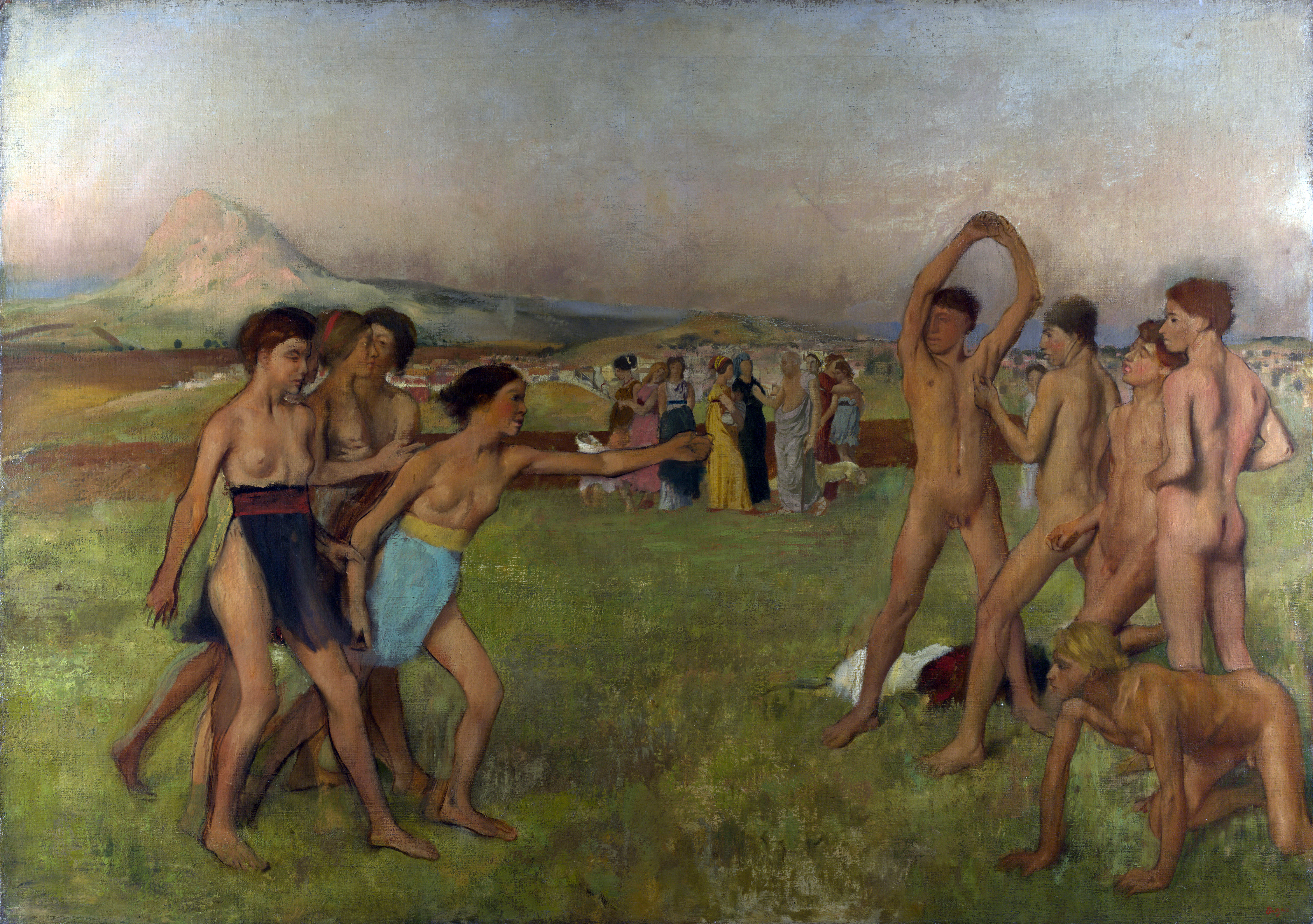
One of the greatest armies in history was the Spartan army. But what made them great? They used the phalanx as was customary of the time and their phalanxes were filled with ranks of hoplites. The difference for the Spartans may have come from their militaristic society. The Spartans began training warriors almost from birth, the men going through a process called the Agoge, or “the upbringing” to become the warriors and the women being educated to run the affairs of the house and prepared to give birth to warriors.

Image

Young Spartans Exercising, located in the National Gallery in London. http://en.wikipedia.org/wiki/Young_Spartans_Exercising


When a child was born in Sparta, they were washed with wine, and presented before a council of elders who would decide if the child was strong enough and healthy enough to be a Spartan. If the council decided the child wasn’t healthy enough, the child was taken to Mount Taygetus to die from exposure. Otherwise the children lived at home until they were 7 years old. At age seven, the boys were put into a mitilary school and their training began. They were trained in several disciplines including gymnastics, warfare, and others,  all of which were designed to produce great warriors. As part of their training, they were not well fed, which was believed to produce tall warriors (Cartledge, p. 69-70). The lack of food also prepared the men for long campaigns with little food, and encouraged stealing. If the boys were caught stealing, they were punished for being caught, rather than for stealing. Stealth was a highly desired quality for Spartan warriors.


When the boys reached the age of 20, they had ten years to join a group or messes (pheiditia, sussitia). Election into these groups was highly competitive. All members of a mess had to accept the applicant in order for them to join the group. If the individual was not accepted into one of these groups by age 30, they were not granted full citizenship in Sparta. These individuals became part of the Perioikoi, a group of free people but not full citizens who contributed to society in a variety of ways.. They may have been part of what we would understand as the military reserve, but that isn’t known for sure. They were a step up from the helots, who were serfs, the group of the Spartan society that did not enjoy freedom (Wikipedia, Sparta).


After being admitted into a group, the warriors continued training and the leaders would have rewards to keep the men fit for battle. In Xenophon”s Hellenika, Xenophon records “As [Agesilaos] wished to train the army, he set up prizes among the hoplites for the one who was found to be in the best physical condition.” Agesilaos also set up prizes for the cavalry, the peltasts, and the archers as well.  Xenophon continues, “Because of this policy, one could see all the gymnasia full of men exercising,” and the other groups all training and preparing for their specific factions of the army (Xenophon, p 105).


The spartan army was one of the greatest armies of the world and much of that was in part to the lifestyle of complete dedication of the men to the military until they reached the age of 60. If a person wanted to be a Spartan, they had to live the life, be part of a mess, and fight honorably and with singularity of purpose. The training brought discipline, discipline brought trust, trust brought unity, and unity led to success for the Spartans.


Works Cited

“Agoge.” Wikipedia. Wikimedia Foundation, 16 Feb. 2014. Web. 7th Feb. 2014. <http://en.wikipedia.org/wiki/Agoge&gt;.


Cartledge, Paul. “Under the Sign of Lycurgus.” The Spartans: The World of the Warrior-heroes of Ancient Greece, from Utopia to Crisis and Collapse. Woodstock, NY: Overlook, 2003. 69-70. Print.


Degas, Edgar. Young Spartans Exercising. 1860. Oil on Canvas. National Gallery, London. Wikipedia. Wikimedia Foundation, 3 Jan. 2014. Web. 10 Feb. 2014. <http://en.wikipedia.org/wiki/Young_Spartans_Exercising&gt;.


Kyriazis, Nicholas, and Xenophon Paparrigopoulos. “War and Democracy in Ancient Greece.” European Journal of Law and Economics. 2012. Springer US. Web. 12 Feb. 2014. <http://link.springer.com/article/10.1007/s10657-012-9352-1#page-1&gt;.


Sacks, David, and Oswyn Murray. “Sparta.” A Dictionary of the Ancient Greek World. New York: Oxford UP, 1995. 233. Print.


“Sparta.” Wikipedia. Wikimedia Foundation, 17 Feb. 2014. Web. 8 Feb. 2014. <http://en.wikipedia.org/wiki/Sparta&gt;.


Xenophon. The Landmark Xenophon’s Hellenika: A New Translation. Trans. John Marincola, and Robert B. Strassler. New York: Pantheon, 2009. 105. Print.

Leave a comment

Filed under Uncategorized