Alexander the Great – The epitome of siege Equipment in the battle of Tyre and a little boasting.

Perhaps the most notorious siege of Alexander the Great was that of Tyre in 332 BC. The potential for siege machinery was perhaps first understood by Alexander’s father King Philip, but Alexander likewise saw the benefit for the equipment and better epitomized its use during his campaign against Persia. The use of machinery to besiege cities was made relatively shorter compared to the past where a city was circumscribed by an opposing attacker. (Potter 127).

Brief History and Account of the Siege of Tyre given by Arrian.

After Alexander the Great was denied permission to enter the city of Tyre and sacrifice to the god Herakles, he considered the consequences to his empire if Tyre was left to their own devices. Therefore, Alexander convinced the generals of the need to capture the threatening Tyre, despite the apparent naval and defensive advantages Tyre held. Tyre had a much larger navy (being a port city) and also was a great defensive stronghold (being an island surrounded by a large wall). (2.18.2-4). Arrian mentions the size of the wall to be “150 feet high and proportionately thick” (2.21.4).

File:Tyre-aerial-photo-by-France-Military-1934.jpg

Aerial view of Tyre taken in aprox. 1934

Despite these detriments, Alexander was not deterred and found it in his best interest to build a mole or causeway from the Phoenician inland shore to the Island (Arrian, 2.18.2-4).  As the construction of the mole became closer to the city, it also drew deeper into the water and eventually the mole and its workers became vulnerable to the ranged ballistic attacks from the wall and the triremes in the Tyrian military. This temporarily halted the construction of the mole as Alexander then ordered his engineers and workers to build two siege towers on the edge of the mole, which would hold equipment designed to counter-fire against the Tyrians. Further, Alexander’s engineers draped the towers with skins as to better shield the workers and provide cover so they could resume their work on the mole (2.18.5-6).

In retaliation the Tyrians boarded vessels filled with flammable materials which they deployed against the towers and then set fire to them; thus, destroying the towers and much of the progress of the mole (2.19.1-5).

Alexander comprehended that the siege would be futile as long as the Tyrians held the upper hand, therefore, he instructed his engineers to widen the mole and to construct more siege equipment.  Alexander then left for the surrounding Phoenician regions to procure reinforcements by claiming dues owed from kings and granting amnesty towards others (2.19.6-2.20.1-8).

Alexander amassed a large navy, infantry, and engineers and again returned to the siege of Tyre in approximately 11 days. In a defensive maneuver the Tyrian navy took position in their two harbors one facing Sidon and the other facing Egypt (2.20.7-8). While the Tyrian navy was held at bay, war engines were built and assembled on the mole, horse-transports, and slow sailing triremes. Alexander then had the war machines bought across the mole and started bombardment against the wall. Ships holding siege machinery was halted until large stones could be hauled from the water as they could not get in range for their weapons. (2.21-1-3).

Taking countermeasures, the Tyrians attempted to cut the anchors cords away from the triremes moving the stones but were thwarted by the Macedonians who used chains. In a last attempt, the Tyrian navy attacked some empty moored ship destroying a few. However, in return Alexander set up a blockade preventing other Tyrian vessels to make it out of the harbor and the set out to defeating the vessels which had attacked the moored ships (2.21.4-7-22.1-5).

The siege equipment at the site of the wall proved to be unsuccessful; therefore, Alexander took the ships holding siege equipment around the island bombarding various points along the wall eventually breaking through. Initially, Alexander attempted to enter the city but was fought back (2.22.6-7).

Alexander, waiting two days later, is determined to enter the city. He instructed the siege equipment to fire at the wall for a considerable length of time and then prepared and eventually landed on the island capturing Tyre (2.23.1-6).

The End – of the brief history lesson.

Some discussion and boasting in Alexander’s behalf…

As stated earlier the battle of Tyre is perhaps one of the most famous sieges of Alexander’s campaign. It is at this battle when we see siege machinery used to break down a wall which surrounds a city as well as the use of battering-rams at sea (Nossov, 40-41). Likewise, this example displays a diverse array of siege equipment including: torsion projectors which fired arrows (katapetai) and stones (litoboloi or petroboloi), as well as battering-rams, and towers in diverse offensive and defensive methods.

Diodorus (17.43.1 and 17.45.1-4) goes into more detail regarding the technological innovations introduced by both sides during this siege. Alexander’s engineers devised catapults large enough to hurl stones capable of smashing the Tyrian walls, apparently the first time artillery weapons had been used against fortifications rather than personnel. The Tyrians for their part made cushions out of hides stuffed with seaweed to absorb the impact of the stones, and further warded them off with some sort of wheel-like device that deflected missile fire as it spun around. Phoenicians were famous in antiquity and their engineering skill, so it is not surprising that Alexander recruited much of the local talent into his army or that both sides in the conflict made rapid advances in military technology over the course of the seven-month siege (qtd. in Arian by Mensch, 88).

During Alexander’s campaign he included engineers in his baggage train throughout his expedition, as Potter puts it: “Alexander brought experts in siege warfare, katapeltaphetai, with him, and their extraordinary accomplishment at places such as Tyre show that they could construct massive weapons on the spot and improve their technology as the years passed” (Potter, 127). Engles pointed out that in Areia it was clear that the use of carts would be used to transport siege machinery but also engineers would carry tools and supplies required to build equipment (15-17). The ability to build rather than transport siege equipment allowed the army to move swiftly and efficiently, while most likely allowing the equipment to be more reliable and adaptable depending on the situations Alexander and his army found themselves in. Stark examples of this can be obtained through recall of Arrian provides us.

* I found some good examples (in my opinion) of some of the siege equipment that would have been used during Alexander’s campaign at http://www.ancientworlds.net/aw/Post/1222743 and some nice images of the battle at http://www.ancientworlds.net/aw/Post/1225046. I have contacted them for permission to use some images but have yet to hear a reply. Professor Payne, maybe if you get a chance to look at these you could tell me if any of them are out of copyright if fall under fair-use. In the interim I hope the class enjoys!

Works Cited:

Arian. The Landmark Arrian: the campaigns of Alexander a new translation. Trans. Pamela Mensch. Ed. James Romm and Robert B. Strassler. New York: Pantheon Books-Random House, 2010.

Engels, Donald W. Alexander the Great and the Logistics of the Macedonian Army. Berkeley: University of California Press, 1978.

Image GEOEYE , Google Earth, and ORIONN-ME. 2012 Map. “Harbor of Tyre, Lebanon.” Data Sio, NOAA, U.S. NAVY, NGA, GEBCO.  9 Feb. 2012.

Poidebard, A. UN GRAND PORT DISPARU T Y R RECHERCHES AÉRIENNES ET SOUS-ARINES 1934-1936. 1939. LIBRAIRIE ORIENTALISTE PAUL GEUTHNER 12, RUE VAVIN – PARIS (Vl). 9 Feb. 2012 http://almashriq.hiof.no/general/900/930/933/tyr-poidebard/tyr.html.

Potter, David. “Alexander the Great and Hellenistic Warfare.” The Ancient World at War. Ed. Philip de Souza. New York, NY: Thames & Hudson, 2008. 119-38.

Nossov, Konstanin. Ancient and Medieval Siege Weapons: A Fully Illustrated Guide to Siege Weapons and Tactics. Guilford: The Lyons Press-The Globe Pequot press, 2005.

Leave a comment

Filed under Uncategorized

Due date change for Alexander

Your Alexander blog is now due on Thursday, Feb. 9 by midnight MST.

Email me if you’ve got any questions.

Leave a comment

Filed under Class Stuff

In-Class Assignment: How did Hannibal Get Elephants over the Alps?*

  1. Hannibal’s army was directed by guides.
  2. He had the animals walk carefully through narrow places.
  3. He had his men clear vegetation.
  4. He had his men build roads.
  5. He had his men follow the contours in the mountains.
  6. He hit detours at cliffs and was misled by guides from time to time.
  7. He had his men clear away snow and ice.
  8. He had his men cut through rock to create paths by quickly heating frozen rock, using sour wine as a corrosive, and then using picks.
  9. He had his men create a zig-zag track to minimize the slope of the road during the group’s descent.
  10. The elephants took longer to move over the top of the mountains than the men and horses because they had to widen the path.
  11. The animals had to eat local vegetation along the way, so the animals almost starved while they were stuck at the peak.
  12. The Italian side of the Alps has ample vegetation, so once Hannibal got the army over the top of the mountain, the party was able to feed the animals and rest.

*Notes based on information from http://www.livius.org/ha-hd/hannibal/alps_text.html

Leave a comment

Filed under Uncategorized

Battle Of Marathon


The Battle of Marathon was fought on the plain of Marathon around the 10 of September or 12 of August 490 according to the full moon. The Persians sailed to the bay of Marathon (25 miles from Athens). The Athenian general Miltiades quickly formed a small army of hoplites or infrantrymen. There were about 10,000 heavily armed Athenians and 1,000 Plataeans (Livius) that went to fight against the numerous army of Persia at the Battle of Marathon. The great runner Pheidippides was sent to Sparta to request reinforcements but the Spartans could not respond due to the religious festival of Carneia which prevented the Spartans from any military operation until the full moon. The 11,000 hoplites were divided into ten tribes with a Strategoi (generals) over each “tribe.”(Tucker). Miltiades, Aristides and Themistocles were some of the generals over the tribes. Callimachus was elected by the tribes to be the polemarch.

Callimachus was in command of the right wing which consisted of the Athenians while the left wing was commanded by the Plataeans. The wings surrounded the numerous Persians in what modern sources call a “double envelopment” (Tucker). The Persians deemed the endeavor to be “Suicidal Madness” as written by Herodotus of Halicarnassus. However the Greeks were able to defeat the Persians and save Athens as well as capture seven of their ships. Afterwards, the Greeks left a detachment to make sure the Persians did not return. The Persians had already set course for Athens but when they arrived they found that the rest of small but successful Greek Army ready for them. The Persians Retreated and thus ended the Battle of Marathon.

Figure 1: the way the Greeks(Red) surrounded the Persians(Blue); source: en.wikipedia.org/Double_envelopment

Image

Works Cited

J.A. S. Evans. “Herodotus and the Battle of Marathon.” http://www.jstor.org. [Online] 3st Qtr. 1993. [Cited: Jan 31, 2012.] http://www.jstor.org/stable/4436293

Doenges, Norman A. “The Campain of the Battle of the Marathon.” www.jstor.org. [Online] 1st Qtr. 1988. [Cited: Jan 31, 2012.] http://www.jstor.org.hal.weber.edu:2200/stable/4436491?seq=7.

“Battle of the Marathon.” en.wikipedia.org. [Online] January 9, 2012. [Cited: January 31, 2012.] http://en.wikipedia.org/wiki/Battle_of_marathon.

Battle of Marathon. http://www.livius.org. [Online] September 12, 2010. [Cited: Jan 31, 2012.] http://www.livius.org/man-md/marathon/marathon.html.

Tucker, Spencer. “Battles That Changed History: An Encyclopedia of World Conflict.” Greenwood Publishing Group. ABC-CLIO Nov. 11, 2010. [Cited Jan 31, 2012] Print.

Herodotus of Halicarnassus. Ed: A.D. Godley. “The Histories” Perseus.tufts.edu. [Cited Jan 31, 2012] http://www.perseus.tufts.edu/hopper/text?doc=Perseus%3Atext%3A1999.01.0126&redirect=true

Leave a comment

Filed under Uncategorized

Grecian Military Technology at the Battle of Marathon

Advancing two kilometers under a broiling August sun, each combatant sweltering under more than 30 kg of bronze, wood and leather, and running the last 100 m through a storm of arrows, the Greeks smashed into their lightly armored foes. Driving the Persians back to their ships, the Athenians killed 6,400 of them while losing only 192 of their own men. Then, in perhaps the day’s most impressive military feat, the exhausted Greeks turned around and raced 42 km back to Athens — the length of a modern marathon run– arriving in time to protect it from the Persian fleet.” (Bethune)

Undoubtedly, weapons and military technology play a crucial part in the decision of victory or defeat. Had the Persians been as heavily armored as Greeks, western civilization as we know it would not exist. For the sake of brevity, Grecian siege weapons and naval technology will not be covered in this blog. Instead, we will focus on military technology relevant to the Battle of Marathon from a Greek perspective. Mainly, this would include the weapons and battle techniques of Athenian and Plataean Hoplites, since the Greeks had “neither cavalry nor archers” (Herodotus).

Hoplites are heavily armored infantry, their name deriving from the word hoplon, or a piece of armor or equipment. Their greatest innovation and primary piece of equipment, the aspis, or shield, had both defensive and offensive capabilities. The typical Bronze Age aspis measured one meter in diameter and weighed about nine kilograms (approx. twenty pounds) or more, being made of a concave wooden disc overlaid with bronze. To hold this type of shield, the left arm would be inserted through two leather straps, one strap bearing most of the shield’s weight on the forearm, the other strap being held in the hand for maneuverability (Strickland). Being thus attached to the left arm, one can imagine the hoplite’s right side would be vulnerable to attack. However, the close knit formation of the phalanx remedied this problem; each man’s shield would cover his left side as well as the right side of the person next to him, creating a nearly impenetrable wall of defense.

A Hoplon shield

While good defense is very helpful, bashing one’s enemy with a twenty pound shield is not going to cut it. That said, a Hoplite’s primary weapon of choice was a doru. The doru was a six to ten foot long spear, two inches in diameter, made of cornel or ash wood. It weighed two to four pounds, fronted by a flat, leaf-shaped iron spearhead counterbalanced by a bronze butt-spike. The butt-spike was nicknamed “lizard killer” after the way an enemy’s toes looked, peeking out from under their shield. “The blunt, square shape would prevent the spike from penetrating deeply enough into the foot or ankle to entangle it and would have maximized damage to the bones, ligaments, and tendons of the foot with a minimum of force” (Wikipedia). Stabbing this bronze spike into an exposed leg or foot would likely be enough to bring an opponent to their knees – and consequently, their demise. This innovation also enabled the rear ranks of a phalanx to dispatch any Persian that may have fallen to the ground as the phalanx pushed forward.

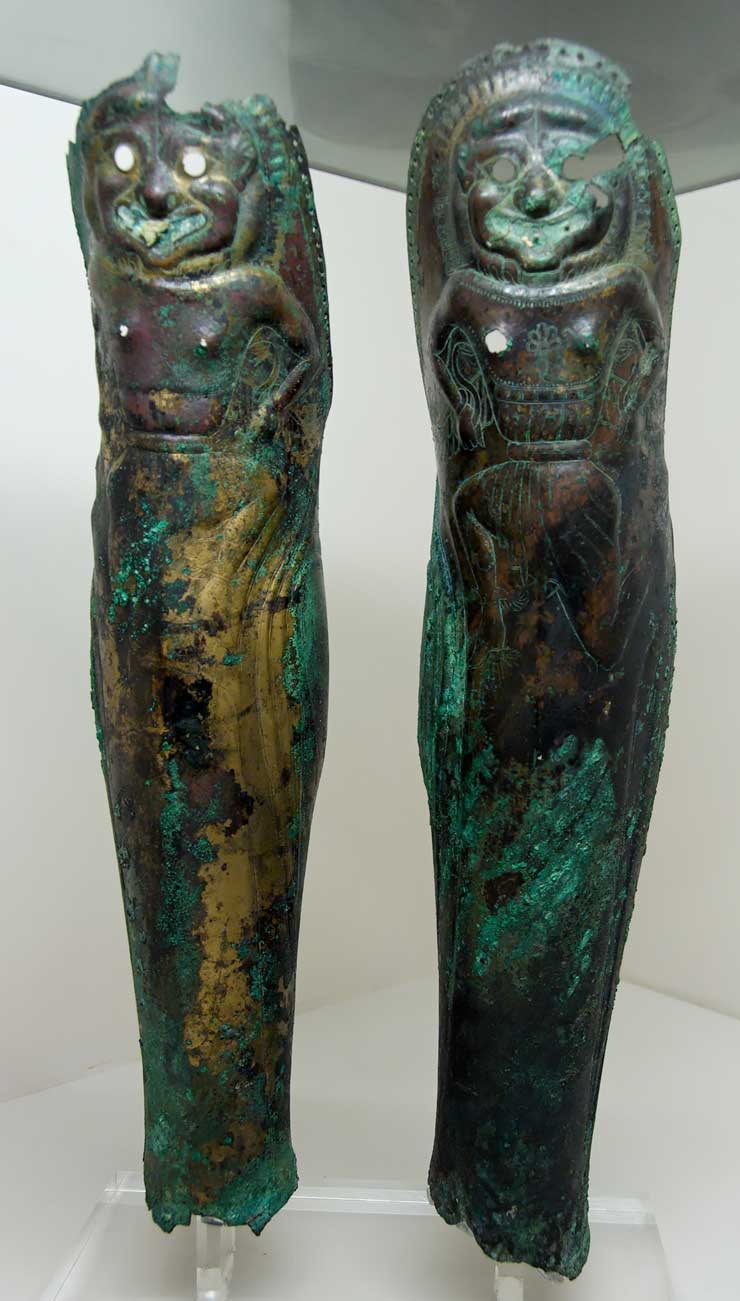
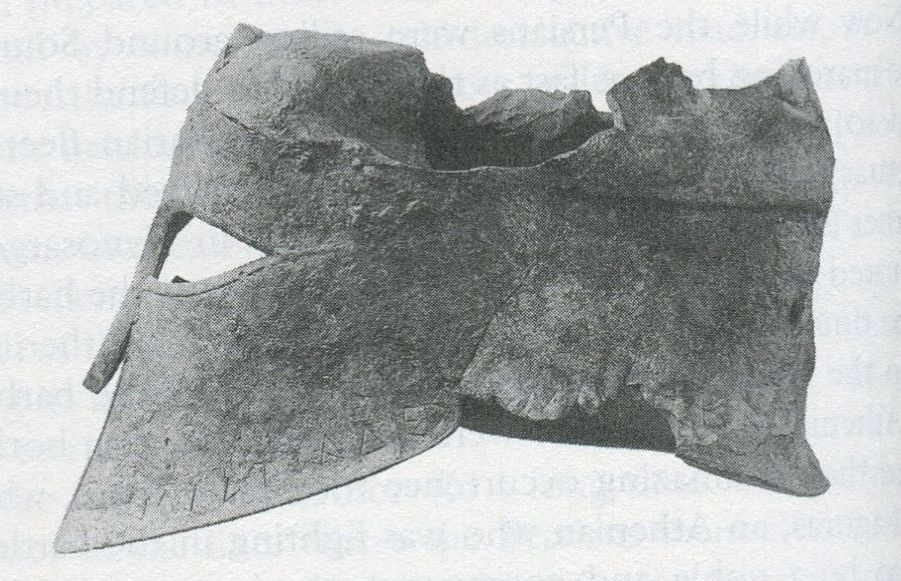
The secondary weapon of choice was a short sword of iron known as the xiphos. Hoplites were trained for phalanx warfare; developing skill as a swordsmen was left up to the individual. Being somewhat lacking in that area, the average hoplite would most likely draw his sword only if the spear was no longer an option. Lesser equipment such as the helmet, breastplate, and greaves were developed with much less care than the aspis or doru. Because of the aspis, Hoplites could wear smaller, more form-fitting body armor. The lesser armor was typically made of bronze, making them still quite heavy. The 10,000 heavily armored infantrymen present at the battle had a considerable advantage over their lightly-armored Persian adversaries  not only because of their equipment, but also because of the combination of tactics and terrain. The wrong tactic can cancel out any superiority in weapons: “Greek hoplites, for instance, proved to be ineffective against light-armed infantry on rough terrain, exactly like light-armed troops proved useless against heavy infantry on level ground “ (Fagan and Trundle).

Iron sword, arrowhead, and two lead sling bullets found on the field of  Marathon

Bronze greaves

Works Cited

Herodotus. The Landmark Herodotus: the histories. New York: Pantheon Books, 2007. Print

Bethune, Brian. “The most decisive conflict in world history.” Maclean’s Dec. 2005. Academic Search Premier. Web. 30 Jan. 2012.

Strickland, Tod. “An Impressive and Amazing Force: The Hoplite Warrior” Fall 2001. Google Scholar. Web. 30 Jan. 2012.

Fagan, Garrett and Matthew Trundle. New Perspectives on Ancient Warfare. Brill, 2010. Google Scholar. Web. 30 Jan. 2012

“Battle of Marathon.” Wikipedia. Web. 30 Jan. 2012

“Doru.” Wikipedia. Web. 30 Jan. 2012

“Aspis” Wikipedia. Web. 30 Jan. 2012

Leave a comment

Filed under Cohort II, Marathon, Thermopylae & Salamis

Medicine? Maybe a little Religion?

  Battle of Marathon Battle of Thermopylae Battle of Salamis
Time August/September490 BCE August 7 or September 8-10, 480 BCE September, 480 BCE
Where it was fought Marathon Greece Thermopylae, Greece The Straits of Salamis
 Who’s fighting who AtheniansAnd Plateans


Greek City- States  Persian Empire  Persians  Greek City-states  Achaemenid Empire 
  

Led By

Miltiades the younger, Callimachus Themistocles, Leonidas I and Demophilus Xerxes I of Persia, Mardonius, and Hydarnes Datis,  Artaphernes Eurybiades, Themistocles Xerxes I of Persia, Artemisia I of Caria, and Ariabignes
Result Greek victory Persian Victory Greek Victory


Herodotus gives 378 ships of the alliance, but his numbers add up to 366.[1]

Looking at the Persian Wars from the Greeks side, the Medicine is much as would be expected. Back then they didnt have to worry about things like .50 cals’, Grenades, RPG’s, or Nukes. The main use’s for medicine were for battle fatigue, “shell shock”, and arrow wounds. After a battle in the war, the Greek warrior Ajax, appeared to have battle fatigue. Homer described his behavior as “delusional”. Herodutus  suggested combat induced mental illness; in the Battle of Marathon, particularly with the Athenian army. However, battle related abnormalities were rarely diagnosed as disease prior to the 20th century.


Leave a comment

Filed under Marathon, Thermopylae & Salamis

Scouting and Intelligence in the Battle of the Marathon

  Battle of Marathon Battle of Thermopylae Battle of Salamis
Time August/September490 BCE August 7 or September 8-10, 480 BCE September, 480 BCE
Where it was fought Marathon Greece Thermopylae, Greece The Straits of Salamis
 Who’s fighting who AtheniansAnd Plateans Greek City- States Persian Empire Persians Greek City-states Achaemenid Empire
  Led By Miltiades the younger, Callimachus Themistocles, Leonidas I and Demophilus Xerxes I of Persia, Mardonius, and Hydarnes Datis,  Artaphernes Eurybiades, Themistocles Xerxes I of Persia, Artemisia I of Caria, and Ariabignes
Result Greek victory Persian Victory Greek Victory

The Battle of the Marathon took place in 490 BC, between the Athenians, aided by their allies the Paletean hoplites (estimated to be between 600-1000 men), and the Persians (Doenges, 1988).  This battle was important for the Greeks they proved that they could defeat the Persians.  In spite of the fact that the Persians solders out-numbered the Greeks by two to one, the Greeks won the battle using a strategic plan to block the road to Athens. This allowed them the strategic advantage of physically blocking the Persians from entering city, thus illuminating the need for an army as large as the Persians (Battle of the Marathon, 2012).  Their strategy was to stand close together and in a tight line and align their shields so that it was hard for the Persians to get through.

http://en.wikipedia.org/wiki/File:Greek_Phalanx.jpg

Modern drawing of the Phalanx formation employed by Greek hoplites (File:Greek Phalanx.jpg, 2007)

Isolated Figure from a Panathenaic Black-figure amphora, Berlin Painter, 480-470 BC, showing a middle-distance race “hippios”

(File:Greek Phalanx.jpg, 2007)

When the Greeks determined the size of the Persian army they would be facing it was determined that reinforcements would be needed.  The blocked the road to Athens and at the same time sent a messenger named Phiedippides to ask the Spartans to join them in the battle.  Phiedippides was known for his ability to run great distances in a short time. He made the trip to Sparta and back to the front in three days.  He brought the message that the Spartans were going to send reinforcements (Battle of Marathon, 2010).

Works Cited

File:Greek Phalanx.jpg. (2007, August 21). Retrieved from Wikipedia.org: http://en.wikipedia.org/wiki/File:Greek_Phalanx.jpg

Battle of Marathon. (2010, September 12). Retrieved Jan 31, 2012, from http://www.livius.org: http://www.livius.org/man-md/marathon/marathon.html

Battle of the Marathon. (2012, January 9). Retrieved January 31, 2012, from http://en.wikipedia.org/wiki/Battle_of_marathon

Doenges, N. A. (1988, 1st Qtr.). The Campain of the Battle of the Marathon. Retrieved Jan 31, 2012, from http://www.jstor.org: http://www.jstor.org.hal.weber.edu:2200/stable/4436491?seq=7

Painter, B. Phidippides. Retrieved from http://www.mlahanas.de/Greeks/Philipides.htm

Leave a comment

Filed under Uncategorized

Military Tech of the Battle of Salamis: the Trireme

The Battle of Salamis was a naval battle that took place in September 480 BC, in the straits of Salamis, between the island of Salamis and the mainland of Greece. As part of the second Persian invasion of Greece, the Persian fleet of 1,207 ships sought a decisive battle against the allied Greek fleet of 380 ships (“The Battle of Salamis”).


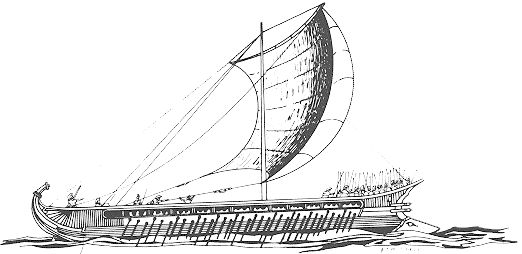
The trireme (Greek for “three-oarer”) was a type of warship used in the Mediterranean, consisting of three stacked rows of oars on each side of the ship. Evolving from the bireme (two rows of oars), the first triremes were likely from Phoenicia, though some earlier historians suggested it was introduced to Greece from Corinth. The trireme became the warship-of-choice in the Mediterranean area by the early 5th century (“Trireme”).


The trireme was a fast, agile ship. With 170 men rowing in synchronization, they could reach speeds of 9-10 nautical miles per hour (in a short burst of speed), or 5-8 at a normal or somewhat hurried pace. Unfortunately, these thin ships were not equipped for the harsh open waters, and were only useful in coastal seas (Strauss, xviii).


Depiction of a Greek trireme


Trireme design varied from area to area. The most historical documentation is on the Athenian trireme. These ships would have been approximately 130 feet long and 18 feet wide (39 feet wide when the oars were extended), and would have sat 8½ feet above the waterline. Weapons themselves, the ships featured a prow that would have been tipped with a large, bronze-encased ram that extended about 7 feet off the stem at the waterline. The Phoenician triremes (which made up approximately ¼ of the Persian fleet) were wider than the Athenian triremes, to hold more troops on the decks. The Phoenician ram would have been longer and more tapered than the Athenian counterpart (Strauss, xvii-xviii).


Triremes were ships of considerable size, and required a considerable amount of wood to build. Greece was mostly deforested by the sixth century, so they had to import their lumber for building ships. Other countries, like Egypt, also had this problem (Johnson, 199). As expected, those countries that contributed the most to the Persian fleet were those that had more available lumber, except Egypt, which was wealthy enough to import it (Johnson, 203).


The Persian fleet was made up of 1,207 ships of Persian-controlled nations. Herodotus lists that the Phoenicians provided 300 ships, the Egyptians provided 200, the Cyprians 150, the Cilicians 100, the Ionians 100, as well as six other countries providing various two-digit numbers of ships (Herodotus). Because the Persians were a land power, they felt uncomfortable in a sea-battle of merely ships. Instead of relying only on the abilities of the ships and their crews, they packed the ships with infantry and archers in order to try boarding enemy ships instead of sinking them. This was an additional 70 infantrymen and archers (30 Persian/Mede, the rest miscellaneous other troops) on each of the ships in the Persian fleet (Strauss, 132). Unfortunately, this was a futile strategy, because many ships in the Persian fleet were sunk before they could board the enemy ships. And more unfortunately, most of the Persian troops couldn’t swim.


Works Cited

Herodotus. The Histories of Herodotus: Book VII. Trans. George Rawlinson, 1942. Ed. Bruce J. Butterfield. ParsTimes.com. Web. 1 Feb. 2012. <http://www.parstimes.com/history/herodotus/persian_wars/polymnia.html&gt;


Johnson, Allan Chester. “Ancient Forests and Navies.” Transactions and Proceedings of the American Philological Association 58 (1927): 199-209. Print.


Mitchell, F. Greek Trireme. 1984. <http://www.au.af.mil/au/awc/awcgate/gabrmetz/gabr0066.htm&gt;


Strauss, Barry S. The Battle of Salamis: The Naval Encounter That Saved Greece – and Western Civilization. New York: Simon & Schuster, 2004. Print.


Wikipedia Contributors. “Trireme.” Wikipedia, The Free Encyclopedia. Wikipedia, The Free Encyclopedia, 23 Jan. 2012. Web. 1 Feb. 2012.


Wikipedia Contributors. “Battle of Salamis.” Wikipedia, The Free Encyclopedia. Wikipedia, The Free Encyclopedia, 1 Feb. 2012. Web. 1 Feb. 2012.

Leave a comment

Filed under Marathon, Thermopylae & Salamis

Honor and Shame for Battle of Thermopylae

After the defeat of the battle of Marathon, the Persian King Darius I was enraged and “needed to Punish Athens for its involvement in Persian affairs.” (Brosius, 23) However this was postponed for reasons such as the revolt from Egypt and Babylon, as well as the fact that Darius I died in the winter of 486 B.C. (Brosius, 23) His son, Xerxes I, was the next in line for the thrown and had to reclaim their land and to punish the Athenians for everything they have done.

Xerxes knew that to have his father’s vengeance, he had to make a greater army, greater navy and stronger warriors in order to defeat the Greeks. (Picture) The honor/shame that Xerxes had was one that had been passed down for many generations of early Persian kings was how great their power becomes during their reign. Each king had to try to succeed the other and to surpass their father, grandfather, and sometimes brother. (Brosius, 33) With Darius failing with their first invasion to Greece, Xerxes “over the course of three days, during the second Persian invasion to Greece. It took place simultaneously with the naval battle at Artemisium, in August or September 480 BC, at the narrow coastal pass of Thermopylae (The Hot Gates).” (Wikipedia)

When the first invasion of Greece happened in 490 BC, the Persians were brutally defeated at the Battle of Marathon. However, with Xerxes out for revenge for the second invasion, he had his mind set on destroying the Greeks. King Leonidas I, the Spartan leader and leader of the Greeks in the second invasion, underestimated the new Persian army under Xerxes. Leonidas not know that Xerxes had created an army that would not end or what they called the “Immortals” (Livius) Leonidas underestimated how many attacks and heats of people Xerxes had, and this was the element of surprise that Xerxes used against Leonidas. After the first two heats of the Persian warriors were defeated, Kind Leonidas had a problem. The honor/shame of losing the men of his army because they left, or because they were told to leave because the Athenians thought they were going to win. The honor/shame of leaving your army was not acceptable to the Greeks and especially the Spartans in the early centuries. (Kraft, 183) At Thermopylae, which is a passage in the mountains, there were only 300 Spartans, 700 Thespians, 400 Thebans and perhaps a few hundred others, the vast majority of whom were killed. (Wikipedia) It is not known if Leonidas told the rest of his army to leave or if they were cowards or over confident and went home, but this was one of the first steps of the fall of the Greek Empire. And Xerxes did a job that his own father could not do, and they wiped the Spartans and the rest of the Greeks out.

File:Persian warriors from Berlin Museum.jpg

Sources: http://en.wikipedia.org/wiki/Battle_of_Thermopylae

http://www.livius.org/th/thermopylae/thermopylae2.html

The Pass at Thermopylae, Greece.John C. Kraft, George Rapp, Jr., George J. Szemler, Christos Tziavos and Edward W. Kase

Journal of Field Archaeology , Vol. 14, No. 2 (Summer, 1987), pp. 181-198
Herdotus, Histories. 1. VII. Rawlinson: <http://classics.mit.edu/Herodotus/history.7.vii.html&gt;.
Brosius, Maria. The Persians: An introduction. New York: Routledge, 2006. Print.

Leave a comment

Filed under Cohort VII Scutum Decoris, Marathon, Thermopylae & Salamis

Greek Strategy in the Battle of Marathon

  Battle of Marathon Battle of Thermopylae Battle of Salamis
Time August/September

490 BCE

August 7 or September 8-10, 480 BCE September, 480 BCE
Where it was fought Marathon Greece Thermopylae, Greece The Straits of Salamis
 

Who’s fighting who

Athenians

And Plateans

Greek City- States Persian Empire Persians Greek City-states Achaemenid Empire


Led By

Miltiades the younger, Callimachus Themistocles, Leonidas I and Demophilus Xerxes I of Persia, Mardonius, and Hydarnes Datis,  Artaphernes Eurybiades, Themistocles Xerxes I of Persia, Artemisia I of Caria, and Ariabignes
Result Greek victory Persian Victory Greek Victory

Looking at the Battle of Marathon from the Greek side, we see that strategically the Greek (particularly Athenian) motivation was to defend themselves against Persian invaders. It is believed that King Darius of Persia ordered his general, Mardonius, to pillage, burn and enslave Athens as punishment for their role in the feeding the Ionian Revolt which lasted from c. 499 to 493 BCE (“Greco-Persian Wars”). In the battle of Marathon, 10,000 Athenian citizen-soldiers confronted an overwhelmingly larger Persian force and miraculously emerged victorious.

Even though fighting on home turf, the Greek force was still at a disadvantage.  Terrain is a definite deciding factor in any battle as each group developed fighting tactics based on the nature of the country—therefore, if one group can entice their opponent into an engagement on favorable terrain, there is a decisive advantage given to one party while the other is fatally handicapped. While the Greeks may have had home court advantage, the flat battlefield and surrounding country was ideal for the Persian cavalry (“The Battle of Marathon, 490 BC). Greek victory may be partially attributed to the ineffectiveness or tardiness of the Persian cavalry.

To Fight, or Not to Fight:

Herodotus recounts Athenian generals being divided in opinion whether to risk battle with the Persians because the Athenian forces were too few in number. The ten generals cast a vote, with the deciding eleventh vote belonging to Callimachus of Aphindae. It is believed that Miltiades, a general in favor of battle, approached Callimachus in an attempt to persuade his vote toward engaging in battle. His argument for conflict was that the people of Athens were faced with one of two options: submit to slavery without engaging in conflict or fight to defend themselves with the hopes that with a just cause and the assistance of the gods they can overcome the enemy and leave a legacy for future generations (Koeller).

When the vote was cast, the Athenian force prepared for battle. The small army succeeded in blocking the two exits to the plain of Marathon which brought about a stalemate. After waiting five days, the Athenians attacked the Persians (“The Battle of Marathon, 490 BC”). To the astonishment of the Persian army, what appeared to be a small handful of men charged across the plain of Marathon without archers or cavalry—apparently welcoming their own destruction (Koeller). Even outnumbered as they were, the Greek hoplites were much more effective against the Persian infantry (“The Battle of Marathon, 490 BC”).  In defense of their lives, freedom and city, the Athenian army slew about six thousand four hundred barbarians, while only losing one hundred ninety two of their own (Koeller). The victory at Marathon was monumental to Greeks, so much so that after the death of Aeschylus (a famous Greek playwright who is considered the father of tragedy) his participation in the Battle of Marathon was held in higher esteem than his life as a successful playwright (West).

Αἰσχύλον Εὐφορίωνος Ἀθηναῖον τόδε κεύθει

μνῆμα καταφθίμενον πυροφόροιο Γέλας·

ἀλκὴν δ’ εὐδόκιμον Μαραθώνιον ἄλσος ἂν εἴποι

καὶ βαθυχαιτήεις Μῆδος ἐπιστάμενος

Beneath this stone lies Aeschylus, son of Euphorion, the Athenian,

who perished in the wheat-bearing land of Gela;

of his noble prowess the grove of Marathon can speak,

and the long-haired Persian knows it well.

Copy & Translation of the inscription on Aeschylus’s tomb (“Aeschylus”)


Battle Plan: Battle of Marathon (Hatzigeorgiou)


Fighting on the plain of Marathon (Hatzigeorgiou)


Sources:

Research:

Koeller, David. Then Again. “Herodotus The Persian Wars: The Battle of Marathon.” Liberal Arts College in Chicago , IL., 2005. Web. 24 Jan 2012. http://www.thenagain.info/Classes/Sources/HerodotusMarathon.html

“Aeschylus.” Wikipedia, 26 Jan 2012. Web. 24 Jan 2012. en.wikipedia.org/wiki/Aeschylus

“Greco-Persian Wars” Wikipedia, 20 Jan 2012. Web. 31 Jan 2012. http://en.wikipedia.org/wiki/GrecoPersian_Wars

“The Battle of Marathon, 490 BC.” EyeWitness to History, 2006. Web. 31 Jan 2012. eyewitnesstohistory.com

 Images:

Hatzigeorgiou, Karen J. “Battle of Marathon.” Karen’s Whimsy, 2011. Web. 31Jan 2012. karenswhimsy.com/battleofmarathon.shtm

“Aeschylus.” Wikipedia, 26 Jan 2012. Web. 24 Jan 2012. en.wikipedia.org/wiki/Aeschylus


Leave a comment

Filed under Class Stuff, Cohort II, Marathon, Thermopylae & Salamis