Battle of Salamis: Greek Tactics/Organization REDONE

The Battle of Salamis

Tales From Herodotus XVI. The Battle of Salamis, 480 B.C.

Battle of Salamis

Greek Tactics/Organization 

     In the roaring waters near Salamis, the Greek fleet laid anchor, as the Persian fleet arrived and closed off the Greek retreat, keeping them in straights between Salamis and Attica.  At the same time, the Peloponnesians were building a wall to prevent the advance of the Persian army. A naval battle was soon fought between the Greek city-states and the Achaemenid Empire of Persia in September 480 BC.  As numerous ships trailed through the waters, the marking of the soon to be war was upon them as they lined up in preparation to see who would be victorious.

     As each side prepared for battle, different tactics and strategies engulfed the minds of each side. The number of ships is debated, but it is estimated that there were about 1200 Persian ships, but according to some modern historians, they reject this number and state that there may have been about 600-800 triremes. No matter what the number, the Greeks were still facing a disadvantage against the Persians due to this matter. Even though the Persians had a large numerical advantage, they still had some disadvantages as well. One of these was that they would have to attack the Greeks in the narrow straight rather than in the large, open sea because in confined spaces they could not outflank the smaller Greek force. The straights were so narrow that only half the Persian fleet could enter into it. The Persians, expecting an easy victory, were at a significant tactical advantage, outnumbering their allies.  Most of their marines carried a bow, which the Persians relied greatly on in their battles, which would most likely fail if their ship was boarded, as the bow would be negated due to the standoff range because it was not as good in hand to hand fighting.  Persians had ships with triremes being equipped with a ram at the bows, which would be used for ramming, which required skilled sailing, Persians were more likely to employ this technique.

     Led by Themistocles, the Greeks sailed there estimated 300 plus ships, (Herodotus reports that there were around 378 triremes) which were faster than the Persians, to battle. Being outnumbered by almost 3:1, the Greeks had the plan to counter this by fighting the Persians in a narrow space, as it would be favorable to the Greeks, as the leader, Themistocles, persuaded them to stay and fight the Persians in the narrows. Another tactic sought out by Themistocles was sending out a trusted slave to send a message to the Persian King that stated, “that the Greeks were about to flee.” Once the slave delivered the message, he returned telling the Greeks that the king had fallen for the trick and had ordered his captains to spend the night blocking all the escape routes that they had. As the Persians stood the whole at their ores, the Greeks slept soundly.

       Confident of their victory, the Persian king Xerxes, scoured up a hill to find a vantage point where he could watch the battle take place and by morning, all the Persians ships were in place. Some of the Persian ships blocked the Western straight while others packed the narrow waters of Salamis. This is where they waited for movement from the Greek fleet, but nothing came. Stunned, Xerxes was led to asking advice from his commanders who all told the king to attack, but one voice differed from the others. This voice came from the only woman commander, Queen Artemisia. Herodotus says, “Xerxes held a council with the Persian fleet at Phalerum.”  During this time, the Queen Artemisia tried to convince Xerxes to wait until the allies surrendered; adding that attacking was an unnecessary risk. Xeroxes ignored her advice.

        In the meanwhile, this was all beneficial for the Greeks, as they had a perfect night’s sleep and were prepared for battle. As another one of the Greeks tactics, the wind was now blowing south as they had hoped for, which began pushing all the Persian boats closer and closer to Themistocles. Finally, the Greek ships began to execute their well thought out plan. The Greeks felt confident knowing that the Persians would be exhausted and worn out after patrolling all night. Quickly the Persians realized this horrible mistake, the Greeks were nowhere close to fleeing, a battle was about to take place.

            The oarsman pulled and push like a powerful engine as they headed towards the Persians. Soon it all began as a Greek ship rammed a Persian ship, sending bodies into the waters. The maneuverable Greek ships soon brought havoc upon the Persians, as the Persians boats could not move as well. The stranded Persian ships with their exhausted men were almost like sitting ducks. Themistocles plan had worked.

          As the queen escaped, the scene over 200 Persian ships that were sunk was viewed. Many men were lost in the battle, even Xerxes brother. Xerxes left to Asia, leaving his army to carry on the battle, but he knew that when he didn’t have command of the sea, he would never control Greece. And so it was a defeat for the Persians.


Works Cited

Elayi, Josette. The Role of the Phoenician Kings at the Battle of Salamis (480 B.C.E.). Vol. 126. Paris: Journal of the American Oriental Society, 2006. Scholarly Journal.

Gabriel, Richard A. Battle of Salamis. Vol. 26. Military History, 2009. 28 January 2014. <http://web.a.ebscohost.com.hal.weber.edu/&gt;.

Rainey, William. Death of the Persian admiral at Salamis. The Stapleton Collection / The Bridgeman Art Library. Plutarch’s Lives for Boys and Girls’,. n.d. Colour Lithograph.PICTURE.

Rawlinson, George. Herodotus: The History. Vol. 4. New York Appleman & Company, 1885. Print.

Waterfield, Robin. Herodotus:The Histories. 2008. Book.

Wood, Adrian K. Warships of the World. 2012. Book.


Leave a comment

Filed under Uncategorized

Piece 60

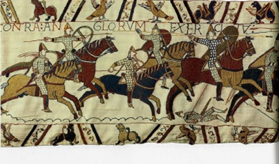
My piece of the Bayeux tapestry at first glance doesn’t look like a very important piece.  It is just men on horses followed by a few archers.  But after studying this section of the Bayeux tapestry, I learned that it’s contents were actually a very important part of the story.

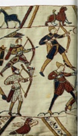
This piece is of the Norman soldiers charging the English.  The archers behind them are providing cover for the men charging on horses, archers usually were the last in the army.   The archers wore much less armor than the cavalry men, if any at all. One thing i noticed about the archers were that their clothes were all different colors.  They all had the same color scheme, but different items of clothing on them were different colors.   One archer is covered in full armor like the men on the horses, but the rest were armor less.  I found this odd because I am sure archers were just as likely to get hit by opposing arrows as cavalry men. Maybe they didn’t have enough armor to give to all the archers.  Spears seemed to be the weapon of choice for the warriors charging on horses.  Spears were long and could stab people easily while riding by them, they could also throw the spears to try to hit further targets.  Upon further research i found out that this piece is actually quite important, it  is important because it is a transition piece.  The horses in the pieces prior to my piece are walking and in my piece they move to a gallop. This is significant because the cavalry are increasing speed riding into battle.The caption of this plate is that the battle has begun. So even though this section of the tapestry might seem uneventful, it actually is quite the opposite, it is the start of the action.  The bottom border of my piece contains animals, but in the next piece the bottom borders are filled with dead soldiers and mangled body parts.  In the piece after, all of the dead English are seen with arrows sticking out of them, thanks to the archers in my piece most likely, this leads me to believe that in my piece they are still far away from the English. I don’t see any men dead from spears yet, so at this point there still must be some distance between the armies.

The Battle has Begun

The Battle has Begun


Some more interesting things I found out about this piece were that the lower border and upper border contain animals that are thought to be fables.  I am not sure what specific fables they are suppose to represent, because some of the animals are unidentifiable, still to this very day nobody knows what some of the animals are. The archers in piece 60 are the first Norman warriors that are seen on foot. In all the pieces before where the Normans are traveling or marching to war, all have been on horseback, pr ships. I thought this was a significant piece because it is the last piece before combat, the war starts in the section after my section.  So piece 60 is a very important piece because it is a transition piece from non violence to violence.  Transitioning is a very important aspect in art, and I think they transitioned well in this tapestry.

The archers ready their arrows while behind the cavalry.

The archers ready their arrows while behind the cavalry.

Work cited


“Britain’s Bayeux Tapestry.” (2000-2004): n. page. <http://www.bayeuxtapestry.org.uk/&gt;.


Hicks, Carola. The Bayeux Tapestry. London: Vintage, 2007. Print.


Wilson , David. The Bayeux Tapestry. New York, New York: Thames and Hudson, 1985. Print.

Leave a comment

Filed under Uncategorized

Bayuex Tapestry Plate 62: Historical Insights

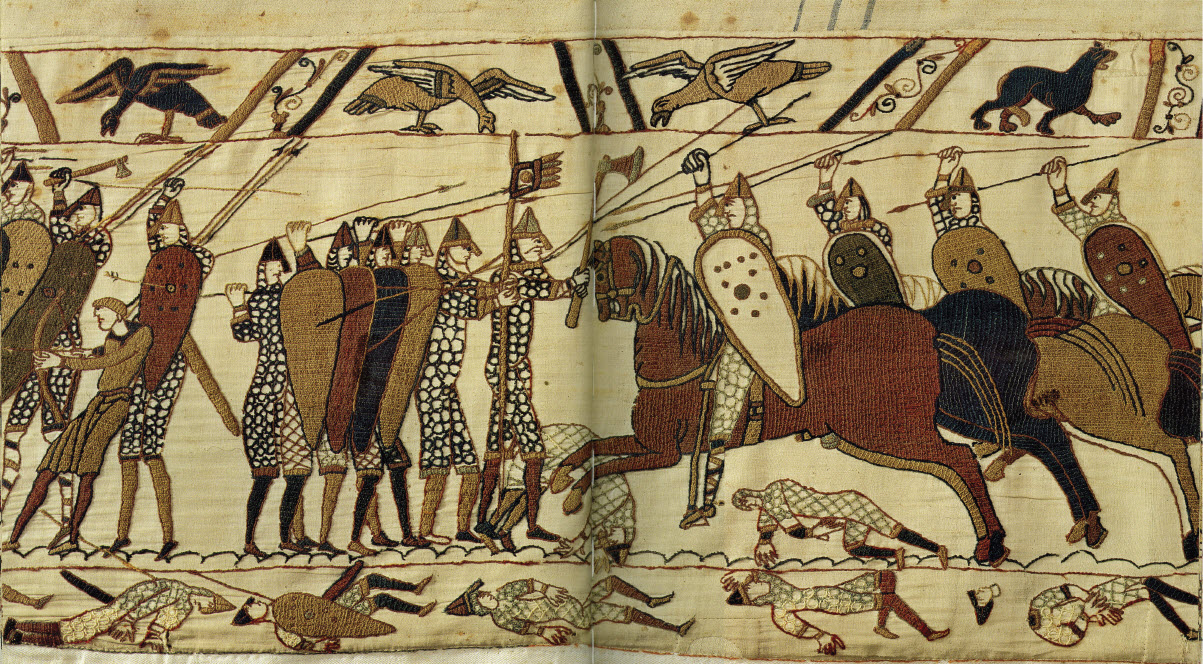
Plate 62 of the Bayeux Tapestry depicts a violent clash between armored soldiers on horses and foot. Below them, on the bottom border, lie fallen soldiers. Above the scene, in the upper border, are three birds and one bear-like animal (Wilson pl.62). There is no Latin text included in the panel. Apart of a series of panels depicting a battle, Panel 62 shows the Battle of Hastings, as William’s forces clash with Harold II’s English forces in 1066 in present-day England (History Learning Contributors). Clues about the historical meaning of the panel can be gathered from the details of armor of the soldiers. According to Wilson, the heavy armor of the men on the panel reveals it is a conflict between the aristocratic soldiers of both sides, “The whole scene must be interpreted as a conventionalized battle—a fight between the more aristocratic soldiers on each side. They are, with few exceptions, fully armed with mail-shirts and knightly armor” (Wilson 171). Additionally, it is important to note that all soldiers use spears, save one individual, who uses an arrow (Wilson, pl. 62). Thus, this panel is depicting soldiers not a part of the archery unit, supporting Wilson’s hypothesis that these forces are both aristocratic. Therefore, this part of the tapestry is indicating there was an aristocratic clash with both forces.

Plate 62, Wilson 171. Norman and English forces meeting in battle.

Plate 62, Wilson 171. Norman and English forces meeting in battle.

Additionally, it is important to note the inclusion of fallen soldiers, something not typical of Anglo-Saxon art. According to Wilson, “Dead soldiers are, however, rarely seen in Anglo-Saxon art” (Wilson, 171). This would support George Beech’s hypothesis that tapestry was not made in England, but rather, in France. Beech argues that according to the history in Historia Sancti Florenti Salmurensis, the tapestry was commissioned “by a certain Queen from over-seas” (Bloch 161). Thus, this evidence provided with the artistic style conflicting with the typical work of Anglo-Saxons, suggests the possibility that it was commissioned outside of England.
Panel 62 may also lend insight into military strategy of the time. While one interpretation of the panel leads to an exclusive illustration of the aristocratic portion of the armies, another reading suggests the single archer represented the full archery forces. Thus, the archers were protected by the fully-armed soldiers, who formed a line. Wilson’s also offers insights on this in his narration of the battle based on the tapestry, “The battle commences. The Norman calvary, backed by the archers, charge the English army, which consists of unmounted soldiers (including one archer who wears no armour) and which seems to be formed behind the legendary ‘shield-wall’” (Wilson).
Thus, the tapestry potentially reveals information about a perceived show-down between aristocratic forces in the battle, the origin of where it was made, as well as the battle strategies for both armies.


Bibliography
Bloch, H. (2007). Was the Bayeux Tapestry Made in France? The Case for Saint-Florent of Saumur by George Beech. Medieval Academy of America, 161.
Contributors. (2013). The Bayeux Tapestry. Retrieved from History Learning Site: http://www.historylearningsite.co.uk/bayeux_tapestry.htm
Wilson, David M. The Bayeux Tapestry: The Complete Tapestry in Color. New York: A.A. Knopf, 1985. Print.

Leave a comment

Filed under Uncategorized

The Mystery of King Harold


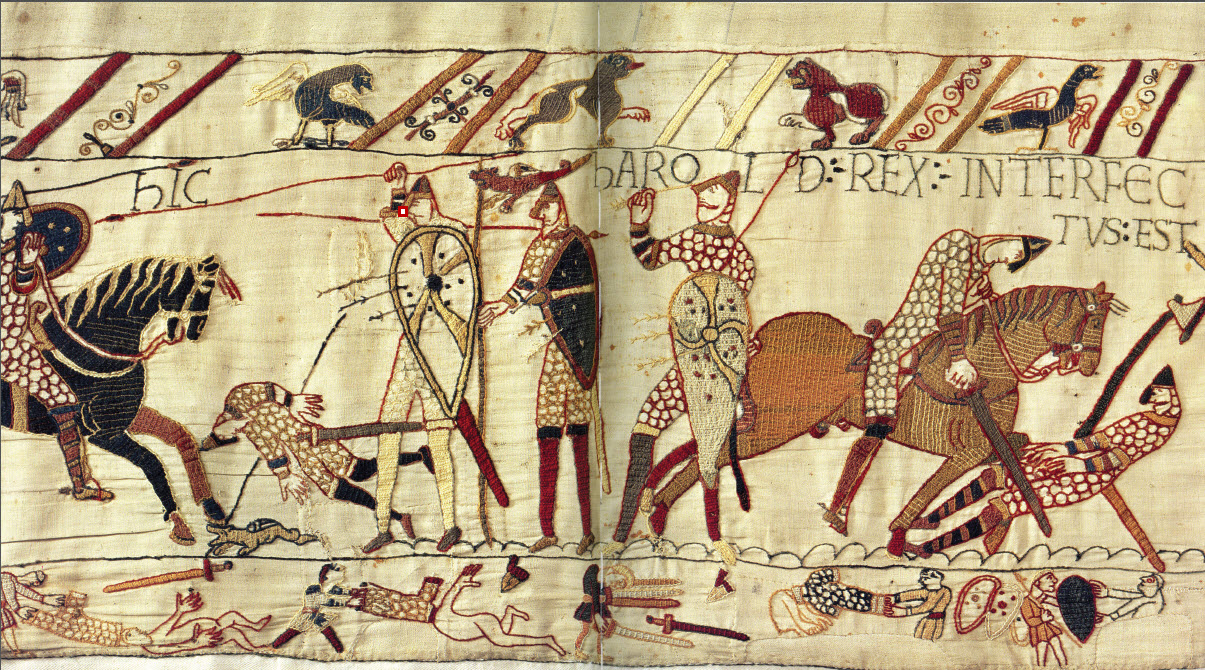
Figure 1: Panel 71 of the Bayeux Tapestry

Figure 1: Panel 71 of the Bayeux Tapestry

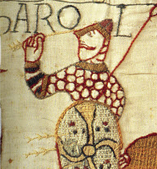
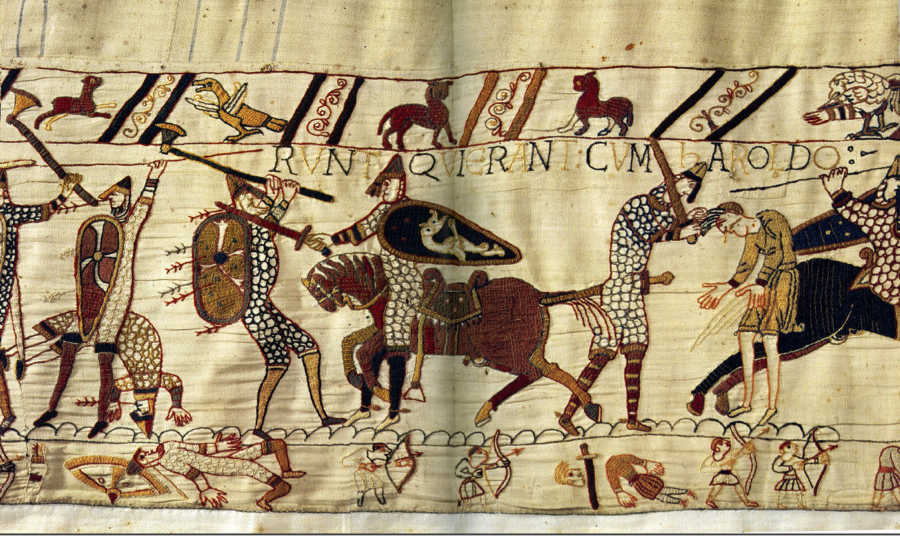
In my panel of the Bayeux Tapestry, panel 71, King Harold is killed. This is determined through translating the Latin on the panel Hic Harold rex interfectus est, or “Here King Harold has been killed” (Wilson 173). The big controversy over this scene is which figure is really King Harold. David M. Wilson states that “the killing of Harold is one of the scenes in the Tapestry most difficult of interpretation” (Wilson 194). Brooks and Walker argue against C. H. Gibbs-Smith’s opinion of which figure in this panel is really King Harold. “Brooks and Walker argue that Harold is indeed killed by an arrow in his eye but that he is shown again lying on the ground being cut in the leg by a sword” (Wilson 194). C. H. Gibbs-Smith, as well as Sir Frank Stenton believe that King Harold is the figure at the end of the panel that is being ridden down by a horseman. Guy of Amiens, the French Bishop, believes that “Harold was downed by four knights: Eustace of Boulogne, a son of Count Guy of Ponthieu, Walter Giffard and Hugo of Montford” (Rud 87). Some researchers doubt that Harold was really struck with an arrow in the eye. “The arrow is a later addition following a period of repair” (Wikipedia Contributors). The makers of Britain’s Bayeux Tapestry website feel that he is shown twice “first plucking an arrow from his eye, and then being hacked down by a Norman knight” (Britain’s Bayeux Tapestry). It seems that no one can really agree on which figure is King Harold. Which figure in this scene is really King Harold? This mystery of the Bayeux Tapestry may never be resolved, but we can certainly conclude that this is the panel portraying Harold’s death

Figure 2: Possibly King Harold pulling an arrow out of his eye

Figure 2: Possibly King Harold pulling an arrow out of his eye

Bibliography:

“Battle of Hastings”. Britain’s Bayeux Tapestry at the Museum of Reading. 8 April 2014. Web.

http://www.bayeuxtapestry.org.uk/Bayeux31.htm

Rud, Mogens. The Bayeux Tapestry And the Battle of Hastings 1066. 1st ed. Copenhagen: Christian Ejlers Publishers, 2002. 87. Print.

Wikipedia Contributors. “Bayeux Tapestry.” Wikipedia: The Free Encyclopedia. 24 Mar 2014. Web. 8 Apr 2014. <http://en.wikipedia.org/wiki/Bayeux_Tapestry&gt;.

Wilson, David. The Bayeux Tapestry. 1st. London: Thames & Hudson Ltd., 1985. 194-195. Print.

Leave a comment

Filed under Uncategorized

Blog 1 Death From Above: The Persian Bow

During the time of the Achaemenid Dynasty, Persians were able to conquer most of the known world.  Persian leaders, such as Cyrus, fought to conquer and control land and people from Ionia in Asia Minor, South to Egypt, and as far east as present day Afghanistan.  Instrumental in the Persian’s conquest were their weapons and battle tactics.  One of these lethal weapons was the Persian Bow.  With a range of around 500 feet—almost two football fields—the armies of the empire of Persia were able to rain down death from above.  Although they often took 18 months to manufacture, the Persian bow and the two major innovations it contained, was well worth the wait (“Iranian…”).

Untitled

(Mshamma. Persian archers in ceremonial robe. The smaller size of their composite bows allowed for easier traveling.)

One of the contributors to the lethality of the Persian Bow was the fact that it was made of composite materials.  The bow had a wooden core.  Strips of horn were glued to the belly, while sinew was attached to the back.  Both of these measures were meant to reinforce the weapon. This technique was so effective, that it allowed the bows to have the same amount of power as much larger weapons of the same nature.  It packed a great amount of power in only a 48-inch frame (Dwyer and Khorasani 3-4).

Perhaps the best advantage to the Persian Bow was in its recurved design.  Traditional long bows of other periods were only a long, bent piece of wood.  The major drawback to this was the fact that the resistance was the same all the way through the draw.  Persian craftsmen bent the ends of their bows back towards the grip (as seen in the picture below). This, like its composite make-up, allowed the bow to pack more power than a traditional long bow.  More importantly, this innovation made it so that there was less resistance on the string the father back it was pulled. Tired archers were given a great psychological advantage and were allowed to stay deadly despite fatigue, because of this decrease in draw pressure (Dwyer and Khorasani 5).

Figure 1

(Dwyer and Khorasani. “Figure 1.”  The signature curve of the Ear (Guse) of the bow is what made it so easy to draw)

 Though the composite nature and the special curves of the bow gave it deadly capabilities, it would have been nothing without the arrows to go with it.  Perhaps the most important part of the weapon set, the shafts of the arrows were often made out of wood or reeds, the simplest of materials.  Reed material was preferred because it had great strength for how light it was (Dwyer and Khorasani 5).  The arrows were tipped with bronze or iron heads to pierce the armor of the Persian opponent (Shahbazi).  Together, the Persian Bow and its complementary arrows were a match made in military heaven. They truly were a destructive force that enemies both feared and respected throughout the Persian conquest.


Bibliography

Dwyer, Bede and Manouchehr Moshtagh Khorasani. “An Analysis of a Persian Archery     manuscript written by Kapur      Cand.” Revista De Artes Marciales Asiaticas 8.1 (Jan-June 2013):  1-12. EBSCO. Web. 4 Feb. 2014.

Shahbazi, A. Sh. “History of Iran:  Achaemenid Army.” Iran Chamber Society. Iran Chamber Society. 2014. Web. 4 Feb. 2014.

“Iranian Archer – Soldier Profile.” Military History Monthly. Current Publishing, 10 Nov. 2010. Web. 4 Feb. 2014.

Mshamma. “Persian warriors. Pergamon Museum/Vorderasiatisches Museum.” Photograph. Wikipedia. Wikipedia, n.d. Web. 6 Feb. 2014

Leave a comment

Filed under Uncategorized

The Bayeux Tapestry: A Lasting Question

Panel 70 of the Bayeux Tapestry can be seen as the epitome of what went on during the Battle of Hastings in 1066 (Wilson 194).  Bloodshed emanates from every inch of the cloth.  While it is clear that many men, as well as the British King Harold, are losing their lives, certain details still are not understood.  The basic who’s who in the tapestry can be discerned by historical hints based on weaponry and garb or by textual clues around the images.  Small events of the battle may still be unknown due to the lack of inscription or the loss of records.

plate

(Plate 70, Wilson 194. Infantrymen and archers are dying all around.)

In the center of the panel is a man on horseback cutting down an enemy soldier.  Carnage envelops him on both sides.  The panel prior to the soldier shows him and his fellow cavalrymen charging the opposing infantry.  To highlight the butchery, it also contains an inscription reading, “Here the English and the French fell at the same time in the battle,” (Hicks 17).   The charge seems to be a synergistic attack between the cavalry and a group of archers.

In the bottom border, under the horseman, the archers have the angle of their bows held high, raining down arrows on their adversary in the next frame.  It seems that they have hit their mark in frame 71.  A man lies on the ground dying, while also having his leg hacked at by a horseman.  Next to him is his weapon, a battle-axe.  Also, the dead man seems to be wearing different, more vibrant colors than those around him.   This is a clue about his status.

Earlier in the tapestry Harold, Earl of East Anglia, is shown meeting with King Edward of England.  The man announcing Harold to the King is holding a battle-axe.  This is the first time that an Englishman is seen sporting an axe in the tapestry (Rud 55-56).  This sets a precedence in the coming panels of the piece in that a soldier seen wielding an axe is most likely an Englishman.  This allows the viewer to be able to discern who is who in the mass of soldiers in panel 70.  It also gives a great clue about the man dressed so fancily in the next panel.

It is known that in the final stages of the Battle of Hastings, William the Conqueror told his archers to aim high to rain down arrows on Harold (Rud 86).  This is interesting when one considers panel 70.  As said above, the archers in the bottom border were aiming high.  This is not a coincidence when one takes into account the man dying in panel 71.

Both the angle of the archers bows in panel 70 and the standout in color of the man’s clothes point to one thing.  The man dying in panel 71 is Harold, King of England.  One final thing that supports this is the inscription above this man.  It clearly says in Latin, “Here King Harold has been killed,” (Wilson 173).  Together, these three clues; be they text, coloring, or interpretation from earlier imagery, tell the viewer that panels 70 and 71 diagram the death of King Harold and many of his men.  Not all things in the Bayeux Tapestry are this easily deciphered though.

Detailed plate (pictured below) shows a Norman horseman cutting down an Englishman with a round shield.  The thing that makes it odd is that the man on horseback is sitting on the neck of his horse instead of in the saddle.  Seemingly all other cavalrymen in the tapestry are presented fighting firmly in their saddles.  This presentation is not a mistake.  It is most likely that this frame refers to a specific event during the course of the battle (Wilson 194-195).  Although this is reasonable to assume, the modern viewer cannot be sure whether this is the case, and if it is, which event is it.

detailed plate

(Detailed plate, Wilson 194. Notice the man is sitting on the neck of his horse)

The reason for this is that there is no known account of this specific event that survives (Wilson 195).  Perhaps it is sensible to infer that the audience at the time of the tapestry knew what this small abnormality meant.  However, today one cannot assume.  Certain details either are not transcribed or are lost in translation.  This is one of the constraints that one faces when trying to interpret classical and middle aged art.

The Bayeux Tapestry contains a world of information to the modern viewer.  Panel 70 gives a look into the final stages of the Battle of Hastings.  The archers narrowing in on King Harold and the carnage around them give the observer a look into the past.  While some things can be interpreted, others cannot.  The tapestry leaves modern man to wonder about things such as specific events that may have been known at the time.  Through both the known and the unknown, the Bayeux Tapestry has lent an air of excitement to scores of generations as well as many to come.


Works Cited

Hicks, Carola.  The Bayeux Tapestry:  The Life story of a Masterpiece.  London:  Vintage books, 2006. Print

Rud, Mogens.  The Bayeux Tapestry and the Battle of Hastings 1066.  Copenhagen:  Christian Ejlers, 2002. Print.

Wilson, David M. The Bayeux Tapestry. London:  Thames and Husdon, 1985. Print.


Leave a comment

Filed under Uncategorized

Castrum Sanguinarium

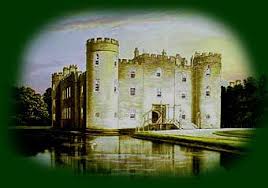
             In designing a fictional castle many things must be taken into consideration.  The defenses must be made impregnable. There must be a supply of food to nourish the defenders and the peasants who come inside the walls for safety.  A castle must also provide space for defensive weapons as well.

            Our fictional castle was located on a precipice surrounded on three sides by the ocean.  This left one road for attackers to use.  To prevent this, we designed two walls with portcullises that ran the length of the Scottish isthmus that housed our keep.  The first wall was composed of iron-reinforced wood; the second was composed of stone. 

            The castle itself had an inner wall and an outer wall surrounding it. Archers manned the outer, 30-foot, wall raining down fire arrows on our adversaries.  Trebuchets and catapults were situated on the inner, 60-foot wall. These provided a defense for our castle during an attack or siege situation.

            Located in the walls was a garden area that would provide our garrison with nourishment.  There were also fields for grazing for goats, sheep, and cows that could also be eaten.  In addition to this, holes, leading down to hidden caves, between the two walls provided us a route to get to the ocean to catch fish and collect other supplies.

            Together, these three attributes contributed to the safety of our people.  The blueprint provided an unassailable barrier between them and the enemy. Also, the fields and garden provided food for our people to survive a siege.  And finally, the width of the walls allowed our garrison and our people to create their own defense.

Leave a comment

Filed under Uncategorized

Panel 64- Who are Gyrth and Leofwine?

I am going to take a different approach to this assignment than I originally thought I would take. Rather than talk mostly about who two of the individuals in this section of the Bayeux Tapestry are, namely Leofwine and Gyrth Godwinson, I am going to look at how the lack of information about these two leaves a lot open for question.

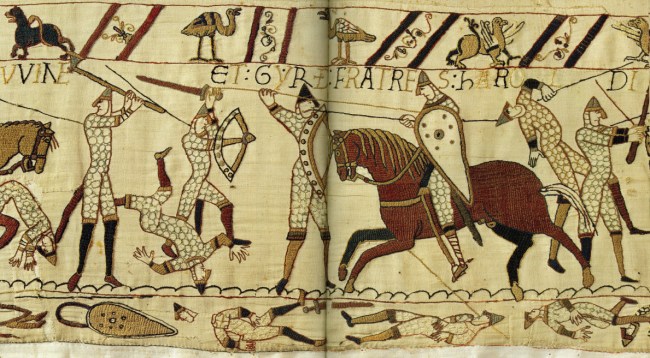
Panel 64 of the Bayeux Tapestry has a total of seven Englishmanon the ground facing what apears to be only one Norman soldiers on horseback, but in viewing more of the tapestry, one can see that there are many more Norman soldiers on horseback surroundingthis group of Englishmen (Wilson, pl. 64). Two of the Englishmen stand taller than the others: The Englishman with his head turned and wielding the axe and the other is the Englishman with a moustache getting stabbed in the face by the Norman on horseback, according to Richard Gameson. These two individuals are believed to be Gyrth Godwinson, the Englishman getting stabbed in the face, and Leofwine Godwinson, the axe wielder. These are the brothers of King Harold Godwinson and both die in the Battle of Hastings as displayed by this panel.

Image

Panel 64 of the Bayeux tapestry depicts the deaths of Gyrth and Leofwine Godwinson, brothers of King Harold Godwinson.


We understand that these two in particular die on October 14, 1066 because of the Latin inscription above the heads of the combatants. The Latin inscription, “Hic ceciderunt Lewine et Gyrth fratres Haroldi regis”translates as follows: “Here were killed Leofwine and Gyrth, the brothers of King Herold. (Wilson, p. 173)” Gyrth was the Earl of East Anglia and Oxfordshire while Leofwine was the Earl over the area from the eastern part of the Thames River, which covered from “Buckinghamshire and Surrey to Essex. (Wilson)” But there isn’t a lot of information about who they were and what they did as Earls or what their part in the battle of Hastings was. This was all I could find in the research I did on this subject. The information that would help us to understand more about Leofwine and Gyrth and information about many other individuals did not make it to us. Thanks to the tapestry we have at least this much information about them. and their story isn’t the only part of the history missing. There are other sections on the tapestry that leave everyone guesing what is meant by the symbols or who is represented by the characters.


Although it isn’t much, the tapestry has provided us with the information that these two individuals and many more died. We can back that up by the history of the battle of Hastings. Who are they? What else were they known for? We may never know. As of right now, that information has been lost and we may never know the whole story about these two men and the people who fought side by side with them.


Works Cited

“The Battle Of Hastings – Scene 3.” The Battle Of Hastings – Scene 3. N.p., n.d. Web. 03 Apr. 2014. <http://www.bayeuxtapestry.org.uk/Bayeux28.htm&gt;.

“Battle of Hastings.” Wikipedia. Wikimedia Foundation, 23 Feb. 2014. Web. 03 Apr. 2014.

Gameson, Richard. “The Authority and Interpretation of the Bayeux Tapestry.” The Study of the Bayeux Tapestry. Rochester, NY: Boydell, 1997. 89. Print.

Jones, Kaye. “Appendix 1: Key People.” 1066: History in an Hour. London: HarperPress, 2011. 33-34. Print.

MacLeod, Dave. “The Bayeux Tapestry: Unpicking the Past.” BBC News. BBC, 17 Feb. 2011. Web. 03 Apr. 2014.

Wilson, David M. The Bayeux Tapestry: The Complete Tapestry in Color. New York: A.A. Knopf, 1985. Print.

Leave a comment

Filed under Uncategorized

Breaking Into the Castle

Bodiam Castle

Bodiam Castle in East Sussex, England, surrounded by a water-filled moat.
From Wikipedia http://en.wikipedia.org/wiki/Castle

 8 April 8, 2014

  Breaking into the Castle

                Breaking into a castle can be a difficult task, you don’t just ram down the door like in many Hollywood movies. There are many considerations one must take when planning to break into a castle. They must consider special tactics such as attack methods, infiltration, logistics, and food/water supplies. The movies may make it look easy, but as you take a look back into the actual history, it becomes a lengthy, tiring pursuit.

                First thing to consider when preparing to take over a castle is considering your infiltration. We plan to have leather skin diving helmets in case we had a moat that we could protect ourselves with. Also, plan to persuade the locals to betray their lord because almost always peasants want to revolt. Our biggest plan would be having a friend in China who sends us gun powder to use. We would use this by dumping buckets of gun powder all around the walls of the castle. This will be put to use during the night to prevent the opposing team from sleeping.

                In the end the most important factor is making sure that our campsite is strongly defended. We don’t plan to have any of the men coming out to destroy our campsite, so we would ensure that we had patrols at regular time intervals to ensure that no one is sneaking in or out. To make sure of this we would have thick wood walls to build up our security. If they try to intervene, we plan to throw our waste at them.

                If the battle lasts longer than expected we plan to plant crops a short distance from camp to keep us well fed. We plan to control the outside water sources, as the castles will be contaminated from our tactics. Also we will loot/buy food from the locals as well. If that all fails we will intercept supply caravans that are meant for the castle. We will be prepared and ready to take down the castle.

Leave a comment

Filed under Uncategorized

Castle Siege Techniques: Attack Methods & Infiltration

It is very likely for the castles to have moats around the outside. Trebuchets would be valuable to shoot hazardous materials such as fragile containers with boiling oil or water, flaming arrows, human waste, and bodies. Ballistas, siege towers, and ladders would help to breach the tall walls. Battering rams, Archimedes screws, chisels, and wedges would be important tools to drill through the walls. Pontoons or boats would allow crossing the moats. The boats would also be used as a blockade to cutoff incoming supplies and ways for the insiders to escape.

Underground infiltration would be the best to overcome the moat. Going through the plumbing would be way to get inside. People could go through or they could send plague-infected rats through to spread disease. Poisoning the water supply would also prove hazardous to the insiders. Just as the Trojan Horse, we could send in a fake supply caravan, filled with armed soldiers. Mining is also an underground option to get inside the castle. Gundpowder is a handy tool to send through the mines.

Leave a comment

Filed under Uncategorized