Monthly Archives: April 2014

Castrum Sanguinarium

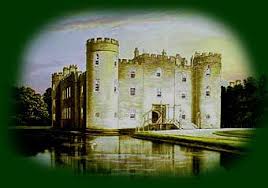
             In designing a fictional castle many things must be taken into consideration.  The defenses must be made impregnable. There must be a supply of food to nourish the defenders and the peasants who come inside the walls for safety.  A castle must also provide space for defensive weapons as well.

            Our fictional castle was located on a precipice surrounded on three sides by the ocean.  This left one road for attackers to use.  To prevent this, we designed two walls with portcullises that ran the length of the Scottish isthmus that housed our keep.  The first wall was composed of iron-reinforced wood; the second was composed of stone. 

            The castle itself had an inner wall and an outer wall surrounding it. Archers manned the outer, 30-foot, wall raining down fire arrows on our adversaries.  Trebuchets and catapults were situated on the inner, 60-foot wall. These provided a defense for our castle during an attack or siege situation.

            Located in the walls was a garden area that would provide our garrison with nourishment.  There were also fields for grazing for goats, sheep, and cows that could also be eaten.  In addition to this, holes, leading down to hidden caves, between the two walls provided us a route to get to the ocean to catch fish and collect other supplies.

            Together, these three attributes contributed to the safety of our people.  The blueprint provided an unassailable barrier between them and the enemy. Also, the fields and garden provided food for our people to survive a siege.  And finally, the width of the walls allowed our garrison and our people to create their own defense.

Leave a comment

Filed under Uncategorized

Panel 64- Who are Gyrth and Leofwine?

I am going to take a different approach to this assignment than I originally thought I would take. Rather than talk mostly about who two of the individuals in this section of the Bayeux Tapestry are, namely Leofwine and Gyrth Godwinson, I am going to look at how the lack of information about these two leaves a lot open for question.

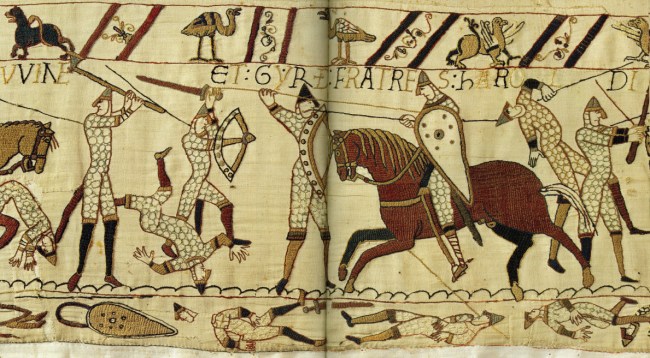
Panel 64 of the Bayeux Tapestry has a total of seven Englishmanon the ground facing what apears to be only one Norman soldiers on horseback, but in viewing more of the tapestry, one can see that there are many more Norman soldiers on horseback surroundingthis group of Englishmen (Wilson, pl. 64). Two of the Englishmen stand taller than the others: The Englishman with his head turned and wielding the axe and the other is the Englishman with a moustache getting stabbed in the face by the Norman on horseback, according to Richard Gameson. These two individuals are believed to be Gyrth Godwinson, the Englishman getting stabbed in the face, and Leofwine Godwinson, the axe wielder. These are the brothers of King Harold Godwinson and both die in the Battle of Hastings as displayed by this panel.

Image

Panel 64 of the Bayeux tapestry depicts the deaths of Gyrth and Leofwine Godwinson, brothers of King Harold Godwinson.


We understand that these two in particular die on October 14, 1066 because of the Latin inscription above the heads of the combatants. The Latin inscription, “Hic ceciderunt Lewine et Gyrth fratres Haroldi regis”translates as follows: “Here were killed Leofwine and Gyrth, the brothers of King Herold. (Wilson, p. 173)” Gyrth was the Earl of East Anglia and Oxfordshire while Leofwine was the Earl over the area from the eastern part of the Thames River, which covered from “Buckinghamshire and Surrey to Essex. (Wilson)” But there isn’t a lot of information about who they were and what they did as Earls or what their part in the battle of Hastings was. This was all I could find in the research I did on this subject. The information that would help us to understand more about Leofwine and Gyrth and information about many other individuals did not make it to us. Thanks to the tapestry we have at least this much information about them. and their story isn’t the only part of the history missing. There are other sections on the tapestry that leave everyone guesing what is meant by the symbols or who is represented by the characters.


Although it isn’t much, the tapestry has provided us with the information that these two individuals and many more died. We can back that up by the history of the battle of Hastings. Who are they? What else were they known for? We may never know. As of right now, that information has been lost and we may never know the whole story about these two men and the people who fought side by side with them.


Works Cited

“The Battle Of Hastings – Scene 3.” The Battle Of Hastings – Scene 3. N.p., n.d. Web. 03 Apr. 2014. <http://www.bayeuxtapestry.org.uk/Bayeux28.htm&gt;.

“Battle of Hastings.” Wikipedia. Wikimedia Foundation, 23 Feb. 2014. Web. 03 Apr. 2014.

Gameson, Richard. “The Authority and Interpretation of the Bayeux Tapestry.” The Study of the Bayeux Tapestry. Rochester, NY: Boydell, 1997. 89. Print.

Jones, Kaye. “Appendix 1: Key People.” 1066: History in an Hour. London: HarperPress, 2011. 33-34. Print.

MacLeod, Dave. “The Bayeux Tapestry: Unpicking the Past.” BBC News. BBC, 17 Feb. 2011. Web. 03 Apr. 2014.

Wilson, David M. The Bayeux Tapestry: The Complete Tapestry in Color. New York: A.A. Knopf, 1985. Print.

Leave a comment

Filed under Uncategorized

Breaking Into the Castle

Bodiam Castle

Bodiam Castle in East Sussex, England, surrounded by a water-filled moat.
From Wikipedia http://en.wikipedia.org/wiki/Castle

 8 April 8, 2014

  Breaking into the Castle

                Breaking into a castle can be a difficult task, you don’t just ram down the door like in many Hollywood movies. There are many considerations one must take when planning to break into a castle. They must consider special tactics such as attack methods, infiltration, logistics, and food/water supplies. The movies may make it look easy, but as you take a look back into the actual history, it becomes a lengthy, tiring pursuit.

                First thing to consider when preparing to take over a castle is considering your infiltration. We plan to have leather skin diving helmets in case we had a moat that we could protect ourselves with. Also, plan to persuade the locals to betray their lord because almost always peasants want to revolt. Our biggest plan would be having a friend in China who sends us gun powder to use. We would use this by dumping buckets of gun powder all around the walls of the castle. This will be put to use during the night to prevent the opposing team from sleeping.

                In the end the most important factor is making sure that our campsite is strongly defended. We don’t plan to have any of the men coming out to destroy our campsite, so we would ensure that we had patrols at regular time intervals to ensure that no one is sneaking in or out. To make sure of this we would have thick wood walls to build up our security. If they try to intervene, we plan to throw our waste at them.

                If the battle lasts longer than expected we plan to plant crops a short distance from camp to keep us well fed. We plan to control the outside water sources, as the castles will be contaminated from our tactics. Also we will loot/buy food from the locals as well. If that all fails we will intercept supply caravans that are meant for the castle. We will be prepared and ready to take down the castle.

Leave a comment

Filed under Uncategorized

Castle Siege Techniques: Attack Methods & Infiltration

It is very likely for the castles to have moats around the outside. Trebuchets would be valuable to shoot hazardous materials such as fragile containers with boiling oil or water, flaming arrows, human waste, and bodies. Ballistas, siege towers, and ladders would help to breach the tall walls. Battering rams, Archimedes screws, chisels, and wedges would be important tools to drill through the walls. Pontoons or boats would allow crossing the moats. The boats would also be used as a blockade to cutoff incoming supplies and ways for the insiders to escape.

Underground infiltration would be the best to overcome the moat. Going through the plumbing would be way to get inside. People could go through or they could send plague-infected rats through to spread disease. Poisoning the water supply would also prove hazardous to the insiders. Just as the Trojan Horse, we could send in a fake supply caravan, filled with armed soldiers. Mining is also an underground option to get inside the castle. Gundpowder is a handy tool to send through the mines.

Leave a comment

Filed under Uncategorized

The Bayeux Tapestry: Panel 72

The Bayeux Tapestry is a giant 230 foot long piece of embroidered cloth, depicting the entire Battle of Hastings. It was created in around 1066 A.D., and it served as a visual representation of what happened during that battle. Just to make things easier to understand, the soldiers on horseback are usually the Norman cavalry and the soldiers on foot are usually the English soldiers. On the top portion of the tapestry there is a borer that covers a couple of inches. In this particular border, nothing of importance is usually shown. There is a middle piece of this embroidery, which is where the main action and story happens. At the bottom of the piece is another border, like that of the top, but in this case the bottom often holds valuable information that pertains to the main action in the middle section.

Panel 72 from Bayeux Tapestry

Panel 72 from the Bayeux Tapestry, as taken from Wilson

In my particular piece, panel 72, it shows English soldiers fighting the Normans. There is lots of death, as depicted in the bottom margins. One particular thing that is out-of-ordinary in the bottom section is that of a man taking the armor off another fallen soldier. During this battle, if there were good suits of armor and weapons that could be salvaged, they would retrieve them.

Removing armor from dead soldier

A soldier’s armor being removed after he had fallen in battle

On the far right side of the panel, the reader can see the beginning of the phrase “et fuga verterunt Angli,” which translates to “… and the English have turned to flight.” In the right side of panel 72 and the panel following mine, one can see that the Norman cavalry are fiercely chasing the English soldiers. In these last two panels, panel 72 and 73, marks the end of the tapestry, or at least the pieces that remain today. There is probably more to the tapestry to show the very end of the battle, but those pieces have been lost.

Bibliography

Britain’s Bayeux Tapestry (n.d.). Retrieved April 8, 2014 from Bayeuxtapestry.org.uk: http://www.bayeutapestry.org.uk/

Ingram, J. (2008). The Anglo-Saxon Chronicle. Retrieved April 8, 2014 from Avalon.law.yale.edu: http://avalon.law.yale.edu/subject_menus/angsax.asp

Weaponry: Norman Arms and Armour. Historynet.com. (June 12, 2006). Retrieved April 8, 2014 from http://www.historynet.com/weaponry-norman-arms-and-armour.htm

Wilson, D. M. (1985). The Bayeux Tapestry. New York: Thames and Hudson Inc., Retrieved April 8, 2014

Leave a comment

Filed under Uncategorized

The Bayeux Tapestry: Tumbling Horses–EDITED

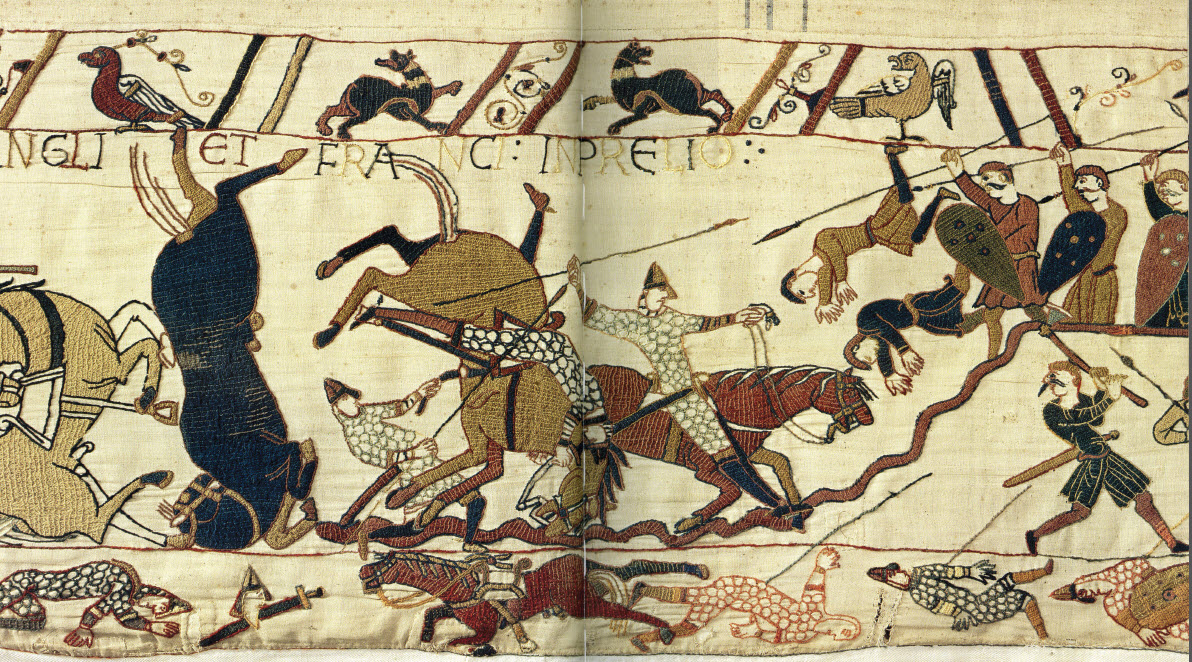
My piece of the Bayeux Tapestry shows an encounter between two separate groups. With all the weapons, commotion, two distinct sides, and confrontation, it is clearly a battle scene. There are horses falling over, and some are even toppling head over heels with their hind hoofs in the air. Their riders are also falling off. Men and horses lay dead and dying on the bottom of the tapestry with weapons strewn about (Wilson, pl. 66).

The two sides are distinctly different; their clothing sets them apart. One side has saddled horses, armor, boots, and helmets while the other side, the enemy, is simply wearing normal clothes, with “kite-shaped shields” as their only piece of armor (Wilson 192). The unarmored group is distinguishable by their facial hair. “Many of them have prominent moustaches and one (pl. 67) has a beard” (Wilson 193).

The complete Latin phrase that comes from my plate and a couple previous sections reads: “Hic ceciderunt simul Angli et Franci in prelio” (Wilson 173). This is translated as meaning “Here at the same time English and French fell in battle” (Wilson 173). The text on the tapestry helps us understand who is fighting with each other. The armored men on horseback are the French and the mustached men are the Englishh.

Weapons include long spears on both sides, swords for the French, and an axe is seen on the English side.

“The tumbling horses represents the so-called Malfosse episode, following William of Malemesbury who may well have been basing his narrative on the Tapestry” (Wilson 192). This seems as though the story is just a story. However, Rud informs us that it was real and that the English wanted to pursue their enemy, disobeying the order of the King. “They were driven up on to a hillock where they were soon overpowered” (Rud 84). Being at the bottom of the hill, not having a real plan, and going against their leader all contributed to the failure of the French army’s attack.

Works Cited

Rud, Mogens. The Bayeux Tapestry and the Battle of Hastings 1066. Copenhagen: Christin Ejlers Publishers, 2002. Print.

Wilson, David M. The Bayeux Tapestry. New York: Thames & Hudson Inc., 1985.

Horses tumble in a battle between the English and the French (Wilson, pl. 66).

Horses tumble in a battle between the English and the French (Wilson, pl. 66).


Leave a comment

Filed under Uncategorized

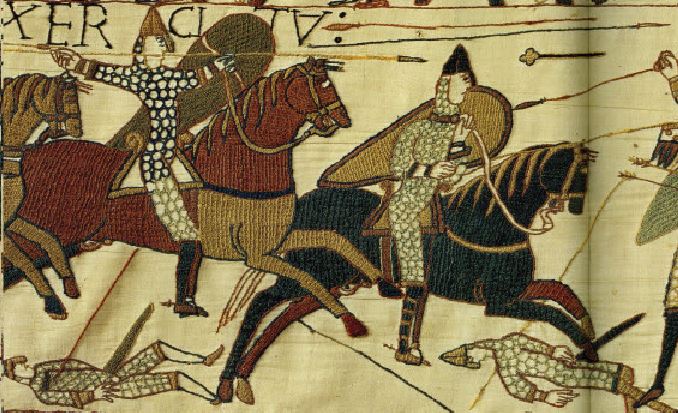
The Bayeux Tapestry: Scene 65

The Bayeux Tapestry is “certainly one of the most important works of pictorial narrative art” (Noxon, 1968, p. 29). At around 230 feet long, the embroidered “tapestry” depicts the story of Harold Godwinson, William of Normandy, and William’s eventual succession of Edward the Confessor’s throne. According to the tapestry, Harold, an English noble, broke an oath of fealty he had made to William while in France, and claimed the throne for himself, resulting in William’s invasion of England and the bloody Battle of Hastings in 1066. The Bayeux Tapestry gives the complete series of events, being one of “the fullest pictorial record[s] of a medieval battle in existence” (Bartlett, 2010). Despite its cartoony representation, the expressive images of the tapestry can tell us not only about the happenings associated with Harold and William, but also about warfare during the Medieval period.

The tapestry is a “complex dramatized narrative, part truth and part fiction” (Noxon, 1968, p. 29). The Normans won the battle and William became king, making it likely that the tapestry was made as a commemorative piece. Because they did win, there could very well have been some embellishments to the story. It is obvious that the tapestry was a “sponsored, propaganda work, designed for an illiterate mass audience,” that was probably commissioned by William’s half-brother Odo, the Bishop of Bayeux (Noxon, 1968, p. 30). It would have been important for the makers to represent Harold as a “brave warrior” with the “fatal flaw[s]” of “overweening pride and vanity,” rather than as a power-hungry villain, because he still had many supporters in England (Noxon, 1968, p. 30).

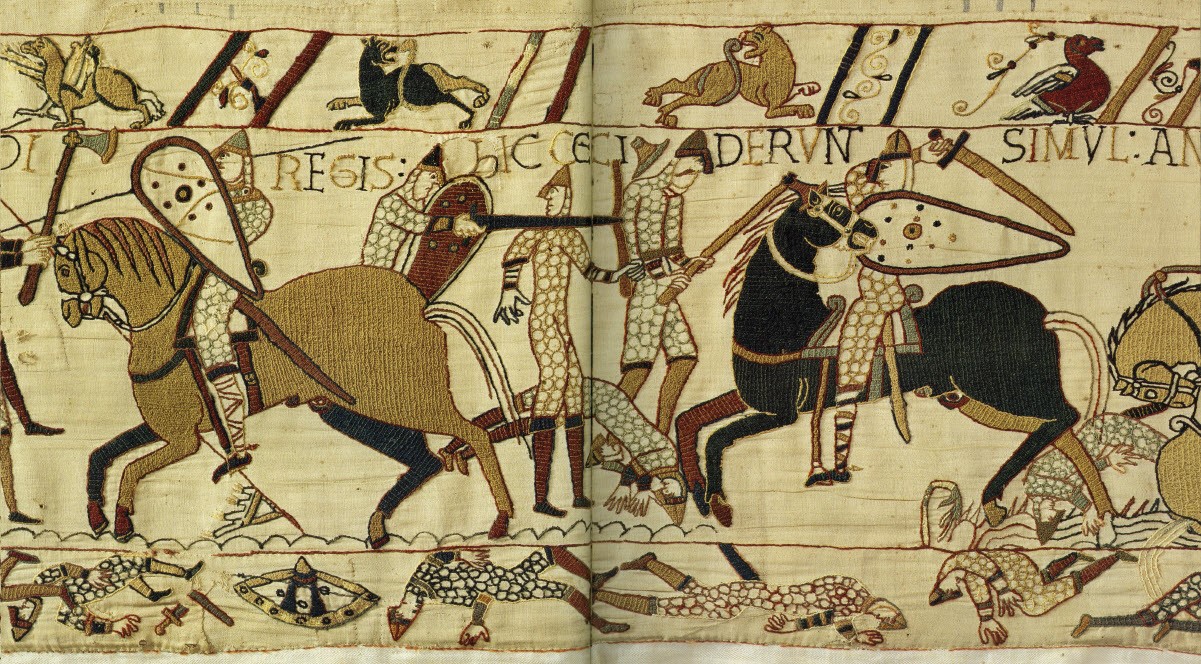
The scene from the tapestry below depicts the Battle of Hastings in all its brutality (Wilson, 1985, Scene 65). The middle and largest band shows the “brutal clash between the onrushing [Norman] cavalry and the stolid, heavily armored group of [English] foot soldiers” (Noxon, 1968, p. 34-35). The bodies of the dead can be seen in the lower margin, including one near a broken sword (Wilson, 1985, Scene 65).

The scene depicts the intense fighting during the Battle of Hastings.

Scene 65 from the Bayeux Tapestry, Wilson. The scene depicts the intense fighting during the Battle of Hastings.

As can be seen by looking at the scene, the Bayeux Tapestry is without a doubt the “best pictorial source of information about the arms and armour of the Normans,” as it illustrates much the equipment and weapons used by their army (“Weaponry,” 2006). The tapestry scene displays many of the characteristics that set the Normans apart in battle. A Norman soldier usually wore a “knee-length mail shirt called a hauberk that…was split from hem to fork to facilitate riding” (“Weaponry,” 2006). The use of chain mail armor allowed for greater movement, which would have been very important for cavalry. Additionally, the Norman horseman would wear a conical steel helmet, with a “wide [nasal] to protect the nose” (“Weaponry,” 2006). The most popular shield was kite-shaped, which provided more protection to the soldiers than the common round shield that was often used. The basic weapon for the Norman cavalry and infantry was the spear, but the cavalry also made use of swords. These were crucial because, “unlike the lance or spear that was easily broken and usually discarded during battle,” swords were much more durable and also highly “valuable [possessions]” for the Normans (“Weaponry,” 2006). Another weapon that may have been even more devastating than the spear and sword was the axe. “If the Bayeux Tapestry is to be believed it could inflict more dire wounds than any other weapon on the battlefield,” and if the Normans fought the battle mostly from horseback, it appears that the English actually made more use of these fierce weapons (“Weaponry,” 2006).

In this panel, the Latin inscription tells us that “[h]ere at the same time English and French fell in battle” (Wilson, 1985, p. 173). It shows the battle getting more intense, with an axe getting “decapitated,” a horse being struck in the head, and a number of soldiers wielding swords and axes “with great abandon” (Wilson, 1985, p. 192). This all would have been taking place after the English “broke ranks to pursue” the Normans, and were lured “into a more vulnerable position,” where the Norman forces could finish them off (Bartlett, 2010).

This panel from the Bayeux Tapestry, with its vivid colors and dramatic fighting, sheds a lot of light on the subject of Norman battle tactics, and will surely continue to be one of history’s greatest pictorial narratives.


Works Cited

Bartlett, R. The Bayeux Tapestry. (August 3, 2010). Retrieved March 26, 2014 from http://www.bbc.co.uk/blogs/ahistoryoftheworld/2010/08/the-bayeux-tapestry.shtml   bbc.co.uk/blogs.

Noxon, G. (1968). The Bayeux Tapestry. Cinema Journal, 7, 29-35. Retrieved from http://www.jstor.org/stable/view/1224876

Weaponry: Norman Arms and Armour. historynet.com. (June 12, 2006). Retrieved March 27, 2014 from http://www.historynet.com/weaponry-norman-arms-and-armour.htm

Wilson, D. M. (1985). The Bayeux Tapestry. New York, NY: Thames & Hudson, Inc.

Leave a comment

Filed under Uncategorized

The Bayeux Tapestry: Panel 73

The Bayeux Tapestry is an elaborate medieval embroidery featuring a visual history of the Battle of Hastings in 1066 A.D. and the events preceding. Throughout the 230 foot tapestry, several important historical figures are depicted in several different scenes and environments, each of different historical importance. Primarily revolving around William, Duke of Normandy (later known as William the Conqueror) and King Harold of England, the tapestry depicts the Norman conquest of England with great detail. Although the textile’s exact origin is unknown, it is predicted to have been commissioned c.a. 1070 A.D. by Bishop Odo, a half-brother to William (W. Contributors, 2014) . The tapestry provides us with lots of information, however one of the greatest mysteries of this historical document is its ending.

As the story of William and Harold progresses, it reaches a climax in the battle of Hastings as a great war between the two parties breaks out. Just prior to the end, an embroidery of the dead King Harold (Panel 71) is seen with the caption “Here King Harold has been killed” (Wilson, 2004). Immediately following this, we see imagery of the English running away from the incoming Normans (Panel 73). Then, without any sense of conclusion the tapestry comes to a rather abrupt close. In accordance with this accelerated ending, many scholars have come to believe that this is not the physical end of the tapestry, suggesting that it is in fact incomplete. This claim seems valid as no border is present following the final scene (Rud, Morgens, 2002). However, there is still plenty of information that we can learn from the 73rd Panel including a somewhat reliable recreation of the aftermath of the gruesome battle of Hastings.

Bayeux

Bayeux Tapestry Panel 73 as taken by Wilson

Panel 73 lives up to the tapestry’s last words, “… and the English have turned to flight” (Wilson, 2004). These sharp words are paired with the grueling imagery of the aftermath of The Battle of Hastings, including dismembered limbs and injured men scattered about the elaborate bordering. On the far right we see several Englishmen running off, some entangled in vines and another with an arrow in his head. On the left we see the confident Norman’s running off the English as if they are cattle. The pains of failure and denial are especially evident in the horrified look of an Englishman looking back over his shoulder. This scene uncovers very directly all the emotions of the aftermath from such a battle. In accordance, this particularly gruesome imagery perfectly represents the nature of this horrendous occasion for the English, contrasted with the triumph and victory of William and the Normans (Ingram, J., 1966). It clearly presents the greatest of confidence along with the despair of failure in one conglomerate frame.

Parts

Depiction of dismembered arm and head from Panel 73 of Bayeux Tapestry as taken by Wilson

The Bayeux Tapestry utilizes great amounts of detail to portray the reality and emotion of the events taking place to the viewer. Although some imagery may not be completely accurate, the tapestry does snapshot many elements of the culture and technology of the time. This is evident as the Normans armor is depicted as a form of a mail or scale design. These were called hauberks and were, in fact, often used to Norman infantry and cavalry (Weaponry, 2006). Use of bows and arrows are also present in the embroidery. The Bayeux Tapestry’s pictorial representations of Norman arms and armor have been cited as some of the best examples of Norman armor, and have been used to confirm the nature of their technology. Details such as these allow us to really receive a more accurate picture of how, where, and when these events took place, which is really what makes this Tapestry so significant.

Normans

Depiction of Norman Cavalry from Panel 73 as taken from Wilson

This amazing textile offers lots of information about the conquest of the Normans, and should be looked at as a history of these crucial events. Although not accurate in all accounts, the amount of effort put into this tapestry speaks for its importance to the people of the time and to us. The detail and craftsmanship of the Bayeux Tapestry truly allows its viewers to peek back into history with all its glory and its horror.


Bibliography


Britain’s Bayeux Tapestry. (n.d.). Retrieved April 1, 2014, from Bayeuxtapestry.org.uk: http://www.bayeuxtapestry.org.uk/

Contributors, W. (2014, March 27). Battle of Hastings. Retrieved April 1, 2014, from Wikipedia.org: http://en.wikipedia.org/wiki/Battle_of_Fulford

Contributors, W. (2014, March 24). Bayeux Tapestry. Retrieved April 1, 2014, from Wikipedia.org: http://en.wikipedia.org/wiki/Bayeux_tapestry

Dowell, C. R. (1966, November). The Bayeux Tapestry and the French Secular Epic. The Burlington Magazine, 108(764), 549-560. Retrieved March 1, 2014, from http://www.jstor.org/stable/875133

Ingram, J. (2008). The Anglo-Saxon Chronicle. Retrieved April 1, 2014, from Avalon.law.yale.edu: http://avalon.law.yale.edu/subject_menus/angsax.asp

Rud, Morgens. The Bayeux Tapestry: And the Battle of Hastings 1066. Trans. Chris Borjensen. Chrisian Eilers, 2002. Book. 1 April 2014.

Weaponry: Norman Arms and Armor. (2006, June 12). Retrieved April 1, 2014, from Historynet.com: http://www.historynet.com/weaponry-norman-arms-and-armour.htm

Wilson, D. M. (2004). The Bayeux Tapestry. New York, New York: Thames and Hudson Inc. Retrieved April 1, 2014


Leave a comment

Filed under Uncategorized

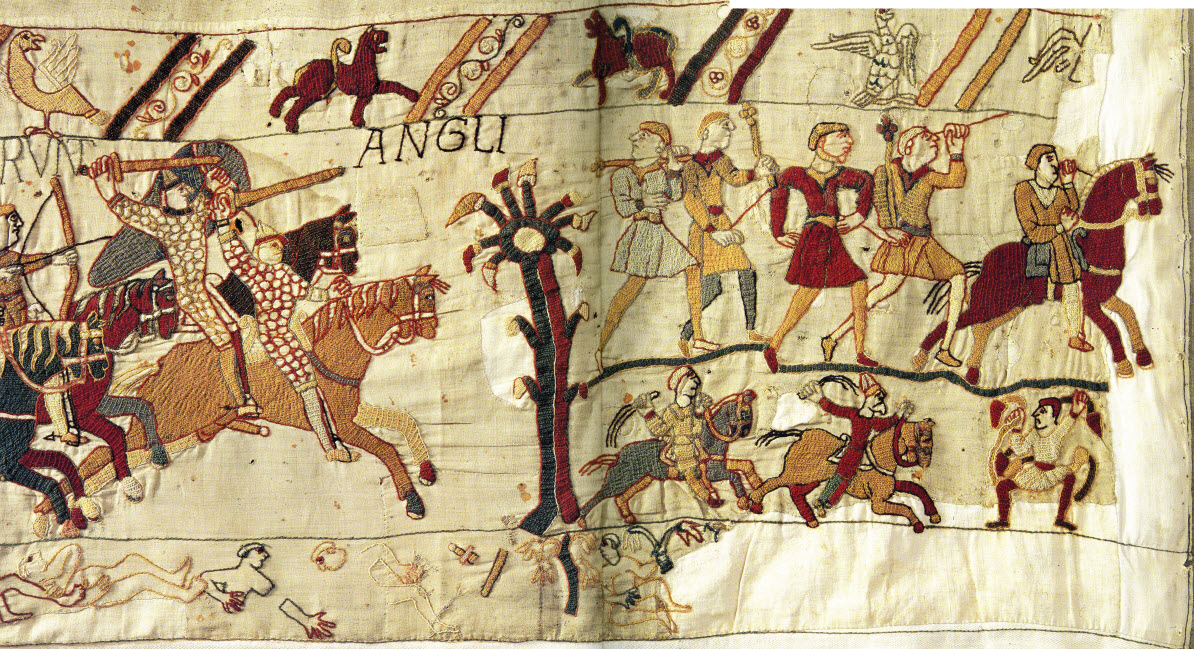
The Bayeux Tapestry, pl 61

The Bayeux Tapestry is a piece of artwork that depicts the battle of Hastings in 1066. The battle took place as part of a succession struggle to claim the throne of England. Amongst the contenders were Harold, king of the Anglo-Saxons, William, the duke of Normandy, a Norwegian king also named Harold, and William’s brother Tostig (Contributers, 2014). Tostig and the Norwegian Harold were both defeated by the Anglo-Saxon Harold, which left only him and William as serious contenders for the throne.

Tapestry Snip
Pl 61, Wilson.

This piece of the tapestry seems to be about the beginning of the battle. One piece of evidence that supports this is that most figures in this section are wielding javelins instead of swords (Magazine, 2006). It was standard practice around this time to begin battle with javelins, as they had better range than swords. When they broke, then it was time to switch over to the swords for up close combat. Another possible piece of evidence comes from the mace, apparently flying through the air, in the upper right corner (Wilson, 1985). This could suggest that it was thrown in panic, the soldier wielding it terrified by the opening cavalry charge. One final piece of evidence can just be glimpsed on the right hand edge of the above image. It is more clearly visible on the full panel, but it appears that the Anglo-Saxon’s shields are full of arrows. This suggests that the opening volley of arrows wasn’t terribly effective (Rud, 2002). Each of these pieces individually might not be clear evidence as to what is happening in the panel, but taken as a whole it makes for a compelling case.

While it is difficult to predict where the battle could have gone from the opening alone, we do in fact know what happened. Harold’s army used a shield wall as a defensive tactic, which was quite effective at first. Eventually though, the wall was broken, allowing the Norman’s to slip through. Harold was killed, and while his army fought bravely afterward, their cause was lost and they eventually fled the battlefield (Ibeji, 2011). William hadn’t won the throne just yet, but by Christmas the crown was his.

Bibliography

Contributers, W. (2014, April 1). Battle of Hastings. Retrieved from Wikipedia: http://en.wikipedia.org/wiki/The_Battle_of_Hastings

Ibeji, M. (2011, February 17). 1066. Retrieved from BBC: http://www.bbc.co.uk/history/british/normans/1066_01.shtml

Magazine, B. H. (2006, June 12). Weaponry: Norman Arms and Armour. Retrieved from Historynet: http://www.historynet.com/weaponry-norman-arms-and-armour.htm

Rud, M. (2002). The Bayeux Tapestry and the Battle of Hastings 1066. Copenhagen: Christian Ejlers Publishers.

Wilson, D. M. (1985). The Bayeux Tapestry. London: Thames & Hudson.


Leave a comment

Filed under Uncategorized

Bayeux Tapestry

Bayeux Tapestry

Bayeux Tapestry

Bayeux Tapestry

Blog Post 3

March 30, 2014

Imagine an embroidered cloth, around 230 ft. long, that depicts many events, all in amazing imagery, and all done on one long piece of cloth. This is what the Bayeux Tapestry accomplished. The Bayeux Tapestry is a supreme accomplishment that depicts scenes from the Norman conquest of England, which included William, Duke of Normandy and Harold, Earl of Wessex (who later became King of England) in the Battle of Hastings.

Although not a true tapestry, where the design is actually woven into the cloth, indeed it is magnificent embroidery. The Bayeux Tapestry’s survival isn’t the only amazing; its length, colors, workmanship and harmony is something that surprises many as they view this spectacular work of art. This tapestry contains over 60 endless fascinating scenes that contain Latin writings embroidered on the cloth. The scenes are embroidered with wool yarn on tabby-woven linen estimated to be about 224.3 ft × 1.6 ft, and is estimated to be longer since historians suggest that some pieces are missing. Two different methods were used to create these scenes, outline or stem stitch for lettering and the outlines of figures and couching or laid work for filling in figures. As each panel was completed, it was put together to create one beautiful, colorful masterpiece.

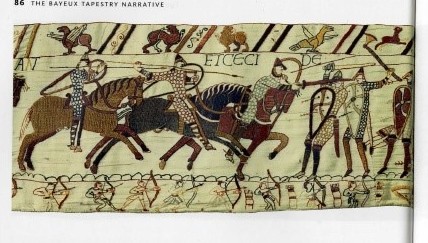
Panel 69 contains scenes of men on horses fighting other men on the ground with long spears and swords. The main yarn colors used in the scene are terracotta, blue-green, gold, olive green, and blue with light yellow also intertwined with the other colors. In this scene I think that the Normans attack viciously as they fight on their horses with spears and swords, stabbing the men on the grounds that carry shields in the design of a twisted X.  I think that this piece of the art was used to show the nature of the battle as numerous horses ride towards the enemy. I think that is starts to show a victory as you look at the different scenes after this panel as it describes how Harold is struck, and Normans become victorious. While also included in the scene is Latin words, which according to many sites, state that in my panel, it is saying that the men who were with Harold fell and here King Harold was killed.

As fighting scenes are viewed throughout many of the panels, there is also some scenes of nudity as well, although not in my panel, I thought it was interesting that they also included nudity in a piece of art like this as well. I think it shows how nudity was an important aspect to display, to show more meaning to the art. Although my scene showed mostly men fighting on horses, it was interesting looking at the detail put into this panel. As you look above, on both top and bottom of the panel there are borders that have detailed embroiders as well.

Throughout each border are men, who all look slightly different, that carry bow and arrows. There are bags filled with arrows in front of the men, while they all point in the direction of the enemy. All wear similar types of clothing, which I believe shows how they were all on the same side. I thought this bottom border had a lot of detail because each man has a different face shape/expression, some have a beard, while others don’t; showing that a lot of time was put into this stitching.  While the top borders show a lot of mythological creatures such as dragons, lions, and hunter-type images which I think adds meaning as well.

As so much detail was put into this piece, it is remarkable how it could last so long many years later. The detail in this panel is absolutely incredible. The Bayeux Tapestry shows the detail of the horses, the face expressions, the clothing, and armor. It is so well detailed that you can almost imagine in your head the whole day this battle took place. You see the detailed weapons of the Norman horseman; every character throughout the tapestry plays a role. With this well-detailed panel, you can almost tell everything that’s going on just by looking at each man. As one man tries to remove an arrow from his body, you get a sense of who will be victorious.

Bibliography

Aemma. (2000, October 20). A Guide to the Bayeux Tapestry . Retrieved from http://www.aemma.org/onlineResources/bayeux/bayeuxIndex1.html

Bayeux Tapestry. (2013, May 12). Retrieved from Wikipedia : http://en.wikipedia.org/wiki/Bayeux_Tapestry#Construction.2C_design_and_technique

Bloch, H. (2006). A Needle in the Right Hand of God: The Norman Conquest of 1066 and the Making and Meaning of the Bayeux Tapestry. Random House.

Brown, S. A. (1988). The Bayeux Tapestry: History and Bibliography. Boydell: Woodbridge Press.

Ingram, J. (2008, December 12). The Anglo-Saxon Chronicle. Retrieved from Yale Law School: http://avalon.law.yale.edu/subject_menus/angsax.asp

Propaganda on cloth. (n.d.). Retrieved from The Bayeux Tapestry, after 1066: http://www.all-art.org/history194-29tapestry.html

UNESCO. (n.d.). Bayeux Tapestry. Retrieved from Tapestry or embroidery ?: http://www.tapestry-bayeux.com/

Wilson, D. The Bayeux Tapestry.


Leave a comment

Filed under Uncategorized