I had a lot of fun researching biological and chemical warfare in the ancient world. I grew up with two older brothers who loved to burn thing and blow things up so it’s natural that I would take an interest in this topic.
The funnest part for me was reading about the myths and finding out how they correlate with real events and places. The most interesting story for me to read was the story of the Assyrian army under Sennacherib attacked Egypt and the Pharaoh prayed to the god Ptah who sent thousands of mice to chew up their weapons and bring plague to the Assyrian army. The most interesting thing about this story, reported by Herodotus, is that the exact same story happens in Jerusalem. Jerusalem is also under attack by Sennacherib’s army and the god of Israel also sends thousands of mice to defeat the Assyrian army. I found this fascinating as Josephus later backs up Herodotus’ account. Where was the true setting of this story? Is the bible accurate in saying it was Jerusalem or was Egypt where this miracle actually happened?
Another exciting thing I did for the project was when I was researching Greek Fire. All the sources compare Greek Fire to modern napalm. So I decided to make some napalm myself and see just how deadly it could be. My brothers used to make napalm all the time in the summers when they were out of school. I enlisted the help of my oldest brother, Daniel, to help me make napalm. The basic recipe for making napalm is Styrofoam, gasoline, and a metal pot. He told me to pour gasoline into the metal pot. Next, we added bits and pieces of Styrofoam into the gasoline. We kept stirring like it was a batter of caramel and kept adding bits of the Styrofoam until we had a sticky, gray/white, syrupy mixture. Then, we burned it. We dug a small but deep hole and put some grass and twigs into it. Then we put the mixture on and lit it on fire. It was really cool. The fire was bright and the smoke was black. It burned bright for about 20 minutes until it started to die down. It was really fun. I wanted to bring some of my homemade napalm to class to show everyone but I was pretty sure the fire marshal would have frowned upon that.
Animals are everywhere. From dogs to cats and rats to snakes every country has them. The ancient world had many uses for animals the oxen and horses provided means of transportation and proved helpful in wars such as cavalries or elephants used in Hannibal’s invasion of Italy. The animals also provided food and clothing for the people of the ancient days. But animals also have sinister uses. In the bible we read much of plagues and pestilences where god sends an “angel” to help the people of Jerusalem. According the second Book of Kings around 700 BCE a large army of Assyrians under the rule Sennacherib began attacking Jerusalem. Isaiah urges King Hezekiah to keep defending the city and tells him that God will protect the city. God sends an “angel” and smites the 185,000 soldiers camping outside of Jerusalem. The angel of god is a plague carried by rats that swept through the already unsanitary camp of the Assyrians (2 Kings: 19).
A similar story is reported by Herodotus where the pharaoh of Egypt is also under attack by Sennacherib. The Pharaoh was told by the god Ptah in a dream to face the Assyrians for he would send help to the Egyptians. The Pharaoh thought the god meant an Army but instead the god Ptah sent thousands of rats and mice to chew the weapons of the Assyrians and bring (Mayor). According to the book of Samuel, rats and mice were already known to be bringers of plague and death (1 Samuel: 5).
Rats have not been the only deadly animals used in ancient warfare. Snakes, scorpions and smaller insects have also been widely used to attack the enemy. In the ten biblical plagues, lice was the third. Bees have also been used against the enemies. Mayor states that the poisonous hornet’s nest was hurled at the enemy to confuse and to kill the enemies. The swarm of angry hornets would buzz around the unsuspecting enemy and sting them until they either died or found some sort of shelter and even then most soldiers would be badly injured.
The same would be done with other insects and reptiles. In the ancient Mesopotamian city of Hatra, scorpions would be put into clay pots and sealed, then hurled at the enemy where the irritated scorpions were ready to attack the first aggressor that they saw (Herodian). Mayor believes that the clay bombs were not filled only with scorpions but with a “potpourri of scorpions, assassin bugs, wasps, pederin beetles and other venomous insects from the desert around Hatra (Mayor).” Who would have thought that such small animals could do so much damage to strong, brave men?
Works Cited
Herodian. History of the Empire. Trans. C.R. Whittaker. Loeb Classical Library; Harvard University Press, 12 April 2012.
Herodotus. The Histories . Ed. A.D. Godley. n.d. 12 April 2012. <www.perseus.tufts.edu>.
Mayor, Adrienne. Greek Fire, Poison Arrows and Scorpion Bombs: Biological and Chemical Warfare in the Ancient World. New York: The Overlook Press, 2003.
Samuel. “1st Book of Samuel.” Various. The Holy Bible. King James Version. n.d. 12 April 2012.
The Holy Bible. The Old Testament. Ed. King James Version. n.d.
Various. “2nd Book of Kings.” Various. The Holy Bibile. King James Version. n.d. 12 April 2012.
Fire has fascinated man since the beginning. Ever since the fire was first invented we have tried to control it, find ways to make it bigger, last longer, and more deadly. Since as early as 9th BCE, people have been adding chemicals to fire to make incendiary and flaming weapons (Wikipedia). Greek Fire was the deadliest weapon known to man in the ancient world. James Partington compared the horror of the ancient world to the response of modern times towards the Atomic Bomb deployed on Hiroshima and Nagasaki, Japan in August 1945. Greek Fire was used primarily to obliterate the enemies naval vassals. The Byzantines would fill little clay grenades with Greek Fire and throw them onto enemy ships. Adrienne Mayor also describes entire ships alit with the fire and deployed towards enemy ships to destroy an entire fleet. So just what exactly is Greek Fire and where did it come from?
Greek Fire is reported to have been invented Kallinikos, an artificer from Heliopolis (Theophanes) who fled from captivity by the Muslims to Constantinople. Kallinikos taught the Byzantines his recipe for destruction. Greek Fire was first used to end the conquest of Constantinople by the Muslim empire. Many historians such as James Partington and Adrienne Mayor dispute the chronicler Theophanes claims that Kallinikos invented Greek Fire and instead attribute it to the “many centuries of observations, discoveries and experiments with combustible sulphur, quicklime, and naphtha – in formulas known by various names such as liquid fire,…, sea fire, sticky fire…, and so on.” (Mayor) Mayor also notes that similar incendiary weapons were found to have been used in Indian and Chinese warfare.
A lot of secrecy surrounds the manufacture of Greek Fire. All the recipes of Greek Fire have been lost or destroyed so that enemies could not obtain the destructive mixture. Greek fire is speculated to have either a base of saltpeter which would make it a precursor to gunpowder (Roland) or Quicklime, which was well known to be used by the Byzantines and Arabs at the time. Both theories have been refuted by literary and empirical evidence as saltpeter was not known to the western world until much later (Partington) and quicklime would have had to come in contact with water to ignite (Roland).
Many historians now agree that that the main ingredient of Greek Fire had a petroleum base. Greek Fire is compared to Napalm which was invented in 1942 at Harvard University by Louis Fieser and his team of chemists. The two compositions have many similarities as historians speculate that Greek Fire had a petroleum base. They are both liquid and sticky and when described its effect in battle “it clings to the clothes and skin and cannot be extinguished by water (Mayor).
Works Cited
Crosby, Alfred W. Throwing Fire: Projectile Technology Through History. Cambridge University Press, 2002.
Leicester, Henry Marshall. The Historical Background of Chemistry . Courier Dover Publications, 1971.
Mayor, Adrienne. Greek Fire, Poison Arrows and Scorpion Bombs: Biological and Chemical Warfare in the Ancient World. New York: The Overlook Press, 2003.
Partington, James. A History of Greek Fire and Gunpowder. Johns Hopkins University Press, 1999.
Roland, Alex. “Secrecy, Technology, and War: Greek Fire and the Defense of Byzantium.” Technology and Culture 33 (1992): 655-679.
Theophanes. The Chronicle of Theophanes; an English Translation of Anni Mundi 6095-6305 (A.D. 602-813). Trans. Harry Turtledove. Uniersity of Pennsylvania Press, 1982.
Tzu, Sun. The Art of War. Trans. J. H. Huang. New York: Quill William Morrow, 1993.
Wikipedia. “Greek Fire .” n.d. en.wikipedia.org. 2012.
According to legend, it was the great Hercules who first dipped his arrow in the poisonous venom of the Hydra thus inventing the first biological weapon. Hercules used his arrows against many foes such as the centaur Nessus who kidnapped his wife Deianeira. Hercules dipped his arrows in the mythical many-headed Hydra but there were much easier ways to poison your arrow tips. Poisonous snakes and insects were widely used in the Middle East to make their arrow tips deadly. But the most common arrow poisons come from plants such as hellebore, wolfbane, henbane, yew tree, and belladonna . Hellebore was used in both war and medicine (Mayor). When used as a poison, Hellebore would cause swelling of the tongue, vomiting slowing of the heart rate and finally death (Wikipedia). Wolfbane was also very deadly. When pierced with a wolfbane dipped arrow, you would drool and vomit followed by paralysis and death. Henbane was to be gathered without touching the plant in any way or one would suffer from seizures, psychosis and then death (Pliny). All of these poisons bring about a terrible and painful death to those who are unlucky enough to be on the receiving end of the toxic arrows.
Poison has always been seen as a villainous and treacherous tactic to subdue the enemy. There are many ways to poison the enemy without shooting arrows at them. Poisoning wells are a common way to quickly annihilate the enemy and break down the defenses of cities. Hellebore was commonly used to poison the wells. Hellebore was used to attack the strong defensed city of Kirrha around 590 BCE (Mayor). The soldiers of the Greek City States gathered and threw a large amount of hellebore roots into the river Pleistos and caused the city “never-ending diarrhea” (Pausanius). Wolfbane was also used to contaminate wells. Dead bodies were also used to contaminate the waters. Mayor describes a river near Delphi where the Centaur Nessus was said to have died from Hercules arrow. The rotting corpse of Nessus contaminated the water and caused violent diarrhea for the unsuspecting drinker (Mayor).
The myth of the Hercules and the Hydra serves as a cautionary tale against poison. Poisoning your arrows was considered in both the east and the west as dishonorable. Hercules kills many enemies with the poisoned arrows but he also caused the death of many of his friends. His friend Chiron was killed by one of Hercules stray arrows. Hercules was also responsible for indirectly ending his own life. The centaur Nessus got his revenge on Hercules by tricking Hercules’ wife into smearing a vial of his own poisoned blood onto a garment which was then given to Hercules. Hercules died a fiery and painful death just as his enemies had because of his hydra poisoned arrows. Homer also criticized the hero Odysseus for poisoning his arrows (Mayor). Odysseus met his end when he himself was struck with spear poisoned with the venom in a stingray’s spine (Homer).
Works Cited
Elder, Pliny the. The Natural History. Ed. John Bostock and H.T. Riley. Trans. H. Rackham. Perseus, n.d.
Homer. The Illiad. Ed. Bernard Knox. Trans. Robert Fagles. New York: Penguin Books, 1998.
Homer. The Odyssey. Trans. Robert Fagles. New York: Penguin Books , 1996.
Mayor, Adrienne. Greek Fire, Poison Arrows and Scorpion Bombs: Biological and Chemical Warfare in the Ancient World. New York: The Overlook Press, 2003.
Pausanius. Description of Greece. Trans. W. H. S. Jones. Fordham University Press, n.d.
Polyaenus. Stratagems of War. Ed. Attalus.org. Trans. R. Shepherd. n.d.
Wikipedia. Hellebore. en.wikipedia.org, n.d. April 2012.
Biological and chemical warfare has been around for centuries. Starting from the invention of fire and the first poison discovered humans have been using it to our advantage. For centuries we have been discovering and refining the ways we use the weapons. We have figured out how to propel poisons and fire. We have discovered how to artificially create the chemicals needed to make a strong long lasting fire with little effort.
In the ancient world, the use of biological and/or chemical weapons was frowned upon and viewed as cowardly. The famous historian Thucydides stated that “it was supposed that Sparta poisoned the wells.” Even though Sparta won the Peloponnesian War, its reputation was destroyed. Homer also frowned upon the use of biological tactics. He made it clear that Odysseus poisoning his arrows to attack the Trojans was a dishonorable act. Mayor states that the western world was not alone in their condemnation of the use of biological weaponry. The Eastern world also frowned upon such practices. In the Laws of Manu, The Hindus forbade the use of venom or fire on their arrows (The Laws). In Sun Tzu’s Art of War, he approves of the use of fire as a way to frighten and confuse the enemy but condemns using it to cause pain and suffering (Tzu).
Triumphing against these painful and deadly weapons was rare and if a person were lucky enough to escape the torment of these seen as godlike. Even the great demigod Hercules could not escape the torment of the Hydra’s venom.
Works Cited
Buhler, G., trans. The Law of Manu. Fordham University Press, c. 1500 BCE. 30 March 2012.
Homer. The Odyssey. Trans. Robert Fagles. New York: Penguin Books , 1996.
Mayor, Adrienne. Greek Fire, Poison Arrows and Scorpion Bombs: Biological and Chemical Warfare in the Ancient World. New York: The Overlook Press, 2003.
Santosuosso, Antonio. Barbarians, Marauders, and Infidels: The Ways of Medievel Warfare. Westview Press, 2004.
Tzu, Sun. The Art of War. Trans. J. H. Huang. New York: Quill William Morrow, 1993.
Word Book. Inventions and Discoveries: Warfare. Ed. Jake Bumgardner. Chicago: World Book, Inc., 2009.
Disclaimer: this is a fictional character I have made up to talk about daily life in roman Legion.
It has been a month since I’ve joined the Roman army. It has been hard. I am to be awake and dressed by the time the cock crows at dawn. After a quick breakfast of cold meat, we gather for parade where roll call is taken and the other soldiers are reprimanded for falling back asleep while standing. My duties include cleaning the stables and latrines. I hate it. The smells are foul and I get dirty again very quickly. I can’t wait until it’s my turn to guard the gates. After I finish my cleaning I go for training. It’s very difficult but I enjoy the exercise and escape from the stench of the stables. I’m not very good with a sword yet but I’m quickly improving. I can never wait for dinner and I devour the delicious meal of meat, bread and beer. Tonight is my turn for the night watch. I dread this more than cleaning the stables. Last time I dozed off while on watch for a moment and was fined a week’s pay.
It has been 3 months since I’ve been on campaign. I miss mother and my sisters. Today my Contubernium was allowed to go on leave for a day to the local town where we went to the bathhouses which weren’t as fancy as the ones back home but they were a welcome distraction for my pains. Because of all my training I have many aches and the warm water and cheap oils of the Unctorium (massage room) soothed my many aches. The only thing that wasn’t different from home was the games. I played a couple games of Tali and I haven’t yet lost my luck! Afterwards we went to the taverns to explore the local food and drink. The freshness and succulence of the food was a welcome change to the cooking of the other soldiers back at the camp. The best part was we were finally able to drink wine. Although the wine was not of similar quality as in the city, but it would suffice as we could not have wine in camp. A lovely lady caught my attention but we had to return to camp before the camp closed for the night.
Works Cited
Cavazzi, F. The Roman Army. 2012. Web. February 2012.
Davies, Roy. Service in the Roman Army. Ed. D.J. Breeze, V. Mansfield and V. Maxfield. New York: Columbia University Press, 1989.
Elton, Hugh. “Off the Battlefield: The Civilians View of Late Roman Soldiers.” Expedition 39 (1997): 42.
As a knight, chivalry is your main mission. Stories are told of the brave knights who rescue the damsel in distress and slay the mythical dragons. When there weren’t dragons to slay or damsels to save, tournaments were your best option to demonstrate your chivalry. Even if you don’t win the tournaments you still gain respect by participating and being brave enough to get knocked off a horse by a lance. Tournaments were also a great way to keep in shape and improve your skill by having “friendly” competition with your fellow knights. Tournaments began as mock battles to keep up the the physical shape of the soldiers. Since war was scarce and many good men are lost in war, the knights developed a way to train the soldiers in a friendly yet competitive manner.
There are two kinds of tournament; jousting and melee. The joust is an individual tournament event. By far the most popularized form of tournament (Heath Ledger in A Knight’s Tale), Jousting was done on horseback with you galloping toward your opponent and trying to either knock them off their horse in “Joust of War” or shattering your lance by hitting it against your opponents armour in a “Joust of Peace.” In a joust you would face your opponent 3 times, each time armed with full armor including a helmet, a lance under your right arm and over the neck of the horse and a shield placed on your left should where the opponents would strike you. Very few people were actually injured during the jousts. If you would like to experience joust first hand you can play a jousting game at the royalarmouries.org http://www.royalarmouries.org/visit-us/leeds/leeds-galleries/tournament-gallery/tournament-fun/tournament-games
Melee is a team tournament fought either on foot or horseback (Tourney). This is the closest to the original tournaments but less popular and more dangerous. The melee was generally fought using blunt swords and maces which are similar to what one would use come wartime. There were more casualties and injuries associated with the melee than with jousting. William Montague, the earl of Salisbury was reported to have killed his own son in a tournament in 1382 (Prestwich). Rules were put into place to prevent such incidents from happening but the rules weren’t always successful and tragedies happened.
Besides earning respect from the people, a chivalrous knight can win prizes from competing in the tournaments. The victorious knight can win gold, better armor, horses or even the hand of a beautiful maiden. You can also take your opponents horse if you knock him all the off and in some cases even his armor as a trophy.
I saw Blood Diamond on Friday of last week and It made me realize how much we are blessed in the US that we do not have the same worries that everyday people have in Africa. The fact that the R.U.F is going around city to city just to kill people to overthrow the government and to get diamonds to smuggle is something I did not know Africa had a problem with. The people that are dying everyday and it is not only dieases that are killing people, but people killing other people, is something I did not really think still happened today. People that are from the same motherland are killing each other for greed, politics, and significance. At least fifty percent of the people who were the R.U.F were kids and I could not believe the things that training a person to kill would do.
The perspective that the movie holds is between the men, Soloman and Archer. Soloman was a man who was just trying to fight for his family and to get his family back again. Archer was just a man of greed who throughout the movie softens up and becomes the heart of gold who helps Soloman get his family back.
The only thing that could help out with this is if people do not buy diamonds from Africa or at least Sierra Leone and put the R.U.F down. Something as small as a stone is killing thousands and millions of people, its outrageous.
Timeline and Brief History of “Sling-base Throwing Machines”
This is a photograph of a work of art from the 12th century which shows a traction trebuchet. You can see the men pulling down on ropes to give flight to the projectile (Peter of Eboli).
China introduced us to the first sling based throwing machines in the 4th and 5th centuries (Chevedden, Eigenbrod, Foley, and Soedel, l). They were powered by men pulling on ropes that were connected to the end of a swinging arm. Later in the 7th century these man powered machines, manganikon, were developed in the Byzantine Empire. The Arabic empires then adapted the machines calling them manjaniq and were the most accurate and reliable. The Frankish Empire also used these first sling based throwing machines, finding a balance between reliability, accuracy, and cost (Nossov, 163-164).
This is an image of a traction trebuchet contained in a manuscript depicting a Byzantine siege of a citadel. The image is from the 11th century and the author is unknown. It is interesting to note the archer who would attempt to defend the pullers ("Unknown").
In the 8th century, a hybrid counterweight-man powered stone thrower was born, offering more power and accuracy. It easily hurled a 50 kilogram projectile through the air. Innovation of the stone thrower throughout four centuries produced a new throwing machine that used the force of gravity rather than pulling on ropes and by late 12th century the European trebuchet was developed (Nossov 171).
The Concept and Design of Hinged Counterweight Trebuchets.
The development of a trebuchet was an evolutionary process consisting of many engineering innovations throughout centuries of observation and design. Constructing a trebuchet consisted of a “supporting framework with vertical posts joined by an axle.” A beam is un-proportionately positioned through an axle. At the longer end of the beam a sling made of leather or netting was fixed with rope to the beam and then doubled-backed and attached to a metal pin or hook. On the shorter end ropes in the case of a traction trebuchet or an immense counterweight was attached to deliver the necessary conversion from force to mechanical energy (Nossov, 171).
One of two vertical supports that will be attached to a base and joined together by and axle.
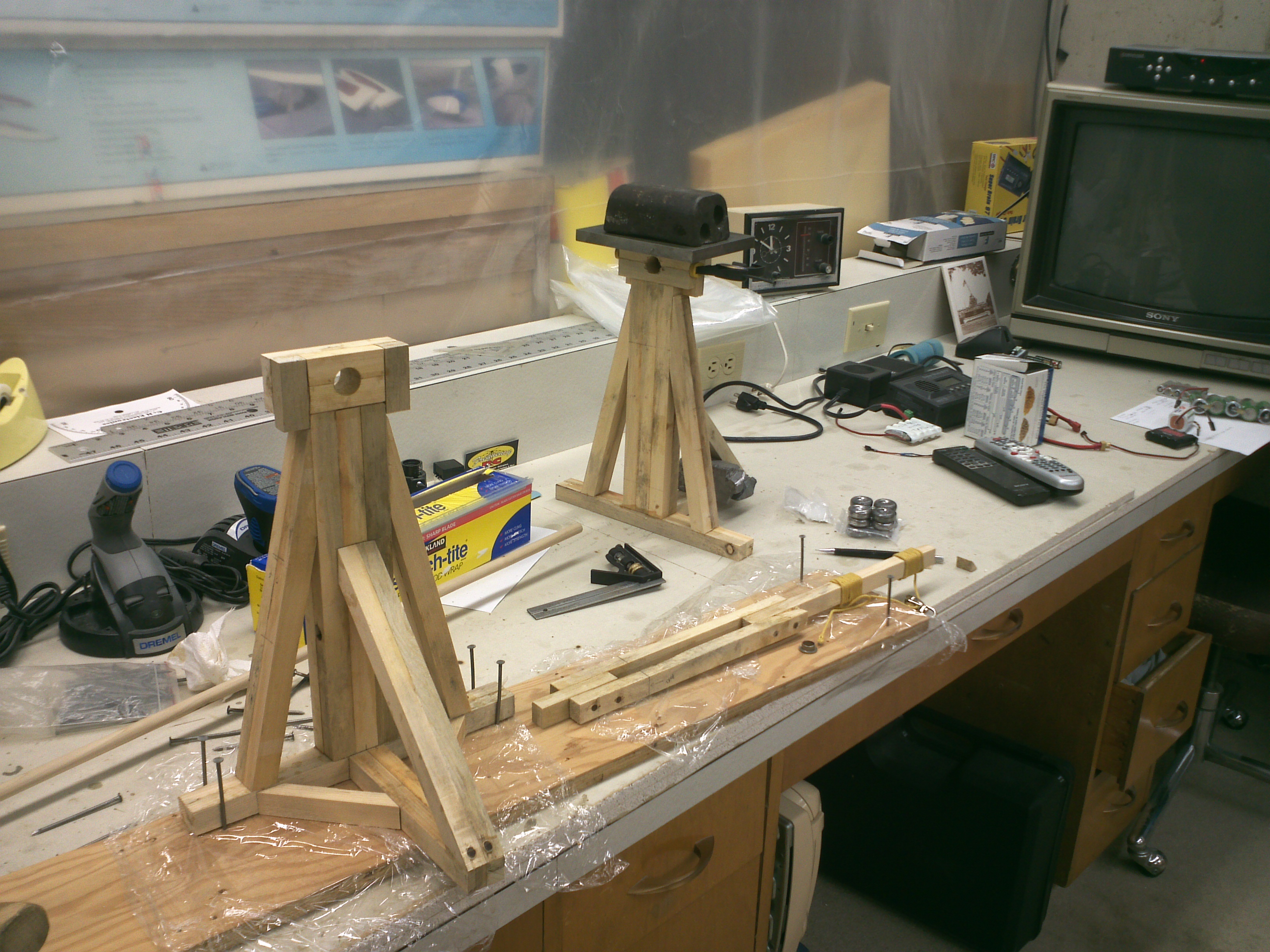
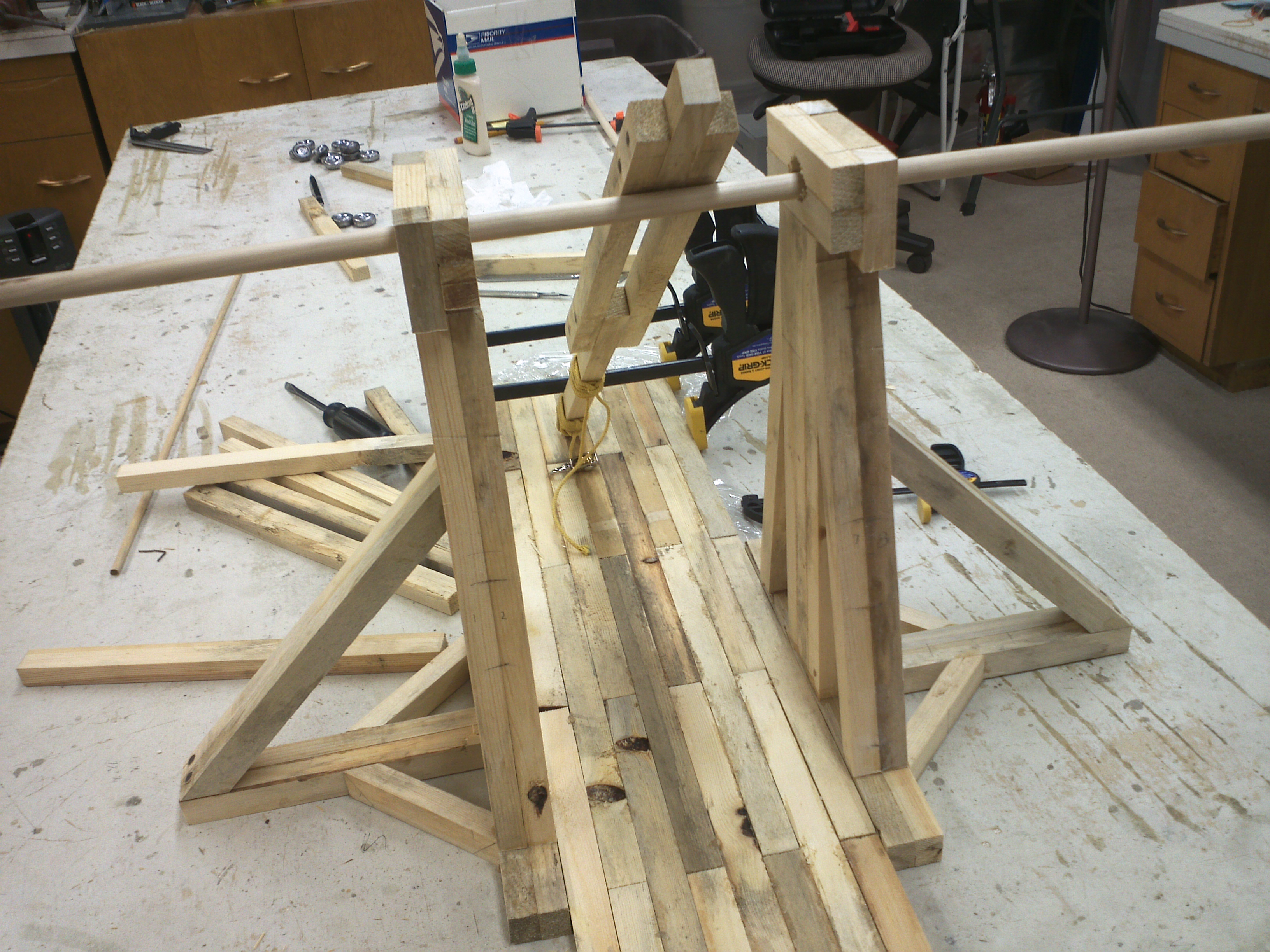
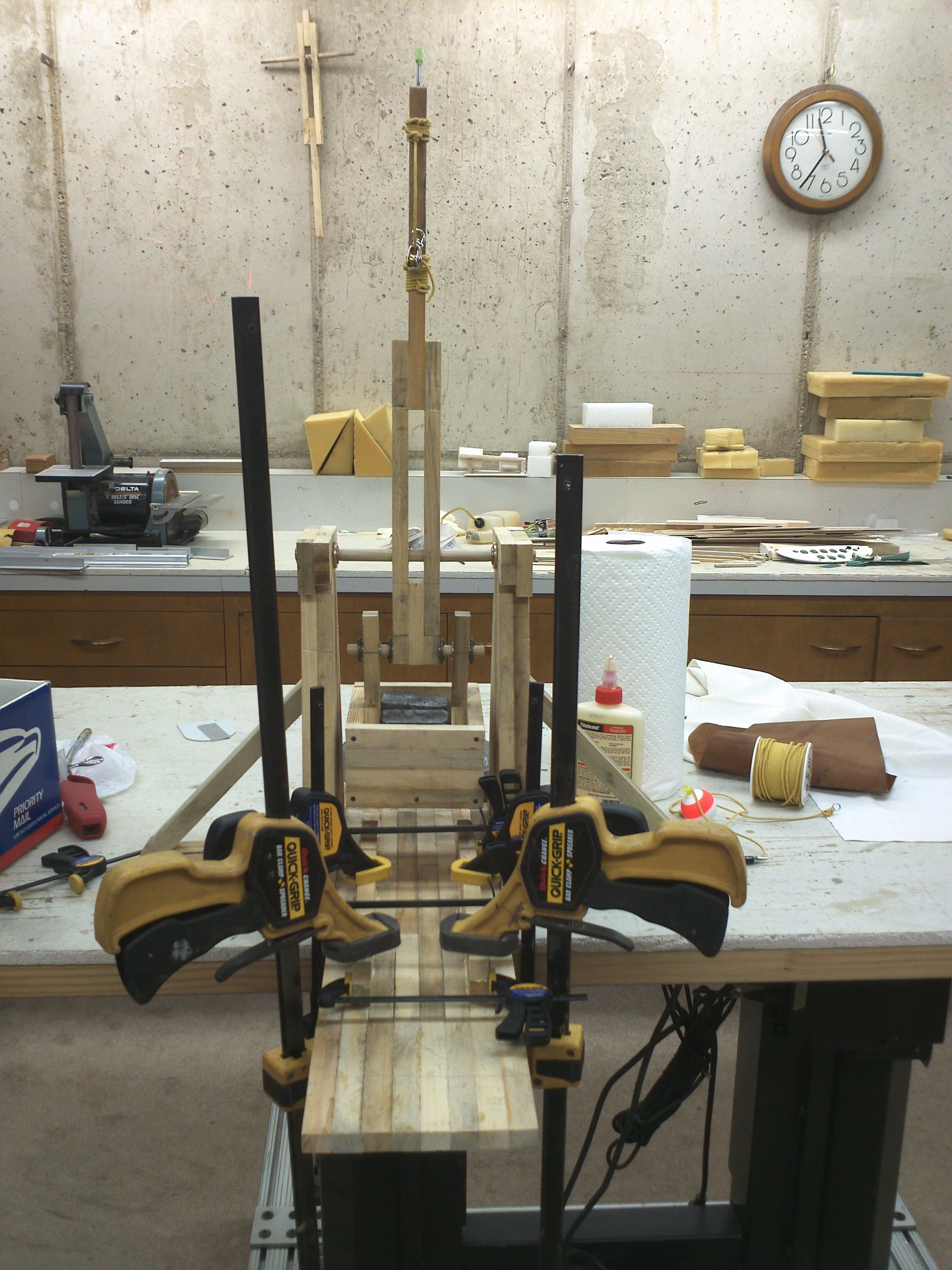
The two vertical supports (framework) of the trebuchet. The beam is also shown here which will have the axle go through it.
The two vertical post are connected to a base to complete the framework for the trebuchet. The hole for the axle has been drilled in the posts but not in the beam. The counterweight box, sling and channel still need to be completed.
Medieval engineers in the 13th century found that counterweights that were hinged could throw projectiles farther as, they were able to harness more energy than their other counterweight counterparts (Nossov, 174). Additionally the hinge proved to be a great braking system for the trebuchet allowing it to nearly completely stop as the beam rotates to an upright vertical position. The breaking system induced by the hinged counterweight decreased the amount of strain inflicted on the structural framework and cushioned the violent reaction that would cause the trebuchet to go off target upon the next firing (Chevedden, Eigenbrod, Foley, and Soedel, 3). As a result “The much gentler release of the trebuchet meant that engineers did not have to reposition the frame between shots and so could shoot more rapidly and accurately” (Chevedden, Eigenbrod, Foley, and Soedel , 3). Other advantages were that hinged or moveable counterweight trebuchets were easier to “transfer and assemble” (Nossov, 174).
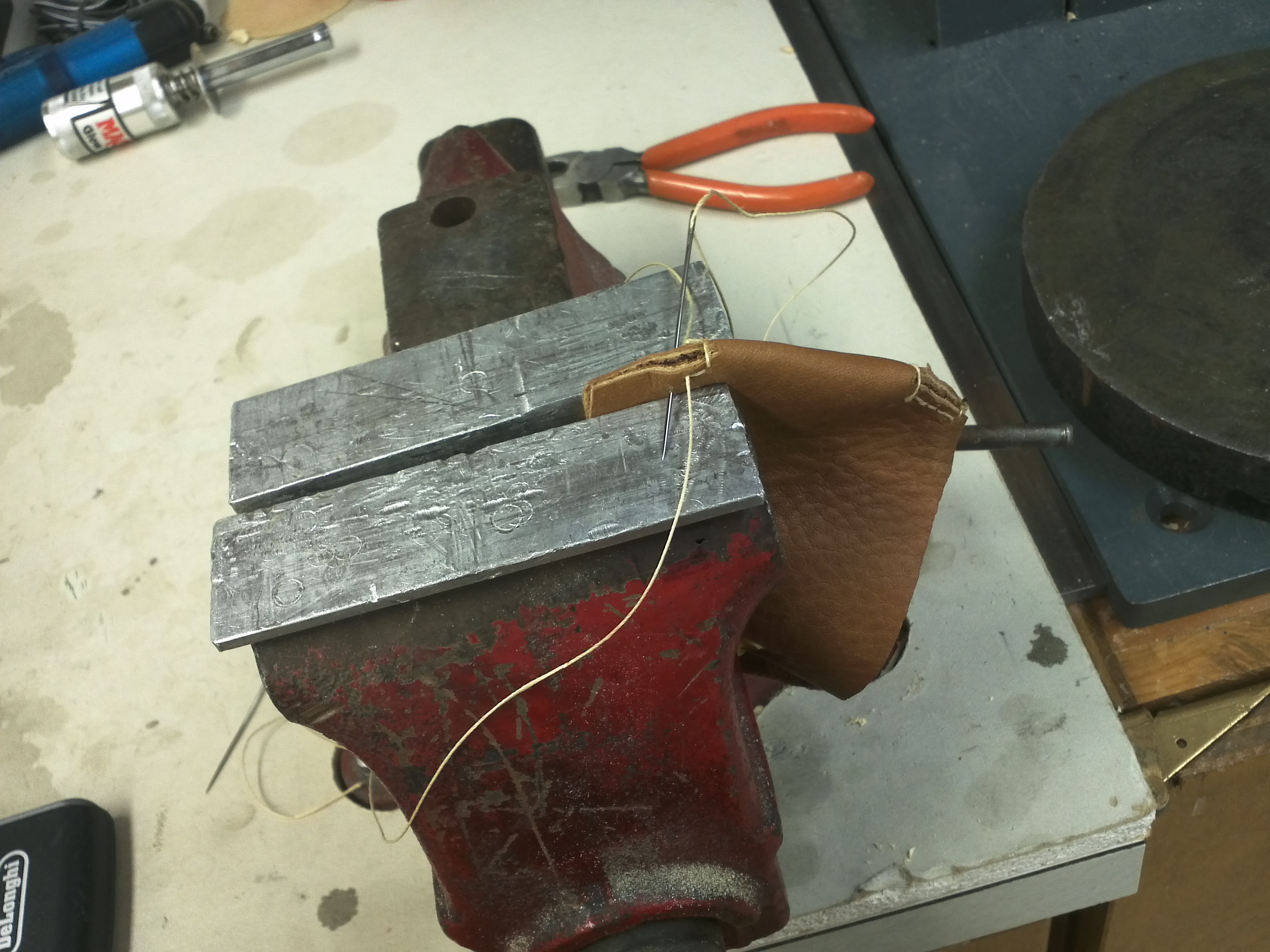
Sling pouch made of leather cut into a diamond like shape. Two triangle pieces of the leather were cut out and stitched together to create a pocket rather than a flap. Grommets were attached to each end of the leather and tied to the rope to complete the sling.
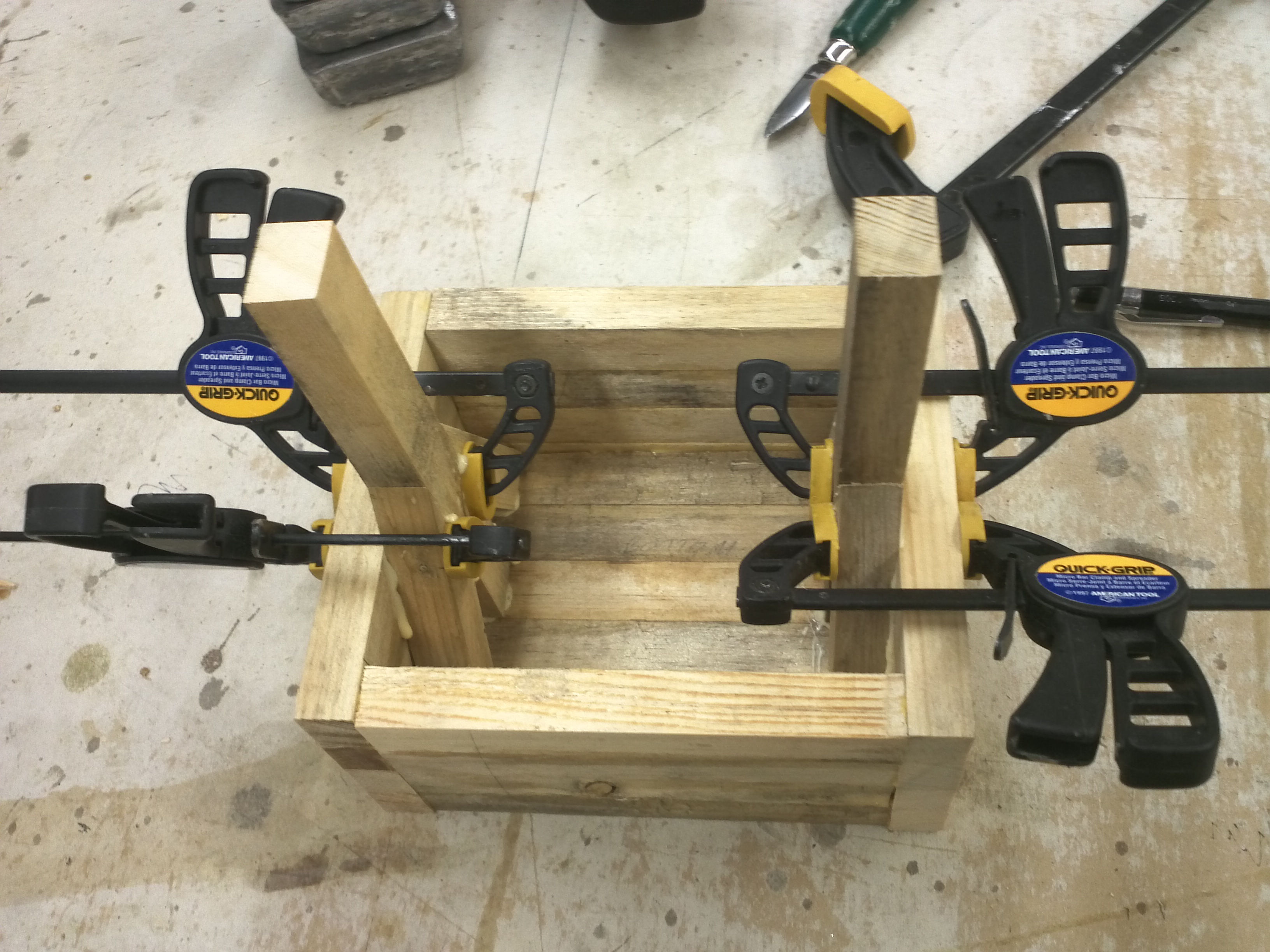
Don't make and glue pieces for the wrong side! Just completed the hinge supports for the counterweight box. Opps...they were for the wrong side. Luckily the glue hadn't dried.
Completed the counterweight box and hinge. The axle will be put through the short end of the beam. This will allow for more energy to be transferred to the sling and ultimately the projectile.
In order to load the trebuchet the long end of the beam was pulled down to the ground by a series of ropes, windlass, and or squirrel’s wheels. A large trebuchet was cocked by 10 to 12 men who could lift a 10-ton counterweight in approximately 6 minutes. When the long end of the beam was lowered into position the trigger was fixed and the sling was prepared (Nossov, 177). The sling entered a special channel which directed the sling and various projectiles: stone or lead balls, pots of flammable substances, cobble-stone grenades, burning sand/tar, darts, diseased corpses, or beehives were loaded inside the sling (“Trebuchets”).
A shot was fired in the following way…the operator released the trigger mechanism and the counterweight sped downwards, propelled by the force of gravity. The longer end of the beam soared upwards respectively. The sling would tear itself off the chute in which it lay, outstripping the lifting of the beam, and would lash around the end of the beam, adding acceleration to the projectile. Depending on the construction of the sling, its end either slid off the cog on the beam or was pulled by a tie; the sling would unfold and release the projectile (Nossov, 174).
Trigger construction and application was diverse. Triggers found in ancient drawings of trebuchets do not always reflect the method of firing a trebuchet. Due to the proximity of the trigger in conjunction with the beam, it has been suggested that the soldier who’s duty to pull the trigger may have been just as dangerous as the soldier on the frontline. A common trigger was a rope-over beam method. The rope then needed to be expelled by a mallet, pin or snap (“Trebuchet Triggers”).
Melted lead into six bricks that weight approx. 1.5 pounds each.
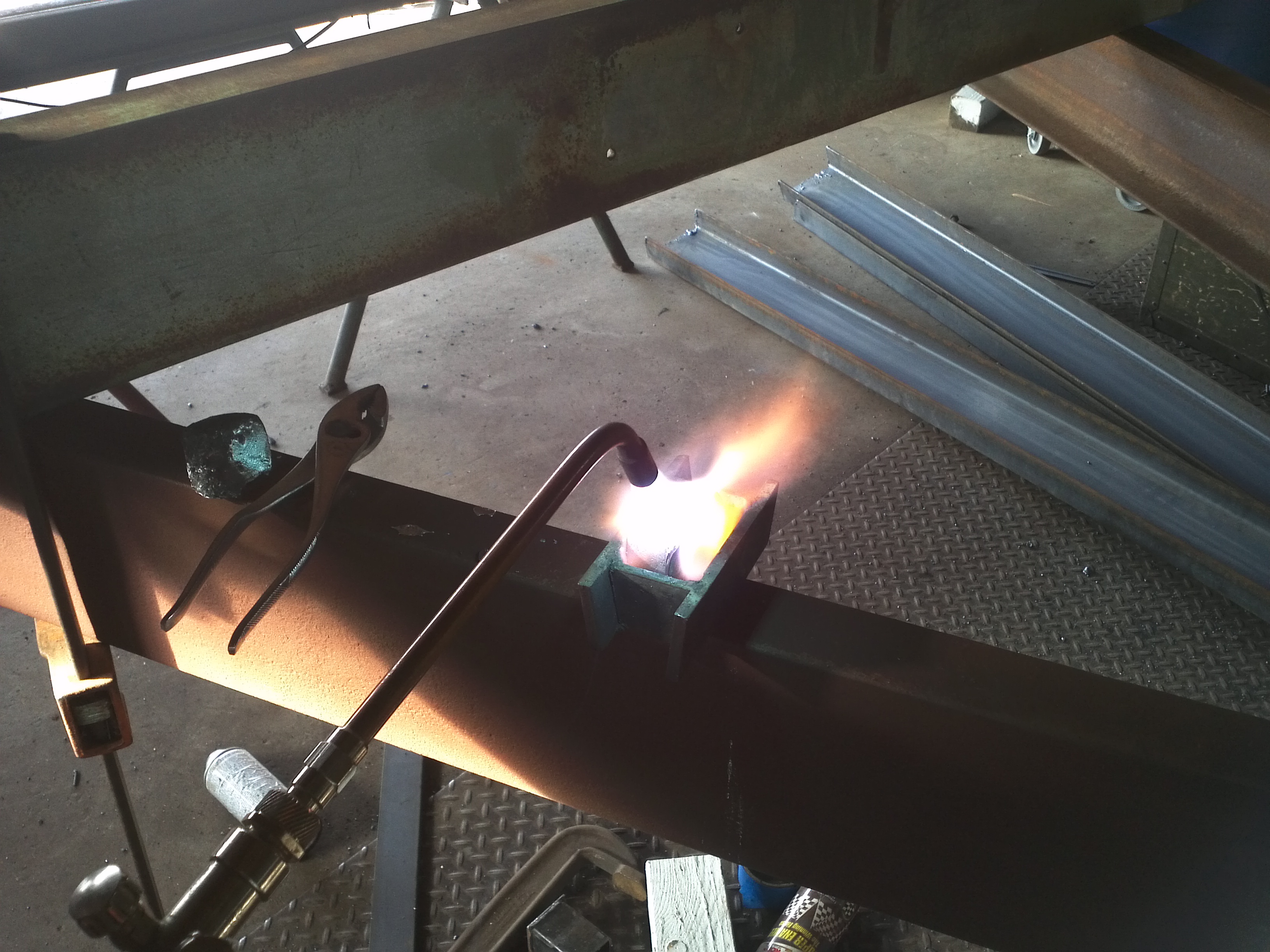
Completed lead bricks to act as counterweight for the trebuchet. Don't touch they are still hot!
Attaching the channel which will guide the sling and keep the projectile on target. Also, in the background you can see my first attempt at the beam. The holes for the axle were not drilled straight.
When laying siege to a wall or castle stone or lead balls of the same caliber (weight and size) were used. This allowed consistent and accurate shots. The complete trebuchet mechanical system is truly a dynamic one. The velocity, distance, and trajectory are not only dependant on the ratio of projectile weight to counterweight but also the sling length, cog length and angles, and beam length and angles and counterweight motion. Firing a projectile in a short sling versus a long sling resulted in a steeper or grazing trajectory respectively. However these trajectories were also determined by the size and weight of the projectiles and counterweight (Nossov, 177).
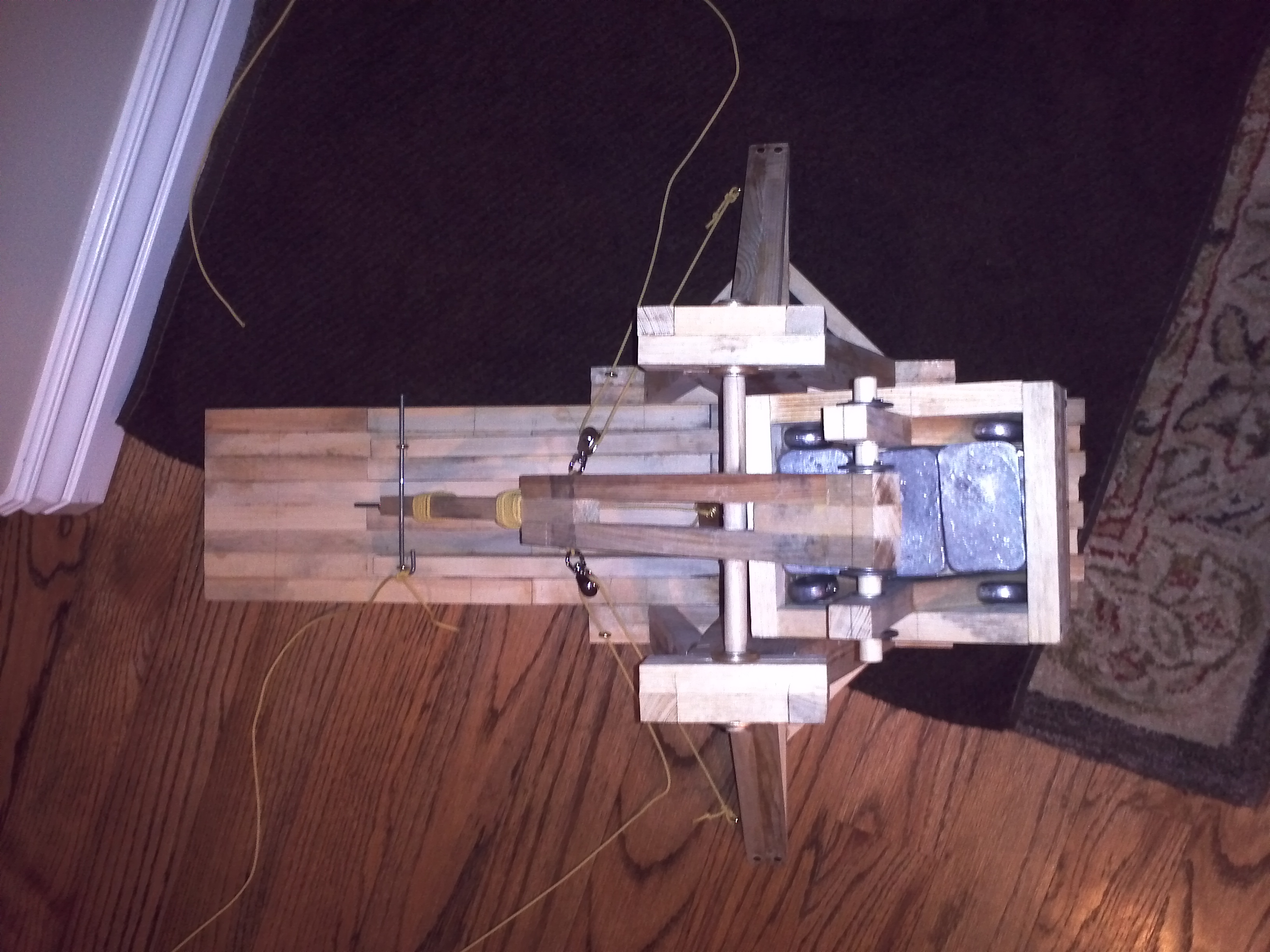
Locked and loaded. Bird-eye view of the completed trebuchet. The trigger is a metal rod connected to a pullrope. The box is loaded to the brim with lead bricks. The ropes and pulleys are connected to the framework and beam to lower the beam after it has been fired. The only thing which wasn't done on this trebuchet was the construction of a windlass.
Impacts of the Trebuchet….
The trebuchet expanded and impacted Islamic, Mongol and European conquest. It was a weapon which held both offensive and defensive operations and was an instrument which helped propelled the “Black Death” epidemic across ancient Europe – as diseased corpses were hurled into cities (Chevedden, Eigenbrod, Foley, and Soedel, 2).Further it seems to have had an impact on theories of motion and the development of clocks and pendelums.
“During their heyday, trebuchets received much attention from engineers indeed; the very word ‘engineering’ is intimately related to them. In Latin and the European venaculars, a common term for trebuchet was ‘engine’ (from ingenium, ‘an ingenious contrivance’), and those who designed, made and used them were called ingeniators” (Chevedden, Eigenbrod, Foley, and Soedel, 3).
The trebuchet was a multifaceted feat that furthered science, engineering, technology, as well as politics and war. It impacted four civilizations of which “its fullest development [was achieved] in Western Europe” (Chevedden, 71-72). Today it’s role helps students understand not only historical achievements but also physical principles that were discovered centuries ago. It has been well enjoyed by historians, layman, hobbyists and enthusiasts. As for myself, I have enjoyed learning what made the trebuchet a “Great Idea of the West.”
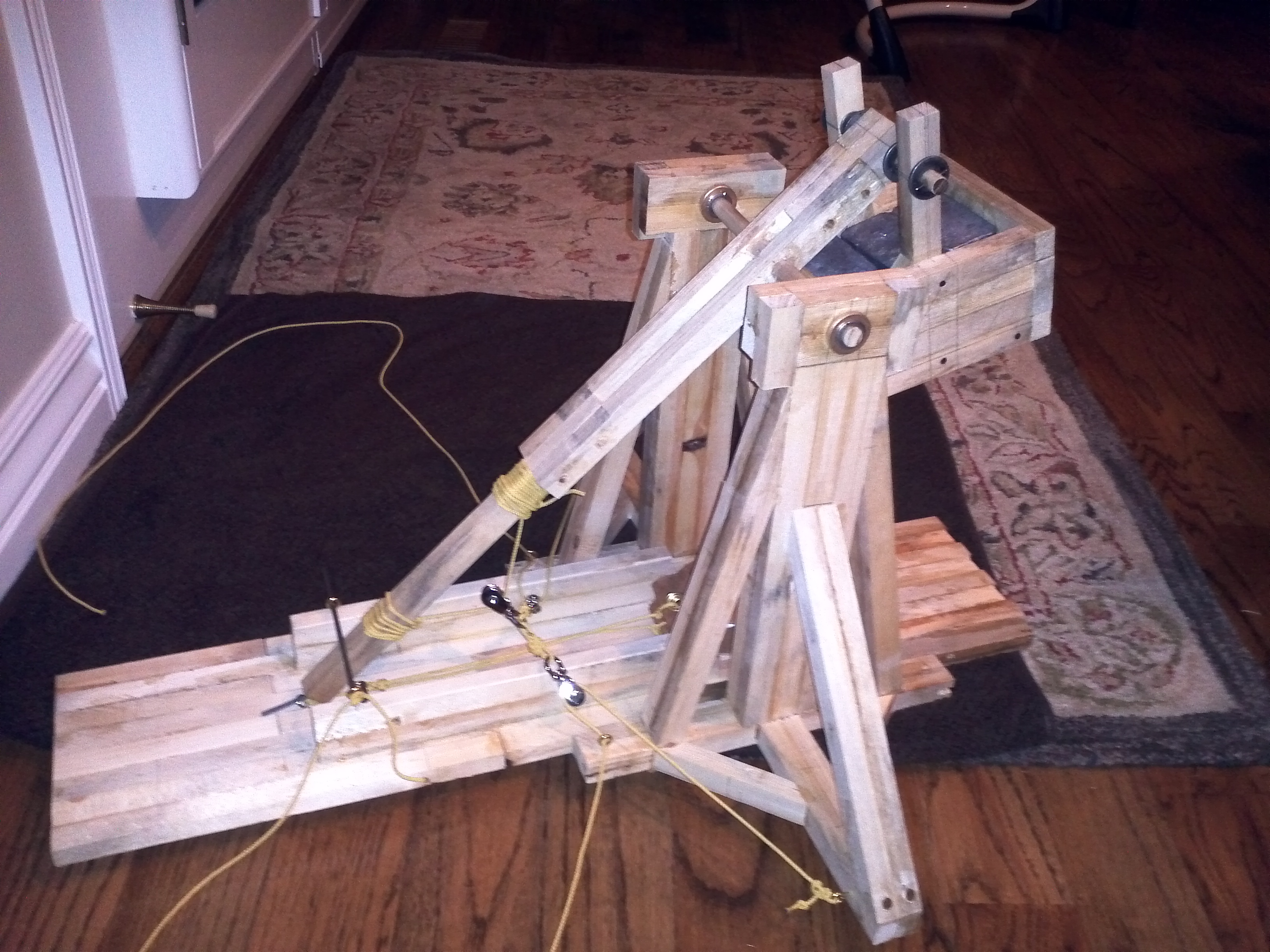
Side view of the completed trebuchet. Not bad considering It started with just a pile of sticks and some random hardware.
Works Cited
Chevedden, Paul E. “The Invention of the Counterweight Trebuchet: A Study in Cultural Diffusion.” Dumbarton Oaks Papers, Vol. 54 (2000): pp. 71-116. JSTOR. Web. Apr 1. 2011. <http://www.jstor.org/stable/1291833>.
Chevedden, Paul E. Eigenbrod, Les. Foley, Vernard. And Soedel, Werner. “The Trebuchet.” Scientific American Spec. Online Issue. Scientific American, Inc. Feb. 2002. Web. 1. Apr. 2012.
Nossov, Konstantin. Ancient and Medieval Siege Weapons: A Fully Illustrated Guide to Siege Weapons and Tactics.Guilford: TheLyons Press-The Globe Pequot press, 2005.
I thought making a replica of legionary outerwear and armor would be a fun project. I just had no idea how fun.
The standard tunic was the easiest part, and probably the most accurate portion of my replica. A real Roman tunic would be made of wool, but in this case, muslin was much more easily available and cost-effective, not to mention an appropriate color to represent un-dyed wool. The neck was made by cutting a slit, and ‘sleeves’ were simply gaps in the stitching. “Many tunics were made with much longer neckslits” in a real legionary’s tunic, “so that for heavy work the right arm could be slipped out.” (Amt) However, I couldn’t foresee any ‘heavy work’ being done during the presentation, and I wanted the tunic to stay on securely, so the neck of my tunic was more fitted.
I was able to make the armor fairly accurate as well, and it was by far the most enjoyable part of the project. Strips of poster-board lined on both sides with duct-tape simulated 1st century “lorica segmentata:” plate armor clearly depicted on Trajan’s column. Ancient armor would have been steel bands “fastened to internal leather straps” which “surrounded the torso in two halves, being fastened at the front and back by means of brass hooks, which were joined by leather laces.” (Wikipedia contributors) But for ease of transportation and presentation, I chose to make my armor in one piece, rather than have to construct and deconstruct it and waste class time.
I was concerned that the armor might not fit perfectly, but I realized that not many soldiers could have afforded custom-made armor. “Some pieces of armor” that have been found and salvaged bore inscriptions of “The names of two, three, or even four men, generally successive owners.” A new recruit may have bought armor from a veteran, inherited it from his father or grandfather, or had it issued to him by the “custos armorum,” (MacMullen) so it makes sense that it wouldn’t be a perfect fit.
The sandals and helmet were the least accurate parts of my presentation, and the only parts I bought rather than constructing myself. Images from Trajan’s column don’t shed much light on Roman military footwear, only showing the occasional ankle strap or visible sole of a shoe. Fashion wasn’t really the column’s focus, and it didn’t help that many Romans seemed to go barefoot at times. Sources varied on whether legionaries wore sandals, or more boot-like leather shoes. All agreed that often “hobnails were hammered into the sole for added strength. Similar to the modern cleat.” (Wikipedia contributors)
Soldiers from the time of the Dacian wars depicted on Trajan’s column generally wore ‘Montefortino’ helmets, “named after the region of Montefortino in Italy,” where one such helmet was uncovered. Rather than the plumed crest of the costume piece I purchased, the average soldier’s helmet would have had “a raised central knob, and a protruding neck guard” Instead of the thin half-guard of the costume helmet. A Montefortino helmet also had “cheek plates to protect the sides of the head,” Not the stylized face-guard of the helmet I presented. (Wikipedia contributors)
All in all, each piece gave me a good jumping-off point to describe a Roman soldier’s typical outerwear, regardless of its relative authenticity. And while duct-tape armor may not hold up against a sword – or even a particularly heavy rain – I learned quite a bit, and had a lot of fun making it.
MacMullen, Ramsay. “Inscriptions on Armor and the Supply of Arms in the Roman Empire.” American Journal of Archaeology. 64.1 (1960): 23-40. Web. 17 Apr. 2012.





 Legio I Lynx Fulminata
