Category Archives: Uncategorized

Alexander the Great: Organization and Leadership of the Macedonian Army

As leader of the Macedonian army, Alexander the Great showed by example what he wished his soldiers to be. He dressed like his soldiers and interacted with them in camp, which gave his troops a feeling of love and concern from their commander and won great affection (Straker). Coupled with his determination and courage, he was able to win the loyalty of his men that endured even in the most desperate of times (Straker). He would most commonly be found at the front of a charge in clear view of  his men and as an obvious target for his enemy. It is likely that he was wounded in battle more frequently than any of his men (Burn, 140).  He built their morale up from the beginning, instilling in them a sense of moral superiority and the belief that under his command nothing was impossible (Burn, 140).

Alexander kept a relatively small army, never numbering more than 40,000 total cavalry and infantry, giving them the advantage of speed and mobility (Straker).

Cavalry:

Hetairoi or companion cavalry was the most prestigious of the mounted troops. During the reign of Phillip II, these soldiers were selected only from Macedonian nobility. Under Alexander, the number increased from 600 horsemen to 3000 troopers. The hetairoi were organized in ilai or “wings” of 200 men, with the exception of the basilike ile (royal squadron) which consisted of 300 to 400 cavalrymen (van Dorst). During battle, these soldiers generally rode in a wedge formation and depending on the circumstances could be heavily or lightly armed. Cavalry men generally always wore metal helmets and body armor (consisting of linen or leather corselets with metal scales, or breastplates made from iron or bronze) and were equipped with heavy thrusting spears, javelins and always carried a sword as a secondary weapon. Shields were reserved for dismounted actions. Prodromoi, the light cavalrymen and scouts of the Macedonian army, were equipped with javelins when on a reconnaissance mission but could be redressed and serve as heavy cavalry (or sarissophori) in battle (van Dorst).It is believed that Alexander’s cavalry forces were an important part of his success in battle, and they were “unmatched on their own ground” (Burn, 141).

Infantry:

Infantry men were recruited territorially. Each Macedonian province provided a single taxis or regiment of pezhetairoi or foot companions, and each regiment consisted of approximately 1500 soldiers (van Dorst). Command of these regiments was usually given to nobles originating from the same province as the men they commanded. The phalanx infantry was much more flexible than the Greek hoplites—equipment and tactics were adjusted to suit different battle situations. Each was equipped with a hoplite shield and normal length spear, which could be traded for light  javelins or a a long pike requiring both hands and a sarissa, or rimpless shield hanging from the shoulder (van Dorst).

Phalanx with Pikes (Wikipedia contributors)

Another very important part of the infantry was the hypaspistai or shield bearers, comprised of 3000 men organized into subunits of 1000 soldiers. The elite formation of shield bearers was the argyraspides or “silvershileds.” Membership in this unit was based entirely upon merit as a soldier in one of the taxes, rather than upon status and nobility (van Dorst). These soldiers were frequently used on special duties and were more likely to carry lighter arms and equipment. In engagements, the shield bearers were generally deployed in the dangerous place of honor—the right flank of the heavy infantry line (van Dorst).

Tactics:

Alexander generally aimed to force his enemy into rapid decisions that would confuse and lower morale. Success depended largely on undermining the confidence of the enemy, and attacking them at weak moments—particularly when the enemy forces were tired after long marches or lack of sleep (van Dorst). He also used tactics such as a fierce cavalry charge on a small portion of the enemy’s forces to break morale and cause panic among the units not yet engaged in the battle (van Dorst).

Works Cited:

Burn. A. R.. “The Generalship of Alexander.” Greece & Rome, Second Series. Vol. 12, No. 2. The Classical Association, Cambridge University Press. 1965. JSTOR. 7 Feb. 2012.

Straker, David. “Alexander the Great.” Changing Minds. Changing Minds. Web. 9 Feb. 2012. http://changingminds.org/disciplines/warfare/commanders/alexander_great.htm

van Dorst, Sander. The Army of Alexander the Great. Ancient Warfare. 2000. Web. 7 Feb 2012. http://s_van_dorst.tripod.com/Alexander.html

Wikipedia contributors. “Macedonian army.” Wikipedia, The Free Encyclopedia. Wikipedia, The Free Encyclopedia, 17 Apr. 2009. Web. 9 Feb. 2012.

2 Comments

Filed under Uncategorized

Seers and Omens in Time of Alexander the Great


Even before Alexander is born to his father King Phillip and his mother Olympia, Aristander played a part in the story of the man who came to be known as Alexander the Great.  King Phillip dreams of sealing up the womb of Olympia with a seal which bore the likeness of a lion device. The soothsayers were suspicious about the dream because they believed that it meant that the King should keep better track of his wife.  Seer, Aristander interprets it to mean that the unborn child will be lion-like and brave (Aristander).

The Greeks were known for their belief in seers and soothsayers.  Alexander the Great was no exception.  He relied on many seers that traveled with him during his campaign in Asia. Aristander has been called the seer extraordinary of Alexander the Great. In one instance he was called upon to explain the strange flight of birds, and on another occasion he was asked what a spring of oil meant by a river (Robinson).  These are just a couple of examples of how Alexander the Great relied on seers to help him interpret what he believed constituted signs about the future.

Aristander performed three main functions in his service to Alexander.  He assisted with the daily sacrifices of animals by determining their status. He interpreted omens and provided prophecies.  The third function was to interpret dreams (Powler).

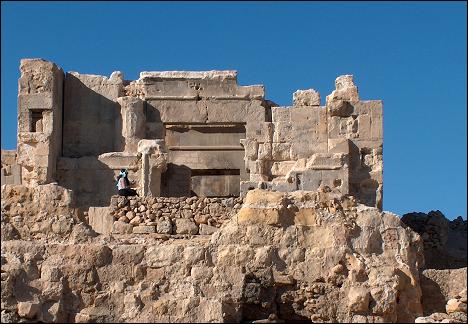
Another thing that Alexander believed in was oracles.  During his conquest he visited the Oracle of Amon on his quest for confirmation that he was the son of Zeus, the Grecian God.  It was Alexander’s wish to be buried at Siwa.  This is a photo of the entrance to the temple complex as it appears in modern times.

Entrance to the Temple site at Siwa

The Inside Wall of the Temple

http://www.minamar.com/alexander-the-great-oracle-siwa-oasis.html

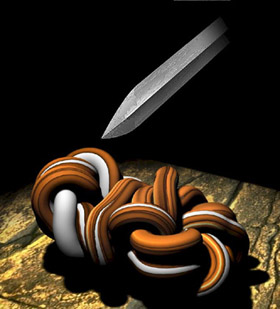
Alexander was in the city of Gordium, Turkey after the battle of Grancius.  Some of the Spartans had been persuaded not to support Alexander. This caused Alexander to hesitate to move forward with his campaign to conquer Asia due to the mixed support of the Greeks.  Gordium was the location of the Gordian knot and it what prophesized that the man who could untie the knot would rule Asia.  Alexander untied the knot buy slashing it with a sword  Alexander took this instance as an omen that he should continue his campaign to conquer Asia (Gill).


The Gordian Knot

http://www.maa.org/devlin/devlin_9_01.html


Works Cited

Aristander. n.d. 7 Feb 2012. <http//en.wikipedia.org/wiki/Alistander>.

Gill, N.S. Gordian Knot-Alexandelr Solves the Gordian Knot. 2012. 9 Feb 2012. <http://ancienthistory.about.com/od/alexanderterms/g/GordianKnot.htm&gt;.

Powler, Thomas-William. All About Alexander the Great. 1994. 7 Feb 2012. <http://www.pothos.org/content/index.php?page=pothos&gt;.

Robinson, Jr. C.A. “The Seer Aristander.” American Journal of Philology 1929: 195-197. 7 Feb 2012. <http://www.jstor.org/stable/290420&gt;.


Leave a comment

Filed under Uncategorized

Alexander the Great: Siege of Gaza

The siege of Gaza occurred in 332 B.C.E. at the city of Gaza. Gaza is a coastal city on the Aegean coast (Fig. 1). Gaza posed a significant challenge because it is located on a plateau that rises up to 60 feet over the surrounding areas. The siege was between Alexander and his 45,000 strong force of Greeks against Batis, King of Gaza and his 49,000 soldiers of the Achaemenid Empire.


Around October of 332 B.C.E. Alexander the Great was on his march south to Egypt in order to secure his flank before marching across the Middle East on his mission of World Conquest. Alexander wanted to shore up his rear In order to avoid having issues behind him so that all of his focus would be in front of him. One of the cities on his path was Gaza, which was ruled by Batis, who was loyal to Egypt.

Alexander arrived at Gaza and quickly spotted the southern walls as the weakest point in the city. Thus he set his siege sights on that part of the city. He quickly built up mounds from which siege weapons would begin to batter the walls. Batis knew that Alexander was coming for Gaza and had therefore provisioned his city in order to withstand a long siege, hoping for the arrival of the Egyptian army to meet Alexander in open battle.

It took 3 unsuccessful attempts to capture the city before Alexanders forces stormed the city and was able to finally bring the city to its knees. When the city fell the men were “put to the sword” and the women and children sold into slavery.

This was the last major obstacle on the Aegean coast for Alexander. After the city fell Alexander was able to successfully claim Egypt and begin his march across the known world.


Bosworth, A.B. Conquest and Empire: The Reign of Alexander the Great. Cambridge: Cambridge University Press, 1988. Web.

Wikipedia. Siege of Gaza. February 2012.


Leave a comment

Filed under Uncategorized

Alexander the Great – The epitome of siege Equipment in the battle of Tyre and a little boasting.

Perhaps the most notorious siege of Alexander the Great was that of Tyre in 332 BC. The potential for siege machinery was perhaps first understood by Alexander’s father King Philip, but Alexander likewise saw the benefit for the equipment and better epitomized its use during his campaign against Persia. The use of machinery to besiege cities was made relatively shorter compared to the past where a city was circumscribed by an opposing attacker. (Potter 127).

Brief History and Account of the Siege of Tyre given by Arrian.

After Alexander the Great was denied permission to enter the city of Tyre and sacrifice to the god Herakles, he considered the consequences to his empire if Tyre was left to their own devices. Therefore, Alexander convinced the generals of the need to capture the threatening Tyre, despite the apparent naval and defensive advantages Tyre held. Tyre had a much larger navy (being a port city) and also was a great defensive stronghold (being an island surrounded by a large wall). (2.18.2-4). Arrian mentions the size of the wall to be “150 feet high and proportionately thick” (2.21.4).

File:Tyre-aerial-photo-by-France-Military-1934.jpg

Aerial view of Tyre taken in aprox. 1934

Despite these detriments, Alexander was not deterred and found it in his best interest to build a mole or causeway from the Phoenician inland shore to the Island (Arrian, 2.18.2-4).  As the construction of the mole became closer to the city, it also drew deeper into the water and eventually the mole and its workers became vulnerable to the ranged ballistic attacks from the wall and the triremes in the Tyrian military. This temporarily halted the construction of the mole as Alexander then ordered his engineers and workers to build two siege towers on the edge of the mole, which would hold equipment designed to counter-fire against the Tyrians. Further, Alexander’s engineers draped the towers with skins as to better shield the workers and provide cover so they could resume their work on the mole (2.18.5-6).

In retaliation the Tyrians boarded vessels filled with flammable materials which they deployed against the towers and then set fire to them; thus, destroying the towers and much of the progress of the mole (2.19.1-5).

Alexander comprehended that the siege would be futile as long as the Tyrians held the upper hand, therefore, he instructed his engineers to widen the mole and to construct more siege equipment.  Alexander then left for the surrounding Phoenician regions to procure reinforcements by claiming dues owed from kings and granting amnesty towards others (2.19.6-2.20.1-8).

Alexander amassed a large navy, infantry, and engineers and again returned to the siege of Tyre in approximately 11 days. In a defensive maneuver the Tyrian navy took position in their two harbors one facing Sidon and the other facing Egypt (2.20.7-8). While the Tyrian navy was held at bay, war engines were built and assembled on the mole, horse-transports, and slow sailing triremes. Alexander then had the war machines bought across the mole and started bombardment against the wall. Ships holding siege machinery was halted until large stones could be hauled from the water as they could not get in range for their weapons. (2.21-1-3).

Taking countermeasures, the Tyrians attempted to cut the anchors cords away from the triremes moving the stones but were thwarted by the Macedonians who used chains. In a last attempt, the Tyrian navy attacked some empty moored ship destroying a few. However, in return Alexander set up a blockade preventing other Tyrian vessels to make it out of the harbor and the set out to defeating the vessels which had attacked the moored ships (2.21.4-7-22.1-5).

The siege equipment at the site of the wall proved to be unsuccessful; therefore, Alexander took the ships holding siege equipment around the island bombarding various points along the wall eventually breaking through. Initially, Alexander attempted to enter the city but was fought back (2.22.6-7).

Alexander, waiting two days later, is determined to enter the city. He instructed the siege equipment to fire at the wall for a considerable length of time and then prepared and eventually landed on the island capturing Tyre (2.23.1-6).

The End – of the brief history lesson.

Some discussion and boasting in Alexander’s behalf…

As stated earlier the battle of Tyre is perhaps one of the most famous sieges of Alexander’s campaign. It is at this battle when we see siege machinery used to break down a wall which surrounds a city as well as the use of battering-rams at sea (Nossov, 40-41). Likewise, this example displays a diverse array of siege equipment including: torsion projectors which fired arrows (katapetai) and stones (litoboloi or petroboloi), as well as battering-rams, and towers in diverse offensive and defensive methods.

Diodorus (17.43.1 and 17.45.1-4) goes into more detail regarding the technological innovations introduced by both sides during this siege. Alexander’s engineers devised catapults large enough to hurl stones capable of smashing the Tyrian walls, apparently the first time artillery weapons had been used against fortifications rather than personnel. The Tyrians for their part made cushions out of hides stuffed with seaweed to absorb the impact of the stones, and further warded them off with some sort of wheel-like device that deflected missile fire as it spun around. Phoenicians were famous in antiquity and their engineering skill, so it is not surprising that Alexander recruited much of the local talent into his army or that both sides in the conflict made rapid advances in military technology over the course of the seven-month siege (qtd. in Arian by Mensch, 88).

During Alexander’s campaign he included engineers in his baggage train throughout his expedition, as Potter puts it: “Alexander brought experts in siege warfare, katapeltaphetai, with him, and their extraordinary accomplishment at places such as Tyre show that they could construct massive weapons on the spot and improve their technology as the years passed” (Potter, 127). Engles pointed out that in Areia it was clear that the use of carts would be used to transport siege machinery but also engineers would carry tools and supplies required to build equipment (15-17). The ability to build rather than transport siege equipment allowed the army to move swiftly and efficiently, while most likely allowing the equipment to be more reliable and adaptable depending on the situations Alexander and his army found themselves in. Stark examples of this can be obtained through recall of Arrian provides us.

* I found some good examples (in my opinion) of some of the siege equipment that would have been used during Alexander’s campaign at http://www.ancientworlds.net/aw/Post/1222743 and some nice images of the battle at http://www.ancientworlds.net/aw/Post/1225046. I have contacted them for permission to use some images but have yet to hear a reply. Professor Payne, maybe if you get a chance to look at these you could tell me if any of them are out of copyright if fall under fair-use. In the interim I hope the class enjoys!

Works Cited:

Arian. The Landmark Arrian: the campaigns of Alexander a new translation. Trans. Pamela Mensch. Ed. James Romm and Robert B. Strassler. New York: Pantheon Books-Random House, 2010.

Engels, Donald W. Alexander the Great and the Logistics of the Macedonian Army. Berkeley: University of California Press, 1978.

Image GEOEYE , Google Earth, and ORIONN-ME. 2012 Map. “Harbor of Tyre, Lebanon.” Data Sio, NOAA, U.S. NAVY, NGA, GEBCO.  9 Feb. 2012.

Poidebard, A. UN GRAND PORT DISPARU T Y R RECHERCHES AÉRIENNES ET SOUS-ARINES 1934-1936. 1939. LIBRAIRIE ORIENTALISTE PAUL GEUTHNER 12, RUE VAVIN – PARIS (Vl). 9 Feb. 2012 http://almashriq.hiof.no/general/900/930/933/tyr-poidebard/tyr.html.

Potter, David. “Alexander the Great and Hellenistic Warfare.” The Ancient World at War. Ed. Philip de Souza. New York, NY: Thames & Hudson, 2008. 119-38.

Nossov, Konstanin. Ancient and Medieval Siege Weapons: A Fully Illustrated Guide to Siege Weapons and Tactics. Guilford: The Lyons Press-The Globe Pequot press, 2005.

Leave a comment

Filed under Uncategorized

In-Class Assignment: How did Hannibal Get Elephants over the Alps?*

  1. Hannibal’s army was directed by guides.
  2. He had the animals walk carefully through narrow places.
  3. He had his men clear vegetation.
  4. He had his men build roads.
  5. He had his men follow the contours in the mountains.
  6. He hit detours at cliffs and was misled by guides from time to time.
  7. He had his men clear away snow and ice.
  8. He had his men cut through rock to create paths by quickly heating frozen rock, using sour wine as a corrosive, and then using picks.
  9. He had his men create a zig-zag track to minimize the slope of the road during the group’s descent.
  10. The elephants took longer to move over the top of the mountains than the men and horses because they had to widen the path.
  11. The animals had to eat local vegetation along the way, so the animals almost starved while they were stuck at the peak.
  12. The Italian side of the Alps has ample vegetation, so once Hannibal got the army over the top of the mountain, the party was able to feed the animals and rest.

*Notes based on information from http://www.livius.org/ha-hd/hannibal/alps_text.html

Leave a comment

Filed under Uncategorized

Battle Of Marathon


The Battle of Marathon was fought on the plain of Marathon around the 10 of September or 12 of August 490 according to the full moon. The Persians sailed to the bay of Marathon (25 miles from Athens). The Athenian general Miltiades quickly formed a small army of hoplites or infrantrymen. There were about 10,000 heavily armed Athenians and 1,000 Plataeans (Livius) that went to fight against the numerous army of Persia at the Battle of Marathon. The great runner Pheidippides was sent to Sparta to request reinforcements but the Spartans could not respond due to the religious festival of Carneia which prevented the Spartans from any military operation until the full moon. The 11,000 hoplites were divided into ten tribes with a Strategoi (generals) over each “tribe.”(Tucker). Miltiades, Aristides and Themistocles were some of the generals over the tribes. Callimachus was elected by the tribes to be the polemarch.

Callimachus was in command of the right wing which consisted of the Athenians while the left wing was commanded by the Plataeans. The wings surrounded the numerous Persians in what modern sources call a “double envelopment” (Tucker). The Persians deemed the endeavor to be “Suicidal Madness” as written by Herodotus of Halicarnassus. However the Greeks were able to defeat the Persians and save Athens as well as capture seven of their ships. Afterwards, the Greeks left a detachment to make sure the Persians did not return. The Persians had already set course for Athens but when they arrived they found that the rest of small but successful Greek Army ready for them. The Persians Retreated and thus ended the Battle of Marathon.

Figure 1: the way the Greeks(Red) surrounded the Persians(Blue); source: en.wikipedia.org/Double_envelopment

Image

Works Cited

J.A. S. Evans. “Herodotus and the Battle of Marathon.” http://www.jstor.org. [Online] 3st Qtr. 1993. [Cited: Jan 31, 2012.] http://www.jstor.org/stable/4436293

Doenges, Norman A. “The Campain of the Battle of the Marathon.” www.jstor.org. [Online] 1st Qtr. 1988. [Cited: Jan 31, 2012.] http://www.jstor.org.hal.weber.edu:2200/stable/4436491?seq=7.

“Battle of the Marathon.” en.wikipedia.org. [Online] January 9, 2012. [Cited: January 31, 2012.] http://en.wikipedia.org/wiki/Battle_of_marathon.

Battle of Marathon. http://www.livius.org. [Online] September 12, 2010. [Cited: Jan 31, 2012.] http://www.livius.org/man-md/marathon/marathon.html.

Tucker, Spencer. “Battles That Changed History: An Encyclopedia of World Conflict.” Greenwood Publishing Group. ABC-CLIO Nov. 11, 2010. [Cited Jan 31, 2012] Print.

Herodotus of Halicarnassus. Ed: A.D. Godley. “The Histories” Perseus.tufts.edu. [Cited Jan 31, 2012] http://www.perseus.tufts.edu/hopper/text?doc=Perseus%3Atext%3A1999.01.0126&redirect=true

Leave a comment

Filed under Uncategorized

Scouting and Intelligence in the Battle of the Marathon

  Battle of Marathon Battle of Thermopylae Battle of Salamis
Time August/September490 BCE August 7 or September 8-10, 480 BCE September, 480 BCE
Where it was fought Marathon Greece Thermopylae, Greece The Straits of Salamis
 Who’s fighting who AtheniansAnd Plateans Greek City- States Persian Empire Persians Greek City-states Achaemenid Empire
  Led By Miltiades the younger, Callimachus Themistocles, Leonidas I and Demophilus Xerxes I of Persia, Mardonius, and Hydarnes Datis,  Artaphernes Eurybiades, Themistocles Xerxes I of Persia, Artemisia I of Caria, and Ariabignes
Result Greek victory Persian Victory Greek Victory

The Battle of the Marathon took place in 490 BC, between the Athenians, aided by their allies the Paletean hoplites (estimated to be between 600-1000 men), and the Persians (Doenges, 1988).  This battle was important for the Greeks they proved that they could defeat the Persians.  In spite of the fact that the Persians solders out-numbered the Greeks by two to one, the Greeks won the battle using a strategic plan to block the road to Athens. This allowed them the strategic advantage of physically blocking the Persians from entering city, thus illuminating the need for an army as large as the Persians (Battle of the Marathon, 2012).  Their strategy was to stand close together and in a tight line and align their shields so that it was hard for the Persians to get through.

http://en.wikipedia.org/wiki/File:Greek_Phalanx.jpg

Modern drawing of the Phalanx formation employed by Greek hoplites (File:Greek Phalanx.jpg, 2007)

Isolated Figure from a Panathenaic Black-figure amphora, Berlin Painter, 480-470 BC, showing a middle-distance race “hippios”

(File:Greek Phalanx.jpg, 2007)

When the Greeks determined the size of the Persian army they would be facing it was determined that reinforcements would be needed.  The blocked the road to Athens and at the same time sent a messenger named Phiedippides to ask the Spartans to join them in the battle.  Phiedippides was known for his ability to run great distances in a short time. He made the trip to Sparta and back to the front in three days.  He brought the message that the Spartans were going to send reinforcements (Battle of Marathon, 2010).

Works Cited

File:Greek Phalanx.jpg. (2007, August 21). Retrieved from Wikipedia.org: http://en.wikipedia.org/wiki/File:Greek_Phalanx.jpg

Battle of Marathon. (2010, September 12). Retrieved Jan 31, 2012, from http://www.livius.org: http://www.livius.org/man-md/marathon/marathon.html

Battle of the Marathon. (2012, January 9). Retrieved January 31, 2012, from http://en.wikipedia.org/wiki/Battle_of_marathon

Doenges, N. A. (1988, 1st Qtr.). The Campain of the Battle of the Marathon. Retrieved Jan 31, 2012, from http://www.jstor.org: http://www.jstor.org.hal.weber.edu:2200/stable/4436491?seq=7

Painter, B. Phidippides. Retrieved from http://www.mlahanas.de/Greeks/Philipides.htm

Leave a comment

Filed under Uncategorized

Women and Warfare: Queen Artemisia at Salamis

Figure 1: Artemisia of Caria. Adapted from Guillaume Rouille. Promptuarii Iconum Insigniorum. “Artemisia I of Caria.” Wikipedia. com. Wikipedia. Web. 31 Jan. 2012.

King Darius of Persia tried to invade Greece after a series of revolts, but was defeated at the Battle of Marathon. In 480 BCE, the Persian King Xerxes I, the son of Darius, began a second invasion of Greece (“Battle of Salamis”). After defeating the Greeks at the battle of Thermopylae, the Persians prepared a fleet of 1,207 ships to fight at sea in the straits between Salamis, a large island, and the Greek mainland (Munson 92). Five of these ships belonged to a female commander from Halicarnassus: Queen Artemisia.

Herodotus introduces Artemisia by saying, “Of the officers I shall make no mention…but I shall mention Queen Artemisia at whom I especially marvel, who being a woman went to war against Greece….on account of her daring and manly courage, and not under any compulsion” (qtd. in Munson 91). Another translation of Herodotus substitutes the words “great spirit and vigor of mind” for “daring and manly courage” (Herodotus 344). It is at any rate clear that the qualities which Herodotus ascribes to Artemisia are worthy of the highest esteem.

Rosaria Munson states that “Unlike most other ruling queens of the Histories, Artemisia is of Greek stock and a ruler and commander of Greeks” (Munson 93). She retained power in her kingdom after the death of her husband (“Artemisia I of Caria”), but translations differ about whether she maintained power because her son was not yet of age or because of her sheer force of will (Herodotus 344, Munson 91). Her military judgment was unimpeachable in the narrative: she advised Xerxes to engage in a “joint land-sea offensive” at Salamis, and Xerxes ignored the advice which resulted in a loss at Salamis (“Artemisia I of Caria”). After the battle, she advised Xerxes to return home to protect himself: this time he followed the advice to positive ends (“Artemisia I of Caria”). The King’s trust and regard for Artemisia were expressed after this incident when he sent his children with her to Ephesus (Herodotus 406). Artemisia was not, however, revered by everyone. The Greeks offered 10,000 drachmae for her capture because they believed that it was “a most disgraceful circumstance that a woman should fight against Athens” (Herodotus 403). She also had political enemies in the Persian court who envied her relationship with the King (Herodotus 397).

Works Cited

“Artemisia I of Caria.” Wikipedia.com. Wikipedia. Web. 31 Jan. 2012.

“Battle of Salamis.” Wikipedia.com. Wikipedia. Web. 31 Jan. 2012.

Herodotus. Herodotus, Translated from the Greek, with Notes and Life of the Author. Trans. William Beloe. Philadelphia: McCarty and Davis, 1844. Web. 31 Jan. 2012.

Munson, Rosaria Vignolo. “Artemisia in Herodotus.” Classical Antiquity 7.1 (1988): 91-106. Web. 31 Jan. 2012.

Leave a comment

Filed under Uncategorized

Tactics and Strategies at Marathon

The battle of Marathon was fought in 490 b.c.e. between the Athenians and their allies against the mighty Persian army. The great Datis and Artaphernes, leaders of the Persian force, chose to fight on the coastal plain approximately 25.4 miles south of Athens (fig.1) due to the plains being ideal for use of the cavalry that gave the Persian force the advantage in many battles (Evans).


(fig. 1)

The Persian army brought somewhere between twenty-thousand and one hundred-thousand infantry to go along around one thousand cavalry, given by modern estimates. This force was at a minimum twice the size of the Athenians who could only field nine-thousand to ten-thousand troops along with one thousand plataens.

However the numbers were tilted, the Athenians showed both strong tactical and strategic movements that were able to undo the might of the Persians. Firstly, the Athenians pinned down the two main exits from the plains, not allowing the Persians to get out into Greece and run rampant. The hoplites that the Athenians fielded were superior to the Light Infantry that was the main body of the Persian force.

The second reason that the Athenians were able to sweep the Persians from the field was an incredibly unorthodox, but ultimately successful charge. The Athenians formed a line that was very weak in the middle ranks, yet very heavy on the wings. When the Athenian force charged the Persians it caught them unaware and according to Herodotus many Persians thought that the Athenians were crazy and had a death-wish. This ultimately worked in the Athenians favor. (Herodotus)

As the Athenian force collided into the Persian army the Persians focused on breaking through the middle of the Athenians force. They were successful in breaking the middle of the line, only to have them fall into the trap that the Athenians had setup. With the middle broken and the Persians attempting to pour through the hole it created, the Athenians swung the heavy wings down on the Persians and routed them in a pincer move. (Herodotus)

With the Persians soundly defeated the Athenians chased the Persians back to their ships on the coast and managed to capture seven vessels before the Persians could sail away. The only glimmer of positive for the Persians was that many famous Athenians were killed in the attacks on the ships.

The Athenians, while greatly outnumbered only sustained approximately 192 casualties to Athenians and 11 plataens. On the other side the Persians lost approximately 6400 soldiers and 7 ships. A resounding victory for the Greeks and a painful sting to the Persians. (Evans)


Works Cited

Evans, J. A. S. Herodotus and the Battle of Marathon. Sitz Stuttgart: Franz Steiner Verlag, 1993. web.

Herodotus. The landmark Herodotus: the histories/a new translationby Andrea L. Purvis. New York: Pantheon Books, 2007. print.

Wikipedia contributors. “Battle of Marathon.” Wikipedia, The Free Encyclopedia. Wikipedia, The Free Encyclopedia, 31 Jan. 2012. Web. 1 Feb. 2012.

Leave a comment

Filed under Uncategorized

Legio I Lynx Fulminata

Coming soon . . .

2 Comments

Filed under Uncategorized