Category Archives: Uncategorized

Final Project 1, Origins of Joan of Arc: Saint or Insane?

George Bernard Shaw famously described her as “the queerest fish among the eccentric worthies of the Middle Ages” (Shaw 1924) after Mark Twain had characterized her as “by far the most extraordinary person the human race has ever produced” (Twain 1896). For my final project, I will be doing a blog series focused on Joan of Arc. As an introductory blog post, I will first be focusing on Joan’s origins and pre-battle history, as well as give some commentary on whether or not she was sane.

Joan was born in 1412 to a French farmer family, living in Domremy, a French Crown loyalist area despite being surrounded by pro-English lands during the Hundred Years’ War. There was much civil unrest surrounding her home and there is evidence to suggest that her village was burned down at least once due to the conflict during her childhood. At her cross-examination during her Heresy trial, Joan reported to hearing divine voices at each thirteen, “I was thirteen when I had a Voice from God for my help and guidance. The first time that I heard this Voice, I was very much frightened; it was mid-day, in the summer, in my father’s garden” (Official Transcript, Translated). She later explained that she frequently heard divine voices and had visions of Saint Michael, Saint Catherine, and Saint Margaret. According to Joan, these saints told her to unify the French people by driving out the English.

At the age of 16 or 17, with the help of a relative, she met with a series of French officials, all with the goal of speaking with the French Crown. Eventually, she met with Charles VII (who had not yet been crowned) and “overwhelmed him with her passion and conviction” (Pettinger 2007). Charles sent her to Siege of Orléans, where Joan defeated the English in nine days.
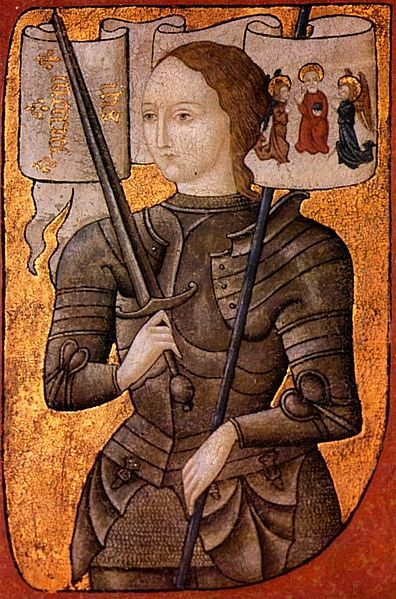
The above picture depicts an artistic interpretation of Joan in 1485, as the only surviving paining of Joan has been lost.  Condemned as a heretic by a pro-English Bishop and later made a Saint by the Roman Catholic Church, much discussion has been made regarding Joan’s sanity. Depending on the individual’s religious inclinations and lens of analysis, conclusions vary. There is no denying Joan’s fervent belief in her visions, which she rigorously defended at her trial. However, it is also important to note that while Joan claimed to have begun having visions at age thirteen, she did not immediately speak of them. Her willingness to express them coincided with her growing passion to drive the English out of France.

In the British Medical Journal, A.S. argued that Joan’s claims of divine manifestations did nothing to undermine her sanity, “She sensed the need for development of a centralized national State, and this made her a figure that neither her contemporaries nor future historians could ignore. This frail girl had a clearer vision than the learned ecclesiastics and the unlettered feudal warriors who were misruling the French provinces. The wonder is that she could impose her will on that motley crew of social pillars, plunderers, and adventurers. She did so by a method characteristic of her day…” (A.S. 1941)

Thus, according to him, Joan’s supernatural visions were an acceptable justification in that time for such a great military undertaking. Supported by Joan’s passion and direction, these divine claims were difficult to dismiss. Perhaps, if the young girl had been less fervent in her military vision, such divine manifestations would have been doubted, but her determination and success made it not so. Ultimately, whether or not these visions actually happened is irrelevant: Joan’s behavior demonstrated a rational, however passionate, mindset which enabled her to lead significant military victories.

Bibliography

A.S. “Joan of Arc.” British Medical Journal (1941): 417. Online.

BARRETT, W. P. THE TRIAL OF JEANNE D’ARC: Translated into English from the original French and Latin Documents. 1932. 24 April 2014

Pernoud, Régine. Joan of Arc: By Herself and Her Witnesses. Lanham: Scarborough House, 1964.

Pettinger, Tejvan. Biography of Joan of Arc. 25 June 2007. Online. 24 April 2014.

Shaw, George Bernard. Saint Joan. Manhattan : Penguin Classics, 1924.

Twain, Mark. “Saint Joan of Arc.” Twain, Mark. Personal Recollections of Joan of Arc. United States: Harper & Brothers, 1896.

 

Leave a comment

Filed under Uncategorized

Spartan Armor: Greaves, Vambraces, Helmet: FINAL

Honors 2110B

14 April 2014

Final Project

The Spartan Attire

http://www.stormthecastle.com/how-to-make-a/spartan-helmet.htm

paper mache spartan helmet exactly how I made mine.


Image

paper mache spartan helmet

Image

This shows a more realistic version of what the helmets looked like. Found on: https://www.strongblade.com/prod/sbh-spartancrested_hist.html

Being one of the most feared military forces, the Spartans definitely left their mark in history. In an article on Wikipedia it is said that Lycurgus, legendary lawgiver of Sparta, said that the Spartans were needed like a “wall of men, instead of bricks.” This quote shows how the Spartans must have been a fierce, strong army. Their strength may have come from the fact that they were put into army involvement at a young age. When the Spartans men were in infancy, he was inspected by the Gerousia, a Spartan council of Elders. It was harsh because if the baby was found to be weak, he was left to die and if the baby was deemed strong, than he was put into the agoge by the age of seven. At the agoge, from Wikipedia’s explanation it sounds like what would be today as a military camp, the children would then learn the rigorous education and training regimen specified for all male Spartan citizens. The training was quite intense, but it was something the Spartans had to put up with, which in the end benefited them when they became fierce fighters. Almost sounds like the movie 300.

As being fierce fighters the Spartans also wore some armor as well. The Spartans had similar hoplite equipment like their other Greek neighbors that they used, but what made them a little bit different were their red cloaks, cuirass, and long hair. In the Archaic period it is said that the Spartan men typically had a bronze, muscled breastplate, a helmet with cheek plates, as well as greaves, and vambraces.

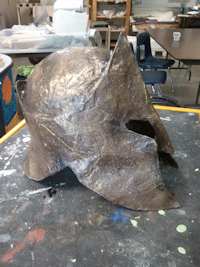
For my final project I constructed some medieval Spartan Armor out of paper mache. I made a Spartan helmet, greaves, and vambraces. Many may question, what part of the body did these cover or protect? First of all, the greaves, or leg guards as we would call them today, were a vital piece of the Spartans armor. The greaves were needed because the shields only covered down to about the thighs. The greaves would protect the shin, knees, and ankles and were almost molded to fit the exact shape of the legs.

Also the Spartans had vambraces, which were like armguards.  The vambraces covered the forearms. These were needed to protect the soldier’s arm for when he reached out to thrust at an enemy, his arms would be protected.

Lastly is the Spartan helmet which was also made of bronze. The helmets followed the Corinthian helmet style. The Spartan helmet provided protection for pretty much the entire face and head. As people take a look at the type of helmets that the Spartans wore, they can tell that these helmets would also restrict their sight and hearing due to the fact that the helmet covered so much. The helmet was long across the sides to help protect the cheeks and also had a long piece down the center to protect the nose. Some of the helmets would have long, red horse hairs called plumes, which were used for intimidation and to make the Spartans appear taller and fiercer. I constructed my helmet of a more basic Corinthian style helmet that would have also been used during that time as well.

Works Cited

Ancient Sparta. (2011, April 13). Retrieved from Trivia: http://www.funtrivia.com/en/subtopics/Spartan-Armament-271128.html

Kalif, W. (2014, April 14). Spartan Vambraces: Armor . Retrieved from Storm the Castle: http://www.stormthecastle.com/

  notes: also more pictures of paper mache hear as well.

Miller, F. (2007). 300. Retrieved from Hollywood vs. History : http://www.historyvshollywood.com/reelfaces/300spartans.php

Sparta: Greatest Military Power of Greece. (2014, April 14). Retrieved from Dress-Spartan Army: http://www.sparta.net/listingview.php?listingID=28

Swords and Weapons of Honor. Retrieved from https://www.strongblade.com/prod/sbh-spartancrested_hist.html

PICTURE

The Spartan Military . (2012, December 14). Retrieved from Ancient Military: http://www.ancientmilitary.com/spartan-military.htm

Wikipedia . (2014, April 10). Retrieved from Spartan Army : http://en.wikipedia.org/wiki/Spartan_army

Wikipedia. (2014, April 14). Retrieved from Lycurgus of Sparta: http://en.wikipedia.org/wiki/Lycurgus_of_Sparta


Leave a comment

Filed under Uncategorized

Armor in the Late Medieval Times

When people hear of the medieval age their first thought usually is about castles, knights, suits of armor, jousting, and other knightly things. Many people often dream of living in such a time. But, little do these people know, many of the things I listed did not stick around for very long. The armor that many people think of when they talk about knights are those full suits of armor, completely decked out with every piece and facet imaginable, sometimes even etched with ornate pictures and engravings. While armor like this did exist, its high point in usage was not nearly as long lived as mail armor. In fact, for almost the whole medieval period, mail armor was used by almost all soldiers during actual battles.

Panel 72 from Bayeux Tapestry

Soldiers fighting in Mail armor. From Panel 72 from the Bayeux Tapestry in Wilson’s book The Bayeux Tapestry. pg. 194

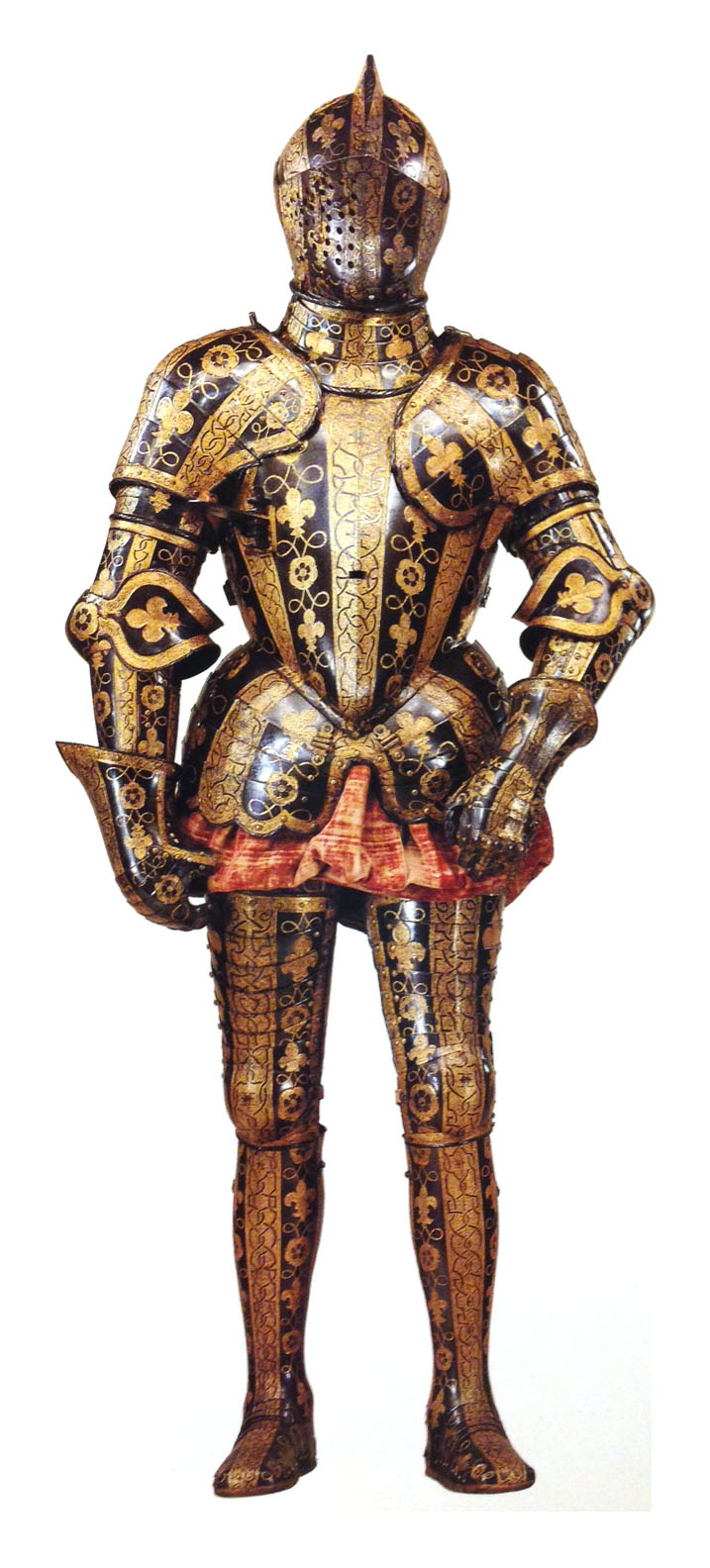
As one can see from the Bayeux Tapestry (c. 1070) mail armor was the main piece of armor used. This was in the heart of the medieval times and the tapestry showed in some great detail what exactly was being used at the time. Chain mail vests, open-faced helmets, large shields, spears, swords, axes, and horses were the predominant technologies of the time.  Full plate armor did not exist until the late medieval age, and quite quickly turned from something to protect the body to more of a piece of art for rich or royal people or for tournament use.

Rather than delve into the background of the evolution of armor (which I think most people know about) I wanted to cover what the actual suit of armor consisted of. Many people have probably not looked close enough into a suit of armor to realize all of the different pieces and hinges that made these things so useful. The type of armor that I will be describing will be steel plate armor from about the late 14th century to the 15th century. First of all, the knight would wear a helmet, which was either open or closed face. An open face helmet did not have a visor or any piece of armor covering the face. This type of helmet was more often found on armor made for royalty, probably to allow viewers to see who was wearing the armor. The closed face helmet had a visor of some sort with only a slit to see out of. This could have made the wearer’s field of vision smaller, but it provided exceptional protection for the face. The next piece of armor was the gorget, which was a piece that covered the neck area between the helmet and the breastplate. The pauldrons covered the shoulders, armpits, and some areas of the chest and back. For knights on horseback, one pauldron was usually cut away on one side to allow the resting of a lance. Next is the breastplate, which was one of the major pieces in the suit of armor. The breastplate covered the chest, torso, and back of the knight, and was made to be one of the strongest pieces of armor. Many breastplates had edges fashioned into them to make it able to withstand strong blows. The armor that covered the arm consisted of the couter and the vambrace. The couter was a piece that covered the elbow while the vambrace covered the areas between the elbow and the gauntlets or between the couter and the pauldron. These pieces advanced from being simple pieces of metal to being articulate joints, allowing a greater ease of motion for wielding weapons. Lastly for the upper body is the gauntlet, which covers the fingers and hands. Gauntlets eventually evolved into very sophisticated pieces of armor by having many hinges or plates to make the fingers have a full range of motion.

On the lower body, you have the fauld, which is made up of many pieces of plate armor that covers the waist. It covers the area that the breastplate cannot cover and protects the upper legs. The cuisse covers the upper thigh down to the knee. Connecting the cuisse to the lower leg guard is a piece called a poleyn. The poleyn is a joint that provides excellent protection while also giving great flexibility and motion. This piece, like the couter and gauntlets, had evolved from being just a piece of metal to being a complex joint. Next are the greaves. The greaves covered the shins and were built to be extremely tough. In comparison to other pieces of armor in the full suit, the greaves needed to be one of the strongest. A good blow to the shin or lower leg could render the entire leg useless, which would often times prove fatal. To compensate for this need for extra protection, the greaves were often fashioned with extra ridges to make them stronger, just like the extra ridges in the breastplate. Last, but not least, are the sabaton, which covers the feet. The sabaton were made out of many pieces of metal to allow for a more natural foot motion.

Chart of plate armor

A chart of the different pieces of plate armor. Taken from DeVries and Smiths’ Medieval Military Technology book. Fig. 2.7, pg. 80 (cited book below)

All of these pieces make up a full suit of steel plate armor. While there are other pieces that I did not mention, these were the most vital components in the suit. But again, right as these great technological advancements were being made to the suit of armor, other deadly weapons were being created. New weaponry made the use of plate armor not as viable to use, which made it fade out rather quickly. People still liked the look of it though, because after the 15th century is when some of the most fantastically beautiful suits of armor were made, but these suits were made for show instead of for battle. To end my blog post, I will show a few examples of these late suits to show how intricate the details were.


Ornate armor

Ornately decorated armor made around 1600. Taken from Pfaffenbichler’s book on Medieval Craftsmen. Fig. 43, pg. 37 (cited book below)

Hercules Armour

The embossed ‘Hercules armour’ of Emporer Maximilian. Taken from Pfaffenbichler’s book on Medieval Craftsmen. Fig. 56, pg. 49. (cited book below)


Work Cited

DeVries, Kelly and Robert Smith. Medieval Military Technology: Second Edition. Toronto: University of Toronto Press, 2012. Print.

Pfaffenbichler, Matthias. Medieval Craftsmen: Armourers. Toronto: University of Toronto Press, 1992. Print.

Wilson, David M. The Bayeux Tapestry: The Complete Tapestry in Color With Introduction, Description and Commentary. New York: Thames & Hudson, 2004. Print.

Leave a comment

Filed under Uncategorized

Ballistas


A powerful weapon in the art of siege warfare is the ballista. “a ballista is generally taken to be a large catapult, like a crossbow, that shoots huge bolts, with force created by a winch” (Rogers, p. 267) but it is more than just that. The earliest form of the ballista was developed by the Greeks in its earliest design as a non-torsion powered weapon and became a more powerful torsion powered machine as time progressed. It went through many improvemments and adjustments to become the formidable siege weapon that they are know for. They were effectively in use by both attackers and defenders up through the middle ages until the invention of the trebuchet and the later development of the cannon, at which point the use of ballistas declined. They varied in purpose, size, design, portablility, and projectiles they fired, as well as name. That being said, the ballista made a difference in siege warfare whatever its size, shape, or if it was throwing arrows or stones.


The earliest ballistas were developed by the Greeks and were non-torsion powered. The earliest form of this kind of ballista was the gastraphetes or “belly bow” in Greek. “It was little more than a large, powerful, and flexible bow (DeVries, p. 117).” It had the look of a primitive crossbow but it did not have a footloop near the bow part of the crossbow that a person stepped in to draw the string back to fire. The gastraphetes had a concave that a person leaned on and, after placing the front of it on the ground, was able to draw the string back and “dishcarge the missile with much greater power than the traditional hand-drawn bowstring (Devries, p. 118).” It had greater range and more importantly greater power and force to help penetrate armor of enemy soldiers. A major limit to the gastraphetes was the limited power it could shoot with. It mostly shot bolts because they were lighter than stone, but bolts were only good for so much. they were great for piercing armor. They were not good to break down buildings. These non-torsion powered machines lasted for roughly 150 years, until they resurfaced during the Middle Ages and the development of the crossbow (Nossov, p. 136).


Adaptations like winches and bases brought greater power, size, stability to the gastraphetes (Devries, p. 118) but it was still limited on it’s power and size because it was non-torsion powered. The only way to increase the power and size was to change how the machine was designed. The bow springs gave way to two arms in tightly twisted springs known as torsion springs, which increased the power of the ballista a great deal. It was the change to torsion springs that gave the bolt shooting machine the label catapult, or shield breaker (Nossov, p. 136) because of how much additional power was aquired from the torsion springs. The rest of the of design stayed very similar. The other major change in design was a deeper groove that made it possible to shoot stone balls as well as the traditional bolts. This allowed for these early ballistas to be used for more impact oriented purposes like breaking walls or different fortification structures.


The power of these torsion-powered siege machines was incredible. Procopius gave an account of the incredible force with which the bolts were projected from these ballistas when he wrote about the defense of Rome in 537-38 BCE:

“At the Salerian gate a Goth of goodly stature and a capable warrior, wearing a corselet and having a helmet on his head, a man who was of no mean station in the Gothic nation… was hit by a missile from an engine which was on a tower at his left. And passing through the corselet and he body of the man sank more than half its length into a tree, and pinning him to the sport where it entered the tree, it suspended him there a corpse.” (Devries, p.121, quoting Barton C. Hacker)

These engines of war were used both by attackers and defenders. For those that were attacking, they would often put the ballistas in their siege towers and use them to provide cover as they drew close to the castle or city walls (Sacks, p. 364). Those on the defensive side of the siege would mount their ballistas on platforms on their towers and shoot down on their enemies (Lawrence, p. 106). This defensive strategy may have been the circumstance in which the person Procopius wrote about died.


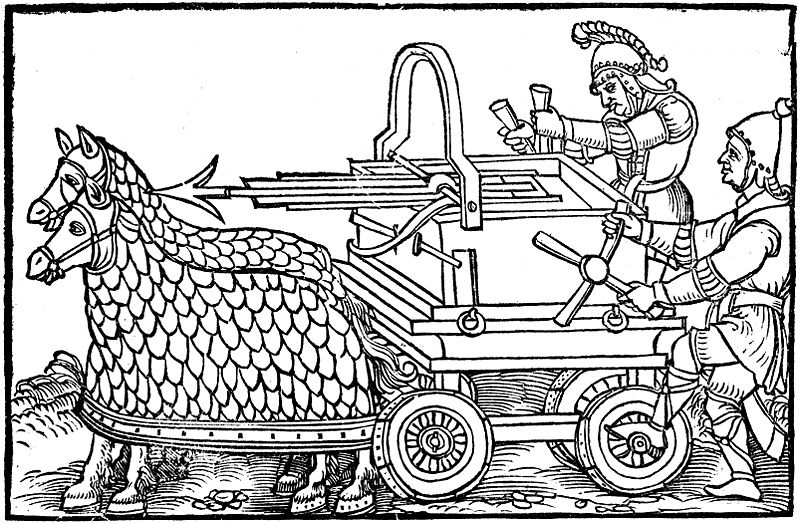
As time progressed, these torsion powered machines grew larger and their projectiles grew proportionally as well. The Romans made changes in the materials used to build the variety of different arrow-firing and stone-throwing ballistas, using metal parts where they could to increase the strength and life of these war machines. Changes were made to increase their portability (DeVries, p. 120). As the technology improved, so did the ballistas. As the ballistas improved, they became more common in armies and fear of these machines grew as well. Below is an example of a horse-drawn ballista. This is but one example of the different kinds of ballistas that developed since the Greek gastraphetes.


 Exemplum balistæ quadrirotis

Print shows two soldiers with a horse-drawn ballista. The device, mounted on a wagon, is manipulated like a crossbow, shooting large arrows at enemy fortifications. The horses are well covered with armor. Taken from the collection Notitia utraque cum orientis tum occidentis ultra Arcadii Honoriique Caesarum tempora (1552) edited by Sigismund Gelenius (1477–1554). This part is from the De Rebus Bellicis, which contains many illustrations of weapons and engines of war.
print: engraving Source: Wikimedia Commons

There is no doubt that the ballista made a significant impact on warfare. From it’s earliest use by the Greeks, to it’s final display during the Middle Ages as the age of gunpowder set in, the ballista in all it’s varieties was an asset for siege warfare, for the defender and the attacker alike.


Works Cited


“Ballista.” Wikipedia. Wikimedia Foundation, 21 Apr. 2014. Web. 25 Apr. 2014.

DeVries, Kelly, and Robert D. Smith. “Non-gunpowder Artillery.” Medieval Military Technology. 2nd ed. Toronto: U of Toronto, 2012. 117-22. Print.

Lawrence, A. W. “Archimedes and the Design of Euryalus Fort.” The Journal of Hellenic Studies 66 (1946): 99-107. JSTOR. Web. 24 Apr. 2014.

Murray, Oswyn, and Margaret Bunson. “Warfare, Siege.” Encyclopedia of the Ancient Greek World. By David Sacks. Revised ed. New York: Facts on File, 2005. 364-65. Print.

Nicholson, Helen J. Medieval Warfare: Theory and Practice of War in Europe, 300-1500. Houndmills, Basingstoke, Hampshire: Palgrave Macmillan, 2004. 94. Print.

Nossov, Konstantin. “Ancient and Medieval Throwing Machines.” Ancient and Medieval Siege Weapons: A Fully Illustrated Guide to Seige Weapons and Tactics. Guilford: Lyons, 2006. 133-162+. Print.

Rogers, Clifford J., William Caferro, and Shelley Reid. The Oxford Encyclopedia of Medieval Warfare and Military Technology. New York: Oxford UP

3 Comments

Filed under Uncategorized

Long Bow Final Project


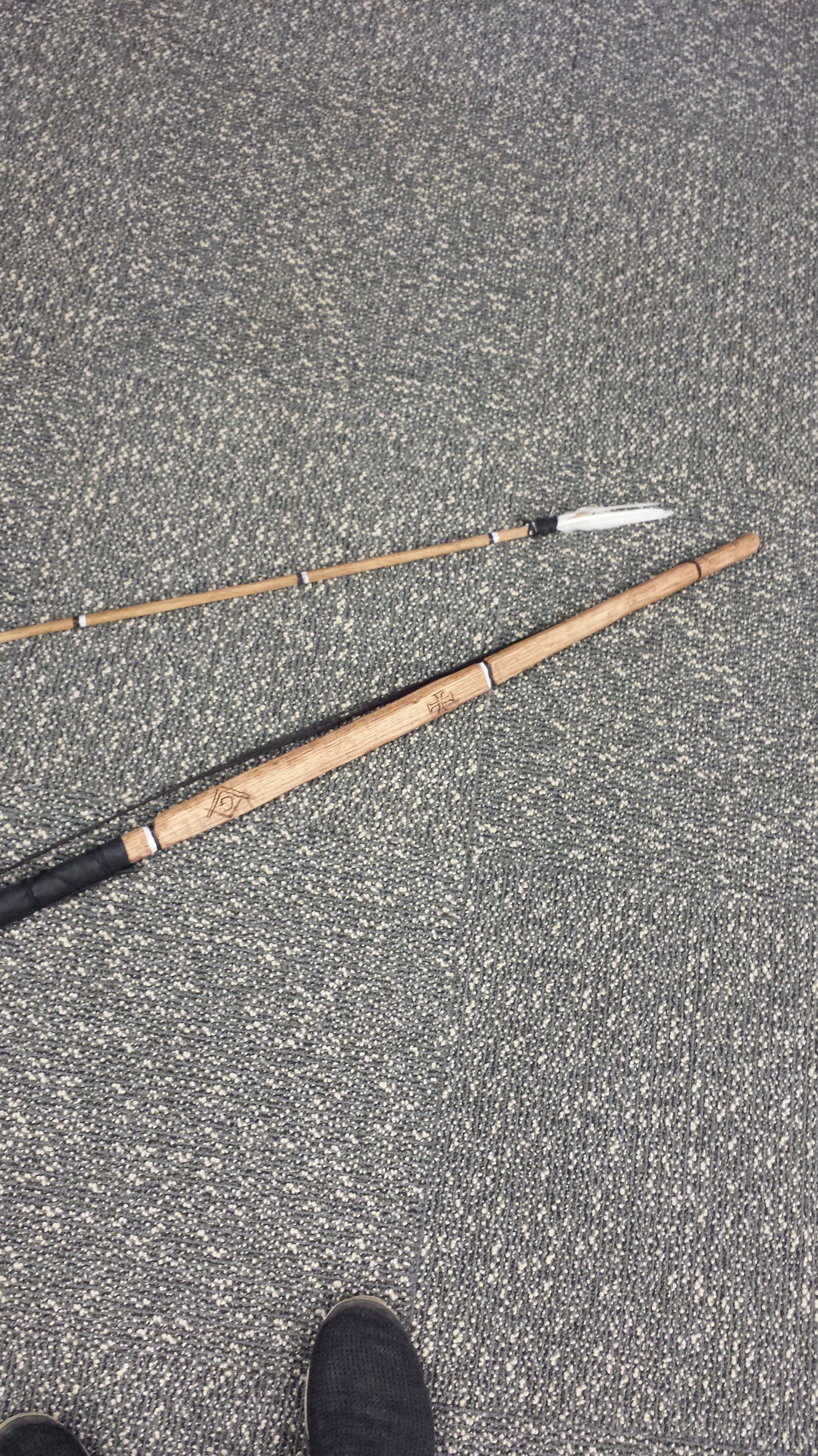
For my final project, I chose to make an English medieval long bow.   I have always been interested in bow and arrows so I was excited for the opportunity to try to make one.  I first started out by researching how the English made their bow and arrows in medieval times.  The wood used for the most part was Yew, but Yew is very expensive and I did not want to spend hundreds of dollars on a piece of wood.  So instead I went to Home Depot and bought a plank of Oak wood for about 9 dollars.  I decided to not use any power tools because they would not have had power tools back when the English were making these long bows.  So the first thing I did with my plank of wood was measure out the dimensions of each part of the bow.  I decided to have a five inch handle, with a 2 inch fade on each side and then twenty eight inches on each side of the bow.  This was a pretty good representation of how long the bows that the English used were.  I cut the wood down to the length I wanted with a hand saw and after that, I began whittling down the wood so that it was thin enough to bend.  The whittling process took a really long time. Oak is a very hard wood and whittling it takes a lot longer than wood like Redwood.  Finally after hours of whittling, I whittled the wood down to the shape and width I wanted. The next step was to sand the wood down.  So I got sand paper and sanded the entire bow to a nice smooth finish. I then took my knife and cut notches in the bottom and top so I could tie the string around each end. I got the bow string from an outdoor sporting store. In medieval times, they would have used dry reed.  I didn’t have reed so I just bought a bow string.  After the bow was basically finished, I decided to stain it with wood stain.  Obviously they wouldn’t have stained the bows that they made back in medieval times, but I thought that the bow would look better stained. I am really happy with the way it turned out. I think that this bow is a good representation of how big English long bows were.  I am interested to see if the bow is able to shoot the arrow I made for it, but because it is Oak I don’t think it is bendy enough to shoot.  I had a really good time making this bow, and I think that the bow turned out really nice.


My finished Bow and Arrow.

My finished Bow and Arrow.

Work Cited

Alensq. “Making a medieval style English longbow.” . N.p., n.d. Web. 25 Apr. 2014. <http://www.instructables.com/id/Making-a-medieval-style-English-longbow/&gt;.

“How to Make a Composite Longbow.” wikiHow. N.p., n.d. Web. 25 Apr. 2014. <http://www.wikihow.com/Make-a-Composite-Longbow&gt;.

“How to make a high performance longbow for under $10. #1.” YouTube. YouTube, 8 July 2011. Web. 25 Apr. 2014. <https://www.youtube.com/watch?v=bjiPXuuKFa4&gt;.

Turgeon , Tom. “.” How to make a Longbow. N.p., n.d. Web. 25 Apr. 2014. <http://www.wwgoa.com/build-your-own-long-bow/&gt;.


Leave a comment

Filed under Uncategorized

Final project: Roman marching camps

For my final project, I used Sketchup to create a virtual Roman marching camp. These camps were remarkably well organized, and could be erected with truly astounding efficiency.

The camp is divided into a couple of main areas. This large, central is the Praetorium, the general’s tent. Around the Praetorium are a number of roads. Leading into the Praetorium from the main gate is the Via Praetoria, which turns into the Via Quaestorium on the other side and runs to the other main gate. There are two more roads, perpendicular to the other two, known as the Via Principalis and the Via Quintana. The Via Principalis connects to the Via Praetoria, and likewise the Via Quintana connects to the Via Quaestorium. These two roads allowed easy access to the other four gates, which were the only other means of entry into the camp.

Surrounding the camp was a ditch and a rampart. The exact size of the ditch varied quite a bit. It could be anywhere from 5 feet wide by 3 feet deep to 17 feet wide by 9 feet deep. While the ditch is mostly triangular in shape, there was a small square slot at the bottom of it. The exact reason for this slot is debated. It could’ve been a waste drainage slot or an ankle breaker defensive measure, but most likely it was used as a base for fencing of some kind. The rampart wasn’t really anything major, it was just made from the soil excavated to make the ditch. To allow access into the camp, two different types of gates were used. When the camp wasn’t in an area particularly threatening, the gates would be simple breaks in ditch and rampart. However, when the threat of an attack was larger, the ditch and rampart would be constructed in a way that was semi-circular. The idea behind this was that any attackers trying to invade through them would expose their right side, the side that held the weapon, not the shield, to archers on the inside. This space between the rampart and the interior of the camp was known as the Intervallum, and is probably where the camp followers stayed.

There is significantly more information available about these camps, but to chronicle it all here would take an unreasonable amount of space. For more information, I would recommend looking at some of the attached sources. Trajan’s Column has a depiction of a camp located on it, which provides for some interesting viewing.  Brueggeman provides a formula that allows the approximate size of a camp to be calculated and helps to show just how large they were. Kaye did quite a lot of research into the logistics of camps, particularly how they provided enough water for all the troops. Matyszak is a good book for a general introduction into Roman life. Finally, Roman Scotland has a more detailed explanation of the layout of the camps.

Attached you will find the file that I created for this project. Feel free to download it and explore. Please, enjoy!

Bibliography

Barrette, P., Beckmann, M., George, M., Rich, S., Rockwell, G., Umholtz, G., & Rockwell, P. (1999). Trajan’s Column. Retrieved from The McMasters Column of Trajan Project: http://www.stoa.org/trajan/index.html

Brueggeman, G. (2003). Camp Size. Retrieved from The Roman Army: http://garyb.0catch.com/camp3_dimensions/camp_dimensions.html

Kaye, S. (2013). Roman Marching Camps. Retrieved from Banda Arc Geophysics: http://www.bandaarcgeophysics.co.uk/arch/roman_marching_camps_uk.html

Matyszak, P. (2009). Legionary: The Roman Soldier’s Unofficial Manual. London: Thames & Hudson.

Roman Marching Camps. (2008, March). Retrieved from Roman Scotland: http://www.romanscotland.org.uk/pages/infrastructure/marchcamps.asp


Leave a comment

Filed under Uncategorized

Final Blog post- Historically accurate (at least as close as possible) Cleopatra VII costume

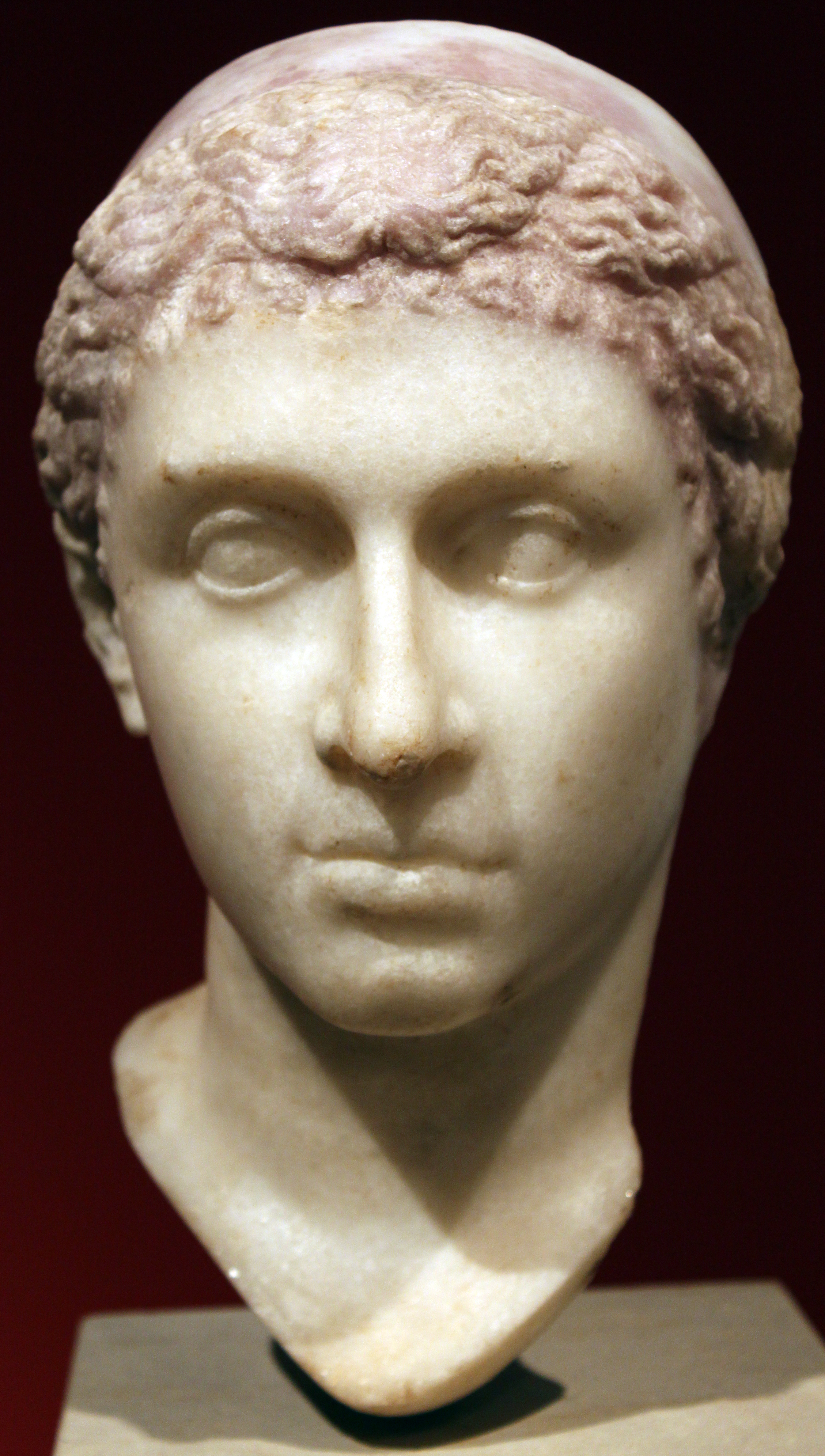
-0035_Altes_Museum_Portrait_Kleopatra_VII_anagoria

Photo Credit to Anagoria on commons.wikimedia.org. Bust of Cleopatra VII at the Altes Museum in Berlin, Germany.

Cleopatra VII Philopator was the last active pharaoh of Egypt before the kingdom fell to and was absorbed by the Roman Empire. Cleopatra co-ruled Egypt for many years with her father then his different brothers. Eventually she became sole ruler of Egypt.

Over the years, Hollywood and popular culture have sensationalized Cleopatra VII’s actions as Egypt’s pharaoh, particularly her relationships with Julius Caesar and Mark Antony. Movies, paintings and plays have kept Cleopatra in the public’s eye even though she died nearly two thousand years ago.

For my final project, I chose to create a costume that would be as close to something that Cleopatra would have worn as possible. Of course, being an amateur costume maker at best, my attempt was modest but I believe it hit the mark in many ways, more often than not reflecting what would’ve been a casual, day-to-day outfit rather than a flamboyant and more dramatic ensemble.

To begin with, I began searching for pictures of Cleopatra VII. Since her tomb has yet to be found, there are relatively few images of what she truly looked like, but there are busts done in the Roman style and coinage that bear her visage. From theses, I gathered that Cleopatra had naturally curly hair which she kept bound back with a headband and pulled into a bun.

To translate this into the costume, I curled my hair naturally stick-straight hair in the smallest sponge curlers available to me. This gave me the naturally curly hair look that Cleopatra would’ve enjoyed when she wasn’t wearing a wig or other headdress.

Dendera_Tempel_14

Photo Credit to Olaf Tausch on commons.wikimedia.org. Etching of Cleopatra VII and her son Caesarion on the temple at Dendera.

Ancient Egypt was known for their elaborate eye makeup. I copied this from papyrus drawings, wearing blue eye shadow and using eyeliner as kohl. I chose to sport an eye of Ra in addition to the thick black eyeliner and blue eye shadow for dramatic effect.

The etching of Cleopatra VII and her son Caesarion on the temple at Dendera show Cleopatra sporting a collar-style necklace and a headdress similar to the one worn by the goddess Isis. The etching has no color, so I used papyrus paintings and jewelry found in ancient Egyptian tombs to determine that semiprecious stones like feldspar, carnelian, jasper, turquoise, jade and lapis lazuli were most likely used in jewelry that Cleopatra would have worn.

Since I’m no master jewelry maker, I created a collar out of crepe-back satin using felt as an interfacing to give the collar some body and attached plastic jewels to it using fabric adhesive. I used red, shades of blue, and yellow colored stones. Respectively, these stones for Cleopatra would have been jasper or carnelian, lapis lazuli and turquoise, and feldspar or topaz.

Photo by Abby Payne. Detail of Eye of Ra eye makeup.

Photo by Abby Payne. Detail of Eye of Ra eye makeup.

Moving caudally, the shift that Cleopatra would have worn would most likely have been made of a fine linen. In ancient Egyptian papyri, statues, and wall etchings, one can see that both men and women wore simple white clothes that required little to no sewing, just a wrapping of fabric around the body held in place by pins, belts, robes or collars.

For my costume, I chose to create the dress of white linen, wrapped around my body several times to ensure modesty. I pinned the fabric to an undershirt at my shoulders to aid in keeping the dress in place. While many ancient Egyptians weren’t terribly worried about keeping their bits and pieces covered, I am.

For my linen shift, I chose to take inspiration from ancient Rome as well, considering that Egypt would have been well acquainted with Roman fashion during Cleopatra’s time as Pharaoh of Egypt. Instead of simply pinning the shift shut, I threw the end the length of fabric over my shoulder and pinned it to my undershirt. This gave an interesting Roman flair to an otherwise distinctly Egyptian costume.

Photo by Kraig Peterson. Finished historically accurate Cleopatra VII costume.

Photo by Kraig Peterson. Finished historically accurate Cleopatra VII costume.

At my waist, I wore a belt made of crepe-back satin and felt. The belt wrapped around my natural waist with a section hanging down in front. The belt is decorated with yellow, blue, and green jewels, respectively those jewels would be feldspar, lapis lazuli, and jade. In reality, Cleopatra’s belt would have been made of gold and contained real jewels.

In ancient Egypt, there wasn’t a real need to wear shoes in order to stay warm, so unless the ground was dangerous, normal people wouldn’t have worn shoes. However, Cleopatra would’ve worn sandals made of leather and reeds decorated with jewels. For this costume, I wore a pair of sandals that have an ankle strap attached to the soul of the shoe with one band going from the ankle strap between my toes.

The finished product was almost exactly as I had in mind. The shape of the collar was a little off, and my hair didn’t exactly what to cooperate, but it all worked out pretty well. In the future, if I do this particular costume again, I think I will invest in some eyeliner in a pot instead of using the felt-tip wand eyeliner I use everyday. Also, I think the collar was a bit tight and I would’ve preferred the shape to be a bit more round and little less rectangular. But, c’est la vie, non? At any rate, I’m pleased with the way that this costume turned out.


Works Cited:

Anagoria, Portrait of Cleopatra VII; Marble; Inv. 1976.10, http://commons.wikimedia.org/wiki/File:-0035_Altes_Museum_Portrait_Kleopatra_VII_anagoria.JPG, 24 April 2014.

“Cleopatra”. Wikipedia. 24 April 2014. http://en.wikipedia.org/wiki/Cleopatra

“Clothing in ancient Egypt”. Wikipedia. 24 April 2014. http://en.wikipedia.org/wiki/Clothing_in_ancient_Egypt

“Egyptian Jewlery”. Nilestone.com. 24 April 2014. http://www.nilestone.com/jewelry-history.htm

Tausch, Olaf. Relief of the Ptolemaic Pharaoh Cleopatra VII and her son Caesarion on the southwest side of the Temple of Dendera, Egypt. http://commons.wikimedia.org/wiki/File:Dendera_Tempel_14.JPG

“The Latest Fashions in Ancient Egypt”. TourEgypt.net. 24 April 2014. http://www.touregypt.net/egypt-info/magazine-mag01012001-magf4.htm

Leave a comment

Filed under Uncategorized

The Roman Scutum: An “Approximation”

In the beginning I set out to build my best approximation of a Roman scutum. It was going to be exciting to learn something about the evolution of Roman tactical equipment while also getting to use power tools. I soon found that making an exact look-alike would be difficult.

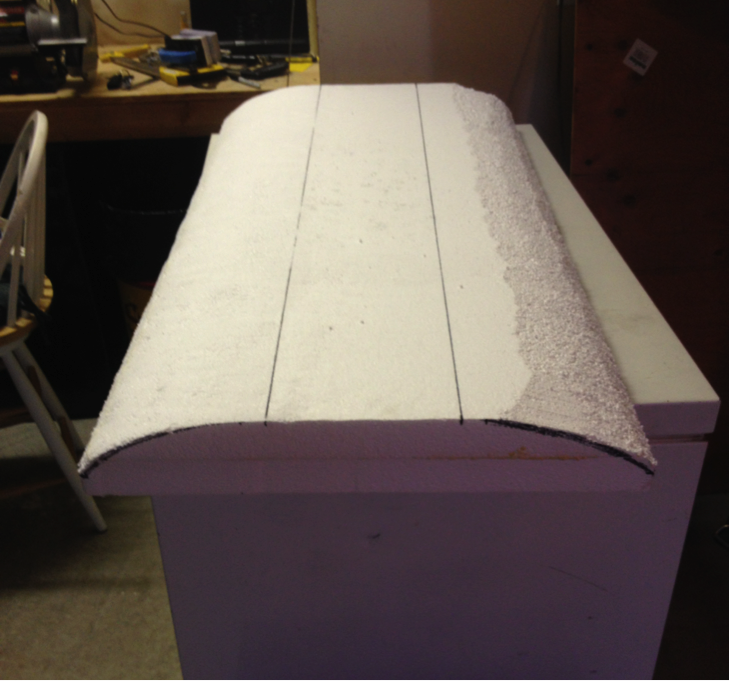
An original shield would have been made of plywood and would have been bent by hand.  Due to time and resource constraints, I decided to craft my shield from polystyrene foam.  This is the kind of hard foam that is used for insulation.  Once I had purchased a block that was four feet long, two feet wide, and 2 inches thick, I proceeded to carve it.  At the start, I tried using an orbital sander.  The filter of this tool quickly clogged with foam particles.  Because of this, I was forced to carve the convex part of the shield the old-fashioned way, by using elbow grease.

1st

(Here you can see the foam during the sculpting process.)

It felt like Christmas while I sculpted the front of the shield with a sanding block.  Small pieces of foam clung to me and everything else they came in contact with.  I modeled the convexity of the front by looking at pictures of replicas and a recovered shield on the Internet.  Due to the thickness of the foam, the scutum I made only had about 1/8 the convexity of the real shield that Roman heavy infantrymen carried.  After about four hours of sanding, I had the shape that I desired.  It was then time for the back.

2nd

(The foam was everywhere. Including in my ears.)

My longing to use power tools was finally satiated when I sculpted the handle in the back of the shield.  The handle was traditionally made of wood and located in the center of the shield. Because my scutum was so thick, I only carved the handle half of the way through the foam.  To accomplish this, I used a dremel tool.  This made the job much more quick than when I sculpted the front with sanding block.  Next, I moved to the central boss.

My boss would not be as deadly as the metal one on the real scutum. This was because it was made of hollow foam, from the floral department of the local craft store.  The installation of the eight-inch half sphere was incredibly easy.  Once it was installed it only took a few coats of paint to make the shield look like a brand new scutum, ready for action.  Some recovered scuta had ornate paint jobs, but due to my lack of artistic ability, I went with garnet for the body and bronze for the boss and  “metal” strips around the edge of the shield.

3rd

(The finished product.)

Through the process of making my shield I had the opportunity to learn about the evolution of Roman military tactics. The fabrication also gave me a chance to get back to my inner craftsman. Although I enjoyed the process, material and time constraints seriously limited the authenticity of my scutum. It seems that in the end, “approximation” was the correct word.

Leave a comment

Filed under Uncategorized

The Roman Scutum: A Revolutionary Design

Movement in to maniples, during the 3rd century BC, called for a more independent Roman swordsman.  He needed to be able to take sole responsibility of protecting himself in open combat, against more free-fighting adversaries.  With the soldier’s evolution came the adaptation of his shield.  The composition and components needed to acclimate to the changing tide of warfare.  His shield would need to give him a new dimension of lethality while also doing its job in protecting the soldier.  This need gave rise to the scutum, a simple yet effective design that the Roman Army used during the end of the republic, all the way through 300 AD.

Making the scutum strong enough to take repeated sword blows, yet light enough to be carried over long journeys was a challenge.  Either oak or birch constituted the body of the shield.  Birch was considered because of its flexibility, while oak was utilized because of its tight grain, which made cutting through it harder (Matyszak 60-61).  Three thin layers of wood were glued together at right angles.  The plywood made from this process and a strip of iron or bronze around the outside gave the shield the strength it needed to protect its holder from the blows of heavy swords (Matyszak 61; Sage 71). It also kept the scutum light for long marches, at about 15 pounds (Kelly, et al.).

The scutum was rectangular in shape and very convex.  It was built to dimensions that would better cover a soldier’s body as he was fighting.  Ideally, the scutum would cover an infantryman from shoulder to knee and be wide enough so that he would not be seen when crouching behind it.  This means that the shield was about 48 inches tall and close to 28 inches wide (Sage 71).  So convex was this shield, that there was a 26-inch gap behind its face (Guttman). The curvature lent protection from the sides while charging and from a stationary position. With the plywood composition, this design made the scutum an amazing defensive tool.

Turtle

(Cristian. This is a picture of a Roman turtle formation from Trajan’s Column. Here you can see the rectangular shape of the Roman soldiers’ shields.)

The large round hoplite shields of the phalanx had seriously limited the Roman soldier while on the offensive.  The round shield had an awkward handle that made it useless for anything other than protection. Two sleek adaptations allowed a legionary to insert his shield into his offensive arsenal.  One is that the handle was both horizontal, and built into the shield.

When adding wooden reinforcing strips to the back, the shield maker would cut two small semi-circles in the center of the shield body. Doing this created a bar in the middle that allowed the shield to be held overhand like a suitcase handle (Matyszak 61).  This grip style gave the wielder some versatility in what he did with the shield.  It allowed him to bring the shield up sharply in defense against a sword.  Offensively, it allowed the soldier to punch out with the shield as if it was a big fist (Matyszak 61).  Legionaries often did this to knock their opponents to the ground and jab them with their sword (Kelly, et al.).  Something that allowed a soldier to pack a little more punch into his wallop was the central boss of the shield.

Scutum

(Kelly, et al. This is a shield that this researcher believes to have been found at Dura Europas. The piece of wood in the middle of the hole is the handle.  The space would have been covered by a metal boss to protect the soldiers’ hands)

The boss was made of bronze or iron to match the metal-bound edge (Kelly, et al.). It was attached to the center of the shield over the horizontal grip to protect the hand from sword blows.  Often the bosses were round or came to a point.  This added to the offensive lethality of the shield (Guttman).  During a punching motion, a sharp pointed boss could puncture through the armor of an enemy and kill him or leave a large open wound that would almost certainly become infected.  Together, the handle and the central boss allowed a legionary to add some offense to his defense.

As the battlefield opened up, the Roman shield had to adapt to allow its user to survive.  Maniples forced the soldier to fight more as an individual.  Because of this, the scutum changed its shape and its composition.  The rectangular shape and taller dimensions kept a legionary safe during the course of the battle.  The special handle and the metal boss at the center helped the soldier use his scutum on the offensive. The combination of these defensive and offensive adaptations allowed the shield and the legionary to survive and thrive for many, many years.


Works Cited

Cristian, Chirita. “Roman turtle formation on Trajan column.” Photograph. Wikimedia Commons. Wikipedia:  23 Feb. 2013. Web. 1 April 2014.

Guttman, Jon. “Roman Gladius and Scutum:  Carving out an Empire.” Historynet.com.  Weider History Group:  13 Aug 2010. Web. 9 April 2014.

Kelly, Patrick, et al. “The Shield:  An Abridged History of its Use and Development.” myArmoury.com. Ed. Patrick Kelly. myArmoury.com, 2012. Web. 23 March 2014.

Matyszak, Philip. Legionary:  The Roman Soldier’s Unofficial Manual. London:  Thames and Hudson, 2009. Print.

Sage, Michael M. The Republican Roman Army: A Sourcebook. New York:  Routledge, 2008. Print.

Leave a comment

Filed under Uncategorized

The Roman Scutum: An Evolution

According to the theory of evolution, an organism must adapt or die.  Much like evolution, types of warfare and equipment must change.  These changes must be made to ensure survival of the organism, which in this analogy, is an army.  The army of the early Roman Republic understood this law and changed, or adapted, their techniques to survive in an ever-changing world. Their transition from a phalanx unit into maniples was necessary for the army to survive against more loose-fighting adversaries.  Like one gene that changes a whole organism, the Roman tactical adaptation set in motion many changes.  One of these was the change in the soldiers’ shields.

From the 10th through 7th century BC the shield of the armies of Rome closely resembled that of the Etruscans, with whom they were almost continually fighting. The shield was a large, round, convex, and made of wood.  This made it very heavy. It also had a very unique grip (Sage 15). The strength of this shield was the way in which it was used.  Its unique grip rendered it very awkward for single combat but made it near impossible to breach in a tight formation (Sage 14).  It was made this way because the Etruscans, neighbors to Rome, fought in a phalanx.  Romans evolved their earlier shields into something similar in order to defeat the Etruscans at their own game.

600px-Hoplites_tondo_MAR_Palermo_NI2104

(Nguyen. This is a depiction of the large hoplite shield.  It is easy to see how it could cover the man next to the holder)

A phalanx was a tight, rectangular formation of men.  Men in the phalanx were trained to move as one.  This allowed them to push back enemy troops and always protect their comrades’ sides.  The large round shield of these warriors allowed a soldier on the right to cover the right side of another soldier on the left (Sage 15).  Every combatant did this, and together they formed a line of protection around each other.  On even ground, the soldiers were always able to cover their fellows while advancing against and battling foes.  However, fighting on uneven ground proved not as effective.

When on uneven ground the soldiers of the phalanx were often forced to fight on different levels from one another.  This meant that they were unable to cover each other as effectively.  In the 5th century BC, Rome used round shields because their fighting against the Etruscans, on even ground, allowed them to utilize the phalanx.  As their adversary changed, around the 3rd Century BC, the Romans were forced to fight on more hilly and mountainous terrain (Sage 63).  Their adversary, the Samnite mountain tribes, understood how to fight on uneven ground.  Their fighting was more loose and single combat centered (Rosenstein 151).  Seeing this, the Roman Republican Army chose to once again adapt to survive.

From this decision came the advent, or evolution, of maniples.  On mountainous terrain, a large phalanx was unable to maneuver.  Manipular division of men solved this problem.  A maniple was a smaller, more maneuverable group of soldiers.  The fighters were also more spread out. Each troop occupied six feet of space, which was about double what he had occupied in the phalanx (Rosenstein 143).   This new space demanded a evolution of equipment; it called for a revolutionary rectangular shield (Rosenstein 144; Sage 64).

In the maniples, soldiers were asked to fight more as individuals rather then a solid unit (Sage 71). Their new shield needed to be lighter than the round shield of old and needed to provide more protection for their whole body.  This means that it would be held easily in one hand (“Scutum…”).  The new shield needed to be made out of slightly different materials and different dimensions then those of old. The Roman army had to adapt their equipment once again in order to defeat their enemy.

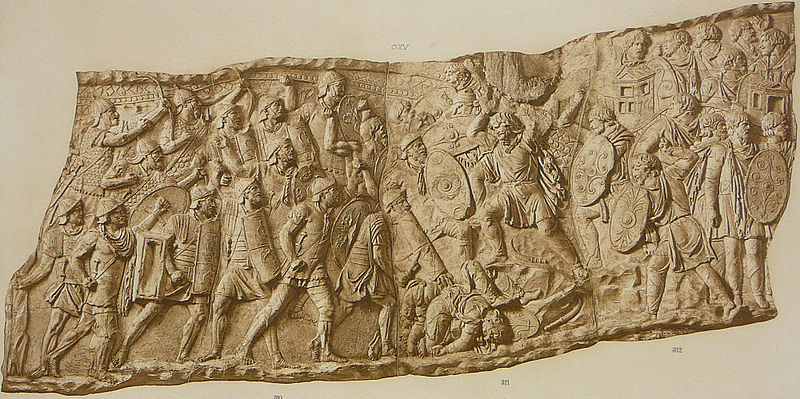
800px-086_Conrad_Cichorius,_Die_Reliefs_der_Traianssäule,_Tafel_LXXXVI

(Cichorius. This is a relief of Trajan’s column.  One can see the Romans, with their rectangular shields, fighting spread apart from each other)

The evolution in Roman battle technique and equipment was essential to the state’s survival.  Shields utilized by the Roman army were adapted to be the best fit to defeat their adversary.  Phalanx warfare called for a larger shield to protect more than just one soldier.  Movement into maniples necessitated the need for a new breed of shields.  This version needed to be more mobile and agile.  When utilized right, its design became the standard for the Roman Republican Army and would be utilized for many centuries to come.


Works Cited

Cichorius, Conrad. “The Reliefs of Trajan’s Column.” Photograph. Wikimedia Commons. Wikipedia: 3 Nov. 2008. Web. 5     April 2014.

Nguyen, Marie-Lan. “Hoplite wearing his shield with a dog decoration. Attic red-figure eye-cup, 500–490 BC. From    Chiusi.” Photograph. Wikimedia Commons. Wikipedia:  20 Sept. 2008. Web. 5 April 2014.

Rosenstein, Nathan. “Armies of the Roman Republic.” The Ancient World at War:  A Global History. Ed. Philip de Souza.   London:  Thames and Hudson, 2008. 139-155. Print.

Sage, Michael M. The Republican Roman Army: A Sourcebook. New York:  Routledge, 2008. Print.

“Scutum (shield).” Wikipedia. Wikipedia:  17 Dec. 2013. Web. 5 April 2014.

Leave a comment

Filed under Uncategorized