

Plate 21 from Wilson
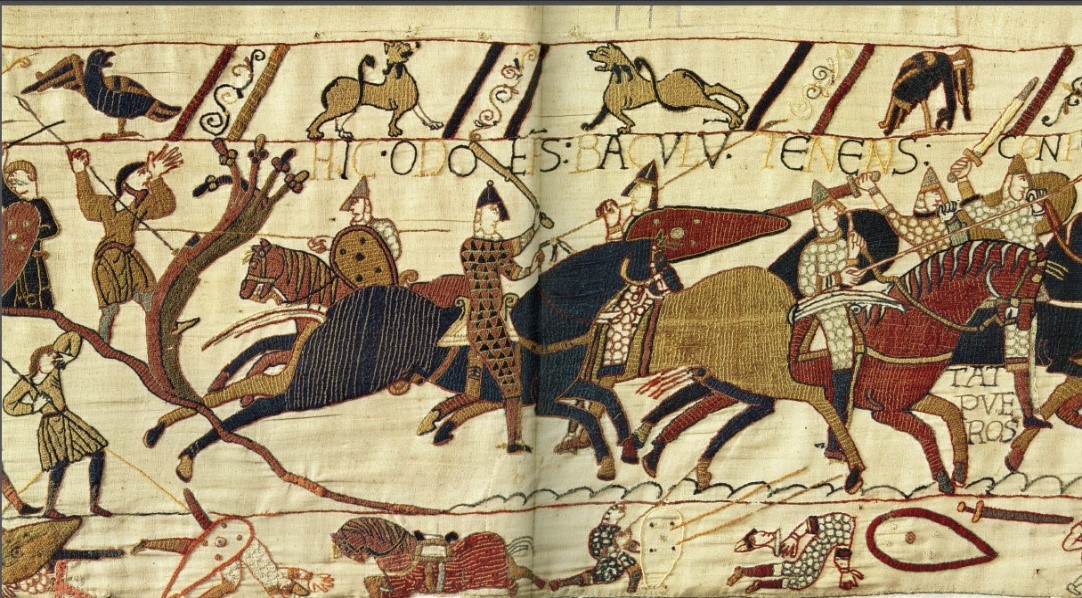
In this section of the Bayeux tapestry, the Norman forces, William the Conqueror, Harold Godwinson and Rivallon of Dol-Combourgh attack the Dol de Bretagne. Duke Conan II of Brittany escaped the Normans using a rope and climbing out a window. The main focus of this section of the tapestry depicts Duke Conan escaping through a window and the Normans pursuing Duke Conan past the capital of Brittany, Rennes.
The Bayeux tapestry is one of the first appearances of a coat of arms. On several of the shields of the soldiers is featured a cross. The Bayeux tapestry was created in the 11th century. Coats of arms didn’t come into vogue until the 12th century. Characters typical of coats of arms appear in both the top and the bottom boarders of this section of the Bayeux tapestry. A coat of arms has much symbolism, everything from the colors used to the animals represented. The presence of elements of different coats of arms can symbolize the dominance or inferiority of one side or the other.
In the border of this section of the Bayeux tapestry is the depiction of a the characters in the coat of arms of each side of the battle. On the top is the depiction of the the lion from the duchy of Norman’s coat of arms and the fleur-de-lis (lily flower in French) from the duchy of Brittany’s coat of arms. On the bottom border is the duchy of Brittany’s fleur-de-lis and the griffin from the coat of arms of the kingdom of England.
Color is an important element in art, especially a piece of art like the Bayeux tapestry that depicts historically important events. The fleur-de-lis, griffins and lions all appear in black, red and yellow. Through the ages, colors have often taken on different meanings, however certain themes about color have remained constant. Black often represents power, red stands for strength and yellow for energy.
That there is far color in the fleur-de-lis would insinuate that the artist that created the Bayeux tapestry thought that while Conan had power, strength and energy, he did not have as much as William the Conquer, Harold and Rivallion.
It should be noted that the figures represented in the borders of the Bayeux tapestry are not equal in size. The fleur-de-lis are much smaller than the griffins and the lions. This difference in size would insinuate that the artist saw an incongruence of power between Brittany and the Normans and England.
Works Cited:
Wilson, David M. The Bayeux Tapestry. New York: Thames & Hudson Inc., 2004. Print.
“Brothers in Arms- scene 2”. Britain’s Bayeux Tapestry at the Museum of Reading. 31 March 2014. Web. http://www.bayeuxtapestry.org.uk/bayeux9.htm
“Breton-Norman War” Wikipedia. 31 March 2014. Web. http://en.wikipedia.org/wiki/Breton-Norman_War
“Heraldry Symbols and their Meanings”. familytreeandcrest.com. 31 March 2014. Web. http://www.familytreesandcrests.com/heraldry-symbols.htm
 Legio I Lynx Fulminata