Monthly Archives: April 2012

The Legionary Marching Pack

In 107 BC, General Gaius Marius instituted a group of military reforms, such as the formation of a standing army, the standardization of legionary training and equipment, and the reorganization of the legions. This final reform included reducing the baggage train by having each legionary carry their own supplies and a few days worth of rations (Wikipedia contributors, “Marian reforms”). Matyszak put the average weight of a marching pack at a bit less than 60 pounds (66).

Roman soldiers with marching packs. From the cast of Trajan's column in the Victoria and Albert museum, London. Picture by "Gaius Cornelius". Via http://en.wikipedia.org/wiki/File:Roman_soldiers_with_marching_packs_01.JPG.

Instead of being directly carried like the modern backpack, the marching pack was strapped to a cross-shaped pole called a furca (Matyszak, 67). I created my furca out of wooden dowels based on measurements from the Legio XX Online Handbook: a 4 foot tall wooden pole with a 20 inch crossbar secured about 3 inches from the top of the pole (“Marching Pack”). It is unclear from the images on Trajan’s Column how the bars were secured, so the reenactment Handbook suggested bolting or nailing the crossbar to the pole, and wrapping the joint with a leather or rawhide thong. I was afraid of splitting the wood and did not have access to good quality leather or rawhide, so I secured the crossbar by wrapping it with a nylon rope that was strong enough to hold the joint.

When not being worn, the legionary’s cloak could be rolled and tied to the furca, or held in a bag attached to the crossbar. One type of cloak was the sagum, a rectangular blanket-sized cloth that would have doubled as the legionary’s bedroll (“Cloak”). Saga were used from the time of the Roman Republic to the Dominate (Bishop & Coulston, 68, 111, 184, 224). The cloaks would have been made of wool soaked in lanolin oils to keep it waterproofed (Matyszak, 67), and it would have likely been yellow brown in color because the undyed wool may have kept more of the natural oils from the wool (Sumner, “Did an Ordinary…”). I used dark red cotton corduroy to make the sagum because I found a large stretch for cheap, and because it was a heavy fabric that could approximate the weight of wool. Sagums would be pinned at the shoulder or throat with a fibula, a brooch or pin that was usually bronze, but occassionaly iron, silver, or gold (“Cloak”). For my fibula, I used a large safety pin, the design of which wasn’t far from some Roman fibulae. The dimensions I used were approximately 2.70 m (8 ft 10 in) long by 1.40 m (4 ft 7 in) wide, the measurements of an existing cloak from Israel (Sumner, “Sagum”).

The sagum was very long; the extra length could be flipped to the back to get out of the way or thrown over the head to protect against the elements.

On Trajan’s Column, a satchel is depicted with diagonal reinforcements. I used leftover corduroy from the sagum to create a non-reinforced satchel following the dimensions given by the Legio XX Handbook, about 18 inches wide by 12 inches tall (“Marching Pack”). The satchel would usually be leather, and might carry a variety of items.

The legionary’s mess kit would have consisted of his patera, a bowl about 7 inches in diameter that could be used as a bowl, cup, and cooking pot (Matyszak, 67). I used a small saucepan and covered the plastic handle with duct tape to imitate metal, though they would have been made of bronze, not silvery metals (Matyszak, 67). The Legio XX Online Handbook additionally mentioned a bronze cookpot or situla, which I represented by a duct-tape covered cookie tin (“Mess Gear”). I included a wooden stirring spoon as a stand-in for an eating spoon, which would be iron, bronze, wood, bone, or horn (“Mess Gear”).

Each soldier was supposed to carry three days worth of rations (6-8 lbs of food) and water (“Marching Pack”). Rations that would be carried on a march would include preserved food, such as bucellatum (a type of hardtack), bacon, salted meat, flour, dried lentils, etc. I sewed a small pouch for rations out of a light cotton fabric and created a drawstring using the suede lace that was too weak to hold anything else in my recreation. In this I stuffed some beef jerky and homemade bucellatum, using a recipe I found on the Legio XX reenactment site (“Mess Gear”). The way which the legionaries would carry water is much more controversial. Some iron or ceramic flasks have been found, but it is unclear if they were used as canteens (“Mess Gear”). Reenactors have tried many other solutions, from leather waterskins to animal bladders (which don’t work well because they become brittle when they dry out) (“Waterskins”). I used a modern bota bag to represent a leather waterskin.

Bucellatum and dried meat - yummy!

I included mostly the basics of what a legionary would carry. They would also carry personal items such as shaving gear, a small knife, extra clothes, and so on. Vindolanda Tablet 346 is a letter (perhaps accompanying a package) telling the recipient that he was sent two pairs of socks, four pairs of sandals, and two pairs of underpants (Tab. Vindol. II 346). Though Vindolanda was a garrison, if the legionary were to go anywhere, he would have to take those extra items in his pack. The soldiers might also carry souvenirs if they traveled, or booty distributed by the commander after a battle or capturing a city (Sage, 209).

"Nice hobo pack," my friend told me. I'd advise anyone who'd like to keep their life to refrain from saying that to a real legionary.


Works Cited

Bishop, M.C. and Coulston, J.C.N. Roman Military Equipment: From the Punic Wars to the Fall of Rome. 2nd ed. Oxford: Osbow Books, 2006. Print.

“Cloak.” Legio XX Online Handbook. Legio XX: The Imperial Roman Twentieth Legion. 15 Oct. 2003. Web. 3 Apr. 2012.

“Marching Pack.” Legio XX Online Handbook. Legio XX: The Imperial Roman Twentieth Legion. 2 Dec. 2006. Web. 3 Apr. 2012.

Matyszak, Philip. Legionary: A Roman Soldier’s (Unofficial) Manual. London: Thames & Hudson, 2009. Print.

“Mess Gear.” Legio XX Online Handbook. Legio XX: The Imperial Roman Twentieth Legion. 2 Jan. 2009. Web. 3 Apr. 2012.

Sage, Michael M. The Republican Roman Army: A Sourcebook. Routledge Sourcebooks for the Ancient World. New York: Routledge, 2008. Print.

Sumner, Graham. “Did an Ordinary Roman Soldier Wear a Cape.” 12 Aug. 2006. RomanArmy.com. Web. 4 Apr. 2012.

Sumner, Graham. “Sagum.” 24 Apr. 2006. RomanArmy.com. Web. 4 Apr. 2012.

Tab. Vindol. II 346. Vindolanda Tablets Online.   Script, Image and the Culture of Writing in the Ancient World, Oxford University. Web. 8 Apr. 2012.

“Waterskins.” 22 Jan. 2012. RomanArmy.com. Web. 5 Apr. 2012.

Wikipedia contributors. “Marian reforms.” Wikipedia, The Free Encyclopedia. Wikipedia, The Free Encyclopedia, 13 Apr. 2012. Web. 19 Apr. 2012.

Leave a comment

Filed under Cohort VII Scutum Decoris, Final Projects - Cohort VII

Women’s Rights: Property Inheritance in Medieval Society

For a woman of wealth and status in medieval times, her most important role was to produce a suitable male heir (Medieval Women). In the tradition of patrilineality and primogeniture, the inheritance of titles and property in medieval times was passed through the male line to the oldest son (Wikipedia contributors: Patrilineality; Jewell 60). In situations where there is no son and only a single daughter, she was sole heiress. In the case of several daughters, they were treated as coheiresses and partition of property would result (Jewell 122) In birth order, the eldest daughter was immediately ousted as heiress with the birth of a brother, and inheritance diminished with the birth of each sister (Jewell 20).

"Eleanor of Aquitaine"
Mural in the Chapel of St. Radegund
(Wikipedia contributors)

As king Louis VI of France (aka Louis the Fat) lay on his death bed, word was brought of the death of Guillaume, Count of Poitou and duke of Aquitaine (Kelley 1). The untimely end of this feudatory and the lack of a male heir left Guillaume’s eldest daughter Eleanor the duchess of a particularly influential feudal territory (Kelley 2). Not to mention that she was only fifteen at the time (Kelley 6). As King Louis’ vassal, Eleanor’s marriage contract was his prize to bestow as he wished. Under the circumstances it best suited his interests to peacefully unite Poitou and Aquitaine with his own lands, more than doubling his own feudal lands in the aquisition (Kelley 2).

Because of Eleanor’s inheritance it was decided that a hasty union between the duchess and Louis the Young, second son and heir to the throne of France following the death of his elder brother Philip, would be favorable (Kelley 2). Though young, she had spent much time traveling throughout the fiefdom and had experience with ducal business (Kelley 6). Upon the death of Louis VI, and her union with Young Louis (only two years her senior), the duchess of Aquitaine became Queen of the Franks in late summer of  1137.

Following the unsuccessful Second Crusade, Eleanor sought an annulment of her marriage (Wikipedia Contributors: Eleanor of Aquitaine). In early spring of 1152, Louis agreed to the annulment, Eleanor’s lands were restored to her and she later married Henry, Count of Anjou (Kelley 82). With this union she  became the Duchess of Normandy and Poitou, and the Countess of Anjou (Kelley 83).  She also enjoyed new freedom from restraint and surveillance, allowing her to diffuse ideas from the enlightenment throughout her domain (Kelley 85). Eleanor was young, rich, liberal and ambitious, demonstrating that while women were somewhat disadvantaged in their right to property inheritance, it was not an impossibility to create or become part of a powerful, successful, wealthy fiefdom.

Works Cited:

Jewell, Helen. Women in Medieval England. Manchester University Press: 1996. Google Books. Web. 19 Apr 2012. http://books.google.com/books?hl=en&lr=&id=ud_BAAAAIAAJ&oi=fnd&pg=PR6&dq=property+rights+for+women+in+medieval+times&ots=-8l854uoVC&sig=Nn2AAb4gBG0gzdnJodckKCjqqfs#v=onepage&q=primogeniture&f=true

Kelley, Amy. Eleanor of Aquitaine and the Four Kings. Massachusetts: 1950. Google Books. Web. 19 Apr 2012. http://books.google.com/books?hl=en&lr=&id=Qts7Heh3_sMC&oi=fnd&pg=PA1&dq=eleanor+of+aquitaine&ots=N3dpHU5XRV&sig=eVYbuumvZFzWdCRqwqgKVksAfPI#v=onepage&q=eleanor%20of%20aquitaine&f=false

Wikipedia contributors. “Patrilineality.” Wikipedia, The Free Encyclopedia. Wikipedia, The Free Encyclopedia, 20 Mar. 2012. Web. 19 Apr. 2012.

Wikipedia contributors. “Eleanor of Aquitaine.” Wikipedia, The Free Encyclopedia. Wikipedia, The Free Encyclopedia, 18 Apr. 2012. Web. 19 Apr. 2012.

Wikipedia contributors. “Women’s Property Rights.” Wikipedia, The Free Encyclopedia. Wikipedia, The Free Encyclopedia, 29 Feb. 2012. Web. 19 Apr. 2012.

“Medieval Women.” History Learning Site. Web. 19 Apr 2012. http://www.historylearningsite.co.uk/medieval_women.htm

Leave a comment

Filed under Final Projects -- Cohort II, Uncategorized

Composite Bows: Weapon of Ancient Nomadic Equestrian Cultures

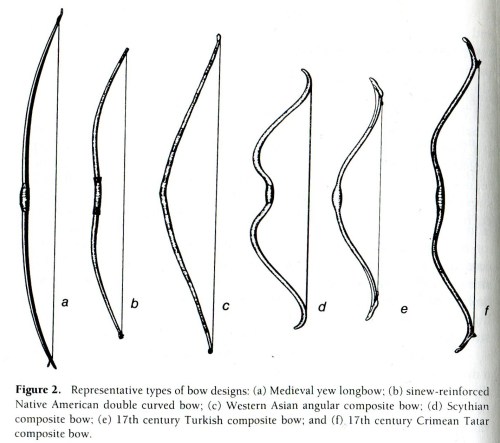
Types of bows

Introduction

Archery is simple in concept, yet it represents an extremely sophisticated  technology. In its most basic form, a bow is a piece of wood slightly bent and held in tension by a connecting bowstring. However, as the bow is drawn, tensile stress increases along the back or outside curve simultaneously with compressive forces developing along the inside curve or belly. (Knecht) The bow stored the force of the archer’s draw as potential energy, then transferred it to the bowstring as kinetic energy, imparting speed and killing power to the arrow.

Advantages and Construction

Like its namesake, the composite bow combines different materials (wood, sinew, and horn)  and utilizes them fully, creating a mechanical tour de force. Specifically, the sinew on the back handles tensile stress, while the horn on the belly has 3.5 times more compressive strength than wood (Knecht).  It starts with a wooden core of maple, poplar, or ash. The core can be any type of wood, so long as glue can stick to it easily, it is flexible and bends easily, and has a straight grain, to avoid twisting of the limbs(Knecht). The core is thin, acting more like a spacer and surface to which the horn and sinew was attached. Its thinness also reduced the overall weight of the bow. Composites are made of multiple pieces, each joined with animal glue in V-splices to allow for the sharp bends that many recurve bows require. Water buffalo horn is the most common, although gemsbok, oryx, ibex and Hungarian grey cattle horns are also used (Wikipedia Contributors). Sinew, generally the Achilles tendon or back tendons of wild deer, is soaked in glue and applied in layers on the back of the bow. After attaching the sinew, the bow was placed in a cool, dry location to allow the glue to set. After six months or more of drying, the bowyer slowly bends the bow into its final shape, adjusting to make sure the limbs will draw evenly . Finally, a waterproof covering of thin leather, bark, or snakeskin is added. Scythian and early sarmatian bows were short at 3 ft, the handle set back and the limbs curving with slightly curled ends, middle to late sarmatian and hunnic weapons were longer at 5 ft (De Souza).
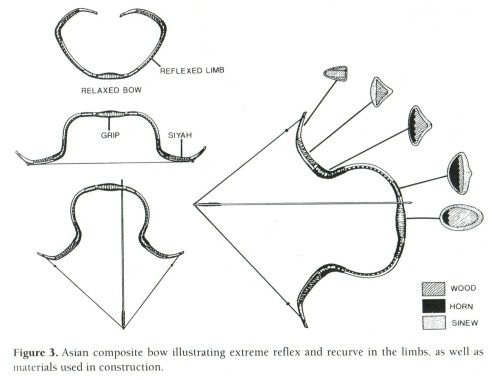
Unstrung, strung, and drawn composite bow & Cut out diagram of construction materials

A bow can store no more energy than the archer is capable of producing in a single movement of the muscles of his/her back and arms, but the composite recurve released the stored energy at a higher velocity, thus overcoming the arm’s inherent limitations (Encyclopedia Britannica). Longbows are bigger, heavier, and shoot at a lower velocity. Composites not only shoot with greater velocity, they are much smaller and lighter, making them perfect for horseback archery. A prime advantage of the composite bow was that it could be engineered to essentially any desired strength, the bowyer being able to produce a bow capable of shooting light arrows at long range, or maximize penetrative power of heavy arrows. (Encyclopedia Britannica) Composites are mechanically superior to wooden bows as the horn and sinew made it capable of standing greater compression while maintaining more elasticity. The steppe bow could transfer most of its energy to the arrow, thus allowing it to shoot farther than a bow of equal draw weight, a typical cast being 300 meters (Szabó).The more powerful composite bows, being very highly stressed, reversed their curvature into a complete ‘C’ shape when unstrung. They acquired the name recurved since the outer arms of the bow curved away from the archer when the bow was strung, imparting yet another mechanical advantage at the end of the draw.

Historical Context

The composite bow appears to have developed in separate regions but at roughly the same time, in cultures in Mesopotamia, Anatolia, and the Eurasian Steppes. The earliest surviving examples of composite bow is western Asian angular bow that appeared during 3rd Millennium BC. (Knecht)

Akkadian Stele from the 3rd Millennia BC. Depicts composite bows utilized by army of Sargon of Akkad

In 1992, from among the Egyptian artifacts in Tutankhamun’s Tomb, Howard Carter recovered 32 angular composite bows along with arrows, quivers, and bow cases (Knecht). These bows are an earlier form that made a shallower angle and had shallower recurve limbs. Replicas of these suggest that the angular composite bow provided Egyptian archers with a smooth accurate and high powered shot. The short length of these bows made them lightweight and maneuverable, highly suited for chariot-borne archers. (Knecht)The introduction of composite bow, stronger and more effective than the simple bow, was part of a striking change in military technology at the beginning of the Pharaonic New Kingdom. This modernization was to keep pace with the military innovations of neighboring countries and prevent any recurrence of a foreign incursion like that of the Hykso, who had possession of composites,  in the second intermediate period (1650-1550bc). (Knecht)(Wikipedia Contributors)

The most prominent form of composite bow is a design referred to as the Scythian bow, known to the Romans as Sythicus Arcus. (Knecht) Its form became fully developed under the Cimmerians by the 9th century BC. The Scythians, originally from Iran (De Souza) moved into the Pontic Steppe north of the Black Sea in the 8th Century BC. Records from 700 BC onward mention composite bows being used by the Cimmerians and Scythians, who attacked the kingdom of Urartu and ravaged the Anatolian kingdoms of Lydia and Phrygia (Szabó). In the next century, they raided Assyria, Damascus, Phoenicia and Israel, up to the Egyptian border. The prophet Jeremiah wrote: “At the sound of horsemen and archers, every town takes to flight.”( Szabó) It is impossible to discuss recurve composite bows without recognizing the equestrian cultures that developed them. Eurasia is a series of connected regions of flat, grassland steppe. As mentioned by Herodotus, “they [the Scythians] are all mounted archers who carry their homes along with them and derive their sustenance not from cultivated fields but from their herds…their land and their rivers support this way of life.” The land there is perfect for grazing animals like horses and cattle, leading the cultures there to develop around that. Steppe nomads excelled in horse husbandry and horseback riding, developing equestrian culture of decorated saddlery and harness, herding tools and clothing fashions. Characteristic also of the black sea hinterland and the lands down to northern Greece are finds of gold sheet covers for bow case and quiver combinations, called gorytoi. These demonstrate that the bow was carried strung on the horse archer’s left side. (De Souza)
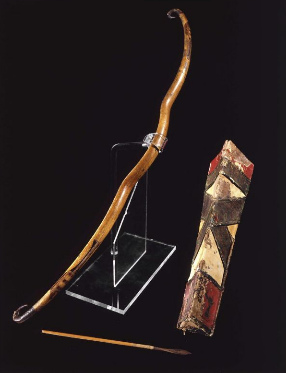
Scythian bow artifacts
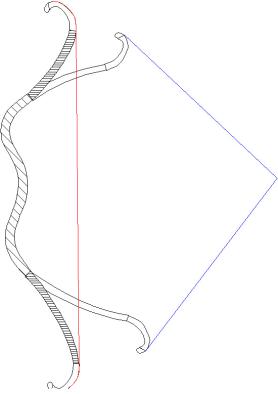
Diagram of drawn Scythian bow

For other goods not provided by their herds, like grain, textiles, and metalwork, nomads traded with their sedentary neighbors. They could also just take things by force.  Horse archers could shoot their bows in a near 360 degree arc from a fast moving platform. This meant that mounted-archer warfare was mobile and fluid, operating in a cloud of riders, concentrating on specific targets and then wheeling away out of reach when threatened (De Souza). Shooting was rapid and at close range to defeat armor. All horse archers could shoot backwards as they withdrew in a ‘Parthian shot’. The appearance of nomad hordes often bewilderingly sudden and unexpected. The mobility of horse archer groups meant they could range widely in short time and numbers difficult to estimate accurately. Nomads could also campaign much more effectively than sedentarists in winter, when steppe horses could forage in deep snow, and summer obstacles such as rivers and marshes were frozen over. (De Souza)

In 513 BC, King Darius I of Persia invaded Scythia. The Scythians sent their women and children to a safe place and simply let the Persians chase them all over the steppe. Their strategy was to exhaust and harass the Persians with archery and cut them off from supplies(Szabó). They laid waste to the countryside, so the Persians would be unable to forage. Darius withdrew, and Persia was never able to conquer Scythia.

Recurve bows depicted on the walls of the Palace at Susa

From images on the walls of Darius’ palace at Susa, it is likely that the Persians adopted the composite bow from their encounter with the Scythians. During the Greek invasion, at Plataea, “the [Persian] horsemen rode out and attacked, inflicting injuries on the entire Greek army with their javelins and arrows, for they were mounted archers and it was impossible for the Hellenes to close with them” (Herodotus).

Alexander the Great was one of the only commanders who successfully defeated a mounted archer army on his first try. In 328 BC, Alexander battled with Saka and Massageta nomads at Syr Darya, on the very edge of the nomad’s arid steppe (Szabó). It was the first ever defeat of nomadic cavalry by settled agriculturalists, but it was close. Of the 4500 nomadic horsemen, only 800 were dead. Having sustained a considerable loss already, Alexander wisely chose not to follow them into their own lands.
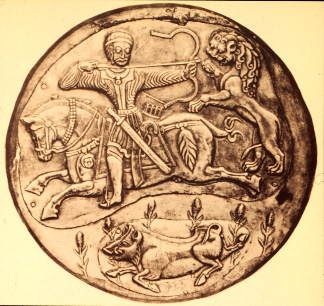
Parthian Shot Coin. Mounted archery shot in which the rider turns in the saddle and shoots backward. Made famous by references to Parthians, but really, any skilled horse archer could do it

“They are really formidable in warfare….. the Parthians make no use of a shield, but their forces consist of mounted archers and lancers, mostly in full armour. Their infantry is small, made up of the weaker men; but even these are all archers. The land, being for the most part level, is excellent for raising horses and very suitable for riding about on horseback; at any rate, even in war they lead about whole droves of horses, so that they can use different ones at different times, can ride up suddenly from a distance and also retire to a distance speedily.” Cassius Dio on 3rd century ad Partho-Sasanians

The Battle of Carrhae in 53 BC pitted sixteen thousand Parthian horsemen against twenty-four thousand Roman soldiers. (Szabó) The highly disciplined army under Marcus Licinius Crassus and his grown son would find the combination of mobility and archery to be deadly. Plutarch wrote of the Parthians: “Their bows were large and strong, yet capable of bending till the arrows were drawn to the head; the force they went with was consequently very great, and the wounds they gave, mortal.” The Parthians pretended to retreat, drawing out the forces of the younger Crassus far from the main army and turning back on them. The Parthian heavy lancers defeated the Roman cavalry, while Crassus’ infantrymen withdrew to a hill, where they were shot to pieces. Ultimately both the elder Crassus and his son were killed and the army surrendered (Szabó).

The Romans, like the Persians, also picked up on composite design, which became the standard weapon of Roman Imperial archers. The stiffening laths (also called siyah in Arabic/Asian bows and szarv  in Hungarian bows) used to form the actual recurved ends have been found on Roman sites throughout the Empire, as far north as Bar Hill on the Antonine Wall in Scotland (Wikipedia Contributors).

The late Roman Empire was dominated and terrorized  by Attila the Hun and his armies. The Huns swept up a mass of peoples, inc. other steppe nomads during their movement west into Europe. Writers such as Ammianus Marcellinus, Olympiodorus, and Procopius acknowledged the Huns to be the world’s best archers. (Szabó) The Hunnic bow, also a composite recurve, was the technical secret to their vast success (Man).The Huns lengthened and stiffened the recurved ends called siyah  or ears, of their bows and set them at sharply recurved angles. Increasing overall energy storage and creating a higher initial draw weight, these alterations allowed  a heavier arrow to be shot more efficiently (Knecht).

If it wasn’t enough to have the Huns, the Byzantine Empire was also attacked by an alliance of Magyars and Pechenegs in 934 AD. In an unnamed battle on the Balkans, the Magyar and Pecheneg horsmen revolved around them ‘like a mill wheel’, and when the Byzantine cavalry rushed forward, gave a murderous volley of arrows from either side, followed by a sword charge (Szabó). The defeated Byzantines surrendered and paid tribute for years.

Throughout the Middle Ages, composite recurves were generally used in more arid countries; the all wooden longbow was the norm for more humid regions, like Great Britain. Composite recurve bows and mounted archery continued to be important in battles right up until the widespread use of firearms and gunpowder. Even still, the composite bow and archery flourishes today as an athletic sporting event.

A modern horse archer at competition

Works Cited

Herodotus. The Landmark Herodotus: the histories. New York: Pantheon Books, 2007. Print

Knecht, Heidi ed. Projectile Technology. New York: Plenum Press, 1997. Print

De Souza, Philip. The Ancient World at War. New York: Thames & Hudson Ltd. 2008. Print

De Waele, An.  “ Composite bowat ed-Dur (Umm al-Qaiwain, U.A.E.)” Arabian Archaeology & Epigraphy. Nov 2005, Vol. 16 Issue 2, p154-160. Web. 18 Apr. 2012.

Man, John. “Centaur of Attention”. History Today; Apr2005, Vol. 55 Issue 4, p62-63. Web. 18 Apr. 2012.

Szabó, Christopher. “The composite bow was the high-tech weapon of the Asian steppes”. Military History; Dec2005, Vol. 22 Issue 9, p12-22. Web. 18 Apr. 2012.

“Composite Bow.” Encyclopædia Britannica. Encyclopædia Britannica Online. Encyclopædia Britannica Inc., 2012. Web. 18 Apr. 2012. http://www.britannica.com/EBchecked/topic/130082/composite-bow.

Wikipedia contributors. “Composite bow.” Wikipedia, The Free Encyclopedia. Wikipedia, The Free Encyclopedia, 14 Mar. 2012. Web. 17 Apr. 2012.

Wikipedia contributors. “Bow shape.” Wikipedia, The Free Encyclopedia. Wikipedia, The Free Encyclopedia, 30 Mar. 2012. Web. 16 Apr. 2012.

2 Comments

Filed under Uncategorized

Warrior Women

Throughout history there have been legendary women warriors and leaders. In Greek mythology Athena was the goddess of war and wisdom and Artemis was goddess of the hunt and leader of the Amazonian women, an all-female society of fierce warriors (Goldstein).

Oil Painting on Silk, "Hua Mulan goes to War" (Wikipedia contributors).

An ancient Chinese ballad tell of Hua Mulan, dressed as a man and took her father’s place in the emperor’s army and was never discovered to be a woman (The Ballad of Hua Mulan).

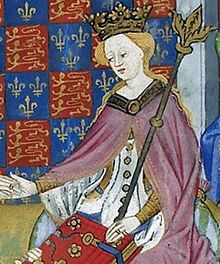
Margaret of Anjou receiving the Book of Romance: original painting from an illuminated manuscript by the Talbot Master (Wikipedia contributors)

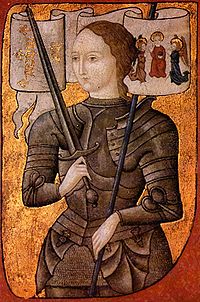
Other women from historical England such as Margaret of Anjou and Catherine of Aragon, as well as Joan of Arc from France were successful warrior-leaders and their actions were immortalized in legends (Wikipedia contributors: Women Warriors in Folklore).

Artist's interpretation of Joan of Arc, 1485: Centre Historique des Archives Nationales, Paris, AE II 2490 (Wikipedia Contributors).

Although there exist many examples of women proving themselves capable warriors, there still exists gender discrimination, particularly in regards to the actual armor worn by women warriors. Camilla, an Amazonic female warrior portrayed in Virgil’s Aeneid, is depicted as entering the fray clothed in tight fitting and exotic garb that emphasizes her idealized beauty while simultaneously demonstrating that she is not an equal to the male warriors (and all their bejeweled armor) portrayed in the Aeneid (Stock 59). Not surprisingly, it is Camilla’s lack of  armor that results in her death–not because of the lack of protection, but because of the increased fascination and attraction she has toward the magnificent armor of another (male) warrior, Chloreus (Stock 58). This distraction results in her being struck down and killed, emphasizing her femininity and demonstrating that although she was an extremely powerful warrior she was lacking the crucial element in becoming an equal match for the male opponents she faced in battle (Stock 59).

In contrast, the title character of the Roman de Silence defies all feminine restrictions in knighthood and assumes all the male-gendered  responsibilities and prerogatives of knighthood. Not only does Silence receive her own armor, but she has a classic arming passage, individual combat and epic battle scenes that equal an male medieval literary warrior (Stock 69). Eventually Silence gains the reputation as the most skilled knight in France, and receives a magnificent suit of armor as a gift from the King of France (Stock 71). Silence’s cross-gender identity formation hinges largely on her armor, because in order to be successful she must ‘pass’ as a male knight (Stock 73). Her adoption of male qualities allows her to be successful in a traditionally male-dominated arena, but effectually ‘silences’ her natural weapon of femininity–her words (Stock 74).

In comparing the two women warriors from medieval legend, we see that both women were disadvantaged in some way. Camilla retained the prowess and power of her femininity, but her death was brought about by her fascination with (and personal lack of) the full armor worn by her male opponent. Silence on the other hand was granted the full armor and literary prowess of arming and battle scenes, but ultimately ended up sacrificing her femininity to gain success in a masculine world.

Works Cited:

Goldstein, Joshua S. “Amazon Women: Myths of Amazon matriarchies.” War and Gender: How Gender Shapes the War System and Vice Versa. Cambridge University Press: 2001. Web. 18 Apr 2012. http://www.warandgender.com/wgamazon.htm

Stock, Lorraine K. “’Arms and the (Wo)man’ in Medieval Romance: The Gendered Arming of Female Warriors in the “Roman d’Eneas” and Heldris’s “Roman de Silence.” Arthuriana 5.4, Arthurian Arms and Arming (1995): pp. 56-83. 29 Mar 2012. http://www.jstor.org/stable/27869148

Wikipedia contributors. “Hua Mulan.” Wikipedia, The Free Encyclopedia. Wikipedia, The Free Encyclopedia, 16 Apr. 2012. Web. 19 Apr. 2012.

Wikipedia contributors. “Joan of Arc.” Wikipedia, The Free Encyclopedia. Wikipedia, The Free Encyclopedia, 19 Apr. 2012. Web. 19 Apr. 2012.

Wikipedia contributors. “List of women warriors in folklore.” Wikipedia, The Free Encyclopedia. Wikipedia, The Free Encyclopedia, 15 Apr. 2012. Web. 19 Apr. 2012.

Wikipedia contributors. “Margaret of Anjou.” Wikipedia, The Free Encyclopedia. Wikipedia, The Free Encyclopedia, 19 Apr. 2012. Web. 19 Apr. 2012.

“The Ballad of Hua Mulan.” c.5 A.D. Web. 18 Apr 2012. http://www.chinese-swords-guide.com/mulan.html

Leave a comment

Filed under Final Projects -- Cohort II

Changed due date

Yes, I’m still grading.  You will have until Monday, April 23 AT NOON to turn in revisions.  If you’re really have problems getting your final project done, email me and we’ll negotiate.

Leave a comment

Filed under Class Stuff

Modern vs. Medieval Marriage

What are the differences between a formal union of man and woman in modern day United States and Medieval times? Much of what we learn about both modern and Medieval marriage the relationships between husband and wife is found in literature or modern day media. Examples from literature such as Tristan and Isolde, Sir Gawain, and Arveragus and Dorigen illustrate relationships that are as varied as those seen in modern times (Berenboym).

John William Waterhouse: Tristan and Isolde Sharing the Potion - 1916
http://www.jwwaterhouse.com/view.cfm?recordid=113

In today’s society it goes without saying that, in a relationship, we expect to love and be loved in return, especially before committing to marriage. Love is considered essential in creating a successful and enduring relationship, but was insignificant in Medieval marriage contracts. Today we see most lackluster marriages coming to an end with a divorce rate in the United States of almost 50% (Worldwide Divorce Statistics).  However,  it is made apparent through literature that in medieval times loveless marriages were common, and love usually existed outside of marriage. In the legend of Tristan and Isolde the lovers are separated by the betrothal and marriage of Isolde, a beautiful Irish princess, to King Mark who is Tristan’s uncle (“Tristan and Isolde”). Although tragically their true love is denied them in life, they are united in death never to be separated again (“Tristan and Isolde”).

Literature also suggests that, although it was less probable, there was the chance of finding love  after marriage (Berenboym). In The Wedding of Sir Gawain and Dame Ragnelle we see a repulsive hag transformed into a beautiful lady, and a marriage changed from a chivalrous agreement to a marriage where love does indeed exist between husband and wife ( Hahn). While not many couples in modern society fall in love with their spouse after marriage, the plot of Gawain and Ragnelle’s romance is a motif in fairy tales like “The Frog Prince,” “Beauty and the Beast,” and others (Hahn).

Perhaps the ideal marriage is seen in “The Franklin’s Tale” from Geoffrey Chaucer’s collection of stories The Canterbury Tales. The love between Arveragus and Dorigen was not dictated by domination, jealousy or mastery, but humility, obedience friendship and faithfulness (Chaucer ch. 45).

Literature is a reflection of reality, both past and present and through literature we see that all marriages have some problem or difficulty. Literature also demonstrates that, in any time period, love is a rare gift and should be cherished and treasured by those who receive it (Berenboym).

Works Cited:

Barenboym, Marina. “Reflections on Love and Marriage in Medieval Literature.” Web. 17 Apr 2012. http://csis.pace.edu/grendel/projs994a/essay1.htm

Chaucer, Geoffry. “The Franklin’s Tale.” The Canterbury Tales. 1392. Web.  18 Apr 2012. http://www.canterburytales.org/canterbury_tales.html

Waterhouse, John W. “Tristan and Isolde Sharing the Potion.” 1916. Web. 18 Apr 2012. http://www.jwwaterhouse.com/view.cfm?recordid=113

Hahn, Thomas. “The Wedding of Sir Gawain and Dame Ragnelle: Introduction.” Sir Gawain: Eleven Romances and Tales. Medieval Institute Publications. Michigan: 1995. Web. 18 Apr 2012. http://www.lib.rochester.edu/camelot/teams/ragintro.htm

“Tristan and Isolde.”  Myths Encyclopedia: Myths and Legends of the World. 2012. Web. 18 Apr 2012. http://www.mythencyclopedia.com/Tr-Wa/Tristan-and-Isolde.html

Leave a comment

Filed under Final Projects -- Cohort II

Death to the Foam! (Final Project)

            For my final project I wanted to demonstrate the weapon styles of the Roman Legionary. I figured that we hadn’t gotten to really destroy anything in class, so I better take advantage of this to get in a little bit of fun. The research was unsurprisingly difficult, many of the books would only mention things in short passages, but not with a lot of detail to really get a solid feeling for how the Romans truly attacked.

             I watched a lot of youtube videos in order to see what re-enactment groups would do, even though that was less fruitful than I had hoped, but it gave me a start.

            I was able to easily find information about the Roman Legionaries formations, the tortoise, and the spear formations were the most readily available and were also simple enough to describe in class with only one of me (Keppie). The entire Roman fighting system was designed around using the shield and sword as a unit, combined with your fellow soldiers. Once I started putting things together I realized how powerful this army would be against other ancient forces.

            For the weapon strikes I simply had to copy what I had seen, however I did pull information from the class also, especially in regards to the piercing style of striking. Using the shield as a level the Gladius was lethal in close combat. While it was wielded with one-hand, the shield gave the ability to maintain on target and strike harder at your foes. Because it was a short sword it was not meant for slashing as much as piercing because the internal organs are better protected from slashes than from piercing, and if you want to drop your opponent, you take those out (Milner).

            The other strike that I found was to go after the knees by quickly lifting the shield up at an angle to your opponent and then a quick, stab at the knee in order to cripple your opponent and then easily finish them off.

            I had a lot of fun with this project and I hope it came across in class. I do not have any of the pictures from the demonstration at this time to include on the blog, but I do believe everyone was there still.

Veni Vidi Vici!!!!

Works Cited

Bishop, M.C. Roman Military Equipment: from the Punic Wars to the fall of Rome. Oxbow: Oxford, 2006. Print.

Bosworth, A.B. Conquest and Empire: The Reign of Alexander the Great. Cambridge: Cambridge University Press, 1988. Web.

Keppie, Lawrence. The Making of the Roman Army: From republic ot empire. Lawrence: University of Oklahoma press, 1984. Print.

Milner, N.P. Vegetius: Epitome of Military Science. Liverpool: Liverpool University Press, 1993. Print.


Leave a comment

Filed under Uncategorized

Extra Credit Blog: Genocide in Darfur

I was a little disappointed when the Center for Diversity and Unity changed the film screening from Blood Diamond to the Genocide in Darfur: Darfur Eyewitness film. The film was made by the United States Holocaust Memorial Museum and was actually a very touching and powerful story. The film featured two men, U.S. Marine Brian Steidle and Jerry Fowler, the director of the Committee on Conscience, who witnessed the effects and bloodshed in Darfur. Fowler told of his time in Chad helping the refugees and he spoke about a woman who had two gunshot wounds in her leg. She told him that she had received the gunshot wounds when she tried to draw water from the village well that the soldiers were guarding. It shocked me that they not only took away the peoples home, destroyed their belongings and families, and now they won’t even let the village people survive with their basic necessities.

To prepare for the screening and the discussion I was supposed to lead following the screening, I looked at many articles talking about Genocide in general I was unaware that Genocide had a clearly defined definition. I always just understood it as a mass killing. But in fact, the real definition of Genocide is much more powerful and clear. It states that:

“Genocide means any of the following acts committed with intent to destroy, in whole or part, a national, ethnical, racial, or religious group, such as

a)      killing members of the group;

b)      causing serious bodily or mental harm to members of the group;

c)      deliberately inflicting on the group conditions of life calculated to bring about its physical destruction in whole or part;

d)     imposing measures intended to prevent births within the group; forcibly transferring children of the group to another group. “

–          United Nations Convention on the Prevention and Punishment of the Crime Genocide, adopted on December 9, 1948

Fowler also mentioned ways we can help stop the genocide in Darfur. We need tell the stories of what’s happening out there, spread awareness and just get people to start caring about genocide. Just like with the KONY campaign we need to make people aware that genocide is happening NOW, that it didn’t stop with the Holocaust. I was disappointed the attendance at the screening was very small, I feel if people took a little time out of their day to share the knowledge of genocide the world might be just a little better.

Check out the Signpost coverage of the event in the Center for Diversity and Unity!!!: http://www.wsusignpost.com/2012/04/07/holocaust/

Leave a comment

Filed under Uncategorized

Final Project Summary on Biochemical Warfare in the Ancient World

I had a lot of fun researching biological and chemical warfare in the ancient world. I grew up with two older brothers who loved to burn thing and blow things up so it’s natural that I would take an interest in this topic.

The funnest part for me was reading about the myths and finding out how they correlate with real events and places. The most interesting story for me to read was the story of the Assyrian army under Sennacherib attacked Egypt and the Pharaoh prayed to the god Ptah who sent thousands of mice to chew up their weapons and bring plague to the Assyrian army. The most interesting thing about this story, reported by Herodotus, is that the exact same story happens in Jerusalem. Jerusalem is also under attack by Sennacherib’s army and the god of Israel also sends thousands of mice to defeat the Assyrian army. I found this fascinating as Josephus later backs up Herodotus’ account. Where was the true setting of this story? Is the bible accurate in saying it was Jerusalem or was Egypt where this miracle actually happened?

Another exciting thing I did for the project was when I was researching Greek Fire. All the sources compare Greek Fire to modern napalm. So I decided to make some napalm myself and see just how deadly it could be. My brothers used to make napalm all the time in the summers when they were out of school. I enlisted the help of my oldest brother, Daniel, to help me make napalm. The basic recipe for making napalm is Styrofoam, gasoline, and a metal pot. He told me to pour gasoline into the metal pot. Next, we added bits and pieces of Styrofoam into the gasoline. We kept stirring like it was a batter of caramel and kept adding bits of the Styrofoam until we had a sticky, gray/white, syrupy mixture. Then, we burned it. We dug a small but deep hole and put some grass and twigs into it. Then we put the mixture on and lit it on fire. It was really cool. The fire was bright and the smoke was black. It burned bright for about 20 minutes until it started to die down. It was really fun. I wanted to bring some of my homemade napalm to class to show everyone but I was pretty sure the fire marshal would have frowned upon that. 

Leave a comment

Filed under Uncategorized

Final Blog IV: Deadly Animals

Animals are everywhere. From dogs to cats and rats to snakes every country has them. The ancient world had many uses for animals the oxen and horses provided means of transportation and proved helpful in wars such as cavalries or elephants used in Hannibal’s invasion of Italy. The animals also provided food and clothing for the people of the ancient days. But animals also have sinister uses. In the bible we read much of plagues and pestilences where god sends an “angel” to help the people of Jerusalem. According the second Book of Kings around 700 BCE a large army of Assyrians under the rule Sennacherib began attacking Jerusalem. Isaiah urges King Hezekiah to keep defending the city and tells him that God will protect the city. God sends an “angel” and smites the 185,000 soldiers camping outside of Jerusalem. The angel of god is a plague carried by rats that swept through the already unsanitary camp of the Assyrians (2 Kings: 19).

A similar story is reported by Herodotus where the pharaoh of Egypt is also under attack by Sennacherib. The Pharaoh was told by the god Ptah in a dream to face the Assyrians for he would send help to the Egyptians. The Pharaoh thought the god meant an Army but instead the god Ptah sent thousands of rats and mice to chew the weapons of the Assyrians and bring (Mayor). According to the book of Samuel, rats and mice were already known to be bringers of plague and death (1 Samuel: 5).

Rats have not been the only deadly animals used in ancient warfare. Snakes, scorpions and smaller insects have also been widely used to attack the enemy.  In the ten biblical plagues, lice was the third. Bees have also been used against the enemies. Mayor states that the poisonous hornet’s nest was hurled at the enemy to confuse and to kill the enemies. The swarm of angry hornets would buzz around the unsuspecting enemy and sting them until they either died or found some sort of shelter and even then most soldiers would be badly injured.

The same would be done with other insects and reptiles. In the ancient Mesopotamian city of Hatra, scorpions would be put into clay pots and sealed, then hurled at the enemy where the irritated scorpions were ready to attack the first aggressor that they saw (Herodian). Mayor believes that the clay bombs were not filled only with scorpions but with a “potpourri of scorpions, assassin bugs, wasps, pederin beetles and other venomous insects from the desert around Hatra (Mayor).”  Who would have thought that such small animals could do so much damage to strong, brave men? 

Works Cited

Herodian. History of the Empire. Trans. C.R. Whittaker. Loeb Classical Library; Harvard University Press, 12 April 2012.

Herodotus. The Histories . Ed. A.D. Godley. n.d. 12 April 2012. <www.perseus.tufts.edu>.

Mayor, Adrienne. Greek Fire, Poison Arrows and Scorpion Bombs: Biological and Chemical Warfare in the Ancient World. New York: The Overlook Press, 2003.

Samuel. “1st Book of Samuel.” Various. The Holy Bible. King James Version. n.d. 12 April 2012.

The Holy Bible. The Old Testament. Ed. King James Version. n.d.

Various. “2nd Book of Kings.” Various. The Holy Bibile. King James Version. n.d. 12 April 2012.


Leave a comment

Filed under Uncategorized