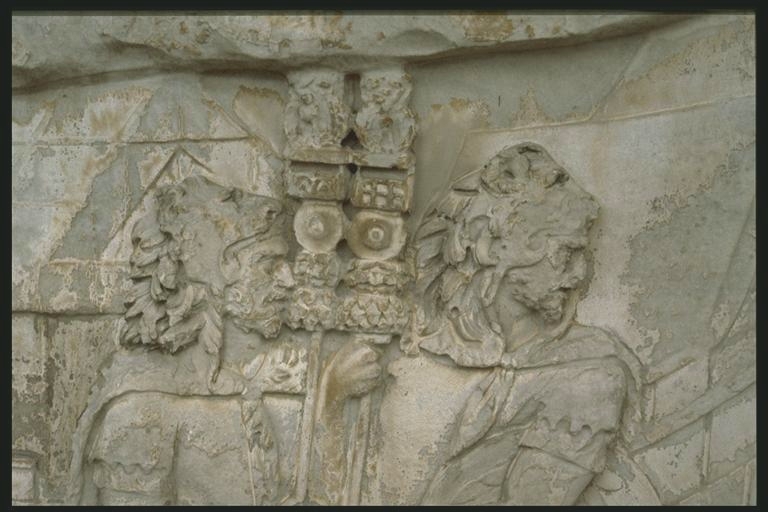
Vehicles on Trajan’s Column

Pairs of mules drag carroballistae, cart-mounted missile throwing weapons, into battle

Scene 40, Carroballistae. Used with permission. Copywrite Peter Rockwell. Via http://www.stoa.org/trajan/images/hi/1.12.h.jpg

Trajan’s column gives a glimpse of life at war and war technology during Trajan’s campaign against the Dacians.  One particular insight on the column shows the use of wagons and siege equipment specifically a carroballistae. This type of ballista was mounted to a cart with two eight spoke wheels and drawn by mules or horses. This is an assumed technological advancement allowing for mobile artillery. Richmond suggests that it is “much like a hopper-trailer of a modern field gun (13). The wagon was serviced by two soldiers. One soldier seems to be loading and the other preparing the torrsion propulsion system.

The ballista was mounted on a cart were one man took position on the back to aim and fire the bolt while another solider likely wound the winch to create the needed tension for firing. Disputes amoung scholars has suggested the carts were only used to transport the ballistaes during the campaign; however, depictions on the column show the ballistaes loaded. This would have been a very dangerous way to transport them. Also, there is evidence that ballistaes mounted on carts or charriots have been seen on other forms of archeology (Wikipedia).

Scene 40, Soldiers above ballistae. Used with permission. Copywrite Peter Rockwell. Via http://www.stoa.org/trajan/images/hi/1.10.h.jpg

The viewer must keep in mind that Trajan’s Column is monument to a victorious campaign on a monochrome stone medium. It was carved by a scuplter rather than a soldier. The portrayal of the soldiers are too simplistic to be a rendition of actual soldiers in battle. Evidence of this can be seen in the uniforms as well as in the incorrect representations of the ballista.  The depictions are meant to be decisively recognized as roman. (Richmond, 14).


Works Cited 

“Carroballista.” Wikipedia. Wikimedia Foundations. Mar. 6 2011. Web. Mar 8 2012. 

Richmond, I. A. “Trajan’s Army on Trajan’s Column.: Papers  of the British School at Rome. Vol. 13 (1935), pp. 1-40. JSTOR Web. Feb 28 2012.

Rockwell, Peter. Soldiers above ballistae. Trajan’s Column. Photograph. The McMaster Trajan Project.  1999. 8 Mar. 2012. Web.

Rockwell, Peter. Carroballistae. Trajan’s Column. Photograph. The McMaster Trajan Project.  1999. 8 Mar. 2012. Web.

Leave a comment

Filed under Uncategorized

Legatus

Legatus.

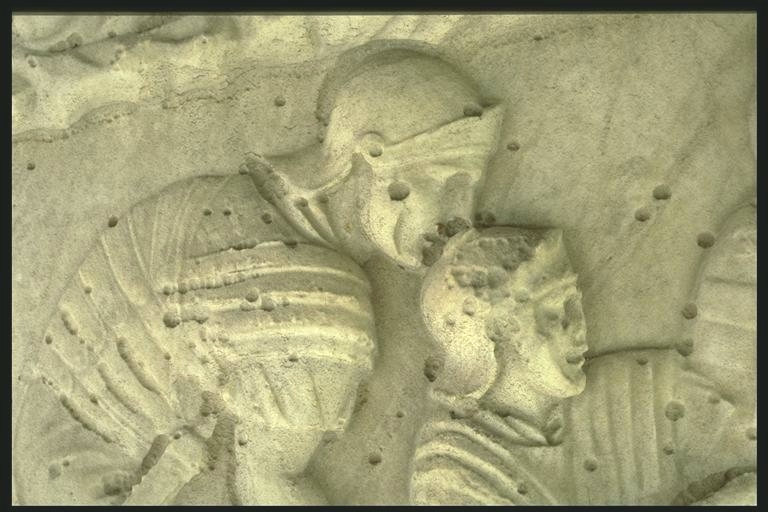
Legate being saluted

The man in charge of the Roman Legions.

The role of Legatus was considered the highest rank that a legionary could strive to gain, while then it was still usually granted to a senator more often than a soldier who worked his way up through the ranks.

The Legatus was in charge of overall military strategy and campaigning. The Legatus would need to lean heavily on the other staff officers that would be surrounded by him, the business of day-to-day operations was run by these officers.

There were a few different “ranks” of Legatus in the Roman Army. There were Legatus in each province, in charge of their own regional legion, who would protect regional interests unless called upon by the Empire to go to battle, which was a common occurrence in the Roman times. (Milner)

One of the most important roles of the Legatus was to know when to press war upon his foes, and when it was time to hold back. In many cases the wisest Legate would listen to the senior “non-commissioned” soldiers who would almost always have the truest feel for what the soldiers were feeling and whether pushing the fight was wise. Vegetius was quoted, via translation, as saying that :

One should find out how soldiers are feeling before battle. Explore carefully how soldiers are feeling on the actual day they are going to fight. For confidence or fear may be discerned from their facial expression, language, gait and gestures. Do not be fully confident if it is the recruits who want battle, for was is sweet to the inexperienced. You will know to postpone it if the experienced warriors are afraid of fighting. An army gains courage and fighting spirits from advice and encouragement from their general, especially if they are given such an account of the coming battle as leads them to believe they will easily win a victory. (Keppie)

One of the largest dangers of the rank of Legatus is that they were subject to the displeasure of the Emperor. If a Legate has a bad campaign, they may not be long for the rank.

Works Cited

Keppie, Lawrence. The Making of the Roman Army: From republic ot empire. Lawrence: University of Oklahoma press, 1984. Print.

Milner, N.P. Vegetius: Epitome of Military Science. Liverpool: Liverpool University Press, 1993. Print.


Leave a comment

Filed under Cohort VII Scutum Decoris

The Lost Legions of Varus

“In the field, the bones of the soldiers lay scattered about, each where he had fallen either standing his ground or trying to flee. There were bits of weapons, and the bones of horses amongst them, and human heads had been nailed to the trunks of the surrounding trees. In these groves stood the barbarian altars where the tribunes and leading centurions had been sacrificed.” – Tacitus

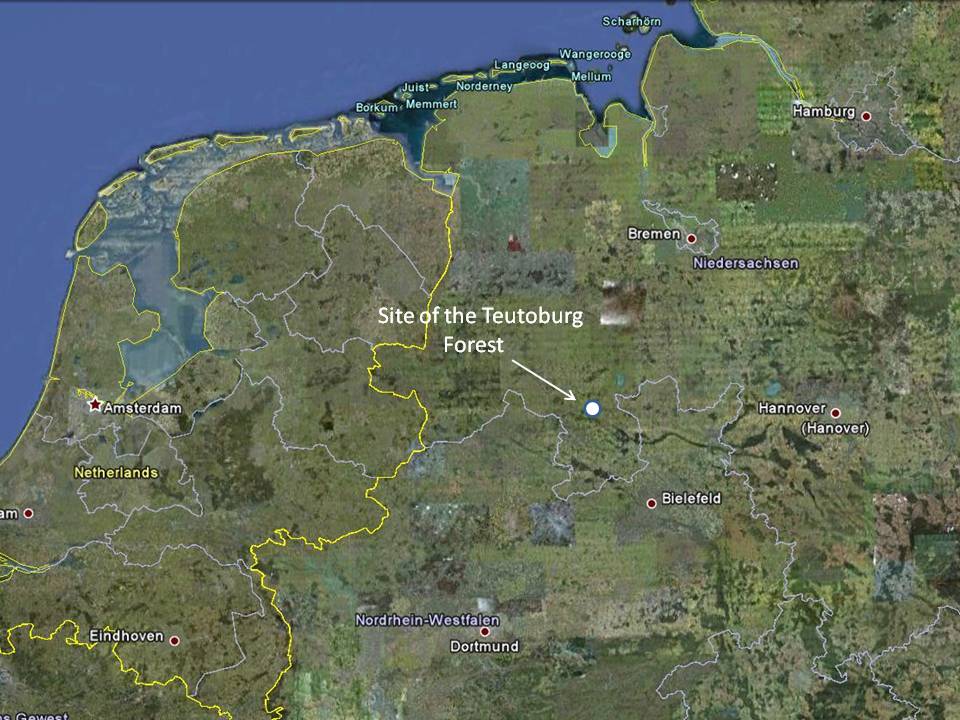
In 9 AD, thirty thousand legionaries and their commander, Quinctilius Varus, were massacred deep within the Teutoberg forest. Led by the ex-auxiliary Arminius, the German tribesmen hunted the scattered legions as they desperately tried to extricate themselves from the forests and bogs of Northern Germany. Shrouded in mystery, even the search for this famous battleground has been going on for more than four hundred years (Damien). The discovery of Roman coins, among other things, have indicated a site near Osnabrück, Germany (Damien).

Approximate location of the Battle of Teutoberg

The Germanic tribes were polar opposites of the Roman legions. While the Romans carried pilum, sword, shield, and fought heavily armored, the Germans carried a light shield made of sticks, a short iron-headed spear, called a frameae, and usually fought naked (Tacitus 40). Unlike the organized and silent Roman charge, the German Furor Teutonicus was a wedge formation of wild, bellowing ferocity that could ‘easily keep up with a cavalry encounter’ (Tacitus). Their remarkable speed is probably what made it possible for them to attack and then vanish into the woods as suddenly as they had appeared (Matyszak 99). The Germans were also reported to be “frighteningly large”, living mostly on a diet of meat, milk, and cheese, and of having a great fondness for beer (Matyszak; Tacitus).  As time passed on, the Germans were becoming more and more Romanized as they traded with them for alcohol and fought alongside them as mercenaries and auxiliaries.

Arminius, a young nobleman of the Cherusci tribe, was one such auxiliary. Velleius describes him as “strong of hand and quick of mind and far more intelligent than your average barbarian . . . the ardour of his face and eyes showed the burning spirit within” (Matyszak 167). Arminius fought in several Roman campaigns and had not only earned Roman citizenship, but was even elevated to the rank of Equestrian. However, Arminius did not appreciate the treatment given to his fellow tribesmen and was in reality deeply disgusted by Roman civilization (Matyszak 168). His experience in the army was both a catalyst and an advantage as he plotted against the Romans.

In the autumn of AD 9 reports of disturbances set Varus and his legions in motion. Segestes, another tribal leader, warned Varus that he was walking right into an ambush. Varus ignored Segestes’ advice, firstly on the grounds that Segestes’ was biased, since Arminius and Segestes’ daughter had recently eloped, and secondly because Varus trusted Arminius.

A forest in Germany. This image is what the Forest of Teutoberg may have looked like to a Roman Legionary

The Legions were already having trouble as they entered the Teutoberg forest; the densely packed trees forced the legions to spread out and made transportation of carts and building of roads very difficult. A few days travel had the legions, plus their wives, children, and servants, spread far apart deep within the forest. Without warning, the Germans attacked. Arminius herded the confused and poorly led Romans between the forest and a nearby marsh, picking them off until the entire army was destroyed.

Arminius’ men were ordered to search for Varus’ body; when they had found him, Arminius had the commander’s head sent Maroboduus of the Marcomanni tribe. He hoped that this victory would convince the chieftain out of his stubborn neutrality (Matyszak 171). Maroboduus was not impressed and passed Varus’ head along to Rome.

A coin found near Osnabruck featuring the head of Quinctilius Varus

The news of the annihilation of Varus’ legions was panic-inducing; with the legions gone, the Alps were the only thing standing between Rome and the Germanic hordes. Emperor Augustus ordered an emergency levy and moved Legion V Alaudae north to fill the gap. The numbers of the lost legions, XVII, XVIII, and XIX, were never used again. Although Augustus acted swiftly, he was deeply affected by the loss. Even months afterward, he would bang his head against the wall shouting “Quinctilius Varus, give me back my legions!”


Works Cited

Tacitus, Publius Cornelius.  Agricola and Germany. Trans. A.R. Birley. New York: Oxford University Press, 2009. Print.

Damien, Gregory. “Coin clues to lost legions.” History Today. 40.8 (Aug90) 3. Web. 29 Feb. 2012.

Matyszak, Philip. Legionary: The Roman Soldier’s Unofficial Manual. London: Thames & Hudson Ltd. 2009. Print.

Matyszak, Philip. Enemies of Rome: from Hannibal to Attila the Hun. London: Thames & Hudson Ltd. 2004. Print.

Leave a comment

Filed under Uncategorized

Legionary Life : Medicine

My induction into the role of medicus for cohort VII Scutum Decoris seemed to me to be a bit slapdash. After all, before joining the Legion I had no formal medical training. However, it was possible for a recruit  “who had demonstrated their capabilities for wound dressing and a primitive surgery, but who were not trained physicians” to fill the role of medicus. These green recruits “Probably…learned their medicine from the ‘senior’ medici present in the legion.” (Scarborough) As “Trained physicians were rare,” lack of formal instruction was hardly a deal-breaker. “Success and experience were the main, and in most cases the only, qualifications” for a legionary medicus. (Nutton)

A trained doctor coming into the legions could expect a few perks, but he was still under the rule of his commanders. “By taking the military oath he became a soldier, a miles-and until he reached the rank of centurion he was still technically a miles -his service was counted in stipendia, and he was bound by military law.” However, since he was certainly more useful alive than dead, “his duties [didn’t] necessarily include fighting.” He’d be counted as a ‘non-combattant’ in the legion and after his service could retire “into the select group of civilian doctors who possess immunity from certain taxes and civic duties” (Nutton)

Medici used tools like these to perform surgery on wounded soldiers

Many think of ancient Roman medicine as the kind of clueless bumbling used in the Dark Ages in Europe, when really they were leaps and bounds ahead of the haphazard theories of the four humors and the use of leeches and bloodletting.

Varro’s warning against building homes near swamps, which he stated bred “minute creatures which cannot be seen by the eyes, which float in the air and enter the body through the mouth and nose and there cause serious diseases” demonstrates that Romans had an understanding of germs centuries before blundering medieval doctors attempted to cure the Black Death by “applying a warm poultice of butter, onion and garlic.” (Alchin) Long before the doctors of the middle ages were making Plague Victim Scampi, Roman medici had a working knowledge of “painkillers such as opium and scopolamine,” and knew how to disinfect wounds with “acetum – the acid in vinegar.” (Wikipedia contributors)

Their methods may seem antiquated and a bit superstitious, but Roman medici knew more than we give them credit for. Herbal medicine can sound like hokum, but right alongside the religious plant sage, Romans used fennel for its calming properties. Modern doctors are now exploring the use of fennel as a potential treatment for hypertension. And that new fad of taking garlic supplements for heart health? Not so new; Romans used it for the exact same thing. (Wikipedia contributors)

No one can say how much a good Roman medicus could have done during outbreaks of the Black Death, or the Spanish Flu epidemic, or even against the common cold. We will never be able to measure exactly how, but the loss of Roman medical knowledge irrevocably changed the shape of our history far beyond the field of medicine.


SOURCES:

Alchin, L.K.. “Medicine in the Middle Ages.” Middle-Ages.org.uk. N.p., n.d. Web. 20 Feb 2012. http://www.middle-ages.org.uk/medicine-in-the-middle-ages.htm.


Nutton, Vivian. “Medicine and the Roman army: a further reconsideration.” Medical History. 13.3 (1969): 260-270. Web. 29 Feb. 2012. http://www.ncbi.nlm.nih.gov/pmc/articles/PMC1033953/.


Scarborough, John. “Roman medicine and the legions: a reconsideration.” Medical History. 12.3 (1968): 254–261. Web. 29 Feb. 2012. http://www.ncbi.nlm.nih.gov/pmc/articles/PMC1033827/.


Varro, Marcus Terentius. De Re Rustica. 1. Loeb Classical Library, 1934. 211. Web. http://penelope.uchicago.edu/Thayer/E/Roman/Texts/Varro/de_Re_Rustica/1*.html


Wikipedia contributors. “Medicine in ancient Rome.” Wikipedia, The Free Encyclopedia. Wikipedia, The Free Encyclopedia, 25 feb 2012. Web. 26 Feb 2012. http://en.wikipedia.org/wiki/Medicine_in_ancient_Rome.

Leave a comment

Filed under Cohort VII Scutum Decoris, Uncategorized

Roman Scouts

When it came to gathering intelligence for the Roman army, the exploratores and the speculatores were the units most often used. Although each unit had specific duties, their jobs did tend to overlap from time to time. Exploratores were generally used to gain information through the use of patrols at a distance from the enemy, whereas speculatores most often acquired enemy intelligence through undercover operations (Evov, 81). Both positions were important to the Roman army when it came to battle strategy and to provide protection from enemies when not in combat.

As previously mentioned, exploratores gathered information concerning the enemy by patrolling the areas around hostiles. When sent on a mission, their objectives were to provide the captain with details of enemy movement and activity. Also, they were to relay information regarding the conditions of the terrain and any strong or weak points within. They usually patrolled about a day ahead of the main army unit, constantly on the lookout for enemies and potential ambush sites (Ezov, 75). Aside from patrolling, they were used to verify information obtained from prisoners taken from the enemy or deserters. In addition to their previous duties, they were often selected to locate a camp site to be used by the army for a period of time. When choosing a site, they had a few factors to keep in mind: size of the army, location, and security from the enemy (Caesar, 2- 17).

The exploratore unit originated from the cavalry; it already had the great advantage of mobility. The typical soldier assigned to this unit would generally be native to the area due to his knowledge of the terrain. To this day, we still have little evidence regarding the size and organization of an exploratore unit; they were thought to be relatively small in size and because there was no official ranking for them, by default, they were under a centurion (Ezov, 79).

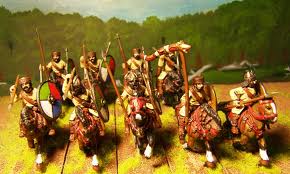
Athough the picture below contains models, it is assumed that this is how the exploratore units functioned. They traveled in small groups and on horses to remain highly maneuverable and quick.

In addition to the use of exploratores for reconnaissance missions, Caesar also used speculatores. Although they did have similar jobs, speculatores usually gathered information by working in disguise and spying on the enemy (Ezov, 80). Exploratores and speculatores both collected information about hostiles, but only speculatores were ever referred to as spies. Gathering intelligence regarding the enemy was their main duty, but in addition, they patrolled like exploratores, although they were usually involved guarding important people (Wikipedia).

Parallel to the situation of exploratores, we have little evidence to the size and organization of these units. Due to the particular missions of these men, conclusions can be drawn that most likely the units contained few men, if not alone, on a mission (Ezov, 83).

 Works Cited

Caesar, J. (1994) The Gallic Wars (trans. W.A. McDevitte and W.S. Bohn.).

Ezov, A. (1996). The “missing dimension” of c. julius caesar. Historia: Zeitschrift für Alte Geschichte, 45(1), 64-94.

Richmond, J. (1998). Spies in ancient greece. Greece & Rome, 45(1), 1-18.

Speculatores. (2011, October 14). Retrieved from http://en.wikipedia.org/wiki/Speculatores

Leave a comment

Filed under Cohort VII Scutum Decoris

Tribunus laticlavius

The Roman army started to form a new form of military ranks between the time of the late Republic and the time of Principate (753 BC to 476 AD). The Roman military was called a legion. “When recruits have been carefully selected who excel in mind and body, and after daily training for four or more months, a legion is formed by order and auspices of the invincible Emperor.” (Vegetius, page 34) In a legion, there are ten cohorts that are carefully selected by a person’s status. This includes family, honor, prestige, and money. The legion of the Roman army would fight primarily against the Germans and the Parthians. There were legions all throughout Europe and the map below are the legion camps that the Romans had settled into. (Wikipedia)

File:Roman Legions camps - AD 80.png

The head leader of a cohort was the legatus legionis but the second in command was the tribunus laticlavius. The laticlavius “broad-stripped tribune” was usually a younger gentleman whom was from one of the richest families in Rome and knew the legionary commander quite well (Wikipedia). The laticlavius was given the name because of the “broad purple striped tunic which contrasted the narrow stripe of the equestrian tribe.” (Maxfield)

The laticlavius was the typical rich, pretty boy who constantly asked the praefectus castrorum, the prefect, what to do or not do while he is guarding or actually on the senate. (Matyszak) If the legionis were to die in battle, the laticlavius took over the legion. (Wikipedia) However, usually the legionis did not die in battle, but was actually poisoned by a person from the cohort senate. Though the laticlavius was young and inexperienced, they were quick learners and had to take in charge quickly otherwise the cohort would not pay attention. They were trained to become commanders, and if there was a legionis before them, they were on the senate as guards and did not give a lot of orders or talk while in second command.

Works Citied

http://en.wikipedia.org/wiki/Tribunus_laticlavius

http://en.wikipedia.org/wiki/Roman_legion

Maxfield, Valerie http://books.google.com/books?hl=en&lr=&id=Nuex2PW7QR0C&oi=fnd&pg=PA10&dq=tribunus+laticlavius&ots=FJVqBxAkIF&sig=XIhCrSOzotuNMFw5kwmQgF5bNto#v=onepage&q=tribunus%20laticlavius&f=false

Milnder, N.P. “Vegetius: Epitome of MilitaryScience.” Vegetius: Epitome of Military Scienc. Second RevisedEdition. Trowbridge, England: Redwood Book, 1996. Print.

Matyszak, Philip. Legionary: The Roman Soldier’s Unoffical Manual. New York, New YorkT: Thames and Hudson, 2009. 91.

http://en.wikipedia.org/wiki/File:Roman_Legions_camps_-_AD_80.png

Leave a comment

Filed under Uncategorized

Legionary Life on Commemorating a Soldier

Tombstones laid for deceased soldiers were methods of displaying personal success and individual identity especially within the legion. The tombstones were often erected and executed by their comrades in arms. As most who received them either had purchased their burial rites before their death or were given to them by fellow soldiers (Hope, 87). A Roman soldier could pay into a burial fund while he was in the service. Likewise, a soldier could commemorate his life by having one constructed for him by his heir as a tribute to a life of service for Rome(Matyszak, 192-193).  These acts of recognition were dually a private affair and received for those servicemen who died off the battlefield. Hope asserts:

Rome and its empire were littered with reminders of battles, but it needs to be emphasized that theses ‘war memorials’ celebrated conquest, victory, and power, rather than death, grief, and individuality. In general, communal expressions of military loss, sacrifice, and mourning were not a feature of the Roman landscape.

On the battlefield death was to be dealt with as opportunity dictated. Burial was a matter of convince and practicality. Corpses on the field were unsightly as well as unhealthy. Most fallen soldiers were cremated and some given shallow graves. Precautions were taken by the surviving troops to limit desecrations to the graves but ultimately practicality gave way. Few corpses were transported home and permissions were only given for the elite. One reason being the large numbers of dead soldiers would deter future enrollment. Any mention of the soldier was likely praiseworthy, as funeral processions were to celebrate the glory and honor of Rome (Hope,87-88).

Hopes research helps us construct a society different than our own. But like she suggests we must be critical of our assertions and assumptions reasons being: incomplete evidence, different contexts with in the empire, and personal points of view. 

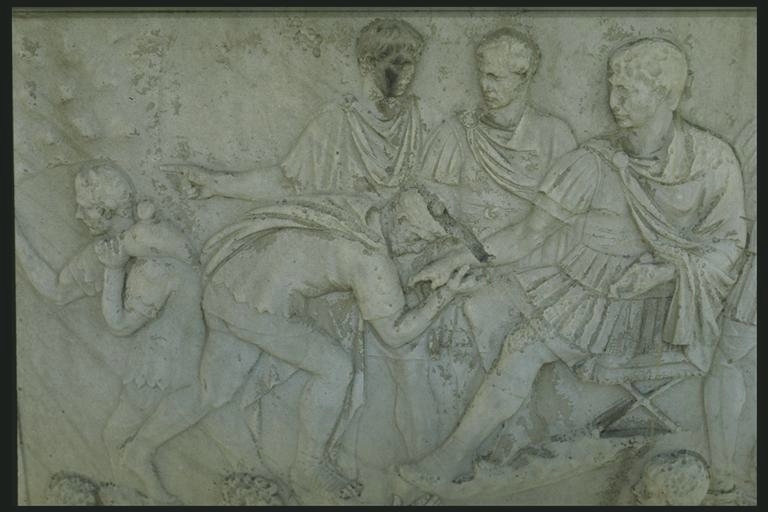
Tribute to Rome was ultimately paid to her conquering generals and emperors.  Monuments and structures such as Trajan’s Column were built to honor a successful campaign. The epitome of the emperors boasting was a triumph. A triumph as listed by Matyszak was parading of jovial generals and soldiers in which the roman civilians celebrated the success of the emperor and the army was congratulated by the people and by the emperor himself. After the parading the soldiers participate in rituals and later would spend a week partying. Hope states, “A triumph was a celebration of and for the living rather than the dead” (82). On both the scales of mega and micro, tribute was paid for success.

Scene 54. Trajan rewarding his troops. Used with permission. Copyright Peter Rockwell. Via http://www.stoa.org/trajan/images/hi/5.48.h.jpg

Contrasting the triumph as we learn from Livy, a Roman soldier’s death on the battlefield was to remain hushed, silent, and private (22.55).  As Hope puts it, “Trophies and triumphs were about forgetting the dead rather than remembering them” (84). The life of a slain soldier was likely meant to be forgotten and the people to move on. Death of a soldier on the battlefield was in no way a public affair.  Rather it was and isolated moment in which the family of the soldier could find solace. Not to say that death on the battlefield received no public attention for it did, but its recognition was fostered in a private and silent way.

Works Cited

Hope, Valerie M. “Trophies and Tombstones: Commemorating the Roman Soldier.” World Archaeology, Vol. 35, No. 1, The Social Commemoration of Warfare (Jun 2003), pp. 79-97  JSTOR  Web. Feb. 28 2012. 

Livy, Titus. “Livy’s History of Rome: Book 22 The Disaster of Cannae.” The History of Rome, Vol. III  http://etext.lib.virginia.edu/etcbin/toccer-new2?id=Liv3His.sgm&images=images/modeng&data=/texts/english/modeng/parsed&tag=public&part=2&division=div1  Web. 18 Feb. 2012.

Matyszak, Philip. Legionary The Roman Soldier’s (Unofficial) Manual.London: Thames andHudson. 2009. Print.

Rockwell, Peter. Trajan rewarding his troops. Trajan’s Column. Photograph. The McMaster Trajan Project.  1999. 28 Feb. 2012. Web.

2 Comments

Filed under Uncategorized

Standard-Bearers of the Roman Legions

In the Roman Legions, standards were very important. Every century, cohort, and legion had a standard. These symbols represented their units, acted as a symbol of unity and pride, and served as a rallying point during battle (McManus). During the Roman Empire, there were many different kinds of signifers: aquilifers that bore the legion’s eagle, imaginifers that carried an image of the emperor, vexillifers who bore a banner with the legion’s name and symbol, and signifers that carried a signum, a tall pole with an open hand, the symbol of the legionaries’ oath of loyalty (Wikipedia contributors). All signifers wore animal-skin headpieces in order to be distinguished from the normal soldiers (McManus).

Scene 113. Roman standard-bearers. Used with permission. Copyright Peter Rockwell. Via http://www.stoa.org/trajan/images/hi/2.84.m.jpg

Signifers had rather dangerous jobs in battle, but had relatively good jobs in day-to-day life. On the front lines in battle, a signifer could only carry a buckler (small shield) and did not have a weapon to protect himself. Polybius, when describing who is selected for the position of signifer, described them as “the bravest and most vigorous among the soldiers” (Polybius, History, Book 6). Although they would have to also be literate and good with numbers in order to act as bankers for the many members of the legion. Outside of battle, signifers were in charge of the legionaries’ pensions, meaning they had clerk-type work that would be done indoors. Matyszak suggests that putting the pension in the hands of the standard-bearer was beneficial because the legionaries would fight all the harder to protect him during battle (80).  Signifers were counted as officers, so they received twice the pay of a normal legionary (Breeze), which is not surprising, given the importance of all their duties.


Works Cited


Breeze, David J. “Pay Grades and Ranks below the Centurionate.” The Journal of Roman Studies 61 (1971):130-135. Print.


Matyszak, Philip. Legionary: The Roman Soldier’s (Unofficial) Manual. London: Thames & Hudson, 2009. Print.


McManus, Barbara F. “The Roman Army in the Late Republic and Early Empire.” VRoma. The VRoma Project, June 1999. Web. 28 Feb. 2012.


Polybius. History: Book 6. Trans. Oliver J. Thatcher. Constitution.org. Constitution Society, 1999. Web. 28 Feb. 2012.


Rockwell, Peter. Photo of Roman standard-bearers on Trajan’s Column. n.d. The Stoa Consortium. Web. 28 Feb. 2012.


Wikipedia contributors. “Signifer.” Wikipedia, The Free Encyclopedia. Wikipedia, The Free Encyclopedia, 5 Dec. 2011. Web. 28 Feb. 2012.

2 Comments

Filed under Cohort VII Scutum Decoris

The Budget of the Roman Empire

Roman Currency (Wikipedia Contributors)

While there is a relative shortage of accurate information about the finances of the Imperial era, it is assumed that state expenditures of the Roman Empire were first and foremost devoted to military payments. It is estimated that these expenditures most likely accounted for half of the revenues of the Empire. Whatever these revenues may have been they were eaten up so quickly that often taxes were increased (or invented) depending on circumstances (Southern, 75-76).

For the average legionary, military life was not a life of great wealth, even though “[Roman] soldiers formed part of the rare salaried class in antiquity” (Bohec, 209). The appeal of legionary life did not lie in an opportunity to earn a large fortune, or even anything resembling affluence. Why then did so many young recruits volunteer for service under rather unappealing conditions? The answer lies in looking outside of the military: conditions of daily life were not much better. When under military service, a “[soldier] could…look forward to regular meals, pay, and free medical treatment form an army doctor” (Herz, 307). Each soldier’s level of pay was blatantly uneven and not dependent upon task difficulty or capability, but upon social status (Herz, 308).

Polybius provides the first indication of the amount of a legionary’s stipendium (pay that initially covered a six-month time period). He states that legionaries received two obols daily, centurions double, cavalrymen a whole drachma (Brunt). Polybius’s drachma is taken to mean the Roman denarius which is the equivalent of 10 asses (Brunt).

Denarii

Denarii depicting various Roman Emperors (Wikipedia Contributors)

It has also been noted that the stipendium is not so much the equivalent of a modern day wage, but more a credit record to compensate for costs incurred by a legionary during the term of service, i.e. clothing, food and arms supplied by the Empire (Brunt). One example of deductions made for a soldier’s foodstuffs over the period of service indicated that “state deductions for provisions were usually higher than their cost, and that the state normally made a profit” (Herz, 311). The assumption has been made that generally, about two-thirds of a soldier’s gross income was kept back and remained under the control of the state (Herz, 311). Perhaps the most distinct example of pay deductions can be seen in a young recruit—with the necessary supply of weapons, clothing and food, a new legionary incurred a large deficit that could only be paid off after a few years of service (Herz, 314).

Although the costs of maintaining a functioning army were certainly the largest portion of the Roman budget, the political and economic benefits provided by the army’s existence cannot be translated into a financial figure. The stability and security provided by the army both internally and externally, as well as the valuable contributions to the infrastructure of the Roman Empire are astronomically important to the history of the Roman state, and “represented the largest organized and qualified work-force that was present throughout the empire” (Herz, 319). Though it was costly, the value of the Roman army was well worth the price required to sustain it.

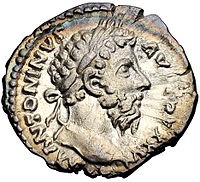
Denarius of Marcus Aurelius

Denarius of Marcus Aurelius (Wikipedia Contributors)

Works Cited:

Bohec, Yann Le. The Imperial Roman Army. Trans. Raphael Bate. Routledge, 2000. Print. 28 Feb. 2012.

Brunt. P. A. “Pay and Superannuation in the Roman Army.” Papers of the British School at Rome. Vol. 18. British School at Rome, 1950. Pg. 50-71. Web. 28 Feb. 2012. http://www.jstor.org/stable40301480.

Herz, Peter. “Finances and Costs of the Roman Army.” A Companion to the Roman Army. Ed. Paul Erdkamp. Blackwell Publishing Ltd, 2007. Web. 28 Feb. 2012. http://onlinelibrary.wiley.com/doi/10.1002/9780470996577.ch18/pdf

Southern, Pat. The Roman Army: A Social & Institutional History. New York: Oxford University Press, 2007. Print. 28 Feb. 2012.

Wikipedia contributors. “Denarius.” Wikipedia, The Free Encyclopedia. Wikipedia, The Free Encyclopedia, 27 Feb. 2012. Web. 28 Feb. 2012.

Wikipedia contributors. “Roman currency.” Wikipedia, The Free Encyclopedia. Wikipedia, The Free Encyclopedia, 24 Feb. 2012. Web. 28 Feb. 2012.

Leave a comment

Filed under Uncategorized

Legionary Selection and Training

The Roman Army did not begin as a finely tuned fighting machine, but it did develop into one.  In the beginning it mostly consisted of Roman citizens who were farmers.  Part of the reason the leaders would choose the type of man for the legion is because they were in good physical condition because the work they did was physically demanding. In the beginning men would join part-time and then the men would return home after a summer of fighting.  Under the leadership of the Roman general Marius, the army began to be more of a profession (Gill, 2012).

The recruitment of soldiers was the foundation on which the army was built upon.  The plan for their training was geared specifically for the requirements of the work which they would be expected to do.  It would take great skill and courage to be able to leap into a trench or the opponent’s line of battle and engage in the type of combat the Romans were notorious for.  The length of time that a soldier would be in training would depend on his condition, skills, and how quickly he could master the tasks that would be required of him.  It was important for the recruits to be skillfully selected, learn to use and care for arms, be in top physical condition and strong.  In addition they had to learn about every situation they may encounter in battle and how to deal with it, as well as learn to obey orders (Stout, 1921).

  According to Vegetius the new recruits should be judged according to their strength as well as their moral characture.  He could see no benefit to training a coward.  They had strict requirements such as height (between 5’10” and 6 ft. at the minimum), good eyesight, muscular build, and long fingers.  Part of the process of becoming a soldier would be giving him a tattoo with the official mark, but the man would have to prove himself before he could truly become part of the military.  The potential soldier would have to prove his mobility and strength, as well as be able to learn to use weapons and prove he had self-confidence. After he proved himself, he would receive the mark and begin to learn the “science of arms” in his daily training (Vegetius, 1996).

The Romans were known for their ability to build military training camps.  This is where the training would take place.  It really didn’t matter if the site was a permanent installation or a place to stay for the night, the Roman military was good at it.  Vegetius wrote, “one could almost say that the Roman military carried a walled town with them were ever they went.”  New recruits would be trained in the art of building these camps as well as entrenchments (Davies, Breeze, & Maxfield, 1989).

Once the soldier was placed officially in training he would have to endure a rigorous routine of training to do many things.  Examples of things that the soldiers were required to be good at are: military step, both running and in jumping, swimming in case there was no bridge to cross a river.  They also had to train with wooden swords that were heavy and shields that were made of wicker.  They were also taught to use the point and not the edge when they were in combat, this way they would do more damage to their opponents.  They were also proficient at throwing javelins and using arrows, firing stones with slings, and using lead weighted darts.  They had to learn to vault onto horses.  This was done by practicing with wooden horses.  In addition to all of the things mentioned they were expected to carry about 60 pounds of equipment while they were marching in full armor (Vegetius, 1996).

All of this rigorous training was designed to give the soldier strength, courage, and the ability to face the enemy without fear, because the soldier would know that he was superior to his enemy.

The image below is a sketch of a what a Roman soldier may have looked like when he was getting ready to face his enemy.


http://ancienthistory.about.com/od/romeweapons/p/RomanArmy.htm


References

Davies, R., Breeze, D., & Maxfield, V. A. (1989). Service in the roman army. New York: Columbia University Press.

Gill, N. (2012). The roman army and the roman republic. Retrieved from About.com: http://ancienthistory.about.com/od/romeweapons/p/RomanArmy.htm

Stout. (1921). Training soldiers for the roman army. The Classical Journal, 16(7), 423-431. Retrieved from http://www.jstor.org/stable/3288082

Vegetius. (1996). Epitome of military science (2 ed.). (N. Milner, Trans.) Liverpool: Liverpool University Press.


Leave a comment

Filed under Uncategorized