Category Archives: Uncategorized

Proffessional driver on a closed course. Do not use in actual war against Dacians.

I thought making a replica of legionary outerwear and armor would be a fun project. I just had no idea how fun.

The standard tunic was the easiest part, and probably the most accurate portion of my replica. A real Roman tunic would be made of wool, but in this case, muslin was much more easily available and cost-effective, not to mention an appropriate color to represent un-dyed wool. The neck was made by cutting a slit, and ‘sleeves’ were simply gaps in the stitching. “Many tunics were made with much longer neckslits” in a real legionary’s tunic, “so that for heavy work the right arm could be slipped out.” (Amt) However, I couldn’t foresee any ‘heavy work’ being done during the presentation, and I wanted the tunic to stay on securely, so the neck of my tunic was more fitted.

I was able to make the armor fairly accurate as well, and it was by far the most enjoyable part of the project. Strips of poster-board lined on both sides with duct-tape simulated 1st century “lorica segmentata:” plate armor clearly depicted on Trajan’s column. Ancient armor would have been steel bands “fastened to internal leather straps” which “surrounded the torso in two halves, being fastened at the front and back by means of brass hooks, which were joined by leather laces.” (Wikipedia contributors) But for ease of transportation and presentation, I chose to make my armor in one piece, rather than have to construct and deconstruct it and waste class time.

I was concerned that the armor might not fit perfectly, but I realized that not many soldiers could have afforded custom-made armor. “Some pieces of armor” that have been found and salvaged bore inscriptions of “The names of two, three, or even four men, generally successive owners.” A new recruit may have bought armor from a veteran, inherited it from his father or grandfather, or had it issued to him by the “custos armorum,” (MacMullen) so it makes sense that it wouldn’t be a perfect fit.

The sandals and helmet were the least accurate parts of my presentation, and the only parts I bought rather than constructing myself. Images from Trajan’s column don’t shed much light on Roman military footwear, only showing the occasional ankle strap or visible sole of a shoe. Fashion wasn’t really the column’s focus, and it didn’t help that many Romans seemed to go barefoot at times. Sources varied on whether legionaries wore sandals, or more boot-like leather shoes. All agreed that often “hobnails were hammered into the sole for added strength. Similar to the modern cleat.” (Wikipedia contributors)

Soldiers from the time of the Dacian wars depicted on Trajan’s column generally wore ‘Montefortino’ helmets, “named after the region of Montefortino in Italy,” where one such helmet was uncovered. Rather than the plumed crest of the costume piece I purchased, the average soldier’s helmet would have had “a raised central knob, and a protruding neck guard” Instead of the thin half-guard of the costume helmet. A Montefortino helmet also had “cheek plates to protect the sides of the head,” Not the stylized face-guard of the helmet I presented. (Wikipedia contributors)

All in all, each piece gave me a good jumping-off point to describe a Roman soldier’s typical outerwear, regardless of its relative authenticity. And while duct-tape armor may not hold up against a sword – or even a particularly heavy rain – I learned quite a bit, and had a lot of fun making it.

Used with permission, Copyright Peter Rockwell


Amt, Matthew R. “Tunic.” LEGIO XX ONLINE HANDBOOK. larp.com, 18 mar 2011. Web. 12 Apr 2012. <http://www.larp.com/legioxx/tunic.html&gt;.

MacMullen, Ramsay. “Inscriptions on Armor and the Supply of Arms in the Roman Empire.” American Journal of Archaeology. 64.1 (1960): 23-40. Web. 17 Apr. 2012.

Wikipedia contributors. “Montefortino Helmet.” Wikipedia, The Free Encyclopedia. Wikipedia, The Free Encyclopedia, 01 Feb 2012. Web. 12 Apr 2012. <http://en.wikipedia.org/wiki/Montefortino_helmet&gt;.

Wikipedia contributors. “Roman military personal equipment.” Wikipedia, The Free Encyclopedia. Wikipedia, The Free Encyclopedia, 08 Apr 2012 . Web. 12 Apr 2012. <http://en.wikipedia.org/wiki/Roman_military_personal_equipment

((Primary source is image from Trajan’s column))

Leave a comment

Filed under Uncategorized

Final Project- Ballista

Before the appearance of the ballista and other similar machines, the power of a weapon was limited to the frame of itself. Around 350 BC, the technology of a torsion powered machine was born (Nossov 136) Torsion machines uses ropes or animal cords tightly wound with a wooden arm in the middle to fire projectiles. By twisting the rope, these people were able to achieve greater power from their weapons and it was less likely to break their machines, just the ropes.

Although the original appearance of ballistae was around 350 BC, it wasn’t until roughly 334 BC that they started being widely used. Alexander was the first to start using these machines, which fired large arrows usually to take out soldiers, not structures (Nossov 136). As time progressed, they were adapted to throw stones. This meant the ballista was equipped with a larger frame and also metal parts began to be integrated into the construction to support the strain (Wikipedia 2012). With the capability of throwing stones, they were now able to take out structures rather than mainly soldiers. There is a wide variety of the calibers of stones used, each having its own purpose. The stones which were thrown ranged from 10 pounds up to 85 pounds; with the lighter stones being used primarily for defense and the heavier stones being used for offense (Nossov 138).

The ballista was a fairly simple weapon for the average soldier to operate; it worked similarly to a crossbow. Soldiers pulled levers at the rear of the machine to retract the pusher through a series of ratchets. All the energy was stored in the ropes, which carried a much higher potential energy than could have possibly been stored in

the wooden throwing arms. Due to this ratcheting system, it could be ready to fire in a moments notice. This weapon was highly accurate and there have been multiple accounts of skilled ballista shooters being able to take out enemy soldiers from a few hundred yards (Wikipedia 2012). Although they were highly accurate, they

Scene 40, Carroballistae. Used with permission, Copyright Peter Rockwell. http://www.stoa.org/trajan/buildtrajanpage.cgi?21

weren’t able to shoot very large projectiles and this eventually became the job of newly developed catapults (Nossov 150).

In this early version of a ballista, it can still be seen how they were used to fire arrows. These machines were relatively small, but that made it much easier to carry from place to place. As these weapons grew with new engineering techniques, they became more complex and had to be built more durably. As a result, metal was added to these machines, but this also made transportation more difficult. This required that they needed to be disassembled and reassembled at the site of war.

Works Cited

E. Schramm: Die antiken Geschütze der Saalburg. (Berlin 1918), S. 41 Abb. 14, 42 Abb. 15

Gurstelle, W. (2001). Backyard ballistics. (pp. 91-101). Chicago: Chicago Review Press.

Gurstelle, W. (2004). The art of the catapult. (pp. 60-69). Chicago: Chicago Review Press.

Nossov, K. (2005). Ancient and medieval siege weapons. (p. 136, 138, 150). Guilford: The Lyons Press.

Rockwell, P. (Photographer). (1999). Carroballistae. [Print Photo]. Retrieved from http://www.stoa.org/trajan/buildtrajanpage.cgi?21

Wikipedia. (2012, April 08). Ballista. Retrieved from http://en.wikipedia.org/wiki/Ballista

Demo:

Leave a comment

Filed under Class Stuff, Cohort VII Scutum Decoris, Final Projects - Cohort VII, Uncategorized

John Hawkwood the Condottiero

There were many kinds of knights in medieval Europe. Perhaps some of the most interesting were the condottieri, or mercenary knights. During approximately 1268 to 1513, political divisions caused by the “struggle between popes and emperors had promoted the growth of independent communes or city-states, particularly in northern Italy” (“Despots and Condottieri”). These factions struggled against each other, and often the cities hired condottieri “under contract to fight their wars” (“Despots and Condottieri”). The condottieri are controversial figures because of their pecuniary interest in armed conflict. It is important however, as a modern reader, to remember that “the lure of instant knighthood (the case of John Hawkwood) and wealth through pillaging attracted many to the recruiting campaigns, but no military man ventured to war in the fourteenth century without being paid wages” (Pratt 20).One of the most famous of these mercenary knights was John Hawkwood.

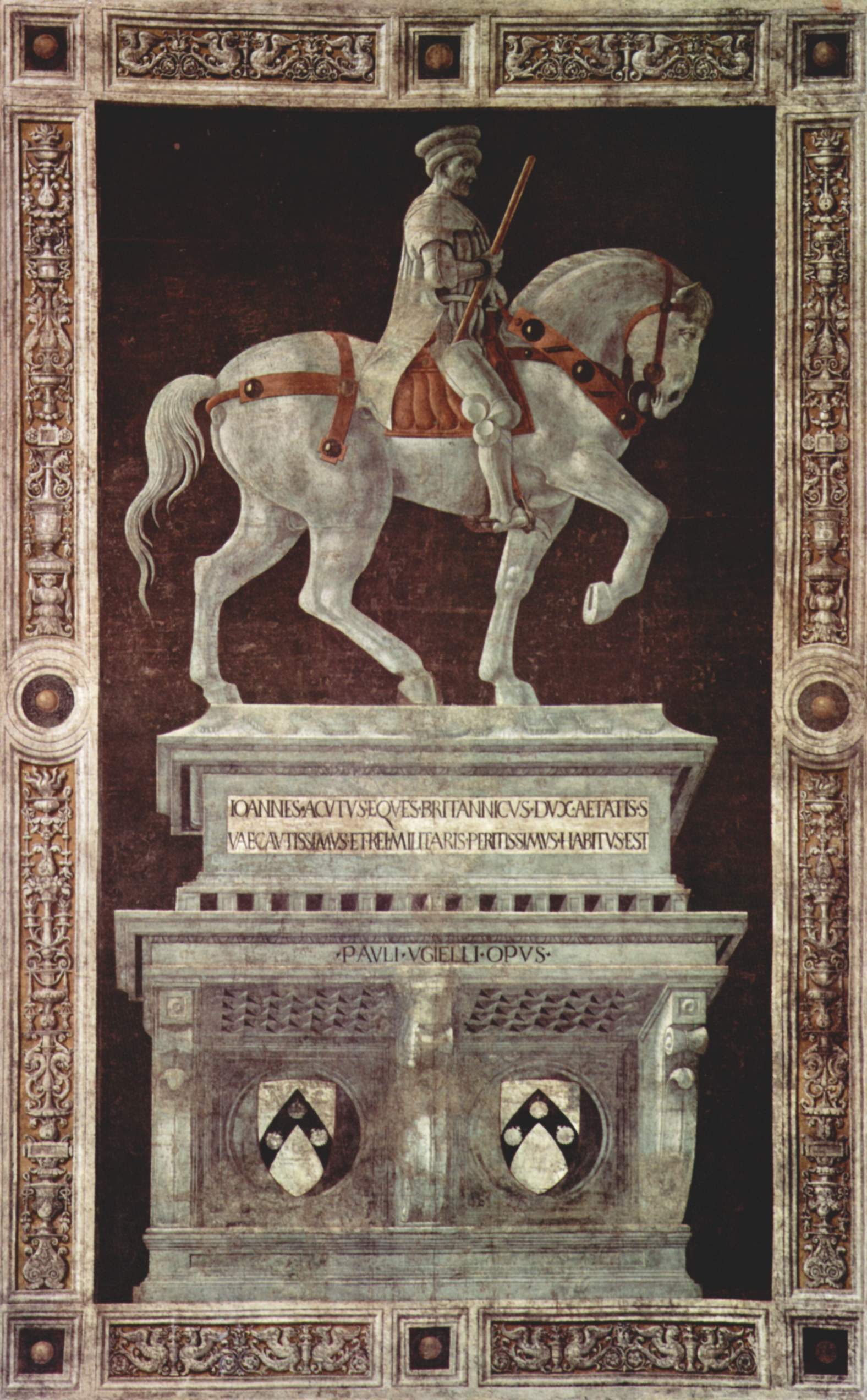
Figure 1. “Funerary Monument to Sir John Hawkwood.” Wikipedia, The Free Encyclopedia. Wikipedia, The Free Encyclopedia, 4 Apr. 2012. Web. 9 Apr. 2012.

John Hawkwood was born in England, but made a name for himself during his campaigns in Italy. He was a “soldier of immense ability….[a] tactician, strategist and inspiring leader” and additionally had  “the diplomatic skill to succeed in the complex world of Italian city rivalries” (Prestwich 11). His value as a soldier is emphasized by his employment record. Hawkwood worked for “Pisa, Milan, Padua, the Papacy, and above all Florence” (Prestwich 11). He was so successful in the Florentine campaigns that the city created a fresco in his honor (see Figure 1).

As a mercenary knight, Hawkwood’s character is surrounded by a great deal of propaganda. The fresco created in Hawkwood’s honor is clearly congratulatory. The horse has one foot raised in motion and is erect and dignified. Hawkwood also sits erect and is dressed in an Italian style hat that evokes a sense of loyalty to the Italian people. The inscription on the monument further honors Hawkwood. It reads, “‘Ioannes Actus eques brittanicus dux aetatis suae cautissimus et rei militaris pertissimus habitus est’ (John Hawkwood, British knight, most prudent leader of his age and most expert in the art of war)” (Wikipedia Contributors). All of this seems to indicate that Hawkwood was a beloved leader. It is important to note, however, that “the fresco was initially commissioned, decades after Hawkwood’s death, in 1433 by the Albizzi government, just months before the regime’s collapse” (Wikipedia contributors). These factors certainly influence the sentimental Hawkwood depicted in the piece. Though Hawkwood does seem to have been a very skilled man-at-arms, he also plundered (Prestwich 101) and appears not to have been entirely loyal to Italy as he intended to return to England at the end of his life (Wikipedia Contributors).


Works Cited

“Despots and Condottieri in Italy, 1268-1513: the Rise of the Nation.” Bigsiteofhistory.com. Big Site of History. Web. 10 Apr. 2012.

Pratt, John H. “Was Chaucer’s Knight Really a Mercenary?” The Chaucer Review 22.1 (1987): 8-27. JSTOR. Web. 10 Apr. 2012.

Prestwich, Michael. Knight: The Medieval Warrior’s Unofficial Manual. London: Thames & Hudson Ltd., 2010. Print.

Wikipedia contributors. “Funerary Monument to Sir John Hawkwood.” Wikipedia, The Free Encyclopedia. Wikipedia, The Free Encyclopedia, 4 Apr. 2012. Web. 9 Apr. 2012.

Leave a comment

Filed under Uncategorized

A Real Knight’s Tale

Many of us have seen the movie A Knight’s Tale, the story of William Thatcher’s adventures revolving around his impersonation of a knight named Ulrich Von Lichtenstein. But what few know is that ‘Ulrich’ wasn’t just a nom-de-guerre created for the Columbia Pictures Organization, but a real person.

Ulrich Von Lichtenstein was a “Prominent member of the nobility in Styria who was especially active in politics and poetry in the middle third of the thirteenth century.” (Heinen) He “was born in 1200 in… Present-day Austria,” but the rest of his life is not so easily ascertained by historians. His most famous work is the “supposedly autobiographical poetry collection Frauendienst” (Wikipedia contributors) which “Describe[s] a journey he made dressed as the goddess Venus, during which he took part in innumerable jousts and tournaments, all for the unrequited love of his lady.” (Prestwich)

Few can forget the image of William Thatcher bravely tilting against nobles and royals and winning the hand of the fair Jocelyn, but I’m sure the real Ulrich Von Lichtenstein (or at least his literary alter-ego) cut an even more memorable figure with a crowned Venus, “wield[ing] a red arrow and a flaming, red torch… ‘rid[ing]’ on [his] helmet as he rides on his horse, triumphing over him” even as he bested other knights. His choice of clothing represents not only his love for his chosen lady, but the metaphorical triumph of Venus over Mars, of love over warfare. That the power of Venus often bested even “Hercules, Paris, Achilles, Troilus, Aeneas, Samson, Tristan, and Lancelot.” A knight had his duties to his superiors and his code, but all were “overcome by a triumphant Venus at one point or another.” (Baldwin).

Ulrich von Lichtenstein, from the Codex Manesse, 1305

Baldwin, Robert. “SocialHistoryofArt.com.” German, Poet-Knight [Ulrich von Lichtenstein] Rides into Battle Under the Crest of Venus, from the Codex Manesse, ca. 1300 . Robert Baldwin, 02 Mar 2012. Web. 2 Apr 2012. <http://www.google.com/url?sa=t&rct=j&q=&esrc=s&frm=1&source=web&cd=4&sqi=2&ved=0CD4QFjAD&url=http://www.socialhistoryofart.com/Baldwin%20%20The%20Knight%20of%20Love%20in%20the%20Manesse%20Codex.doc&ei=Z7yAT5K4CorjiAKEqeWIAw&usg=AFQjCNFj-CrFrax1BQuXc0Gt-F9TeOb29A&gt;.

Scholar: Heinen, Hubert. “Ulrich von Lichtenstein: “Homo (il)litteratus” or Poet/Performer?.” Journal of English and Germanic Philology. 83.2 (1984): 159-172. Web. 2 Apr. 2012. <http://www.jstor.org/stable/27709309&gt;.

Prestwich, Michael. Knight the Medieval Warrior’s Unofficial Manual. New York: Thames and Hudson, 2010. 83. Print.

Wikipedia contributors. “Ulrich von Liechtenstein.” Wikipedia, The Free Encyclopedia. Wikipedia, The Free Encyclopedia, 04 Mar 2012. Web. 5 Apr 2012. http://en.wikipedia.org/wiki/Ulrich_von_Liechtenstein

((Primary source is my image.))

Leave a comment

Filed under Uncategorized

The Demise of the Templar Knights

The Poor Fellow-Soldiers of Christ and of the Temple of Solomon (also known as Knights of the Order of the Temple or Templar Knights) established in 1118 were monastic knights who practiced and vowed celibacy, humility, and poverty in the name of their Lord. They held high standards, but also they were knights who took up the sword to defend the truth and help protect and expand their Christian disciples (William of Trye). Clairvaux records:

They are seen [to be] both more gentle than lambs, and more ferocious than lions, that I almost doubt what I should prefer them to be called, namely monks or knights, unless I should call them in fact most suitably by both [names], in whom neither is known to be lacking, neither the gentleness of the monk nor the strength of the knight (qtd. in Menache, 3).

The first knights held their white mantles high, protecting weary, Christian pilgrams. Achieving endorsement by the Catholic Church around 1129 A.D. the order grew in power defending with prowess in the crusades for the church. The order established and maintained commanderies in every state in Europe, including France which inclueded 42 strongholds. One such example was Castle Pilgrim which offered cavalry/barraks  as well as chapels to the knights ( Moeller). The Order later answered only to the church and was ratified from obeying any laws except for the Pope’s. Soon the Templars amassed large amounts of monetary support and estates,  achieving “innovating financial techniques that were an early form of banking” (Wikipedia).

Templars being burned at the stake. Illustration From the Creation of the World until 1384. Out of Copyright in the United States.

As the Arabic world unified under Saladin, the Templars noble order, after time degraded and entropy set in. Its noble deeds and chivalric esteem was lost or rather abandoned. William of Trye observed with a critical eye,

in the same year, certain noble men of knightly rank, religious men, devoted to God and fearing him, bound themselves to Christ’s service in the hands of Lord Patriarch. They promised to live in perpetuity as regular canons, without possessions, under vows of chastity and obedience…Although the kings now had been established for nine years, there were still only nine of them. From this time onward their number began to grow and their possession began to multiply…It is said today that their wealth is equal to the treasures of kings…Although they maintained their establishment honorably for a long time and fulfilled their vocation with sufficient prudence, later,  because of the neglect of humility (which is known as the guardian of all virtues and which, since it sits in the lowest place, cannot fall), they with drew from the Patriarch of Jerusalem, by whom their order was founded and from whom they received their first benefices and to whom they denied the obedience which their predecessors renders. They have also taken away tithes and first fruits from God’s churches, have disturbed their possessions, and have made themselves exceedingly troublesome.

This troublesomeness was an array of sinful and treacherous deeds against the Catholic Church and secular associations including the crown. These deeds included: Greed, bribery of the enemy and betrayal of the Crusade, drinking, profanity, sexual sins (including sodomy), disavowing Christ, the Virgin Mary, and the Saints, and having graven images (Menache).

The abolition of the Templar Knights by Pope Clemet V occurred around 1312 A.D. Menache suggests, society of the time disdained their deeds, but perhaps even more so because of their monastic vows. Although the Templars were not held in high esteem by noble or common folk, King Philip IV may have had more than moral or religious reasons for disbanding the Order. King Philip focused on religious propaganda rather than the treachery against the crown to persuade society in favor of the king and against the order. Philip wanted control over the financial assets which grew within the order from its infancy. Ramifications against the order included both Spiritual and temporal penalties (12-13). Another reason might include that the order was protected and controlled by the Church.

Despite the unfavorable opinion held by the public, the members of the order in France could only be convicted by confession. The French King cunningly employed torture as a means to indict them (some in-front of the Pope) (Moeller). Ultimately, the Pope divided its assets into the Order of Hospitallers and many of the  innocent Templar knights were taken in by that order.

Works Cited

Bibliothèque Municipale, Besançon, France. Erich Lessing/Art Resource, NY. http://de.wikipedia.org/wiki/Bild:Templars_on_Stake.jpg de:Benutzer:Lysis Eingescannt aus: Louis Crompton, Homosexuality & Civilization. Cambridge, Mass.; London 2003. S. 196. Web. 5 Apr. 2012.

“Knights Templar.” Wikipedia. Wikimedia Foundations. Apr. 2 2011. Web. Apr 5 2012.

Menache, Sophia. “The Templar Order: A Failed Ideal?.” The Catholic Historical Review, Vol 79, No. 1 (Jan. 1993). pp. 1-21. via < http://www.jstor.org.hal.weber.edu:2200/stable/25023942&gt;. JSTOR. Web. 5 Apr. 2012.

Moeller, Charles. “The Knights Templars.” The Catholic Encyclopedia. Vol. 14. New York: Robert Appleton Company, 1912. 7 Apr. 2012 <http://www.newadvent.org/cathen/14493a.htm&gt;. Web. 5 Apr. 2012.

William of Tyre, Historia rerum in partibus transmarinis gestarum, XII, 7, Patrologia Latina 201, 526-27, Trans. Brundage, James.  The Crusades: A Documentary History, (Milwaukee, WI: Marquette University Press, 1962), 70-73. Web. Accessed 5 Apr. 2012. from Medival Sourcebook: The foundation of the Order of Knights Templar via <http://www.fordham.edu/halsall/source/tyre-cde.html#templars>.

Leave a comment

Filed under Uncategorized

Cité de Carcassonne


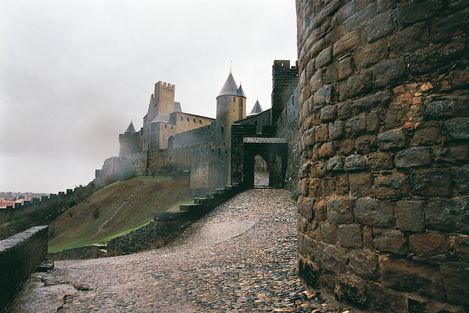
Walking along one of the outer ramparts

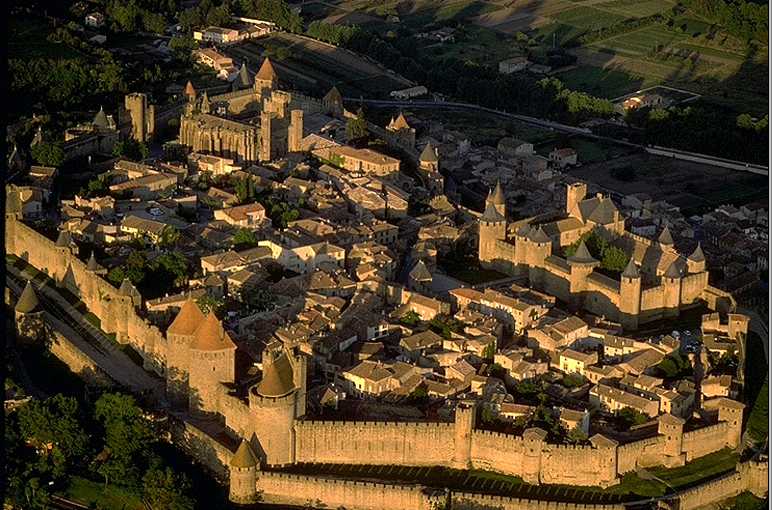
Located in the south of France, the Fortress of Carcassonne is an outstanding example of medieval defense. Positioned in the Languedoc-Roussillon region near the border of Spain, the location of Carcassonne has been occupied for thousands of years, the earliest proof dating to the 6th century BC. When Gaul was absorbed into the Roman Empire, the Celtic settlement that was Carcaso Volcarum Tectosagum, became the Latin Colonia Iulia Carcaso in 27 BC (UNESCO).

Control changed hands several times over the centuries, from Celts, to Romans, to Visigoths, to Saracens, and lastly, to the Franks under Pepin the Short. The last count of this dynasty was childless and without heirs. In 1067 AD, Carcassonne became property of Raymond Bernard Trencavel, Viscount of Albi and Nimes, when he married the count’s sister.

Interior of Carsonne's Basilica de Saint-Nazaire

The Trencavel family built the Chateau Comtal (Castle of the Counts) and the Basilica of Saint-Nazaire (a Romanesque-Gothic style cathedral). The reign of the Trencavels ended during the Albigensian Crusades, where the Pope declared war on the Cathars of Southern France. In 1209 the crusading army of Simon de Montfort terrorized the neighboring city of Beziers. Distinguishing between the Cathars and Catholics living  in the city was easy for the army; the decree being ‘kill them all, God will recognize His own.’

After that, Beziers was looted and burned. Marching west, the Crusaders arrived at Carcassonne, demanding surrender. The terms of the surrender allowed the twenty-four year old viscount, Raymond-Roger Trencavel, and eleven companions to leave the city unharmed. Raymond-Roger refused. The only weakness of the strongly fortified, bravely defended city was its moderate distance from the nearest river. The crusaders quickly cut off the defenders’ water supply by denying them access to the River Aude. Wells in the town were drying up, due to the intense August heat and to additional water consumption by the refugees from Beziers. Morale was sinking as the crusaders offered another form of surrender: all of their lives would be spared if they left everything behind, and abandoning Carcassonne wearing nothing but shirts and breeches. Raymond-Roger met with the besiegers under the law of safe conduct to discuss and accept the terms. Going back on their word, the crusaders did not allow him to return to the city but instead captured him. He died under mysterious circumstances, found dead in his own prison a few weeks later (History Today). According to the terms, the Cathars left. Simon de Montfort became the new Viscount of Carcassonne, adding new fortifications to the walls. In 1247 the city became a part of the kingdom of France under King Louis IX. He and his successor, Philip III built the outer ramparts (Wikipedia Contributors). Cité de Carcassonne had become so well fortified that not even the Edward the Black Prince could break through its defenses.

Aerial view of the 'Cité de Carcassonne'

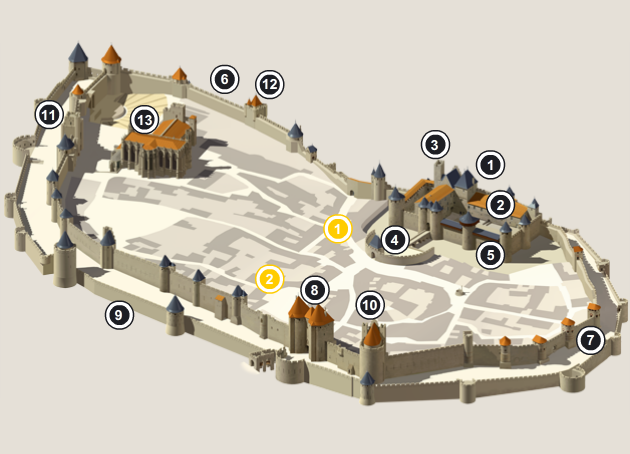
Aerial diagram of Carcasonne. (1) Count's Castle. (4) Defensive entrance to the Chateau. (7) Gallo-Roman Ramparts. (9) Deuxieme Enceinte (or 2nd wall). (13) La Basilique Saint-Nazaire

Works Cited

Froissart, Jean. Chroniques de J. Froissart : 1346-1356 (Depuis le siege de Calais jusqu’à a la prise de Breteuil et aux preliminaires de la bataille de Poitiers).  Google eBook. Web. 5 Apr. 2012. http://books.google.com/books?id=3_kUAAAAQAAJ&dq=froissart+carcassonne&lr=&source=gbs_navlinks_s

“Carcassonne Falls In The Albigensian Crusade.” History Today 59.8 (2009): 10. Academic Search Premier. Web. 5 Apr. 2012.

“Historic Fortified City of Carcassonne”. UNESCO World Heritage Centre. Web. 5 Apr. 2012. http://whc.unesco.org/en/list/345

Wikipedia contributors. “Carcassonne.” Wikipedia, The Free Encyclopedia. Wikipedia, The Free Encyclopedia, 23 Mar. 2012. Web. 6 Apr. 2012.

http://carcassonne.monuments-nationaux.fr/#details (diagram pic)

http://mescladis.free.fr/ANGLAIS/pages%20html/history.htm

http://www.castles.francethisway.com/chateau-carcassonne.php


Leave a comment

Filed under Uncategorized

Crusades: Past and Present

The Crusades all started because the Christians had lost the Holy Land to the Muslims. Thus, the Pope of the Catholic Church, Pope Urban II, said for his people to fight to the death for Jerusalem. Jerusalem was rightfully that of the Church and not people who did not believe that Jesus was the son of God. Thus the first Crusade started against Western Europe (Spain, France, and other followers of the Roman Catholic Church) and the Middle-East as well as Muslim followers in 1095-1099. Pope Urban said that, “Pope Urban II called upon all Christians to join a war against the Turks, promising those who died in the endeavor would receive immediate remission of their sins.” (Wikipedia) In the picture below, it showed how the Christians had won their first battle against the Muslims and that Godfrey of Bouillon had taken over Jerusalem.

However, the question that poses now is the fact that the tables have turned and the Muslims are fighting against the Christians because it is their “Jihad” to get rid of the infidels. The “Jihad” is the Holy War that the Muslims have been told to fight against the infidels such as America to advance the rein of Islam. (Wikipedia) How is this different from the Crusade that the Christians almost one thousand years ago? Christians and the Western world do not think that they have ever had something such as a Jihad and something like what happened on September eleventh. However, the Crusades that happened about 200 years had killed thousands, and maybe even millions of people. The Christians had a “Jihad” just as the Muslims do now, but it happened so long ago that no one seems to mention it now. But, it is the same idea; A holy war that with every person who dies on the right side, will go to heaven for the sake of religion.

Works Citied:

http://books.google.com/books?hl=en&lr=lang_en&id=C8h_VjG4ucsC&oi=fnd&pg=PR11&dq=Crusades&ots=eJMcfTPDAx&sig=wCmrwICfbQnmlsrTQhbjmpd8KLs#v=onepage&q=Crusades&f=false

http://icp.ge.ch/po/cliotexte/le-moyen-age/dossier-islam/Dossier-islam_fichiers/image007.jpg

http://en.wikipedia.org/wiki/Jihad

Leave a comment

Filed under Uncategorized

Becoming a Knight

Becoming a knight requires a certain set of circumstances.  It is often something that runs in families for the most part.  There are rituals and rites of passage that a man must undergo to receive the title.  The process begins when he is very young.  In most countries knighthood was reserved for nobility.  It was an expensive occupation and the man would need to be able to live a life where he did not have to work for the money to pay the equipment that was required. (Prestwich, 2010).

The son of a nobleman or a knight, a boy would most often begin his path to knighthood by being sent to live in a lord’s castle.  There he would serve as a page and learn to handle a horse, use a sword and practice archery, as well as perform other duties around the castle.  At the age of 10 he would be eligible to begin training as a squire, but this would depend on his physical size.  For some boys, it may not have been until they were 14 years of age.  For squires, training focused on strength, fitness and horsemanship, because a knight had to be strong, and skilled in the art of fighting while riding a horse.  Squires were also responsible for taking care of the knight’s horses.  Their duties consisted of cleaning stables and polishing the knight’s armor. He would also have lessons in chivalry because it is a very important part of being a knight (Training a Night, 2000).

The age when the boy would be considered a man and eligible to become a knight was usually 21.  It was known as the age of majority.  There are some instances where nobles where given the status of majority as early as age 15.  The reason for the age restriction was that a knight had to by physically strong and mature to be able to perform the duties of being a knight (James, 1960).

Observing and living the code a chivalry was as important as being trained to perform military duties.  They were asked to “Protect the weak, defenseless, and helpless and fight for the general welfare of all.” The image of a knight included owning expensive weaponry and being an impeccable horseman (Knights, 2012).

When a perspective knight had fulfilled all the requirements he would go through the ceremony of knighthood.  He would be bathed, which would serve as a symbol of going into the water a man and coming out of the water a knight.  He would then be given certain items of clothing which were also symbolic.  For instance, a red tunic symbolized willingness to shed blood, black stockings  symbolized mortality, a white belt symbolized chastity. After he was dressed, he would then proceed to the ceremony which was usually in a church (Prestwich, 2010).

Each knight had a unique code of arms which was used to identify him and used to cover his amour.  It design was unique to the individual and his family. The Dering Roll which is displayed below was used as a document to list the knights who owed the lord a debt of feudal service.  It was created between 1270-1280 and contains the coat of arms of 324 knights (Dering Roll of Arms, 2012).

Resources

Training a Night. (2000). Retrieved from Medivial Life.net: http://www.medieval-life.net/knight_training.htm

Dering Roll of Arms. Retrieved from http://en.wikipedia.org/wiki/File:DeringRoll.jpg

Knights. (2012, April 3). Retrieved from Wikipedia.org: http://en.wikipedia.org/wiki/Knights

James, E. (1960, Jan). The Age of Majority. The American Journal of Legal History, 4(1), 22-33. Retrieved from http://www.jstor.org/stable/844549

Prestwich, M. (2010). Knight. London: Thames & Hudson Ltd.

Leave a comment

Filed under Uncategorized

Things that make you go…..BOOM

In the Dark Ages warfare was a constant state of life. With this constant fighting new ways to defend from attacks created Castles. Once castles and fortifications began changing warfare new methods to overcome these defenses were formed. Siege weapons were the order of the time to defeat castles and similar fortifications. One of the many forms of siege weapons was one of the most feared, and psychologically damaging, sappers.

Imagine for a moment you are on top of a wall fighting against an opponent when there is a low guttural rumble under your feet, suddenly your whole world is turned on its head as the section of wall you were standing on is now crumbling into a gaping hole in the ground and strewn across the castle grounds and surrounding areas, if you were lucky enough to survive.

Example of tunneling under a wall.

Sappers were one of the best weapons for causing mass havoc and ending sieges. These troops would dig tunnels underneath the walls of the castle that was besieged, create large voids, or caves, that were supported by wooden pillars as the earth was removed. Once the caves were large enough the caverns would be filled with combustible materials and then ignited. These fires would destroy the supporting timbers and then, boom, down comes the wall.

One of the best accounts of how effective sappers were comes from a monk who wrote “… after the top of the wall had been somewhat weakened by bombardment from petraries, our engineers succeeded with great difficulty in bringing a four-wheeled wagon, covered in oxhides, close to the wall, from which they set to work to sap the wall” (Historia Albigensis – Pierre des Vaux de Cernay, 53).


Works Cited

Cernay, Peter of les Vaux de. Historia Albensis. 1218. Print.

http://www.medievalwarfare.info. 2010. 4 April 2012.

Marvin, Laurence W. “War in the South: A First Look at Siege Warfare in the Albigensian Crusade,1209–1218.” War in History (2001): 373-395. web.


Leave a comment

Filed under Uncategorized

The Upbringing of a Knight

Great knights of medieval times were reared and trained from a young age. A young boy’s early life was dictated by this ambition. Years of training and careful upbringing contributed to the prestigious accomplishment of becoming a knight, and potential candidates for knighthood were expected to display certain qualities (Prestwich, 13). Initially, the qualities of knighthood would manifest and then be fostered through play and activities. As the boy grows, he will subsequently become a page and then a squire if he displays and develops the right skills and qualities (“Knights, Squires and Pages”).

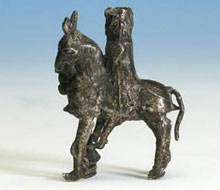
Similar to modern day children, activities and entertainment during medieval times was primarily a small scale replication of adult life. Model toys imitating common objects used by adults have been traced back as early as the 1300’s (“The Culture of Children in Medieval England”; Orme, 53). Similar to toy soldiers of today, fragments have been discovered “portraying knights in armour on horseback” (“Culture…”; Orme, 53).

[Museum of London: replica of a mounted knight; alloy of tin and lead]

(“Childhood in Medieval England”; Orme)

Play also became a form of military training in itself. “The liking of children to imitate adults in their play is very ancient, if not natural to humanity” (“Culture…”; Orme 63). Children during medieval times modeled their play after kings and knights, but this had the potential to turn into a “mimicry of their wars and battles” and children were often hurt, or even killed in these mock military engagements (“Culture…”; Orme 63-64). Often young noble children were given small scale weapons to practice with. Young Henry V is said to have had a sword at the age of nine (Prestwich, 20).  Research also indicates that a royal statute in 1512 required that “every man with boys in his house, aged from seven to seventeen, was to provide them with a bow and two arrows and bring them up to shoot. Play became formally merged with military training” (“Culture…”; Orme, 63). This merger of military training and childhood activities played a significant role in a young boy’s potential for knighthood later in his life.

Although a boy began his journey toward knighthood in his own home, but he could not be expected to acquire all the necessary skills and experience without specific guidance (Alchin). Around the age of seven many boys were sent to become pages where they were able to gain an education at the hands of a nobleman and his wife (Prestwich, 14). This education included: caring for and using military equipment, learning proper manners at court, learning to read and write, riding and handling horses, practice wielding lance and sword, and gaining the necessary physical strength and stamina to endure difficult training and future battles (Prestwich, 14-19).

After years of being trained as a page—around the age of fifteen—a young prospective knight could become a squire (“Knights, Squires and Pages”). Each squire would continue his training in the service of a knight, and hopefully after acquiring and proving that he possessed all the necessary skills, the young squire would “receive the accolade of knighthood” (Prestwich, 21).

Works Cited:

Alchin, Linda. “Steps to Knighthood.”  Middle Ages. 2 April 2012. www.middle-ages.org.uk

Orme, Nicolas. “The Culture of Children in Medieval England.” Past & Present, 148. (1995): 48-88. JSTOR. PDF file. 2 April 2012. http://www.jstor.org/stable/651048.

Orme, Nicolas. “Childhood in Medieval England, c. 500-1500.” Historical Essays, University of Pittsburgh. (2005). 2 April 2012. http://www.representingchildhood.pitt.edu/medieval_child.htm

Prestwich, Michael. “Upbringing & Training.” Knight: The Medieval Warrior’s Unofficial Manual. London: Thames & Hudson, 2010. Print.

“Knights, Squires & Pages.” The Middle Ages for Kids. 2 April 2012.  http://medievaleurope.mrdonn.org/knights.html


Leave a comment

Filed under Uncategorized