Category Archives: Uncategorized

Composite Bows: Weapon of Ancient Nomadic Equestrian Cultures

Types of bows

Introduction

Archery is simple in concept, yet it represents an extremely sophisticated  technology. In its most basic form, a bow is a piece of wood slightly bent and held in tension by a connecting bowstring. However, as the bow is drawn, tensile stress increases along the back or outside curve simultaneously with compressive forces developing along the inside curve or belly. (Knecht) The bow stored the force of the archer’s draw as potential energy, then transferred it to the bowstring as kinetic energy, imparting speed and killing power to the arrow.

Advantages and Construction

Like its namesake, the composite bow combines different materials (wood, sinew, and horn)  and utilizes them fully, creating a mechanical tour de force. Specifically, the sinew on the back handles tensile stress, while the horn on the belly has 3.5 times more compressive strength than wood (Knecht).  It starts with a wooden core of maple, poplar, or ash. The core can be any type of wood, so long as glue can stick to it easily, it is flexible and bends easily, and has a straight grain, to avoid twisting of the limbs(Knecht). The core is thin, acting more like a spacer and surface to which the horn and sinew was attached. Its thinness also reduced the overall weight of the bow. Composites are made of multiple pieces, each joined with animal glue in V-splices to allow for the sharp bends that many recurve bows require. Water buffalo horn is the most common, although gemsbok, oryx, ibex and Hungarian grey cattle horns are also used (Wikipedia Contributors). Sinew, generally the Achilles tendon or back tendons of wild deer, is soaked in glue and applied in layers on the back of the bow. After attaching the sinew, the bow was placed in a cool, dry location to allow the glue to set. After six months or more of drying, the bowyer slowly bends the bow into its final shape, adjusting to make sure the limbs will draw evenly . Finally, a waterproof covering of thin leather, bark, or snakeskin is added. Scythian and early sarmatian bows were short at 3 ft, the handle set back and the limbs curving with slightly curled ends, middle to late sarmatian and hunnic weapons were longer at 5 ft (De Souza).

Unstrung, strung, and drawn composite bow & Cut out diagram of construction materials

A bow can store no more energy than the archer is capable of producing in a single movement of the muscles of his/her back and arms, but the composite recurve released the stored energy at a higher velocity, thus overcoming the arm’s inherent limitations (Encyclopedia Britannica). Longbows are bigger, heavier, and shoot at a lower velocity. Composites not only shoot with greater velocity, they are much smaller and lighter, making them perfect for horseback archery. A prime advantage of the composite bow was that it could be engineered to essentially any desired strength, the bowyer being able to produce a bow capable of shooting light arrows at long range, or maximize penetrative power of heavy arrows. (Encyclopedia Britannica) Composites are mechanically superior to wooden bows as the horn and sinew made it capable of standing greater compression while maintaining more elasticity. The steppe bow could transfer most of its energy to the arrow, thus allowing it to shoot farther than a bow of equal draw weight, a typical cast being 300 meters (Szabó).The more powerful composite bows, being very highly stressed, reversed their curvature into a complete ‘C’ shape when unstrung. They acquired the name recurved since the outer arms of the bow curved away from the archer when the bow was strung, imparting yet another mechanical advantage at the end of the draw.

Historical Context

The composite bow appears to have developed in separate regions but at roughly the same time, in cultures in Mesopotamia, Anatolia, and the Eurasian Steppes. The earliest surviving examples of composite bow is western Asian angular bow that appeared during 3rd Millennium BC. (Knecht)

Akkadian Stele from the 3rd Millennia BC. Depicts composite bows utilized by army of Sargon of Akkad

In 1992, from among the Egyptian artifacts in Tutankhamun’s Tomb, Howard Carter recovered 32 angular composite bows along with arrows, quivers, and bow cases (Knecht). These bows are an earlier form that made a shallower angle and had shallower recurve limbs. Replicas of these suggest that the angular composite bow provided Egyptian archers with a smooth accurate and high powered shot. The short length of these bows made them lightweight and maneuverable, highly suited for chariot-borne archers. (Knecht)The introduction of composite bow, stronger and more effective than the simple bow, was part of a striking change in military technology at the beginning of the Pharaonic New Kingdom. This modernization was to keep pace with the military innovations of neighboring countries and prevent any recurrence of a foreign incursion like that of the Hykso, who had possession of composites,  in the second intermediate period (1650-1550bc). (Knecht)(Wikipedia Contributors)

The most prominent form of composite bow is a design referred to as the Scythian bow, known to the Romans as Sythicus Arcus. (Knecht) Its form became fully developed under the Cimmerians by the 9th century BC. The Scythians, originally from Iran (De Souza) moved into the Pontic Steppe north of the Black Sea in the 8th Century BC. Records from 700 BC onward mention composite bows being used by the Cimmerians and Scythians, who attacked the kingdom of Urartu and ravaged the Anatolian kingdoms of Lydia and Phrygia (Szabó). In the next century, they raided Assyria, Damascus, Phoenicia and Israel, up to the Egyptian border. The prophet Jeremiah wrote: “At the sound of horsemen and archers, every town takes to flight.”( Szabó) It is impossible to discuss recurve composite bows without recognizing the equestrian cultures that developed them. Eurasia is a series of connected regions of flat, grassland steppe. As mentioned by Herodotus, “they [the Scythians] are all mounted archers who carry their homes along with them and derive their sustenance not from cultivated fields but from their herds…their land and their rivers support this way of life.” The land there is perfect for grazing animals like horses and cattle, leading the cultures there to develop around that. Steppe nomads excelled in horse husbandry and horseback riding, developing equestrian culture of decorated saddlery and harness, herding tools and clothing fashions. Characteristic also of the black sea hinterland and the lands down to northern Greece are finds of gold sheet covers for bow case and quiver combinations, called gorytoi. These demonstrate that the bow was carried strung on the horse archer’s left side. (De Souza)

Scythian bow artifacts
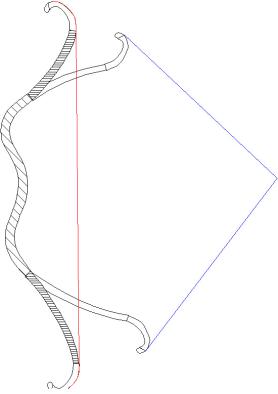
Diagram of drawn Scythian bow

For other goods not provided by their herds, like grain, textiles, and metalwork, nomads traded with their sedentary neighbors. They could also just take things by force.  Horse archers could shoot their bows in a near 360 degree arc from a fast moving platform. This meant that mounted-archer warfare was mobile and fluid, operating in a cloud of riders, concentrating on specific targets and then wheeling away out of reach when threatened (De Souza). Shooting was rapid and at close range to defeat armor. All horse archers could shoot backwards as they withdrew in a ‘Parthian shot’. The appearance of nomad hordes often bewilderingly sudden and unexpected. The mobility of horse archer groups meant they could range widely in short time and numbers difficult to estimate accurately. Nomads could also campaign much more effectively than sedentarists in winter, when steppe horses could forage in deep snow, and summer obstacles such as rivers and marshes were frozen over. (De Souza)

In 513 BC, King Darius I of Persia invaded Scythia. The Scythians sent their women and children to a safe place and simply let the Persians chase them all over the steppe. Their strategy was to exhaust and harass the Persians with archery and cut them off from supplies(Szabó). They laid waste to the countryside, so the Persians would be unable to forage. Darius withdrew, and Persia was never able to conquer Scythia.

Recurve bows depicted on the walls of the Palace at Susa

From images on the walls of Darius’ palace at Susa, it is likely that the Persians adopted the composite bow from their encounter with the Scythians. During the Greek invasion, at Plataea, “the [Persian] horsemen rode out and attacked, inflicting injuries on the entire Greek army with their javelins and arrows, for they were mounted archers and it was impossible for the Hellenes to close with them” (Herodotus).

Alexander the Great was one of the only commanders who successfully defeated a mounted archer army on his first try. In 328 BC, Alexander battled with Saka and Massageta nomads at Syr Darya, on the very edge of the nomad’s arid steppe (Szabó). It was the first ever defeat of nomadic cavalry by settled agriculturalists, but it was close. Of the 4500 nomadic horsemen, only 800 were dead. Having sustained a considerable loss already, Alexander wisely chose not to follow them into their own lands.

Parthian Shot Coin. Mounted archery shot in which the rider turns in the saddle and shoots backward. Made famous by references to Parthians, but really, any skilled horse archer could do it

“They are really formidable in warfare….. the Parthians make no use of a shield, but their forces consist of mounted archers and lancers, mostly in full armour. Their infantry is small, made up of the weaker men; but even these are all archers. The land, being for the most part level, is excellent for raising horses and very suitable for riding about on horseback; at any rate, even in war they lead about whole droves of horses, so that they can use different ones at different times, can ride up suddenly from a distance and also retire to a distance speedily.” Cassius Dio on 3rd century ad Partho-Sasanians

The Battle of Carrhae in 53 BC pitted sixteen thousand Parthian horsemen against twenty-four thousand Roman soldiers. (Szabó) The highly disciplined army under Marcus Licinius Crassus and his grown son would find the combination of mobility and archery to be deadly. Plutarch wrote of the Parthians: “Their bows were large and strong, yet capable of bending till the arrows were drawn to the head; the force they went with was consequently very great, and the wounds they gave, mortal.” The Parthians pretended to retreat, drawing out the forces of the younger Crassus far from the main army and turning back on them. The Parthian heavy lancers defeated the Roman cavalry, while Crassus’ infantrymen withdrew to a hill, where they were shot to pieces. Ultimately both the elder Crassus and his son were killed and the army surrendered (Szabó).

The Romans, like the Persians, also picked up on composite design, which became the standard weapon of Roman Imperial archers. The stiffening laths (also called siyah in Arabic/Asian bows and szarv  in Hungarian bows) used to form the actual recurved ends have been found on Roman sites throughout the Empire, as far north as Bar Hill on the Antonine Wall in Scotland (Wikipedia Contributors).

The late Roman Empire was dominated and terrorized  by Attila the Hun and his armies. The Huns swept up a mass of peoples, inc. other steppe nomads during their movement west into Europe. Writers such as Ammianus Marcellinus, Olympiodorus, and Procopius acknowledged the Huns to be the world’s best archers. (Szabó) The Hunnic bow, also a composite recurve, was the technical secret to their vast success (Man).The Huns lengthened and stiffened the recurved ends called siyah  or ears, of their bows and set them at sharply recurved angles. Increasing overall energy storage and creating a higher initial draw weight, these alterations allowed  a heavier arrow to be shot more efficiently (Knecht).

If it wasn’t enough to have the Huns, the Byzantine Empire was also attacked by an alliance of Magyars and Pechenegs in 934 AD. In an unnamed battle on the Balkans, the Magyar and Pecheneg horsmen revolved around them ‘like a mill wheel’, and when the Byzantine cavalry rushed forward, gave a murderous volley of arrows from either side, followed by a sword charge (Szabó). The defeated Byzantines surrendered and paid tribute for years.

Throughout the Middle Ages, composite recurves were generally used in more arid countries; the all wooden longbow was the norm for more humid regions, like Great Britain. Composite recurve bows and mounted archery continued to be important in battles right up until the widespread use of firearms and gunpowder. Even still, the composite bow and archery flourishes today as an athletic sporting event.

A modern horse archer at competition

Works Cited

Herodotus. The Landmark Herodotus: the histories. New York: Pantheon Books, 2007. Print

Knecht, Heidi ed. Projectile Technology. New York: Plenum Press, 1997. Print

De Souza, Philip. The Ancient World at War. New York: Thames & Hudson Ltd. 2008. Print

De Waele, An.  “ Composite bowat ed-Dur (Umm al-Qaiwain, U.A.E.)” Arabian Archaeology & Epigraphy. Nov 2005, Vol. 16 Issue 2, p154-160. Web. 18 Apr. 2012.

Man, John. “Centaur of Attention”. History Today; Apr2005, Vol. 55 Issue 4, p62-63. Web. 18 Apr. 2012.

Szabó, Christopher. “The composite bow was the high-tech weapon of the Asian steppes”. Military History; Dec2005, Vol. 22 Issue 9, p12-22. Web. 18 Apr. 2012.

“Composite Bow.” Encyclopædia Britannica. Encyclopædia Britannica Online. Encyclopædia Britannica Inc., 2012. Web. 18 Apr. 2012. http://www.britannica.com/EBchecked/topic/130082/composite-bow.

Wikipedia contributors. “Composite bow.” Wikipedia, The Free Encyclopedia. Wikipedia, The Free Encyclopedia, 14 Mar. 2012. Web. 17 Apr. 2012.

Wikipedia contributors. “Bow shape.” Wikipedia, The Free Encyclopedia. Wikipedia, The Free Encyclopedia, 30 Mar. 2012. Web. 16 Apr. 2012.

2 Comments

Filed under Uncategorized

Death to the Foam! (Final Project)

            For my final project I wanted to demonstrate the weapon styles of the Roman Legionary. I figured that we hadn’t gotten to really destroy anything in class, so I better take advantage of this to get in a little bit of fun. The research was unsurprisingly difficult, many of the books would only mention things in short passages, but not with a lot of detail to really get a solid feeling for how the Romans truly attacked.

             I watched a lot of youtube videos in order to see what re-enactment groups would do, even though that was less fruitful than I had hoped, but it gave me a start.

            I was able to easily find information about the Roman Legionaries formations, the tortoise, and the spear formations were the most readily available and were also simple enough to describe in class with only one of me (Keppie). The entire Roman fighting system was designed around using the shield and sword as a unit, combined with your fellow soldiers. Once I started putting things together I realized how powerful this army would be against other ancient forces.

            For the weapon strikes I simply had to copy what I had seen, however I did pull information from the class also, especially in regards to the piercing style of striking. Using the shield as a level the Gladius was lethal in close combat. While it was wielded with one-hand, the shield gave the ability to maintain on target and strike harder at your foes. Because it was a short sword it was not meant for slashing as much as piercing because the internal organs are better protected from slashes than from piercing, and if you want to drop your opponent, you take those out (Milner).

            The other strike that I found was to go after the knees by quickly lifting the shield up at an angle to your opponent and then a quick, stab at the knee in order to cripple your opponent and then easily finish them off.

            I had a lot of fun with this project and I hope it came across in class. I do not have any of the pictures from the demonstration at this time to include on the blog, but I do believe everyone was there still.

Veni Vidi Vici!!!!

Works Cited

Bishop, M.C. Roman Military Equipment: from the Punic Wars to the fall of Rome. Oxbow: Oxford, 2006. Print.

Bosworth, A.B. Conquest and Empire: The Reign of Alexander the Great. Cambridge: Cambridge University Press, 1988. Web.

Keppie, Lawrence. The Making of the Roman Army: From republic ot empire. Lawrence: University of Oklahoma press, 1984. Print.

Milner, N.P. Vegetius: Epitome of Military Science. Liverpool: Liverpool University Press, 1993. Print.


Leave a comment

Filed under Uncategorized

Extra Credit Blog: Genocide in Darfur

I was a little disappointed when the Center for Diversity and Unity changed the film screening from Blood Diamond to the Genocide in Darfur: Darfur Eyewitness film. The film was made by the United States Holocaust Memorial Museum and was actually a very touching and powerful story. The film featured two men, U.S. Marine Brian Steidle and Jerry Fowler, the director of the Committee on Conscience, who witnessed the effects and bloodshed in Darfur. Fowler told of his time in Chad helping the refugees and he spoke about a woman who had two gunshot wounds in her leg. She told him that she had received the gunshot wounds when she tried to draw water from the village well that the soldiers were guarding. It shocked me that they not only took away the peoples home, destroyed their belongings and families, and now they won’t even let the village people survive with their basic necessities.

To prepare for the screening and the discussion I was supposed to lead following the screening, I looked at many articles talking about Genocide in general I was unaware that Genocide had a clearly defined definition. I always just understood it as a mass killing. But in fact, the real definition of Genocide is much more powerful and clear. It states that:

“Genocide means any of the following acts committed with intent to destroy, in whole or part, a national, ethnical, racial, or religious group, such as

a)      killing members of the group;

b)      causing serious bodily or mental harm to members of the group;

c)      deliberately inflicting on the group conditions of life calculated to bring about its physical destruction in whole or part;

d)     imposing measures intended to prevent births within the group; forcibly transferring children of the group to another group. “

–          United Nations Convention on the Prevention and Punishment of the Crime Genocide, adopted on December 9, 1948

Fowler also mentioned ways we can help stop the genocide in Darfur. We need tell the stories of what’s happening out there, spread awareness and just get people to start caring about genocide. Just like with the KONY campaign we need to make people aware that genocide is happening NOW, that it didn’t stop with the Holocaust. I was disappointed the attendance at the screening was very small, I feel if people took a little time out of their day to share the knowledge of genocide the world might be just a little better.

Check out the Signpost coverage of the event in the Center for Diversity and Unity!!!: http://www.wsusignpost.com/2012/04/07/holocaust/

Leave a comment

Filed under Uncategorized

Final Project Summary on Biochemical Warfare in the Ancient World

I had a lot of fun researching biological and chemical warfare in the ancient world. I grew up with two older brothers who loved to burn thing and blow things up so it’s natural that I would take an interest in this topic.

The funnest part for me was reading about the myths and finding out how they correlate with real events and places. The most interesting story for me to read was the story of the Assyrian army under Sennacherib attacked Egypt and the Pharaoh prayed to the god Ptah who sent thousands of mice to chew up their weapons and bring plague to the Assyrian army. The most interesting thing about this story, reported by Herodotus, is that the exact same story happens in Jerusalem. Jerusalem is also under attack by Sennacherib’s army and the god of Israel also sends thousands of mice to defeat the Assyrian army. I found this fascinating as Josephus later backs up Herodotus’ account. Where was the true setting of this story? Is the bible accurate in saying it was Jerusalem or was Egypt where this miracle actually happened?

Another exciting thing I did for the project was when I was researching Greek Fire. All the sources compare Greek Fire to modern napalm. So I decided to make some napalm myself and see just how deadly it could be. My brothers used to make napalm all the time in the summers when they were out of school. I enlisted the help of my oldest brother, Daniel, to help me make napalm. The basic recipe for making napalm is Styrofoam, gasoline, and a metal pot. He told me to pour gasoline into the metal pot. Next, we added bits and pieces of Styrofoam into the gasoline. We kept stirring like it was a batter of caramel and kept adding bits of the Styrofoam until we had a sticky, gray/white, syrupy mixture. Then, we burned it. We dug a small but deep hole and put some grass and twigs into it. Then we put the mixture on and lit it on fire. It was really cool. The fire was bright and the smoke was black. It burned bright for about 20 minutes until it started to die down. It was really fun. I wanted to bring some of my homemade napalm to class to show everyone but I was pretty sure the fire marshal would have frowned upon that. 

Leave a comment

Filed under Uncategorized

Final Blog IV: Deadly Animals

Animals are everywhere. From dogs to cats and rats to snakes every country has them. The ancient world had many uses for animals the oxen and horses provided means of transportation and proved helpful in wars such as cavalries or elephants used in Hannibal’s invasion of Italy. The animals also provided food and clothing for the people of the ancient days. But animals also have sinister uses. In the bible we read much of plagues and pestilences where god sends an “angel” to help the people of Jerusalem. According the second Book of Kings around 700 BCE a large army of Assyrians under the rule Sennacherib began attacking Jerusalem. Isaiah urges King Hezekiah to keep defending the city and tells him that God will protect the city. God sends an “angel” and smites the 185,000 soldiers camping outside of Jerusalem. The angel of god is a plague carried by rats that swept through the already unsanitary camp of the Assyrians (2 Kings: 19).

A similar story is reported by Herodotus where the pharaoh of Egypt is also under attack by Sennacherib. The Pharaoh was told by the god Ptah in a dream to face the Assyrians for he would send help to the Egyptians. The Pharaoh thought the god meant an Army but instead the god Ptah sent thousands of rats and mice to chew the weapons of the Assyrians and bring (Mayor). According to the book of Samuel, rats and mice were already known to be bringers of plague and death (1 Samuel: 5).

Rats have not been the only deadly animals used in ancient warfare. Snakes, scorpions and smaller insects have also been widely used to attack the enemy.  In the ten biblical plagues, lice was the third. Bees have also been used against the enemies. Mayor states that the poisonous hornet’s nest was hurled at the enemy to confuse and to kill the enemies. The swarm of angry hornets would buzz around the unsuspecting enemy and sting them until they either died or found some sort of shelter and even then most soldiers would be badly injured.

The same would be done with other insects and reptiles. In the ancient Mesopotamian city of Hatra, scorpions would be put into clay pots and sealed, then hurled at the enemy where the irritated scorpions were ready to attack the first aggressor that they saw (Herodian). Mayor believes that the clay bombs were not filled only with scorpions but with a “potpourri of scorpions, assassin bugs, wasps, pederin beetles and other venomous insects from the desert around Hatra (Mayor).”  Who would have thought that such small animals could do so much damage to strong, brave men? 

Works Cited

Herodian. History of the Empire. Trans. C.R. Whittaker. Loeb Classical Library; Harvard University Press, 12 April 2012.

Herodotus. The Histories . Ed. A.D. Godley. n.d. 12 April 2012. <www.perseus.tufts.edu>.

Mayor, Adrienne. Greek Fire, Poison Arrows and Scorpion Bombs: Biological and Chemical Warfare in the Ancient World. New York: The Overlook Press, 2003.

Samuel. “1st Book of Samuel.” Various. The Holy Bible. King James Version. n.d. 12 April 2012.

The Holy Bible. The Old Testament. Ed. King James Version. n.d.

Various. “2nd Book of Kings.” Various. The Holy Bibile. King James Version. n.d. 12 April 2012.


Leave a comment

Filed under Uncategorized

Final Blog III: Greek Fire

Fire has fascinated man since the beginning. Ever since the fire was first invented we have tried to control it, find ways to make it bigger, last longer, and more deadly.  Since as early as 9th BCE, people have been adding chemicals to fire to make incendiary and flaming weapons (Wikipedia). Greek Fire was the deadliest weapon known to man in the ancient world. James Partington compared the horror of the ancient world to the response of modern times towards the Atomic Bomb deployed on Hiroshima and Nagasaki, Japan in August 1945. Greek Fire was used primarily to obliterate the enemies naval vassals. The Byzantines would fill little clay grenades with Greek Fire and throw them onto enemy ships. Adrienne Mayor also describes entire ships alit with the fire and deployed towards enemy ships to destroy an entire fleet. So just what exactly is Greek Fire and where did it come from?

Greek Fire is reported to have been invented Kallinikos, an artificer from Heliopolis (Theophanes) who fled from captivity by the Muslims to Constantinople. Kallinikos taught the Byzantines his recipe for destruction. Greek Fire was first used to end the conquest of Constantinople by the Muslim empire. Many historians such as James Partington and Adrienne Mayor dispute the chronicler Theophanes claims that Kallinikos invented Greek Fire and instead attribute it to the “many centuries of observations, discoveries and experiments with combustible sulphur, quicklime, and naphtha – in formulas known by various names such as liquid fire,…, sea fire, sticky fire…, and so on.” (Mayor) Mayor also notes that similar incendiary weapons were found to have been used in Indian and Chinese warfare.

A lot of secrecy surrounds the manufacture of Greek Fire. All the recipes of Greek Fire have been lost or destroyed so that enemies could not obtain the destructive mixture. Greek fire is speculated to have either a base of saltpeter which would make it a precursor to gunpowder (Roland) or Quicklime, which was well known to be used by the Byzantines and Arabs at the time.  Both theories have been refuted by literary and empirical evidence as saltpeter was not known to the western world until much later (Partington) and quicklime would have had to come in contact with water to ignite (Roland).

Many historians now agree that that the main ingredient of Greek Fire had a petroleum base.  Greek Fire is compared to Napalm which was invented in 1942 at Harvard University by Louis Fieser and his team of chemists. The two compositions have many similarities as historians speculate that Greek Fire had a petroleum base. They are both liquid and sticky and when described its effect in battle “it clings to the clothes and skin and cannot be extinguished by water (Mayor).

Works Cited

Crosby, Alfred W. Throwing Fire: Projectile Technology Through History. Cambridge University Press, 2002.

Leicester, Henry Marshall. The Historical Background of Chemistry . Courier Dover Publications, 1971.

Mayor, Adrienne. Greek Fire, Poison Arrows and Scorpion Bombs: Biological and Chemical Warfare in the Ancient World. New York: The Overlook Press, 2003.

Partington, James. A History of Greek Fire and Gunpowder. Johns Hopkins University Press, 1999.

Roland, Alex. “Secrecy, Technology, and War: Greek Fire and the Defense of Byzantium.” Technology and Culture 33 (1992): 655-679.

Theophanes. The Chronicle of Theophanes; an English Translation of Anni Mundi 6095-6305 (A.D. 602-813). Trans. Harry Turtledove. Uniersity of Pennsylvania Press, 1982.

Tzu, Sun. The Art of War. Trans. J. H. Huang. New York: Quill William Morrow, 1993.

Wikipedia. “Greek Fire .” n.d. en.wikipedia.org. 2012.

Leave a comment

Filed under Uncategorized

Final Blog II: Poisoning the Enemy

According to legend, it was the great Hercules who first dipped his arrow in the poisonous venom of the Hydra thus inventing the first biological weapon. Hercules used his arrows against many foes such as the centaur Nessus who kidnapped his wife Deianeira. Hercules dipped his arrows in the mythical many-headed Hydra but there were much easier ways to poison your arrow tips. Poisonous snakes and insects were widely used in the Middle East to make their arrow tips deadly. But the most common arrow poisons come from plants such as hellebore, wolfbane, henbane, yew tree, and belladonna . Hellebore was used in both war and medicine (Mayor). When used as a poison, Hellebore would cause swelling of the tongue, vomiting slowing of the heart rate and finally death (Wikipedia). Wolfbane was also very deadly. When pierced with a wolfbane dipped arrow, you would drool and vomit followed by paralysis and death. Henbane was to be gathered without touching the plant in any way or one would suffer from seizures, psychosis and then death (Pliny). All of these poisons bring about a terrible and painful death to those who are unlucky enough to be on the receiving end of the toxic arrows.

Poison has always been seen as a villainous and treacherous tactic to subdue the enemy.  There are many ways to poison the enemy without shooting arrows at them. Poisoning wells are a common way to quickly annihilate the enemy and break down the defenses of cities. Hellebore was commonly used to poison the wells. Hellebore was used to attack the strong defensed city of Kirrha around 590 BCE (Mayor). The soldiers of the Greek City States gathered and threw a large amount of hellebore roots into the river Pleistos and caused the city “never-ending diarrhea” (Pausanius). Wolfbane was also used to contaminate wells. Dead bodies were also used to contaminate the waters. Mayor describes a river near Delphi where the Centaur Nessus was said to have died from Hercules arrow. The rotting corpse of Nessus contaminated the water and caused violent diarrhea for the unsuspecting drinker (Mayor). 

The myth of the Hercules and the Hydra serves as a cautionary tale against poison. Poisoning your arrows was considered in both the east and the west as dishonorable. Hercules kills many enemies with the poisoned arrows but he also caused the death of many of his friends. His friend Chiron was killed by one of Hercules stray arrows. Hercules was also responsible for indirectly ending his own life. The centaur Nessus got his revenge on Hercules by tricking Hercules’ wife into smearing a vial of his own poisoned blood onto a garment which was then given to Hercules. Hercules died a fiery and painful death just as his enemies had because of his hydra poisoned arrows. Homer also criticized the hero Odysseus for poisoning his arrows (Mayor). Odysseus met his end when he himself was struck with spear poisoned with the venom in a stingray’s spine (Homer).

Works Cited

Elder, Pliny the. The Natural History. Ed. John Bostock and H.T. Riley. Trans. H. Rackham. Perseus, n.d.

Homer. The Illiad. Ed. Bernard Knox. Trans. Robert Fagles. New York: Penguin Books, 1998.

Homer. The Odyssey. Trans. Robert Fagles. New York: Penguin Books , 1996.

Mayor, Adrienne. Greek Fire, Poison Arrows and Scorpion Bombs: Biological and Chemical Warfare in the Ancient World. New York: The Overlook Press, 2003.

Pausanius. Description of Greece. Trans. W. H. S. Jones. Fordham University Press, n.d.

Polyaenus. Stratagems of War. Ed. Attalus.org. Trans. R. Shepherd. n.d.

Wikipedia. Hellebore. en.wikipedia.org, n.d. April 2012.

Leave a comment

Filed under Uncategorized

Final Blog I: Biological and Chemical Warfare of the Ancient World Intro

Biological and chemical warfare has been around for centuries. Starting from the invention of fire and the first poison discovered humans have been using it to our advantage. For centuries we have been discovering and refining the ways we use the weapons. We have figured out how to propel poisons and fire. We have discovered how to artificially create the chemicals needed to make a strong long lasting fire with little effort.

In the ancient world, the use of biological and/or chemical weapons was frowned upon and viewed as cowardly. The famous historian Thucydides stated that “it was supposed that Sparta poisoned the wells.” Even though Sparta won the Peloponnesian War, its reputation was destroyed. Homer also frowned upon the use of biological tactics. He made it clear that Odysseus poisoning his arrows to attack the Trojans was a dishonorable act. Mayor states that the western world was not alone in their condemnation of the use of biological weaponry. The Eastern world also frowned upon such practices. In the Laws of Manu, The Hindus forbade the use of venom or fire on their arrows (The Laws). In Sun Tzu’s Art of War, he approves of the use of fire as a way to frighten and confuse the enemy but condemns using it to cause pain and suffering (Tzu).

Triumphing against these painful and deadly weapons was rare and if a person were lucky enough to escape the torment of these seen as godlike. Even the great demigod Hercules could not escape the torment of the Hydra’s venom.

Works Cited

Buhler, G., trans. The Law of Manu. Fordham University Press, c. 1500 BCE. 30 March 2012.

Homer. The Odyssey. Trans. Robert Fagles. New York: Penguin Books , 1996.

Mayor, Adrienne. Greek Fire, Poison Arrows and Scorpion Bombs: Biological and Chemical Warfare in the Ancient World. New York: The Overlook Press, 2003.

Santosuosso, Antonio. Barbarians, Marauders, and Infidels: The Ways of Medievel Warfare. Westview Press, 2004.

Tzu, Sun. The Art of War. Trans. J. H. Huang. New York: Quill William Morrow, 1993.

Word Book. Inventions and Discoveries: Warfare. Ed. Jake Bumgardner. Chicago: World Book, Inc., 2009. 

Leave a comment

Filed under Uncategorized

Daily Life in the Legions

Disclaimer: this is a fictional character I have made up to talk about daily life in roman Legion.

It has been a month since I’ve joined the Roman army. It has been hard. I am to be awake and dressed by the time the cock crows at dawn. After a quick breakfast of cold meat, we gather for parade where roll call is taken and the other soldiers are reprimanded for falling back asleep while standing. My duties include cleaning the stables and latrines. I hate it. The smells are foul and I get dirty again very quickly. I can’t wait until it’s my turn to guard the gates. After I finish my cleaning I go for training. It’s very difficult but I enjoy the exercise and escape from the stench of the stables. I’m not very good with a sword yet but I’m quickly improving. I can never wait for dinner and I devour the delicious meal of meat, bread and beer. Tonight is my turn for the night watch. I dread this more than cleaning the stables. Last time I dozed off while on watch for a moment and was fined a week’s pay.

It has been 3 months since I’ve been on campaign. I miss mother and my sisters. Today my Contubernium was allowed to go on leave for a day to the local town where we went to the bathhouses which weren’t as fancy as the ones back home but they were a welcome distraction for my pains. Because of all my training I have many aches and the warm water and cheap oils of the Unctorium (massage room) soothed my many aches. The only thing that wasn’t different from home was the games. I played a couple games of Tali and I haven’t yet lost my luck! Afterwards we went to the taverns to explore the local food and drink. The freshness and succulence of the food was a welcome change to the cooking of the other soldiers back at the camp. The best part was we were finally able to drink wine. Although the wine was not of similar quality as in the city, but it would suffice as we could not have wine in camp. A lovely lady caught my attention but we had to return to camp before the camp closed for the night.

Works Cited

Cavazzi, F. The Roman Army. 2012. Web. February 2012.

Davies, Roy. Service in the Roman Army. Ed. D.J. Breeze, V. Mansfield and V. Maxfield. New York: Columbia University Press, 1989.

Elton, Hugh. “Off the Battlefield: The Civilians View of Late Roman Soldiers.” Expedition 39 (1997): 42.

MacMullen, Ramsay. “The Legion as a Society.” Historia: Zeitschrift Für Alte Geschichte (1984): 440-456. <http://www.jstor.org/stable/4435901&gt;.

Matyszak, Philip. Legionary: The Roman Soldiers Unofficial Manual. London: Thames and Hudson Ltd., 2009.

Stout, S.E. “Training Soldiers for the Roman Legion.” The Classical Journal 16.7 (1921): 423-431. <http://www.jstor.org/stable/3288082&gt;.

The Roman Army. n.d. 

Leave a comment

Filed under Uncategorized

Tournaments and Jousts

As a knight, chivalry is your main mission. Stories are told of the brave knights who rescue the damsel in distress and slay the mythical dragons. When there weren’t dragons to slay or damsels to save, tournaments were your best option to demonstrate your chivalry. Even if you don’t win the tournaments you still gain respect by participating and being brave enough to get knocked off a horse by a lance. Tournaments were also a great way to keep in shape and improve your skill by having “friendly” competition with your fellow knights. Tournaments began as mock battles to keep up the the physical shape of the soldiers. Since war was scarce and many good men are lost in war, the knights developed a way to train the soldiers in a friendly yet competitive manner.

There are two kinds of tournament; jousting and melee. The joust is an individual tournament event.  By far the most popularized form of tournament (Heath Ledger in A Knight’s Tale), Jousting was done on horseback with you galloping toward your opponent and trying to either knock them off their horse in “Joust of War” or shattering your lance by hitting it against your  opponents armour in a “Joust of Peace.” In a joust you would face your opponent 3 times, each time armed with full armor including a helmet, a lance under your right arm and over the neck of the horse and a shield placed on your left should where the opponents would strike you. Very few people were actually injured during the jousts. If you would like to experience joust first hand you can play a jousting game at the royalarmouries.org http://www.royalarmouries.org/visit-us/leeds/leeds-galleries/tournament-gallery/tournament-fun/tournament-games

Melee is a team tournament fought either on foot or horseback (Tourney). This is the closest to the original tournaments but less popular and more dangerous. The melee was generally fought using blunt swords and maces which are similar to what one would use come wartime. There were more casualties and injuries associated with the melee than with jousting. William Montague, the earl of Salisbury was reported to have killed his own son in a tournament in 1382 (Prestwich).  Rules were put into place to prevent such incidents from happening but the rules weren’t always successful and tragedies happened.

Besides earning respect from the people, a chivalrous knight can win prizes from competing in the tournaments. The victorious knight can win gold, better armor, horses or even the hand of a beautiful maiden. You can also take your opponents horse if you knock him all the off and in some cases even his armor as a trophy.

Works Cited

Knights Tournaments. n.d. Web. 27 March 2012. <http://www.middle-ages.org.uk/knights-tournaments.htm&gt;.

Medieval Tournaments. n.d. 27 March 2012. <http://www.castles.me.uk/medieval-tournaments.htm&gt;.

Prestwich, Michael. Knight: The Medieval Warriors Unofficial Manual. London: Thames and Hudson Ltd., 2010. Print.

Royal Armouries. Introduction to Tournaments. n.d. Video. 27 March 2012. <http://www.youtube.com/watch?v=G9ga0rQIX90&list=PL02602420B0F3E430&index=1&feature=plpp_video&gt;.

—. Tournament Events. n.d. Web. 27 March 2012. <http://www.royalarmouries.org/home&gt;.

Wikipedia. Tournaments (Medieval). n.d. Web. 27 March 2012. <http://en.wikipedia.org/wiki/Tournament_(medieval)&gt;.

Leave a comment

Filed under Uncategorized