Author Archives: imperia53

Ancient Military Medicine in the Battle of Cannae

The Battle of Cannae was fought between the Romans Republic and the Carthaginian Republic.  The Carthaginian commander was Hannibal and the Roman commanders were Gaius Terentius Varro and Lucius Aemilius Paullus.  The war took place near Cannae a town in southeast Italy. Hannibal’s army defeated the Roman army even though the Roman army was greater in number.  The victory is credited to the fact that Hannibal’s army used superior tactics and they were united in their efforts (The Battle of Cannae).

The health of the soldiers before the war and the treatment of the wounded during and after the war was an important part of maintaining the effectiveness of an army. The conditions that the soldiers had to endure and the number of people in an area created complications for the sick and the wounded.  During that time in history medical facilities where important and many times would be based in temporary camps.  The Greeks and the Romans both had made many discoveries for medical treatments by this time in history, so it was not uncommon to have a doctor (medicus) who was highly skilled as well as assistants who would oversee the operation of the medical facility (Goldsworthy).

Ancient Medical Tools

http://en.wikipedia.org/wiki/Medicine_in_ancient_Rome#Surgical_Tools_used_in_ancient_Rome.5B3.5D


Works Cited

Goldsworthy, Adrian. The Complete Roman Army. London: Thames & Hudson Ltd., 2003.

The Battle of Cannae. 8 Feb 2012. 16 Feb 2012. <http://en.wikipedia.org/wiki/Battle_of_Cannae&gt;.

Leave a comment

Filed under Uncategorized

Seers and Omens in Time of Alexander the Great


Even before Alexander is born to his father King Phillip and his mother Olympia, Aristander played a part in the story of the man who came to be known as Alexander the Great.  King Phillip dreams of sealing up the womb of Olympia with a seal which bore the likeness of a lion device. The soothsayers were suspicious about the dream because they believed that it meant that the King should keep better track of his wife.  Seer, Aristander interprets it to mean that the unborn child will be lion-like and brave (Aristander).

The Greeks were known for their belief in seers and soothsayers.  Alexander the Great was no exception.  He relied on many seers that traveled with him during his campaign in Asia. Aristander has been called the seer extraordinary of Alexander the Great. In one instance he was called upon to explain the strange flight of birds, and on another occasion he was asked what a spring of oil meant by a river (Robinson).  These are just a couple of examples of how Alexander the Great relied on seers to help him interpret what he believed constituted signs about the future.

Aristander performed three main functions in his service to Alexander.  He assisted with the daily sacrifices of animals by determining their status. He interpreted omens and provided prophecies.  The third function was to interpret dreams (Powler).

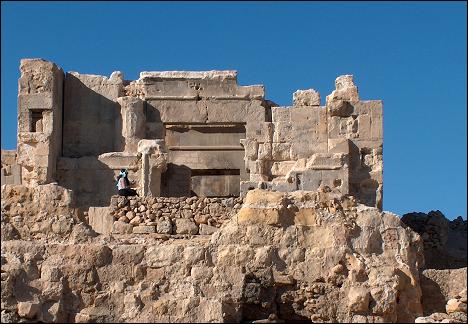
Another thing that Alexander believed in was oracles.  During his conquest he visited the Oracle of Amon on his quest for confirmation that he was the son of Zeus, the Grecian God.  It was Alexander’s wish to be buried at Siwa.  This is a photo of the entrance to the temple complex as it appears in modern times.

Entrance to the Temple site at Siwa

The Inside Wall of the Temple

http://www.minamar.com/alexander-the-great-oracle-siwa-oasis.html

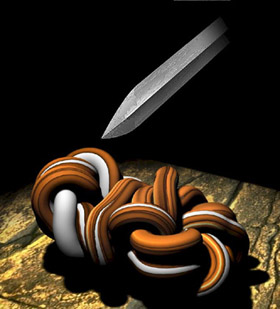
Alexander was in the city of Gordium, Turkey after the battle of Grancius.  Some of the Spartans had been persuaded not to support Alexander. This caused Alexander to hesitate to move forward with his campaign to conquer Asia due to the mixed support of the Greeks.  Gordium was the location of the Gordian knot and it what prophesized that the man who could untie the knot would rule Asia.  Alexander untied the knot buy slashing it with a sword  Alexander took this instance as an omen that he should continue his campaign to conquer Asia (Gill).


The Gordian Knot

http://www.maa.org/devlin/devlin_9_01.html


Works Cited

Aristander. n.d. 7 Feb 2012. <http//en.wikipedia.org/wiki/Alistander>.

Gill, N.S. Gordian Knot-Alexandelr Solves the Gordian Knot. 2012. 9 Feb 2012. <http://ancienthistory.about.com/od/alexanderterms/g/GordianKnot.htm&gt;.

Powler, Thomas-William. All About Alexander the Great. 1994. 7 Feb 2012. <http://www.pothos.org/content/index.php?page=pothos&gt;.

Robinson, Jr. C.A. “The Seer Aristander.” American Journal of Philology 1929: 195-197. 7 Feb 2012. <http://www.jstor.org/stable/290420&gt;.


Leave a comment

Filed under Uncategorized

Scouting and Intelligence in the Battle of the Marathon

  Battle of Marathon Battle of Thermopylae Battle of Salamis
Time August/September490 BCE August 7 or September 8-10, 480 BCE September, 480 BCE
Where it was fought Marathon Greece Thermopylae, Greece The Straits of Salamis
 Who’s fighting who AtheniansAnd Plateans Greek City- States Persian Empire Persians Greek City-states Achaemenid Empire
  Led By Miltiades the younger, Callimachus Themistocles, Leonidas I and Demophilus Xerxes I of Persia, Mardonius, and Hydarnes Datis,  Artaphernes Eurybiades, Themistocles Xerxes I of Persia, Artemisia I of Caria, and Ariabignes
Result Greek victory Persian Victory Greek Victory

The Battle of the Marathon took place in 490 BC, between the Athenians, aided by their allies the Paletean hoplites (estimated to be between 600-1000 men), and the Persians (Doenges, 1988).  This battle was important for the Greeks they proved that they could defeat the Persians.  In spite of the fact that the Persians solders out-numbered the Greeks by two to one, the Greeks won the battle using a strategic plan to block the road to Athens. This allowed them the strategic advantage of physically blocking the Persians from entering city, thus illuminating the need for an army as large as the Persians (Battle of the Marathon, 2012).  Their strategy was to stand close together and in a tight line and align their shields so that it was hard for the Persians to get through.

http://en.wikipedia.org/wiki/File:Greek_Phalanx.jpg

Modern drawing of the Phalanx formation employed by Greek hoplites (File:Greek Phalanx.jpg, 2007)

Isolated Figure from a Panathenaic Black-figure amphora, Berlin Painter, 480-470 BC, showing a middle-distance race “hippios”

(File:Greek Phalanx.jpg, 2007)

When the Greeks determined the size of the Persian army they would be facing it was determined that reinforcements would be needed.  The blocked the road to Athens and at the same time sent a messenger named Phiedippides to ask the Spartans to join them in the battle.  Phiedippides was known for his ability to run great distances in a short time. He made the trip to Sparta and back to the front in three days.  He brought the message that the Spartans were going to send reinforcements (Battle of Marathon, 2010).

Works Cited

File:Greek Phalanx.jpg. (2007, August 21). Retrieved from Wikipedia.org: http://en.wikipedia.org/wiki/File:Greek_Phalanx.jpg

Battle of Marathon. (2010, September 12). Retrieved Jan 31, 2012, from http://www.livius.org: http://www.livius.org/man-md/marathon/marathon.html

Battle of the Marathon. (2012, January 9). Retrieved January 31, 2012, from http://en.wikipedia.org/wiki/Battle_of_marathon

Doenges, N. A. (1988, 1st Qtr.). The Campain of the Battle of the Marathon. Retrieved Jan 31, 2012, from http://www.jstor.org: http://www.jstor.org.hal.weber.edu:2200/stable/4436491?seq=7

Painter, B. Phidippides. Retrieved from http://www.mlahanas.de/Greeks/Philipides.htm

Leave a comment

Filed under Uncategorized