Daily Archives: December 15, 2018

Specific Treatments in Military Medicine

The main bread and butter of military field medicine was woolen bandages.  Every medicus ordinarie would have been equipped with a stash of them.  There is a section of Trajan’s Column that depicts the actions of a medicus ordinarie.  After a battle, there are wounded soldiers being aided by other soldiers (indicated by the same uniform style).  One has a wound on his thigh that is being treated and bandaged, and another has a shoulder wound. (Richmond, 13-15)

1024px-031_Conrad_Cichorius,_Die_Reliefs_der_Traianssäule,_Tafel_XXXI

The Reliefs of Trajan’s Column by Conrad Cichorius. Plate number XXXI: Major Battle against the Dacians (Scene XL)

A common procedure was to apply honey to the woolen bandage before using it on a wound.  Modern science has proven that raw honey is well suited to wound healing, as it inhibits bacterial growth and provides an immune boost, aiding the body’s own healing mechanisms. (Molan, 141) Wool itself is a superior choice for bandages because it wicks moisture away from the skin, also promoting a healthier healing environment for wounds sustained in battle.

Eye problems were a common complaint noted in ancient records.  It would seem likely that the complaint causing most of the trouble stemmed from conjunctivitis, or pink eye.  Highly contagious and debilitating to a soldier’s fighting abilities, it was an illness taken seriously by military medici.  (Allason-Jones, 137)  Eye salves of various types would have been used to treat the condition.

Another issue faced by the army was the spread of feces-borne diseases like dysentery as well as parasites.  Even with sanitation, the close quarters and high density population would have been a favorable breeding ground for such issues. (Allason-Jones, 138-139)

Caches of medical tools have been found, dating back to the Roman Empire.  Most of the tools are forceps or other surgical tools for the removal of weapon remnants or foreign objects.  There are also catheters and bladder sounds, rectal speculums, cautery tools, and cupping vessels.

Though not as common in the Roman army, sometimes a wounded soldier was in need of amputation.  Opium, henbane and white mandrake were the strongest medicines available for anesthetic purposes, and would have been employed on such occasions along with copious amounts of alcohol.  Tools used for the procedure were scalpels, bone saws, and tile cautery tools.  I was able to find a picture of a bronze prosthetic leg, but could find no supporting information to describe how widespread their use was during this period of time.

M0012307 Roman artificial leg of bronze.

Roman artificial Bronze leg

In conclusion, the Roman army’s medical corps was impressive for its day.  It was orderly, just like the military itself, and effective.  In fact, modern militaries have similar systems in place to facilitate the care of soldiers during battle.  Warfare today may look very different, but there are some things that the Romans were ahead of their time about.  Military medicine happened to be one of them.


Sources:

“Medicine in Ancient Rome.” Wikipedia. Accessed December 15, 2018. https://en.wikipedia.org/wiki/Medicine_in_ancient_Rome

Allason-Jones, Lindsay. “Health Care in the Roman North.” Britannia 30 (1999): 133-46. doi:10.2307/526676.

Molan, Peter and Tanya Rhodes. “Honey: A Biologic Wound Dressing.” Wounds: A Compendium of Clinical Research and Practice 27, no. 6 (2015): 141.

Richmond, I. A. “Trajan’s Army on Trajan’s Column.” Papers of the British School at Rome 13 (1935): 1-40. http://www.jstor.org/stable/40310440.

Wesselingh, Robb. “From Milites Medici to Army Medics – A Two Thousand Year Tradition of Military Medicine.” Journal of Military and Veteran’s Health 16, no. 4 (2018):1-5. https://jmvh.org/article/692/

Conrad Cichorius: “Die Reliefs der Traianssäule”, Erster Tafelband: “Die Reliefs des Ersten Dakischen Krieges”, Tafeln 1-57, Verlag von Georg Reimer, Berlin 1896

=={{int:filedesc}}== {{Artwork |artist = |author = |title = Greek and Roman surgical instruments |description = Greek and Roman surgical instruments from the Wellcome Historical Medical Museum <p>Wellcome Ima…

=={{int:filedesc}}== {{Artwork |artist = |author = |title = Greco-Roman cupping vessels and Roman bronze rectal speculum |description = Greco-Roman cupping vessels and Roman bronze rectal speculum from the We…

=={{int:filedesc}}== {{Artwork |artist = |author = |title = 6 Roman surgical instruments |description = 6 Roman surgical instruments: A)Rreplica of Roman bronze scalpel, from Silchester. B) No information. C)…

 

Leave a comment

Filed under Uncategorized

Military Medicine in Action

Prior to the Augustan age, there was no formal military medical apparatus.  (Byrne, 267) It was most likely that soldiers helped each other, providing basic first aid and field surgery.  Upper ranking officers might have brought along their own personal physicians, but they were not widely utilized by the rank and file.  There are references to the treatment of the sick and wounded, particularly that they were sent to the back of the company while they recovered, but there is no mention of care they might have received while falling back in the ranks.

If a soldier was wounded or sick enough to not be able to keep up with the army, they were often quartered in civilian homes to be cared for during their convalescence. (Byrne, 268) The ideal situation for a soldier in this condition would have been to enter the house of an upper class citizen, who had more comforts and likely employed a physician in-house.  Outside of Roman settlements, garrisons of wounded and sick soldiers would have been left behind with adequate supplies to see them through. (Wesseleigh, 2)

Eventually, medics were trained and assigned duties within the army.  There were three orders of medics – medicus ordinaries, medicus legionis and medicus cohortis. (Byrne, 269) The first order was a regular soldier who had extra medical training.  He would have fought alongside his comrades, and offered aid when needed.  The second was over the legion, and would likely have had some rank or additional standing outside of regular soldier.  The last rank was over the whole cohort, and likely remained in the rear of the company to care for the worst of the sick and wounded.  The medicus cohortis would likely have been in charge of the field hospital, or valetudinarium.

Medicine_aryballos_Louvre_CA1989-2183_n2

Physician treating a patient. Red-figure Attic aryballos.

Valetudinaria, also referred to as “flying military camps,” were first just a designated tent or group of tents and later became permanent buildings.  The buildings were built with great care, with sanitation being a first concern. (Wesseleigh, 4) On average, each hospital was built to accommodate up to 5% of the legion it served.  One can therefore assume that the aim of the hospital was not for long term convalescence, but for acute care following injury and treatment.  Archaeological evidence of the valetudinarium near Baden suggests a well equipped pharmacy and surgical theater, along with wards for the recovering soldiers. (Byrne, 271)

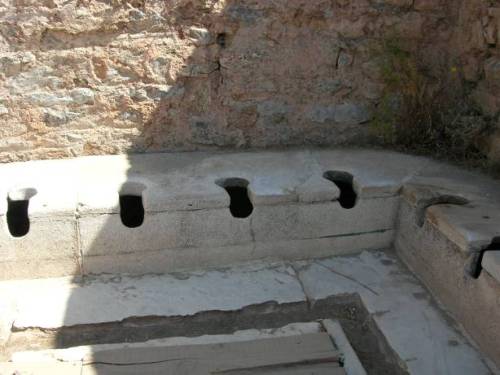
Efez18

Roman latrine

To conclude, the military medical program was an orderly undertaking.  With clear denotations of duties, it helped the care of the sick and wounded to happen with little confusion or fuss. The last post will look at specific treatments used in military medicine, and examine some of the military health records that have been found.


Byrne, Eugene Hugh. “Medicine in the Roman Army.” The Classical Journal 5, no. 6 (1910): 267-72. http://www.jstor.org/stable/3286964.

Wesselingh, Robb. “From Milites Medici to Army Medics – A Two Thousand Year Tradition of Military Medicine.” Journal of Military and Veteran’s Health 16, no. 4 (2018):1-5. https://jmvh.org/article/692/

== {{int:filedesc}} == {{Information Louvre |artist= {{en|Clinic Painter (name-piece)}} {{fr|Peintre de la Clinique (vase éponyme)}} |description= {{en|Physician treating a patient. Red-figure Attic aryballos, ca. 480–470 BC.}} {{fr|Médecin soigna

Leave a comment

Filed under Uncategorized

The Basis for Military Medicine

The Greek tradition of medicine heavily influenced Roman medicine.  Members of the upper classes employed Greek or Hellenistic trained physicians to provide their households with care as needed.  Lower classes clung to the Roman traditions of paterfamilias or allowing the head of the household control over medical diagnoses and curatives.  Although they employed Greek physicians, it seems that overall, Romans preferred to appeal to the Gods first before seeking their care and treatment.  There was a healthy distrust of physicians, in general, especially among the lower classes.  (Scarborough, 297)

In order to appreciate the military’s medical organization, it is important to understand the regular Roman citizen would be treated by either the paterfamilias or sometimes a slave-physician.  Only the upper classes would have had access to a proper Greek physician. (Scarborough, 298) The types of treatments prescribed in a farming family would include cabbage in some form or other.  Cato the Elder, a staunch opponent of physicians, was the most well known promoter of the cabbage cure, which in his estimation could cure just about any ailment from constipation to deafness by preparing the cabbage in a specific way.  (Household Medicine)

The wealthier class would have had access to drugs sold by local chemists (pharmacists), such as opium, and a variety of herbs grown locally or imported from nearby regions.  Dioscorides’ work De Materia Medica was the most referred to volume on the subject of herbs and their medical uses.  No chemist would have been without that reference book. (Dioscorides, wiki)

20181215_044506

Dioscorides, by Cami Isle

L0051528 Titlepage to 'Materia Medica'

L0051528 Titlepage to ‘Materia Medica’

Galen was the premier authority on anatomy and physiology up until the mid-1500’s.  Because Greek law outlawed the dissecting of human bodies, Galen used animals such as pigs and primates to understand the basics of anatomy.  Some of his theories were disproved later, but for the Romans, it was considered accurate enough.  Galen, himself, was the personal physician to Marcus Aurelius. (Galen, wiki)

20181215_044454

Galen, by Cami Isle

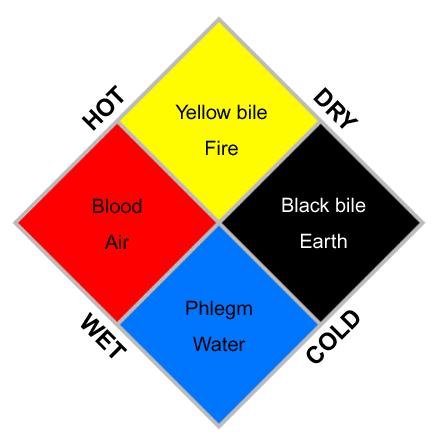
Galen borrowed many ideas from Hippocrates, chiefly the theory of the four humors in the body – blood, yellow bile, black bile, and phlegm.  Hippocrates posited that illness occurred when these humors were out of balance.  Galen furthered the humors theory by adding personality types to the dominant humors – sanguine, choleric, melancholic, and phlegmatic.  Treatments for unbalanced humors included purging, sweating, and bloodletting.  (Galen, wiki)

4_body_fluids

Romans were well known for their public works projects.  Sanitation and clean water were the most prevalent features of most Roman cities.  The bath houses were well used by citizens, and facilitated the overall cleanliness of the people.  Fleas and lice were likely not as prevalent because of the bath houses, however depending on how often the bath house was cleaned, it may have contributed to the spreading of some viral and bacterial infections.

In summary, Romans were quite advanced in their society when it comes to health promoting practices.  They had access to clean water, had adequate sanitation overall, and medicine was available in the case of illness.  These general factors led to the promotion of a military medical apparatus that was superior to most others of the time.  The next blog will examine the specific medical organization within the military and how it changed over time.


“Pedanius Dioscorides.” Wikipedia. Accessed December 15, 2018. https://en.wikipedia.org/wiki/Pedanius_Dioscorides

“Galen.” Wikipedia. Accessed December 15, 2018. https://en.wikipedia.org/wiki/Galen

“Household Medicine In Ancient Rome.” The British Medical Journal 1, no. 2140 (1902): 39-40. http://www.jstor.org/stable/20270775.

Scarborough, John. “Romans and Physicians.” The Classical Journal 65, no. 7 (1970): 296-306. http://www.jstor.org/stable/3295700.

=={{int:filedesc}}== {{Artwork |artist = |author = |title = Titlepage to ‘Materia Medica’ |description = Titlepage to ‘Materia Medica’ <p>Rare Books<br> Keywords: Materia Medica; Plants, Medicinal |date…


Leave a comment

Filed under Uncategorized