Monthly Archives: April 2012

Becoming a Knight

Becoming a knight requires a certain set of circumstances.  It is often something that runs in families for the most part.  There are rituals and rites of passage that a man must undergo to receive the title.  The process begins when he is very young.  In most countries knighthood was reserved for nobility.  It was an expensive occupation and the man would need to be able to live a life where he did not have to work for the money to pay the equipment that was required. (Prestwich, 2010).

The son of a nobleman or a knight, a boy would most often begin his path to knighthood by being sent to live in a lord’s castle.  There he would serve as a page and learn to handle a horse, use a sword and practice archery, as well as perform other duties around the castle.  At the age of 10 he would be eligible to begin training as a squire, but this would depend on his physical size.  For some boys, it may not have been until they were 14 years of age.  For squires, training focused on strength, fitness and horsemanship, because a knight had to be strong, and skilled in the art of fighting while riding a horse.  Squires were also responsible for taking care of the knight’s horses.  Their duties consisted of cleaning stables and polishing the knight’s armor. He would also have lessons in chivalry because it is a very important part of being a knight (Training a Night, 2000).

The age when the boy would be considered a man and eligible to become a knight was usually 21.  It was known as the age of majority.  There are some instances where nobles where given the status of majority as early as age 15.  The reason for the age restriction was that a knight had to by physically strong and mature to be able to perform the duties of being a knight (James, 1960).

Observing and living the code a chivalry was as important as being trained to perform military duties.  They were asked to “Protect the weak, defenseless, and helpless and fight for the general welfare of all.” The image of a knight included owning expensive weaponry and being an impeccable horseman (Knights, 2012).

When a perspective knight had fulfilled all the requirements he would go through the ceremony of knighthood.  He would be bathed, which would serve as a symbol of going into the water a man and coming out of the water a knight.  He would then be given certain items of clothing which were also symbolic.  For instance, a red tunic symbolized willingness to shed blood, black stockings  symbolized mortality, a white belt symbolized chastity. After he was dressed, he would then proceed to the ceremony which was usually in a church (Prestwich, 2010).

Each knight had a unique code of arms which was used to identify him and used to cover his amour.  It design was unique to the individual and his family. The Dering Roll which is displayed below was used as a document to list the knights who owed the lord a debt of feudal service.  It was created between 1270-1280 and contains the coat of arms of 324 knights (Dering Roll of Arms, 2012).

Resources

Training a Night. (2000). Retrieved from Medivial Life.net: http://www.medieval-life.net/knight_training.htm

Dering Roll of Arms. Retrieved from http://en.wikipedia.org/wiki/File:DeringRoll.jpg

Knights. (2012, April 3). Retrieved from Wikipedia.org: http://en.wikipedia.org/wiki/Knights

James, E. (1960, Jan). The Age of Majority. The American Journal of Legal History, 4(1), 22-33. Retrieved from http://www.jstor.org/stable/844549

Prestwich, M. (2010). Knight. London: Thames & Hudson Ltd.

Leave a comment

Filed under Uncategorized

Things that make you go…..BOOM

In the Dark Ages warfare was a constant state of life. With this constant fighting new ways to defend from attacks created Castles. Once castles and fortifications began changing warfare new methods to overcome these defenses were formed. Siege weapons were the order of the time to defeat castles and similar fortifications. One of the many forms of siege weapons was one of the most feared, and psychologically damaging, sappers.

Imagine for a moment you are on top of a wall fighting against an opponent when there is a low guttural rumble under your feet, suddenly your whole world is turned on its head as the section of wall you were standing on is now crumbling into a gaping hole in the ground and strewn across the castle grounds and surrounding areas, if you were lucky enough to survive.

Example of tunneling under a wall.

Sappers were one of the best weapons for causing mass havoc and ending sieges. These troops would dig tunnels underneath the walls of the castle that was besieged, create large voids, or caves, that were supported by wooden pillars as the earth was removed. Once the caves were large enough the caverns would be filled with combustible materials and then ignited. These fires would destroy the supporting timbers and then, boom, down comes the wall.

One of the best accounts of how effective sappers were comes from a monk who wrote “… after the top of the wall had been somewhat weakened by bombardment from petraries, our engineers succeeded with great difficulty in bringing a four-wheeled wagon, covered in oxhides, close to the wall, from which they set to work to sap the wall” (Historia Albigensis – Pierre des Vaux de Cernay, 53).


Works Cited

Cernay, Peter of les Vaux de. Historia Albensis. 1218. Print.

http://www.medievalwarfare.info. 2010. 4 April 2012.

Marvin, Laurence W. “War in the South: A First Look at Siege Warfare in the Albigensian Crusade,1209–1218.” War in History (2001): 373-395. web.


Leave a comment

Filed under Uncategorized

Longbows to Crossbows

At the beginning of the medieval era, the ranged weapon of choice was the longbow due to the power and great number of shots per minute that could be achieved by skilled archers. As time progressed, crossbows started to become favored because of their ease and enormous force that could be produced from the weapon.

The longbow was an easy weapon to produce; it was made from a single piece of wood made in the shape of a D. The height of the bow was similar to the archer using it. These men needed to be strong because longbows designed for war required 200 pounds of force to draw the string back to their chin. (Castle & Manorhouses 2010) Accuracy wasn’t an easy feat for these men to achieve either, it required many years of practice. The majority of these archer started practicing when they were young, so when they were older, they were able to easily take out their targets.

As the crossbow was introduced into the armies, it became a widely used weapon. It enabled common men with the ability of shooting very accurately with a large amount of power. (Claydon 1993) Also they had the great advantage of being able to teach new recruits how to properly use a crossbow within weeks instead of taking a lifetime to perfect the art of the longbow.  Due to the drawing system on crossbows, they were able to pull the string farther back and out shoot a longbow. The first type of crossbow had a notch at the end the archer was able to stick his foot in and push to draw the string back. (Wikipedia 2012) This type did allow the user to draw a considerable amount of power from the crossbow, but users still wanted more power and range; therefore, new drawing mechanisms came about. As time progressed, a windlass system and a crank system were introduced to the crossbow. The windlass allowed the user to turn a mechanism similar to a bicycle wheel, which then drew the string back; while the crank system used a handle to slowly pull the string back through a series of ratchets. Although users were able to gain a considerable amount of power through these devices, it was also extremely time consuming. (Claydon 1993) This did give the user an advantage though because once the bow was drawn, it was locked in place. They could then be ready to fire in a moments notice by simply pulling a steel trigger to release the string.

In the picture to the right, it is shown how easily a crossbow could be used by a common infantryman. It required a small amount of effort to produce a high powered shot able to piece the armor of knights. It also greatly increased the accuracy of these men because it used sights similar to that of a gun; which wasn’t an option with a longbow.

Works Cited

Castle & Manorhouses. (2010). Medieval warfare. Retrieved from http://www.medievalwarfare.info/weapons.htm

Claydon, S. M. (1993). A bolt from the blue. Medicine, Science, and the Law, 33(4), 349-350.

Crossbow. In (2012). Medieval Europe Wikipedia. Retrieved from http://en.wikipedia.org/wiki/Crossbow

Gun Powder Ma. (Producer). (2009). The martyrdom of st. sebastian. [Web Photo]. Retrieved from http://en.wikipedia.org/wiki/File:The_Martyrdom_of_St_Sebastian_(detail).jpg

Verbruggen, J. F. (1997). The art of warfare in western europe during the middle ages. (2 ed.). Boydell & Brewer.

Leave a comment

Filed under Cohort VII Scutum Decoris

The Upbringing of a Knight

Great knights of medieval times were reared and trained from a young age. A young boy’s early life was dictated by this ambition. Years of training and careful upbringing contributed to the prestigious accomplishment of becoming a knight, and potential candidates for knighthood were expected to display certain qualities (Prestwich, 13). Initially, the qualities of knighthood would manifest and then be fostered through play and activities. As the boy grows, he will subsequently become a page and then a squire if he displays and develops the right skills and qualities (“Knights, Squires and Pages”).

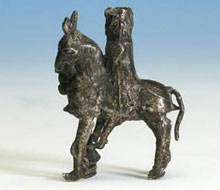
Similar to modern day children, activities and entertainment during medieval times was primarily a small scale replication of adult life. Model toys imitating common objects used by adults have been traced back as early as the 1300’s (“The Culture of Children in Medieval England”; Orme, 53). Similar to toy soldiers of today, fragments have been discovered “portraying knights in armour on horseback” (“Culture…”; Orme, 53).

[Museum of London: replica of a mounted knight; alloy of tin and lead]

(“Childhood in Medieval England”; Orme)

Play also became a form of military training in itself. “The liking of children to imitate adults in their play is very ancient, if not natural to humanity” (“Culture…”; Orme 63). Children during medieval times modeled their play after kings and knights, but this had the potential to turn into a “mimicry of their wars and battles” and children were often hurt, or even killed in these mock military engagements (“Culture…”; Orme 63-64). Often young noble children were given small scale weapons to practice with. Young Henry V is said to have had a sword at the age of nine (Prestwich, 20).  Research also indicates that a royal statute in 1512 required that “every man with boys in his house, aged from seven to seventeen, was to provide them with a bow and two arrows and bring them up to shoot. Play became formally merged with military training” (“Culture…”; Orme, 63). This merger of military training and childhood activities played a significant role in a young boy’s potential for knighthood later in his life.

Although a boy began his journey toward knighthood in his own home, but he could not be expected to acquire all the necessary skills and experience without specific guidance (Alchin). Around the age of seven many boys were sent to become pages where they were able to gain an education at the hands of a nobleman and his wife (Prestwich, 14). This education included: caring for and using military equipment, learning proper manners at court, learning to read and write, riding and handling horses, practice wielding lance and sword, and gaining the necessary physical strength and stamina to endure difficult training and future battles (Prestwich, 14-19).

After years of being trained as a page—around the age of fifteen—a young prospective knight could become a squire (“Knights, Squires and Pages”). Each squire would continue his training in the service of a knight, and hopefully after acquiring and proving that he possessed all the necessary skills, the young squire would “receive the accolade of knighthood” (Prestwich, 21).

Works Cited:

Alchin, Linda. “Steps to Knighthood.”  Middle Ages. 2 April 2012. www.middle-ages.org.uk

Orme, Nicolas. “The Culture of Children in Medieval England.” Past & Present, 148. (1995): 48-88. JSTOR. PDF file. 2 April 2012. http://www.jstor.org/stable/651048.

Orme, Nicolas. “Childhood in Medieval England, c. 500-1500.” Historical Essays, University of Pittsburgh. (2005). 2 April 2012. http://www.representingchildhood.pitt.edu/medieval_child.htm

Prestwich, Michael. “Upbringing & Training.” Knight: The Medieval Warrior’s Unofficial Manual. London: Thames & Hudson, 2010. Print.

“Knights, Squires & Pages.” The Middle Ages for Kids. 2 April 2012.  http://medievaleurope.mrdonn.org/knights.html


Leave a comment

Filed under Uncategorized