Monthly Archives: February 2012

Battle Of Marathon


The Battle of Marathon was fought on the plain of Marathon around the 10 of September or 12 of August 490 according to the full moon. The Persians sailed to the bay of Marathon (25 miles from Athens). The Athenian general Miltiades quickly formed a small army of hoplites or infrantrymen. There were about 10,000 heavily armed Athenians and 1,000 Plataeans (Livius) that went to fight against the numerous army of Persia at the Battle of Marathon. The great runner Pheidippides was sent to Sparta to request reinforcements but the Spartans could not respond due to the religious festival of Carneia which prevented the Spartans from any military operation until the full moon. The 11,000 hoplites were divided into ten tribes with a Strategoi (generals) over each “tribe.”(Tucker). Miltiades, Aristides and Themistocles were some of the generals over the tribes. Callimachus was elected by the tribes to be the polemarch.

Callimachus was in command of the right wing which consisted of the Athenians while the left wing was commanded by the Plataeans. The wings surrounded the numerous Persians in what modern sources call a “double envelopment” (Tucker). The Persians deemed the endeavor to be “Suicidal Madness” as written by Herodotus of Halicarnassus. However the Greeks were able to defeat the Persians and save Athens as well as capture seven of their ships. Afterwards, the Greeks left a detachment to make sure the Persians did not return. The Persians had already set course for Athens but when they arrived they found that the rest of small but successful Greek Army ready for them. The Persians Retreated and thus ended the Battle of Marathon.

Figure 1: the way the Greeks(Red) surrounded the Persians(Blue); source: en.wikipedia.org/Double_envelopment

Image

Works Cited

J.A. S. Evans. “Herodotus and the Battle of Marathon.” http://www.jstor.org. [Online] 3st Qtr. 1993. [Cited: Jan 31, 2012.] http://www.jstor.org/stable/4436293

Doenges, Norman A. “The Campain of the Battle of the Marathon.” www.jstor.org. [Online] 1st Qtr. 1988. [Cited: Jan 31, 2012.] http://www.jstor.org.hal.weber.edu:2200/stable/4436491?seq=7.

“Battle of the Marathon.” en.wikipedia.org. [Online] January 9, 2012. [Cited: January 31, 2012.] http://en.wikipedia.org/wiki/Battle_of_marathon.

Battle of Marathon. http://www.livius.org. [Online] September 12, 2010. [Cited: Jan 31, 2012.] http://www.livius.org/man-md/marathon/marathon.html.

Tucker, Spencer. “Battles That Changed History: An Encyclopedia of World Conflict.” Greenwood Publishing Group. ABC-CLIO Nov. 11, 2010. [Cited Jan 31, 2012] Print.

Herodotus of Halicarnassus. Ed: A.D. Godley. “The Histories” Perseus.tufts.edu. [Cited Jan 31, 2012] http://www.perseus.tufts.edu/hopper/text?doc=Perseus%3Atext%3A1999.01.0126&redirect=true

Leave a comment

Filed under Uncategorized

Grecian Military Technology at the Battle of Marathon

Advancing two kilometers under a broiling August sun, each combatant sweltering under more than 30 kg of bronze, wood and leather, and running the last 100 m through a storm of arrows, the Greeks smashed into their lightly armored foes. Driving the Persians back to their ships, the Athenians killed 6,400 of them while losing only 192 of their own men. Then, in perhaps the day’s most impressive military feat, the exhausted Greeks turned around and raced 42 km back to Athens — the length of a modern marathon run– arriving in time to protect it from the Persian fleet.” (Bethune)

Undoubtedly, weapons and military technology play a crucial part in the decision of victory or defeat. Had the Persians been as heavily armored as Greeks, western civilization as we know it would not exist. For the sake of brevity, Grecian siege weapons and naval technology will not be covered in this blog. Instead, we will focus on military technology relevant to the Battle of Marathon from a Greek perspective. Mainly, this would include the weapons and battle techniques of Athenian and Plataean Hoplites, since the Greeks had “neither cavalry nor archers” (Herodotus).

Hoplites are heavily armored infantry, their name deriving from the word hoplon, or a piece of armor or equipment. Their greatest innovation and primary piece of equipment, the aspis, or shield, had both defensive and offensive capabilities. The typical Bronze Age aspis measured one meter in diameter and weighed about nine kilograms (approx. twenty pounds) or more, being made of a concave wooden disc overlaid with bronze. To hold this type of shield, the left arm would be inserted through two leather straps, one strap bearing most of the shield’s weight on the forearm, the other strap being held in the hand for maneuverability (Strickland). Being thus attached to the left arm, one can imagine the hoplite’s right side would be vulnerable to attack. However, the close knit formation of the phalanx remedied this problem; each man’s shield would cover his left side as well as the right side of the person next to him, creating a nearly impenetrable wall of defense.

A Hoplon shield

While good defense is very helpful, bashing one’s enemy with a twenty pound shield is not going to cut it. That said, a Hoplite’s primary weapon of choice was a doru. The doru was a six to ten foot long spear, two inches in diameter, made of cornel or ash wood. It weighed two to four pounds, fronted by a flat, leaf-shaped iron spearhead counterbalanced by a bronze butt-spike. The butt-spike was nicknamed “lizard killer” after the way an enemy’s toes looked, peeking out from under their shield. “The blunt, square shape would prevent the spike from penetrating deeply enough into the foot or ankle to entangle it and would have maximized damage to the bones, ligaments, and tendons of the foot with a minimum of force” (Wikipedia). Stabbing this bronze spike into an exposed leg or foot would likely be enough to bring an opponent to their knees – and consequently, their demise. This innovation also enabled the rear ranks of a phalanx to dispatch any Persian that may have fallen to the ground as the phalanx pushed forward.

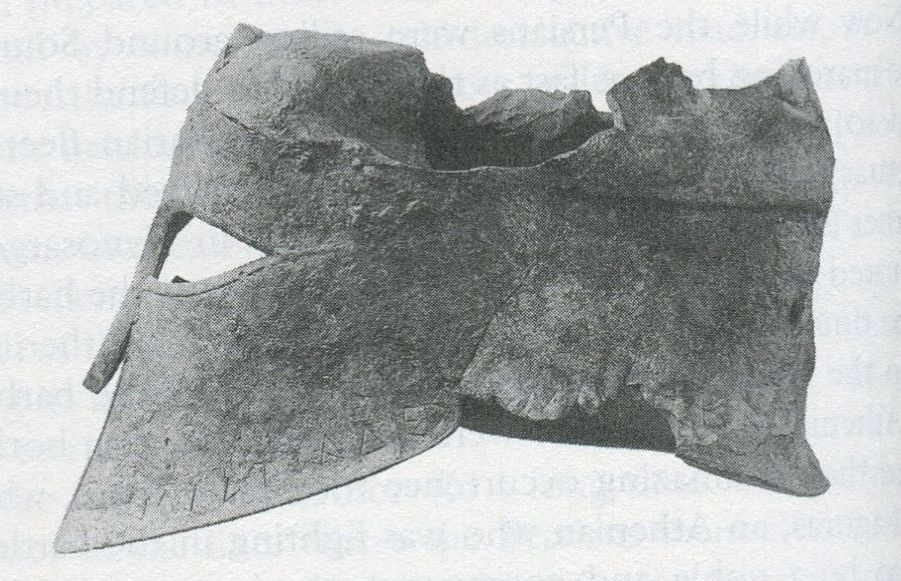
The secondary weapon of choice was a short sword of iron known as the xiphos. Hoplites were trained for phalanx warfare; developing skill as a swordsmen was left up to the individual. Being somewhat lacking in that area, the average hoplite would most likely draw his sword only if the spear was no longer an option. Lesser equipment such as the helmet, breastplate, and greaves were developed with much less care than the aspis or doru. Because of the aspis, Hoplites could wear smaller, more form-fitting body armor. The lesser armor was typically made of bronze, making them still quite heavy. The 10,000 heavily armored infantrymen present at the battle had a considerable advantage over their lightly-armored Persian adversaries  not only because of their equipment, but also because of the combination of tactics and terrain. The wrong tactic can cancel out any superiority in weapons: “Greek hoplites, for instance, proved to be ineffective against light-armed infantry on rough terrain, exactly like light-armed troops proved useless against heavy infantry on level ground “ (Fagan and Trundle).

Iron sword, arrowhead, and two lead sling bullets found on the field of  Marathon

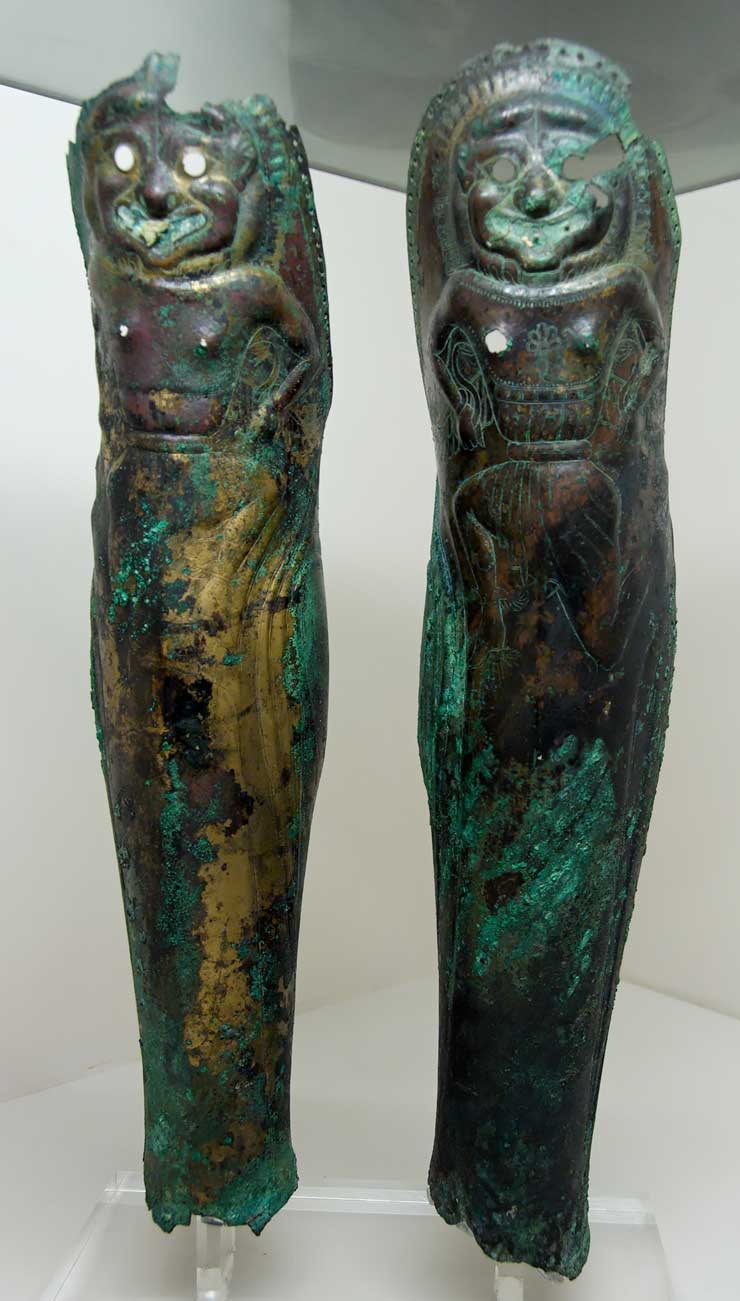
Bronze greaves

Works Cited

Herodotus. The Landmark Herodotus: the histories. New York: Pantheon Books, 2007. Print

Bethune, Brian. “The most decisive conflict in world history.” Maclean’s Dec. 2005. Academic Search Premier. Web. 30 Jan. 2012.

Strickland, Tod. “An Impressive and Amazing Force: The Hoplite Warrior” Fall 2001. Google Scholar. Web. 30 Jan. 2012.

Fagan, Garrett and Matthew Trundle. New Perspectives on Ancient Warfare. Brill, 2010. Google Scholar. Web. 30 Jan. 2012

“Battle of Marathon.” Wikipedia. Web. 30 Jan. 2012

“Doru.” Wikipedia. Web. 30 Jan. 2012

“Aspis” Wikipedia. Web. 30 Jan. 2012

Leave a comment

Filed under Cohort II, Marathon, Thermopylae & Salamis